ADHD and Limerence: When the Dopamine High Masquerades as Love
What is it and how to cope

💫 Introduction: When Infatuation Feels Like Destiny
If you’ve ever fallen headfirst into someone so fast it felt like a movie montage, only to crash later in emotional exhaustion — you might not be “too intense.” You might be experiencing limerence.
Psychologist Dorothy Tennov coined this term in the 1970s to describe the emotional state of obsessive longing — that all-consuming phase where your brain insists,
“This person is The One™ — and I must think about them constantly.”
But here’s the twist: limerence isn’t love. It’s not lust either.
It’s the chemical high of wanting — that intoxicating “what if” energy that keeps your dopamine-hungry brain chasing the next hit of validation and fantasy.
🧠 The Neuroscience Behind Limerence
When we fall into limerence, our brains enter a kind of neurochemical jackpot. Research from Helen Fisher and Semir Zeki using fMRI scans shows that people in the throes of romantic infatuation activate the same neural pathways involved in addiction — particularly the ventral tegmental area (VTA) and nucleus accumbens, both core regions in the dopamine reward system.
In plain English: your brain floods with dopamine, norepinephrine, and phenylethylamine (a natural amphetamine-like chemical).
You feel euphoric, laser-focused, energized — like your entire nervous system just found its favorite song.
Now, for someone with ADHD, this dopamine surge feels especially intoxicating. ADHD is characterized by hypodopaminergia, or low baseline dopamine activity, particularly in the prefrontal cortex (responsible for attention, self-regulation, and impulse control).
So when that person walks in and triggers the “new and exciting” switch?
Your brain doesn’t just light up. It erupts.
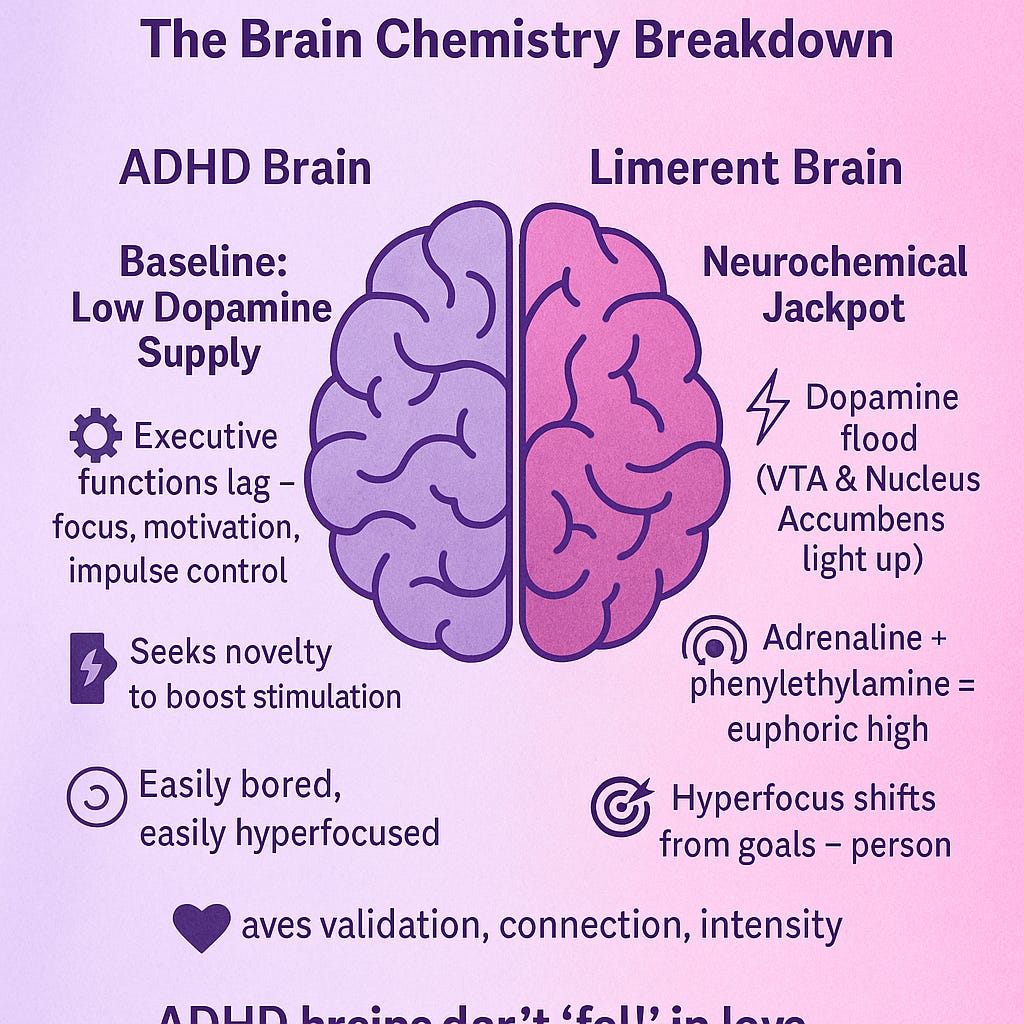
⚡ Why ADHD Brains Are Prime Real Estate for Limerence
Let’s be real — ADHD brains thrive on novelty, intensity, and stimulation.
And what’s more stimulating than a mysterious, emotionally unavailable, or “perfect” person who seems just out of reach?
The ADHD-limerence connection is like neurochemistry’s worst (and best) romance:
⚡ Novelty: The “newness” of a person acts like rocket fuel for the ADHD brain’s reward system. You get a fresh dopamine surge every time they text or smile.
💫 Intensity: Emotional highs and lows create constant stimulation — which can feel like meaning or connection, but it’s often just the brain’s addiction to the rollercoaster.
🧠 Hyperfocus: When something sparks your interest, the ADHD brain goes all in. Suddenly, every thought, song, and notification becomes a breadcrumb leading back to them.
💖 Validation: Someone’s attention feels like proof you’re “enough.” For ADHDers who’ve faced chronic rejection or RSD (rejection sensitive dysphoria), that validation is a literal dopamine jackpot.
So while neurotypical infatuation feels like a breeze, ADHD limerence feels like a tornado — wild, euphoric, and unsustainable.
🌀 What It Feels Like Inside the ADHD-Limerence Loop
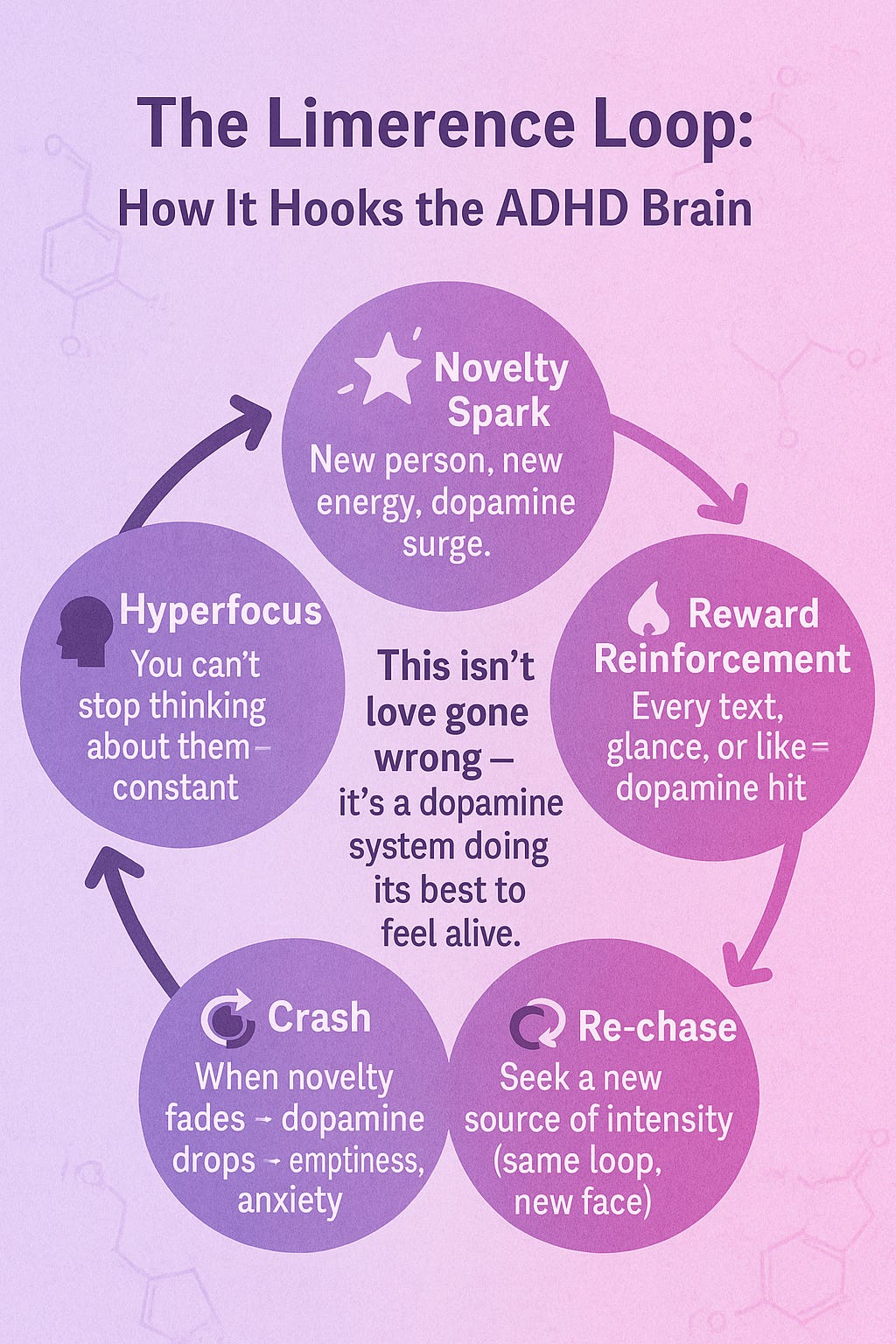
Picture this: you’ve had ten cups of espresso, your brain just discovered Wi-Fi, and it’s locked onto one topic — them.
Every buzz of your phone jolts your nervous system. You replay texts like sacred scripts. You analyze emojis like they’re coded love confessions. You craft the perfect reply, delete it, rewrite it, and send something completely different.
The high is exquisite — purpose, clarity, belonging. You finally feel alive.
But what your brain’s really doing is chasing the next dopamine hit.
And when it fades? Cue the crash: emotional exhaustion, rumination, and rejection sensitivity flare-ups that can feel like physical pain. (And yes — brain scans show rejection actually activates the anterior cingulate cortex, the same area triggered by physical injury.)
💔 When the High Fades: The Cost of Chasing Dopamine
Limerence wears the costume of love, but it’s love on a sugar rush — all sparkle, no sustenance.
When the novelty fades and routine sets in, the ADHD brain’s dopamine pipeline slows. The fireworks are gone, replaced by steady candlelight. But to a brain wired for stimulation, that calm can feel like loss.
That’s when many ADHDers start:
craving new excitement or intensity,
doubting whether the relationship is “real,” or
spiraling into shame, self-blame, or impulsive decisions.
This isn’t moral failure. It’s neurochemistry doing what it does best — seeking balance through stimulation.
Unfortunately, this often leads to emotional whiplash: euphoric connection → inevitable crash → self-criticism → renewed chase.
It’s not that ADHDers can’t love deeply. It’s that the dopamine-driven chase can disguise itself as love, keeping people trapped in a loop of craving instead of connection.
🧩 How to Break the Limerence Loop
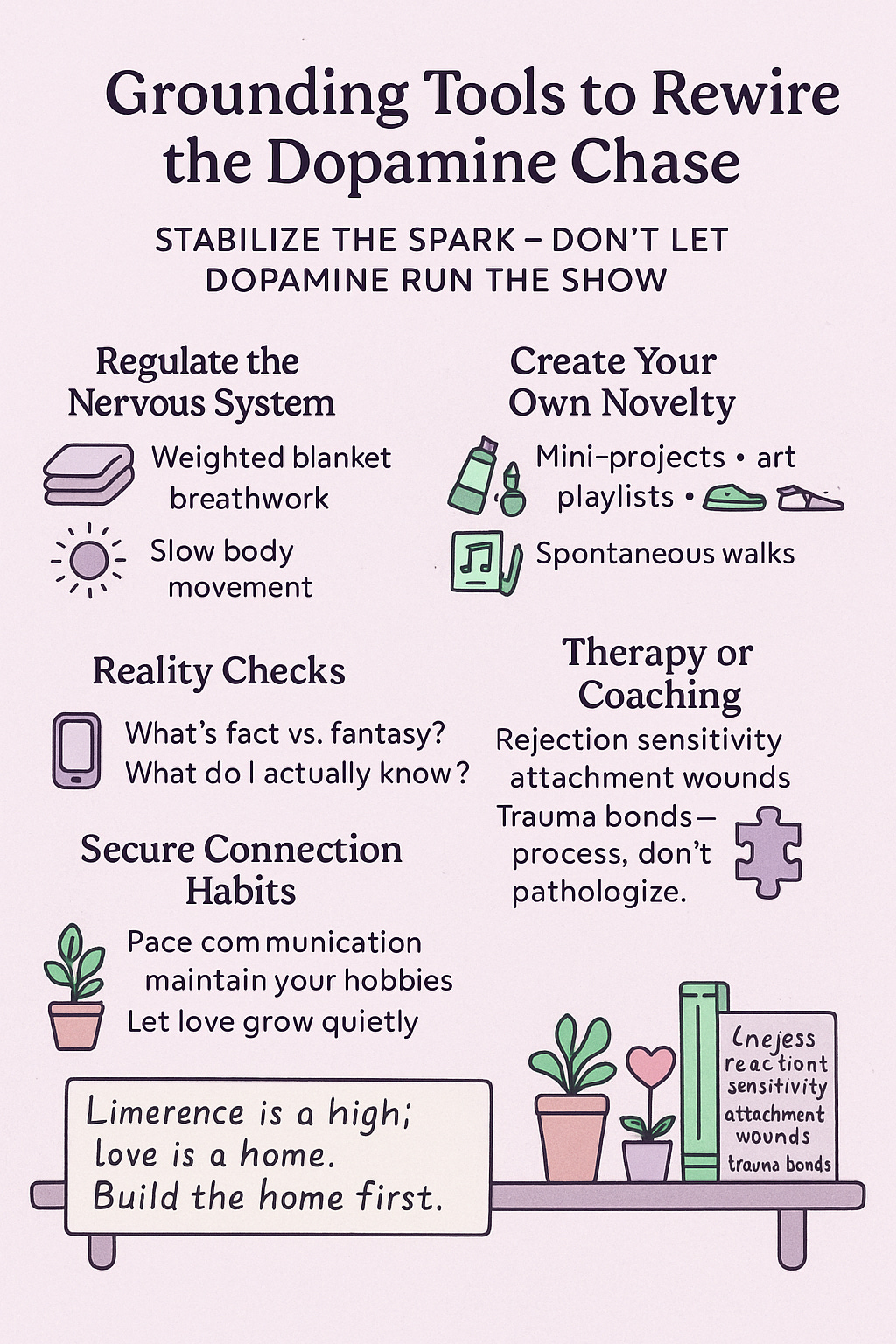
Here’s where neuroscience meets healing. You can rewire this cycle — not by “turning off” your passion, but by grounding it.
🪞 Name it. Awareness creates space between you and the chemical storm. Saying, “This is limerence, not love,” helps you observe without judgment.
⚙️ Regulate your dopamine naturally.
Create consistent dopamine sources that aren’t tied to a person:Movement or dance
Creative flow (art, writing, music)
Novel but safe micro-adventures
Accomplishments, no matter how small
These help stabilize your reward system so relationships aren’t your only source of pleasure.
🧘 Slow the fantasy. Ask yourself:
“What do I know about this person?” vs. “What have I imagined?”
ADHD imagination is vivid — beautiful for creativity, dangerous for attachment.🤝 Build secure attachment habits.
Love thrives in consistency, not chaos. Practice pacing your connections — emotionally, physically, and digitally. Slowing down gives your nervous system room to breathe.💬 Therapy helps.
Especially with ADHD-informed or trauma-informed professionals. Limerence often intersects with RSD, trauma bonds, or abandonment wounds — and these can be gently untangled with the right support.
🌙 The Poetic Truth
Limerence is the firework — dazzling, loud, and gone in seconds.
Love is the campfire — steady, warm, a place you can exhale beside.
ADHD brains deserve love that feels safe enough to stay.
Not the chase that burns them out, but the connection that regulates them.
When you learn to find dopamine in your own life, love stops being the drug — and starts being the grounding.