ADHD Is Not “Right-Brained.” Your Brain Is Just Running 19 Apps, 3 Operating Systems, and One Haunted Printer
ADHD is not a cute little creativity hemisphere. It is a self-regulation, executive function, and network-switching difference — which explains why your brain can build the cathedral but lose the hamm

There is a very familiar kind of rage that happens when someone says, “Oh, you’re ADHD? That means you’re right-brained.”
First of all, thank you, Brain BuzzFeed Quiz from 2009.
Second of all, no.
Third of all, I understand why people say it. I really do. ADHD can look wildly creative from the outside. We jump topics. We connect random ideas. We solve problems sideways. We interrupt ourselves with a thought that somehow started at “I need to pay the electric bill” and ended at “What if raccoons are just neurodivergent toddlers with tiny hands?”
The vibe is creative. The lived experience is often less “right-brained genius” and more “my nervous system is trying to operate a spaceship using a toddler’s sticker chart and a dying iPhone charger.”
So let’s lovingly, firmly, and with the tiniest bit of educational side-eye, retire the myth:
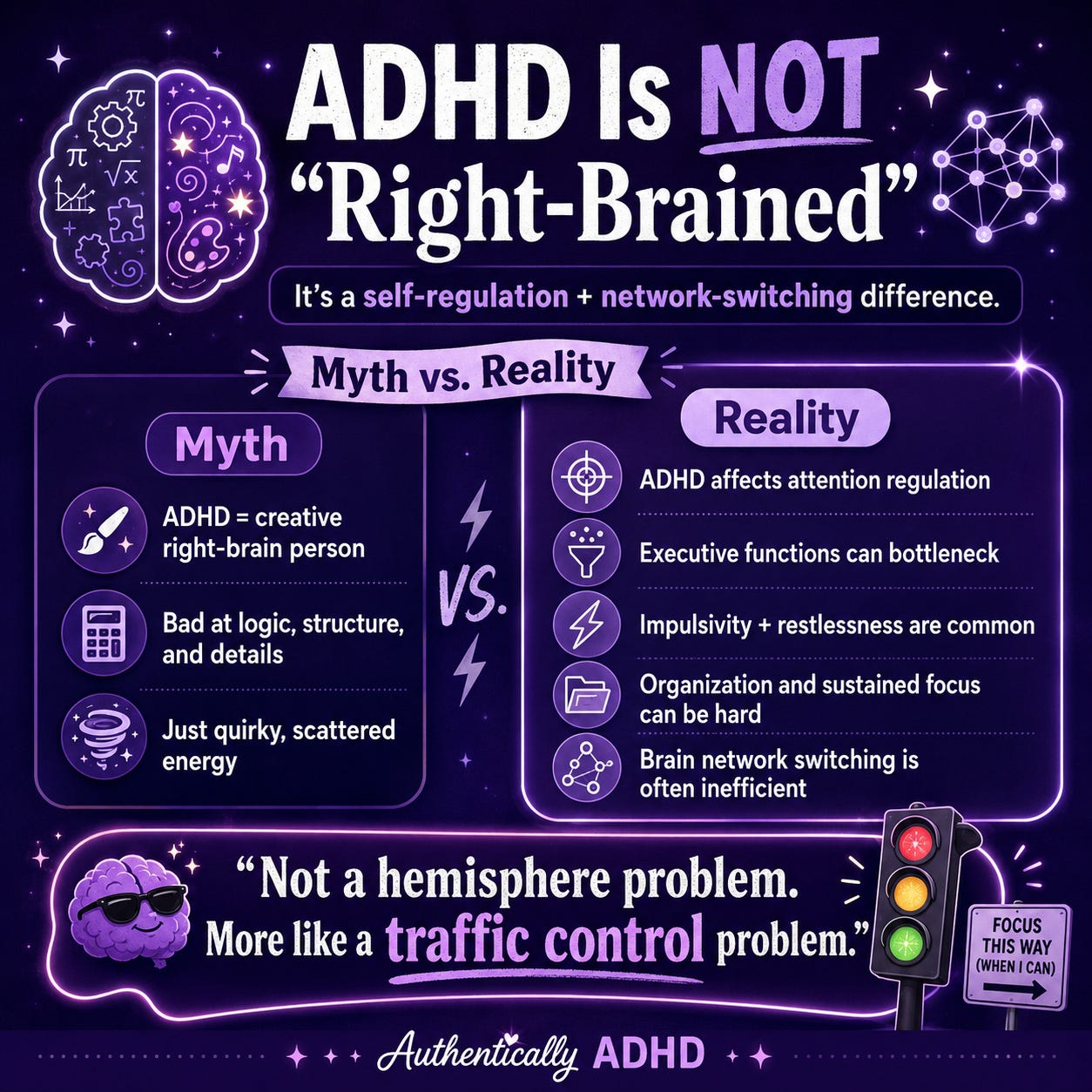
ADHD is not right-brain dominance. ADHD is a self-regulation and network-switching difference.
And that distinction matters.
Because when we call ADHD “right-brained,” we make it sound like a personality flavor. Like, “Oopsie, I’m just whimsical and bad at spreadsheets.” But ADHD is not just being artsy, intuitive, messy, emotional, spontaneous, or allergic to beige office lighting.
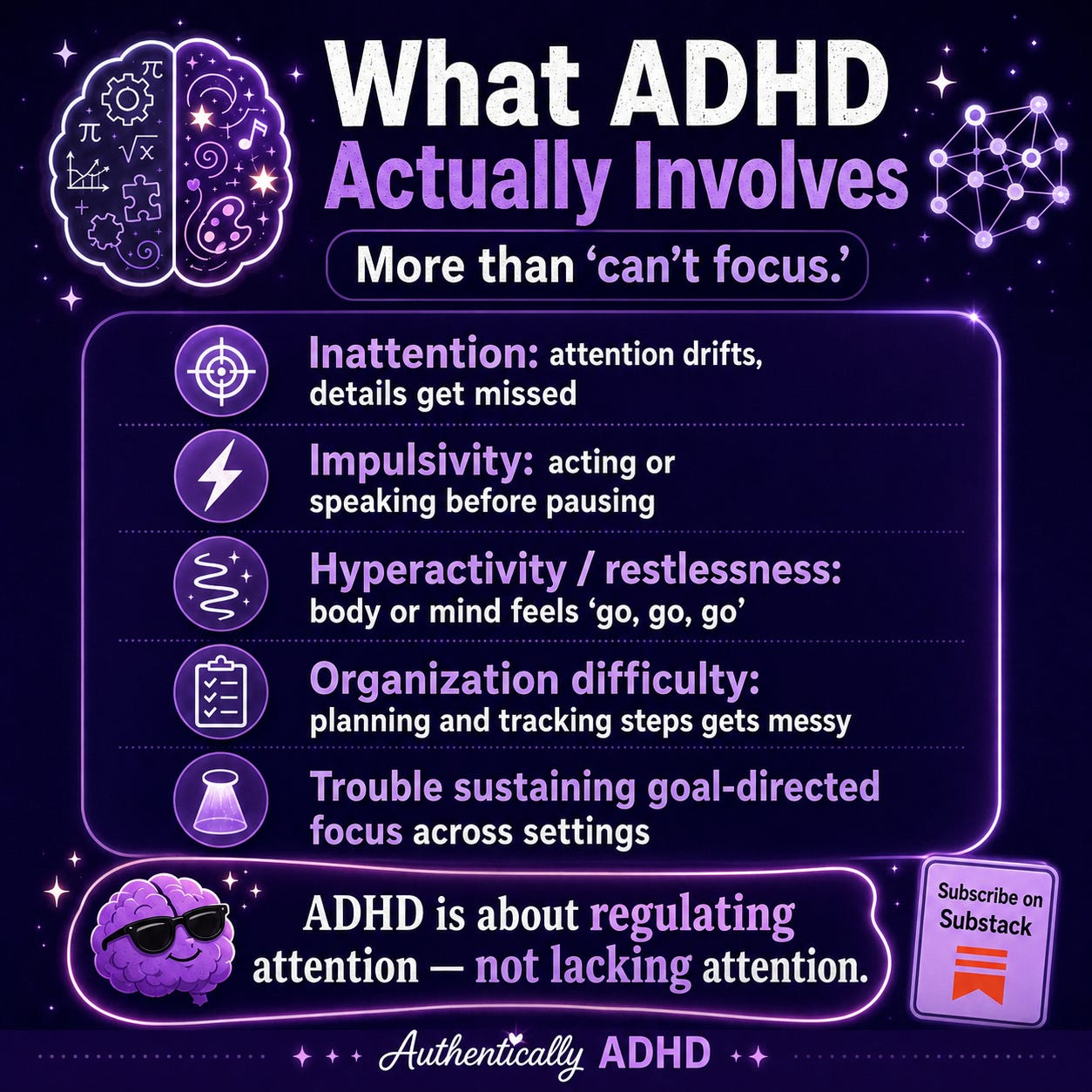
ADHD affects attention, impulse control, motivation, emotional regulation, working memory, organization, time perception, task initiation, and the ability to sustain goal-directed focus across different settings.
Which is why a person with ADHD can have a fully formed, cinematic, emotionally devastating vision for a book, business, classroom system, podcast episode, birthday party, or home organization overhaul…
…and then spend 42 minutes looking for the scissors they were holding three minutes ago.
The idea is there.
The vision is there.
The cathedral is designed.
But the hammer has vanished into the ADHD mist.
Again.
The Problem With the “Right-Brain” Label
The whole “left brain vs. right brain” thing has a grain of truth buried under a Costco-sized pile of oversimplification.
Yes, some functions are more associated with certain brain regions or hemispheres. Language tends to be more left-lateralized for many people. Certain spatial and attention-related processes may involve more right-hemisphere activity. The brain does have specialization.
But the pop culture version says:
Left brain = logical, organized, analytical, linear, math person.
Right brain = creative, emotional, intuitive, artistic, chaos fairy.
And ADHD people often get shoved into the second category because many of us do not naturally move through the world in neat little numbered steps.
We may think in webs instead of lines.
We may see ten possibilities where someone else sees one.
We may hear “make a grocery list” and somehow mentally generate a full meal plan, a childhood memory, a business idea, a sensory issue, and a sudden urgent need to Google whether whales sleep vertically.
But that does not mean we are “right-brained.”
It means our attention system is not always obedient.
It means our executive function has bottlenecks.
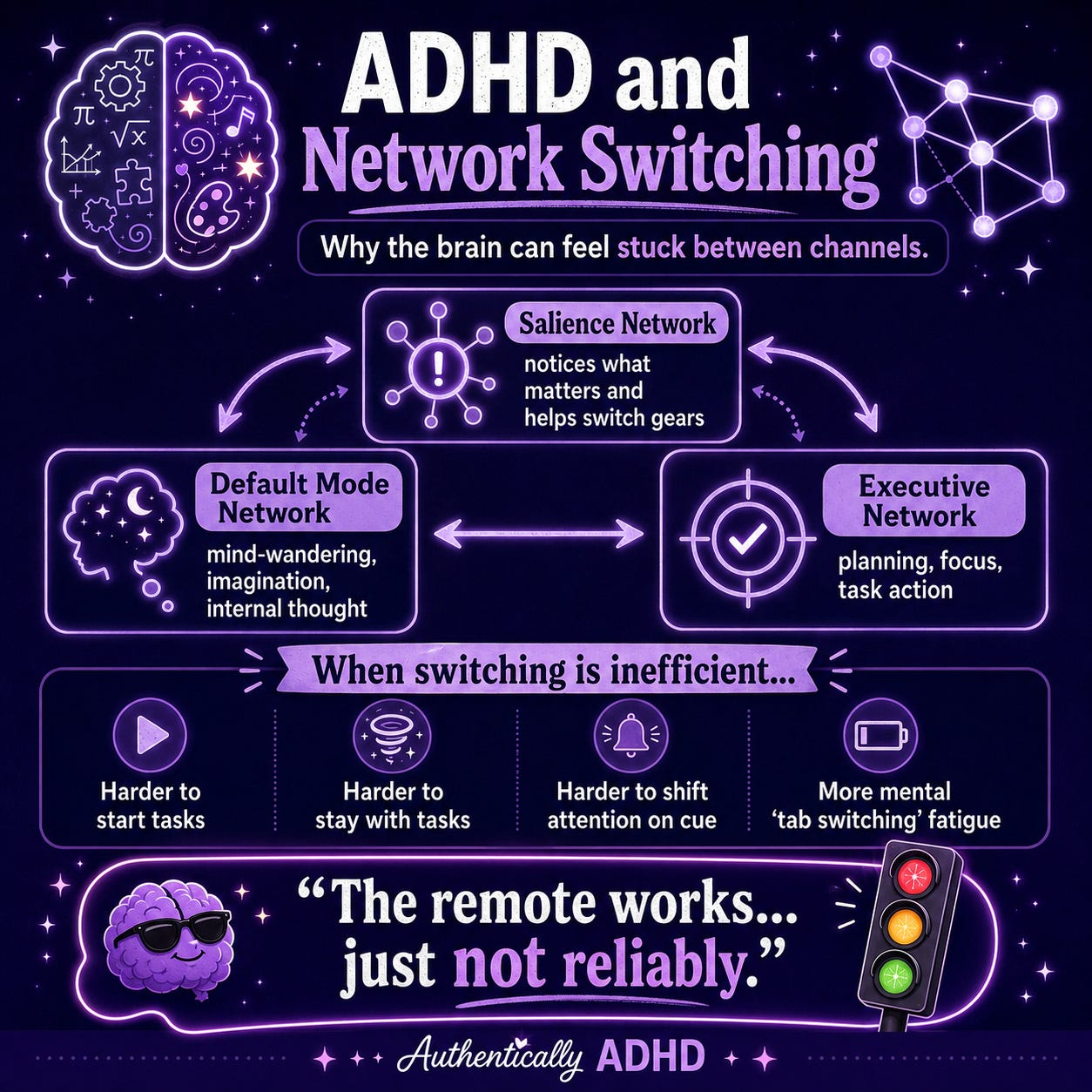
It means our brain networks may struggle to switch cleanly between internal thought, external task focus, salience, planning, and action.
Basically, ADHD is not a hemisphere issue.
It is a traffic control issue.
And the traffic lights are flickering.
And one lane is closed.
And someone has released emotional raccoons onto the highway.
ADHD Is Not a Lack of Attention. It Is Trouble Regulating Attention.
One of the biggest myths about ADHD is that we “can’t pay attention.”
That is adorable.
Incorrect, but adorable.
ADHD is not an absence of attention. ADHD is difficulty regulating attention.
Because, please explain how I can hyperfocus for seven hours on a niche topic, reorganize an entire digital folder system at midnight, research the emotional development of octopuses, or write 3,000 words in a fugue state powered by vibes and one granola bar…
…but I cannot start the dishwasher.
Not because the dishwasher is hard.
Not because I do not understand the dishwasher.
Not because I hate clean plates and want to live like a Victorian orphan.
But because task initiation, sequencing, reward prediction, working memory, and motivation are all involved in “simple” tasks.
There are no simple tasks in an ADHD brain.
There are only tasks with invisible steps.
“Do the dishes” is not one task. It is a cursed nesting doll.
It is:
notice the dishes
care about the dishes
stop what I am doing
tolerate the transition
walk to the sink
decide where to start
touch wet food, which is a crime
unload clean dishes first
remember where cups go
reload dirty dishes
notice the pan that needs handwashing
emotionally recover from the pan
find detergent
start the machine
not wander away halfway through
somehow not turn this into “I should reorganize the entire kitchen”
That is not one step. That is an executive function obstacle course wearing a trench coat.
So when people say, “Just focus,” what they often mean is, “Why can’t you summon goal-directed attention on command and sustain it in the exact direction society prefers?”
And the ADHD brain is like, “Bestie, I can either write a brilliant essay, panic-clean one drawer, or stare at the wall while mentally composing a TED Talk I will never give. Choose wisely.”
The Default Mode Network: The Brain’s Internal Goblin Radio
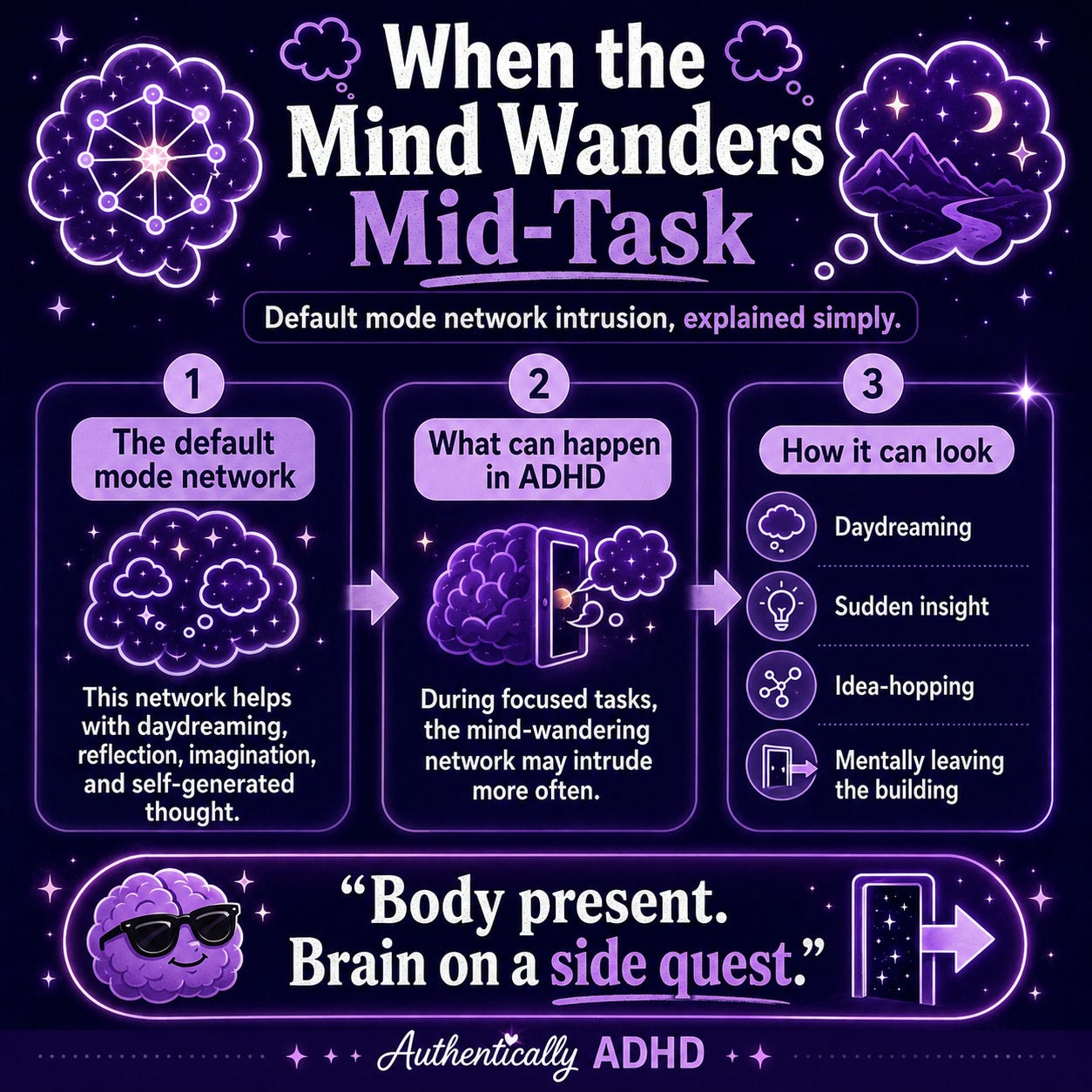
One of the most validating pieces of ADHD neuroscience involves the default mode network.
The default mode network, or DMN, is active when the brain is doing internal stuff: mind-wandering, remembering, imagining, self-referential thought, future planning, emotional processing, and mentally wandering into the forest with a lantern.
It is not bad. It is not useless. It is actually deeply human.
The DMN is part of why we daydream, reflect, connect ideas, imagine futures, process ourselves, and make meaning.
The issue in ADHD is not that the default mode network exists.
The issue is that it may not always step back politely when the task-positive networks need to take the wheel.
In a non-ADHD brain, during a boring but necessary task, the brain may be better at telling the internal thought network, “Okay, sweetie, we love your imagination, but we are currently filing taxes.”
In an ADHD brain, the default mode network may kick the door open mid-task like:
“Hey, remember that conversation from 2017?”
“Also, what if you started a new business?”
“Also, you forgot to drink water.”
“Also, your childhood.”
“Also, this song lyric is now your entire personality.”
“Also, what are birds?”
And suddenly your body is still sitting at the laptop, but mentally you have left the building, crossed state lines, started a podcast, opened six tabs, and emotionally adopted a possum.
This is why ADHD can look like daydreaming, zoning out, idea-hopping, sudden insight, or “I swear I was listening but then my brain opened a side quest.”
It is not laziness.
It is not moral failure.
It is not being “too creative for structure.”
It is network regulation.
The brain is trying to switch channels, but the remote has jammed buttons and someone spilled dopamine on it.
Divergent Thinking: The ADHD Brain as a Popcorn Machine
Now, let’s talk about creativity.
Because ADHD and creativity do have a relationship — it is just more nuanced than “ADHD makes you automatically creative.”
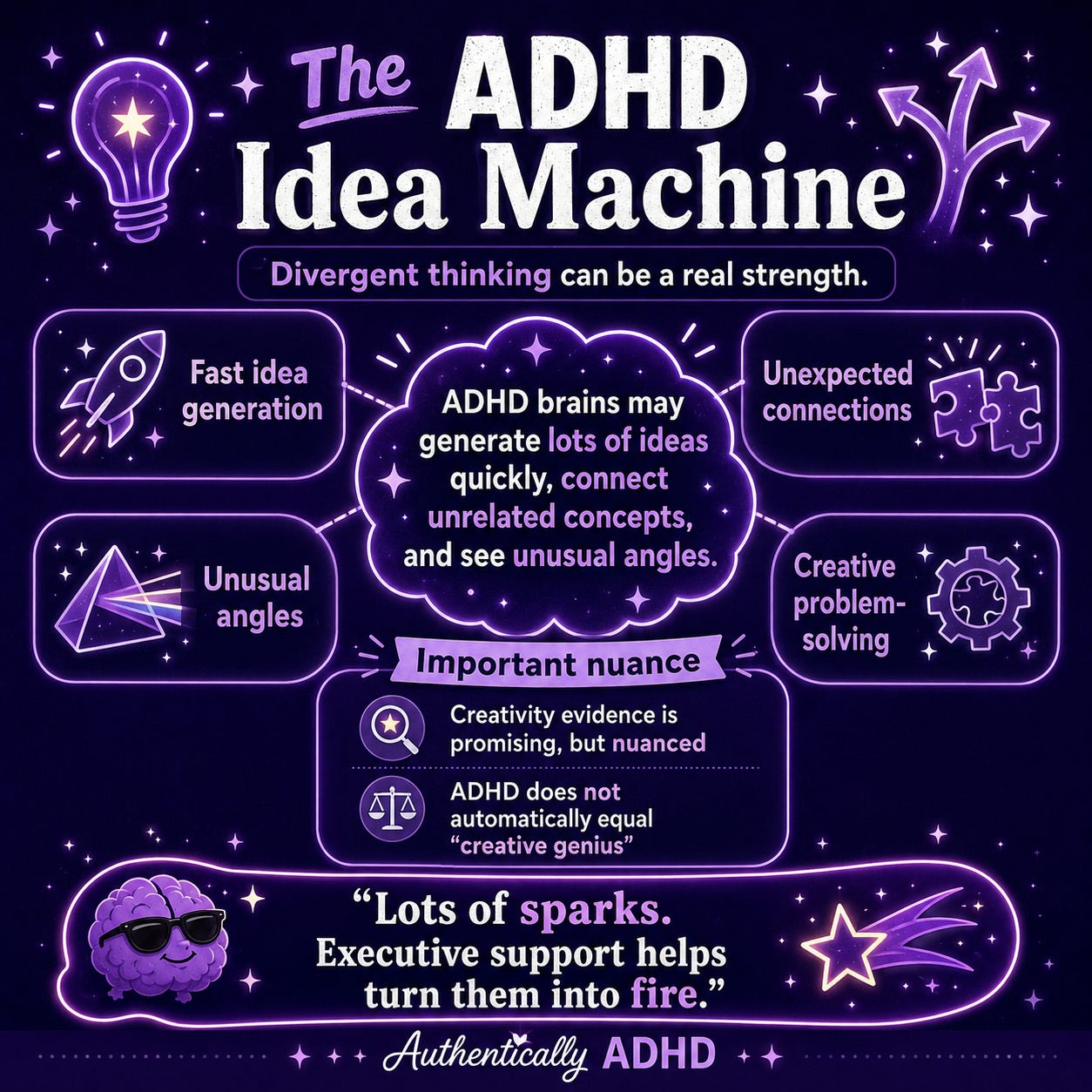
A lot of ADHD brains are excellent at divergent thinking.
Divergent thinking is the ability to generate many possible ideas, solutions, connections, or uses for something. It is the “what else could this be?” part of thinking.
Give an ADHD brain a paperclip and it may say:
A bookmark.
A zipper pull.
A tiny sculpture armature.
A reset button poker.
A symbol of capitalism.
A weapon in a very low-budget spy movie.
An earring if the night gets weird.
That idea generation can be a strength. ADHD brains may connect unrelated concepts quickly. We may see unusual angles. We may notice patterns others miss because our attention is not always walking down the approved sidewalk.
Our thoughts cut through alleys.
Sometimes that means we find a shortcut.
Sometimes that means we end up behind a metaphorical Arby’s at 2 a.m. wondering where the original task went.
That is the thing: divergent thinking can be powerful, but it is not the same as completed creative output.
Ideas are sparks.
Finished projects are fires with containment plans.
ADHD may give you a sky full of sparks. Beautiful, electric, alive.
But without executive function support, those sparks can become 74 unfinished drafts, three half-built systems, one abandoned Etsy shop, a notes app that looks like a conspiracy board, and a vague sense that you were supposed to email someone named Jessica.
Creativity is not just idea generation.
Creativity also requires selection, sequencing, revision, persistence, frustration tolerance, and completion.
That is where ADHD can get tricky.
The brain may generate the magic.
But then it has to package the magic.
Label the magic.
Invoice for the magic.
Remember where it saved the magic.
And unfortunately, the magic was saved as “final_FINAL_reallyfinal2.docx” in a folder called “misc.”
The Executive Function Bottleneck: When the Vision Is Vivid but the Steps Are Mud
This is the part that makes ADHD feel so unfair.
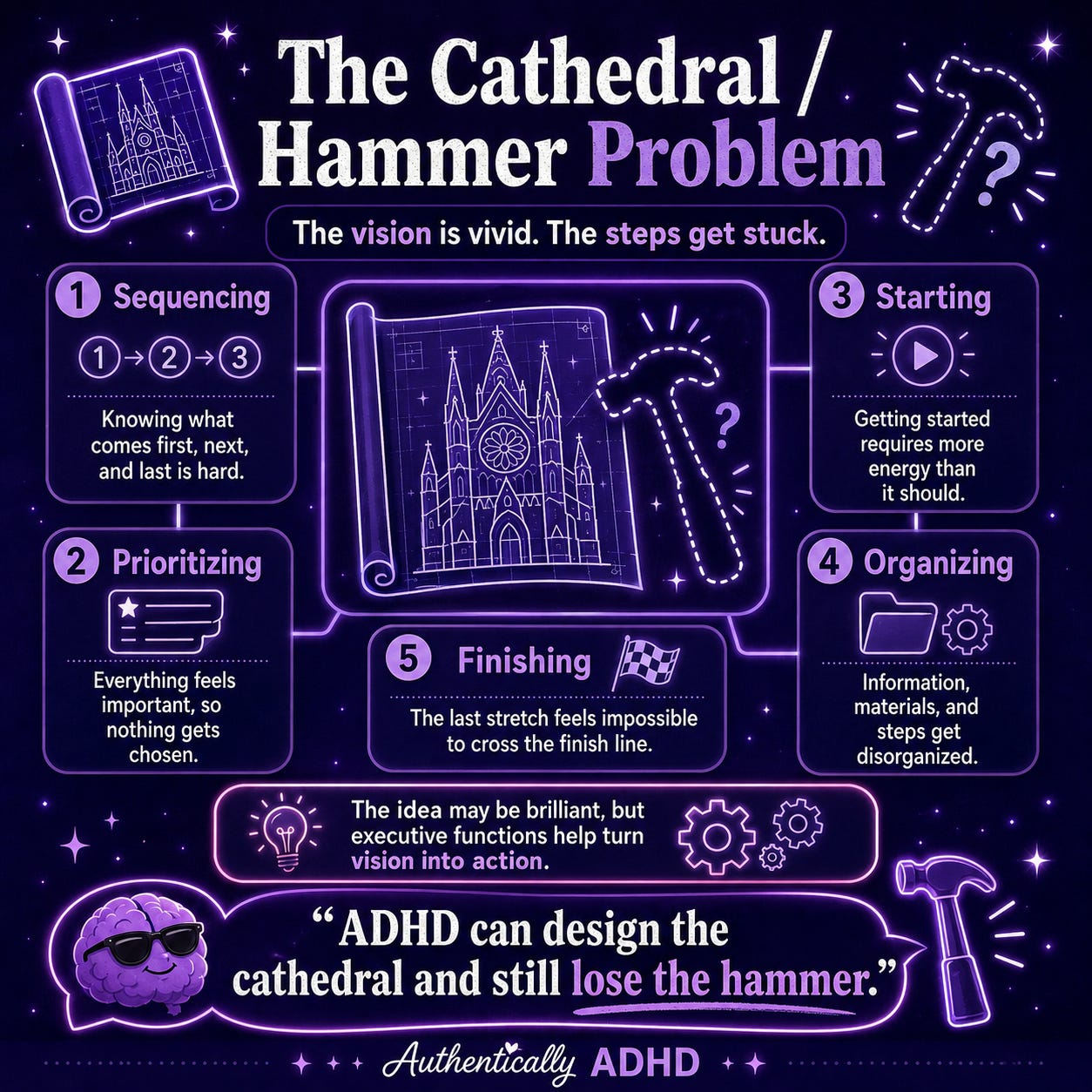
Because we often know what we want to do.
We can see the finished product.
We can imagine the classroom setup, the blog series, the clean kitchen, the organized budget, the new routine, the creative project, the healthier life, the more regulated nervous system.
The vision is not the problem.
The bridge is the problem.
ADHD often affects executive functions like:
starting
stopping
sequencing
prioritizing
remembering
planning
inhibiting impulses
regulating emotions
shifting between tasks
sustaining effort when the reward is delayed
So the ADHD brain can absolutely design a cathedral.
It can picture the stained glass.
It can imagine the acoustics.
It can name the candle scent.
It can create a 12-part podcast series about the spiritual symbolism of the architecture.
But then someone says, “Okay, first step: find the hammer.”
And the brain goes blank.
Not because the person lacks intelligence.
Not because the person does not care.
Not because they are immature, irresponsible, dramatic, or “not applying themselves.”
Because the path from concept to action is not automatic.
For many ADHD brains, “just do it” is not an instruction.
It is a locked door with no visible handle.
Why “Linear Tasks” Can Feel Like Folding a Fitted Sheet in a Wind Tunnel
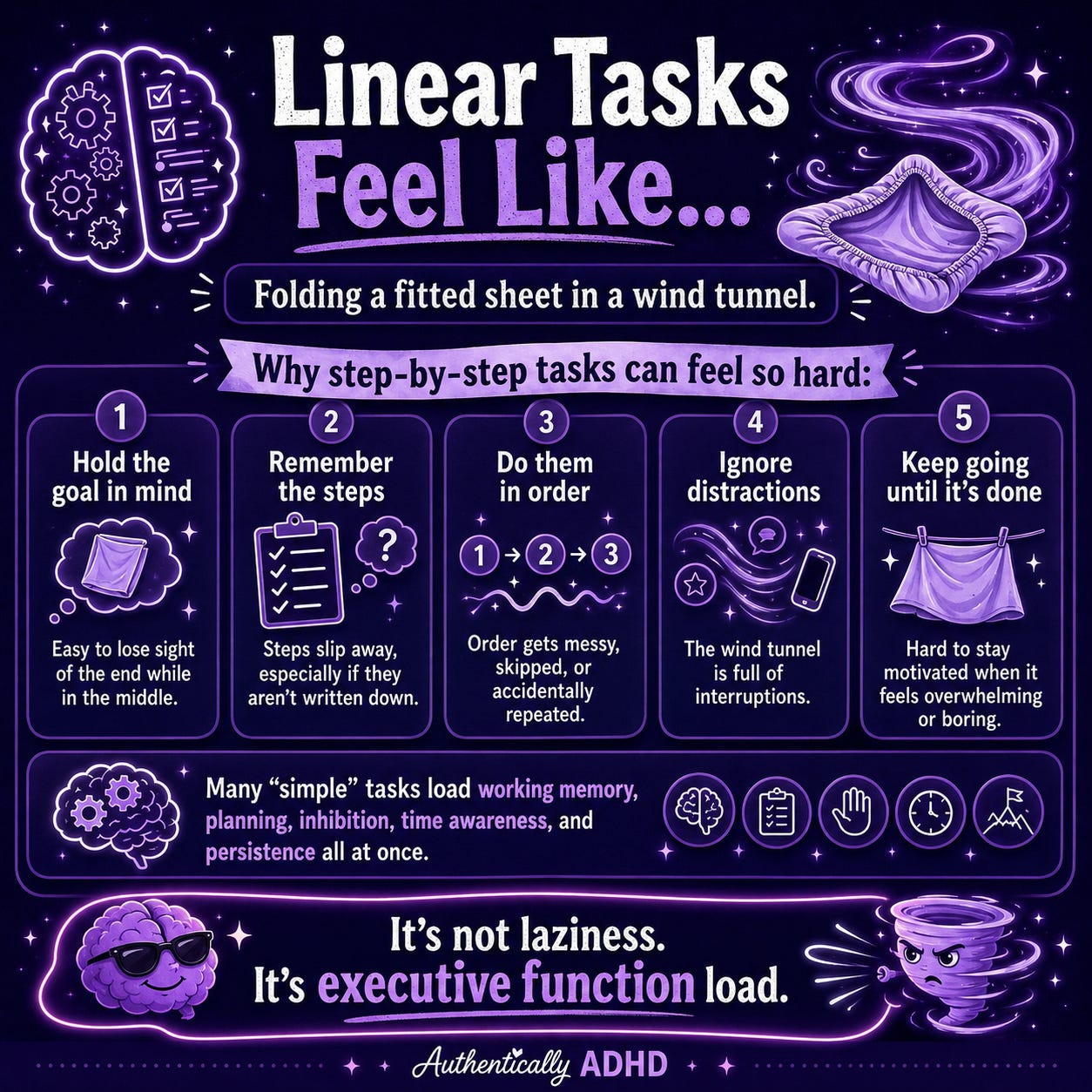
Linear tasks are tasks that require step-by-step movement in a specific order.
Things like:
budgeting
paperwork
lesson planning
cleaning a room
following a recipe
organizing files
completing forms
planning a week
writing an email without accidentally writing a memoir
getting ready in the morning like time is real
These tasks are often “left-brain-coded” in the cultural imagination because they involve logic, sequencing, structure, and order.
But the ADHD struggle with these tasks is not because the left hemisphere packed its bags and moved to Vermont.
It is because these tasks place a heavy load on working memory, planning, inhibition, time awareness, task persistence, and transitions.
A linear task says:
“Hold the goal in mind.”
“Remember the steps.”
“Do them in order.”
“Do not get distracted.”
“Do not overcomplicate.”
“Do not emotionally combust.”
“Do not start reorganizing your sock drawer because the tax form made you feel trapped.”
And the ADHD brain says:
“I hear you. However, I have found seventeen related ideas, four emotional associations, a sensory objection, and an urgent need to make this task aesthetically pleasing before I begin.”
This is why ADHD support cannot just be “try harder.”
Trying harder at an unsupported executive function task is like pressing the elevator button harder when the power is out.
The issue is not effort.
The issue is access.
The ADHD Brain Needs External Structure, Not Shame
Here is where we pivot from “wow, my brain is a haunted carnival” to “okay, what actually helps?”
Because the goal is not to become a different person.
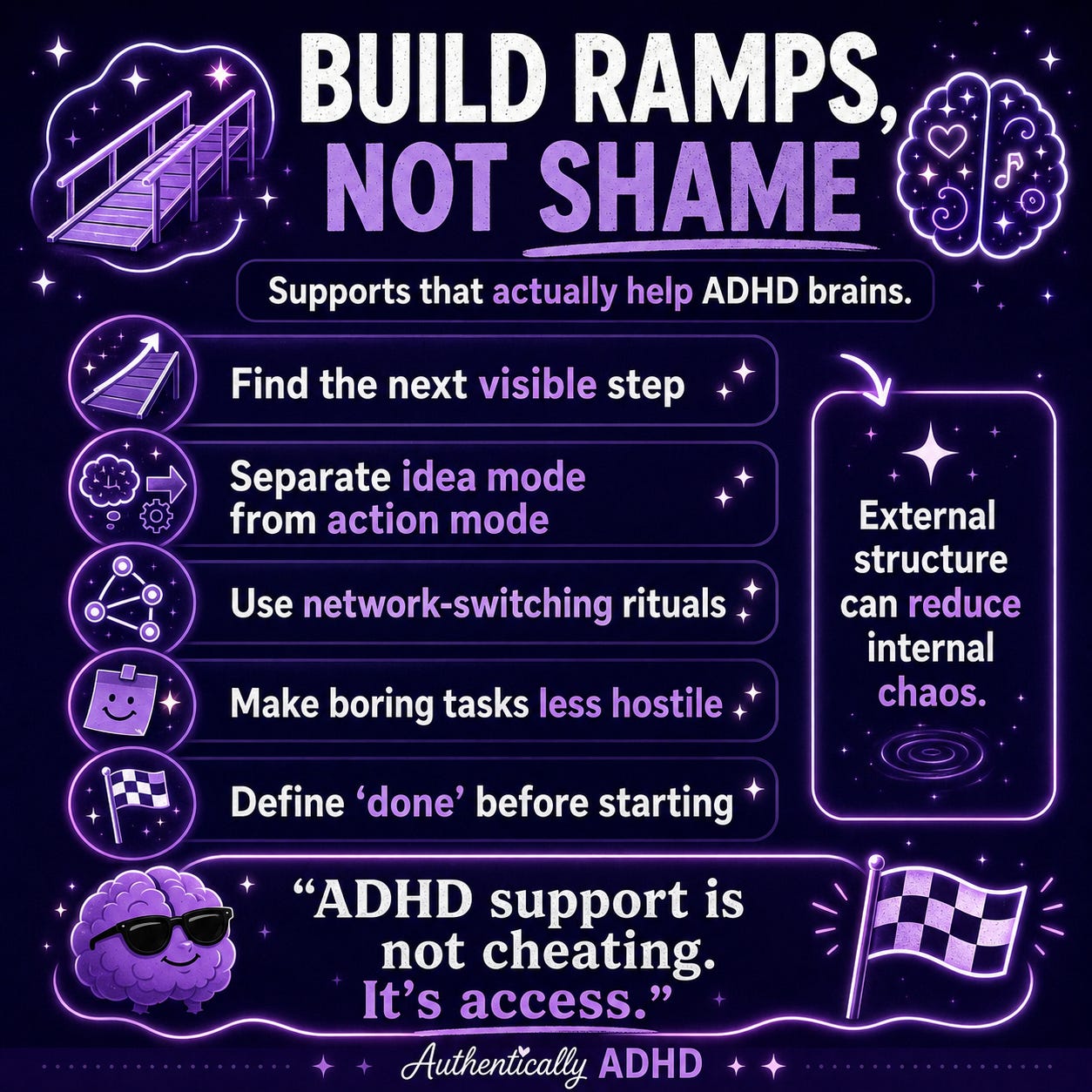
The goal is to build ramps.
ADHD brains often need external supports for the skills that neurotypical brains may perform more automatically.
Not because we are broken.
Because our regulation systems are more context-dependent.
A ramp does not shame the stairs.
A ramp says, “This body deserves access too.”
So for ADHD, the ramp might be:
visual reminders
body doubling
timers
checklists
transition rituals
fewer steps
dopamine before demand
external deadlines
accountability
environmental cues
“good enough” rules
task menus
breaking the start point down until it is laughably tiny
And I do mean laughably tiny.
Not “clean the kitchen.”
Try:
“Stand in kitchen.”
That counts.
Then:
“Throw away five things.”
Then:
“Put cups by sink.”
Then:
“Start dishwasher, even if the counters still look like a raccoon hosted brunch.”
The ADHD brain often does better when the first step is so small it cannot trigger a constitutional crisis
.
Strategy 1: Stop Asking “What Should I Do?” Ask “What Is the Next Visible Step?”
“What should I do?” is too big.
That question opens the entire universe.
The ADHD brain hears “what should I do?” and suddenly you are considering your career path, your childhood wounds, your laundry, your grocery list, your bank account, your purpose on Earth, and whether you should become someone who owns matching food storage containers.
No.
We need smaller.
Ask:
What is the next visible step?
Not the best step.
Not the most efficient step.
Not the morally superior step that would impress a productivity influencer with beige cabinets.
The next visible step.
Examples:
Open the document.
Put shoes on.
Take the laundry basket to the washer.
Write the title.
Find the bill.
Put the trash bag by the door.
Clear one square foot.
Reply with one sentence.
Set a timer for five minutes.
Drink water before solving your entire life.
The next visible step is a flashlight, not a life sentence.
Strategy 2: Separate Idea Mode From Execution Mode
This one is huge.
ADHD brains often suffer because we try to ideate and execute at the same time.
That is like asking a fireworks show to also do accounting.
Idea mode is expansive.
Execution mode is selective.
Idea mode says, “What else?”
Execution mode says, “What now?”
Idea mode opens doors.
Execution mode closes tabs.
Both are valuable. But they are not the same job.
So instead of shaming yourself for having too many ideas, give them a place to land.
Try using two separate spaces:
The Idea Parking Lot
This is where all the shiny thoughts go.
No judgment. No sorting. No immediate action required.
Just: “Cool thought, babe. Park it here.”
The Action Lane
This is where only the next step lives.
Not the whole project.
Not the entire vision.
One next action.
The ADHD brain needs somewhere to put the sparkle so it does not hijack the steering wheel.
Because if every idea becomes an emergency, your day turns into a glitter tornado with a calendar invite.
Strategy 3: Use “Network Switching Rituals”
If ADHD involves difficulty switching between internal thought, external focus, rest, action, and task demands, then transitions need support.
You are not “being dramatic” because transitions are hard.
Transitions are neurologically expensive.
Going from couch to shower, from scrolling to email, from podcast idea to laundry, from childcare to adult admin — those are not just activities. They are state changes.
And ADHD brains often need a bridge between states.
Try a tiny ritual:
stand up
take one sip of water
say the next task out loud
set a five-minute timer
put on task-specific music
move to the location where the task happens
lower the sensory load
use a body double
start with the hands, not the whole brain
Example:
“I am moving from idea mode to email mode. I only have to open the inbox and find the email. That is the whole job.”
Yes, you may feel ridiculous saying it out loud.
Do it anyway.
The nervous system loves clear cues. The ego can file a complaint later.
Strategy 4: Make Boring Tasks Less Neurologically Hostile
A lot of ADHD advice is secretly just punishment in a cardigan.
“Remove all distractions.”
“Sit still.”
“Use a plain planner.”
“Just be consistent.”
“Wake up at 5 a.m. and become a minimalist monk.”
Absolutely not.
Many ADHD brains need stimulation to focus. Not chaos, necessarily. But enough sensory or emotional engagement to keep the brain online.
Boring tasks may need:
music
movement
novelty
color
challenge
a timer
a reward
a buddy
a race
a fake deadline
a cozy drink
a visual checklist
a little dramatic flair
You are allowed to make the task less miserable.
You are allowed to light the candle.
You are allowed to use the purple pen.
You are allowed to make the spreadsheet cute.
You are allowed to fold laundry while watching a documentary about cults.
You are allowed to trick your brain with joy.
That is not childish.
That is design.
Strategy 5: Build Completion Supports Before You Start
Starting is hard.
Finishing is also hard.
But ADHD brains often start with a burst of energy and assume finishing will magically happen because the vibes are strong.
The vibes are liars.
Before starting, ask:
What does “done” mean?
How will I know when to stop?
Where will this live when I am finished?
What is the smallest acceptable version?
What might derail me?
What support do I need at the boring middle?
What is the reward or recovery afterward?
This matters because ADHD projects often die in the swampy middle.
The beginning has dopamine.
The ending has relief.
The middle is where motivation goes to wear wet jeans.
So define “done” early.
Not perfect.
Done.
Examples:
“Done means the blog draft exists, even if I revise later.”
“Done means the dishwasher is running, not that the kitchen is magazine-ready.”
“Done means I paid the bill, not that I created a full financial healing system.”
“Done means I made the appointment, not that I fixed my entire health history.”
Completion needs a finish line.
Otherwise the ADHD brain will keep expanding the task until it becomes a lifestyle brand.
This Is Why ADHD Can Look Like Contradiction
This is why ADHD is so often misunderstood.
Because the outside world sees inconsistency and assumes character flaw.
They see:
brilliant ideas but missed deadlines
deep empathy but forgotten texts
intense focus but unfinished chores
creative problem-solving but messy systems
high intelligence but basic task struggles
emotional depth but impulsive reactions
big dreams but difficulty starting
And they say, “You just need discipline.”
No.
We need regulation.
We need structure that works with our nervous system.
We need support for transitions, initiation, sequencing, and completion.
We need fewer moral judgments and more practical scaffolds.
We need people to understand that ADHD is not “I do not care.”
ADHD is often:
“I care so much that my brain opened twelve tabs, overheated, and crashed before I could begin.”
It is:
“I can see the whole constellation, but I cannot find the next stepping stone.”
It is:
“My mind is fast, but my regulation is inconsistent.”
It is:
“I am not lazy. I am neurologically under-supported.”
So No, ADHD Is Not Right-Brain Dominance
ADHD is not a cute split-brain personality badge.
It is not “creative side strong, logic side weak.”
It is not “quirky artist brain.”
It is not “too dreamy for details.”
ADHD is a difference in self-regulation, attention regulation, executive functioning, inhibition, motivation, and network switching.
And yes, many ADHD brains are creative.
Many of us are pattern-finders, metaphor-makers, dot-connectors, possibility-generators, emotional archaeologists, chaos translators, and professional “wait, what if we tried this?” people.
But creativity is not the whole story.
Because the same brain that generates the brilliant idea may struggle to start the email.
The same brain that sees ten solutions may freeze choosing one.
The same brain that can imagine the cathedral may lose the hammer.
So instead of asking whether ADHD is “right-brained,” ask better questions:
What supports attention regulation?
What reduces executive function load?
What helps this brain switch states?
What makes the next step visible?
What turns the cathedral into one brick?
What kind of ramp does this nervous system need?
Because ADHD does not need more shame dressed up as advice.
It needs translation.
It needs tools.
It needs compassion with a clipboard.
It needs structure that does not feel like a prison.
It needs room for the sparkle and support for the steps.
And maybe, just maybe, it needs us to stop calling complex neurobiology “right-brained” like we are diagnosing people with a Pinterest board.
The ADHD brain is not half a brain.
It is a whole brain with a complicated operating system.
And once we stop shaming the system for not being Windows 95, we can finally start building supports that actually run.