
AuDHD and Organization
Why It Feels So Hard, Why It Looks So Different, and What Actually Helps

Organization gets treated like it is a personality trait.
Like some people were simply born with color-coded drawers, matching containers, and a mystical ability to remember where they put the scissors.
And if you are AuDHD, that story can feel especially brutal.
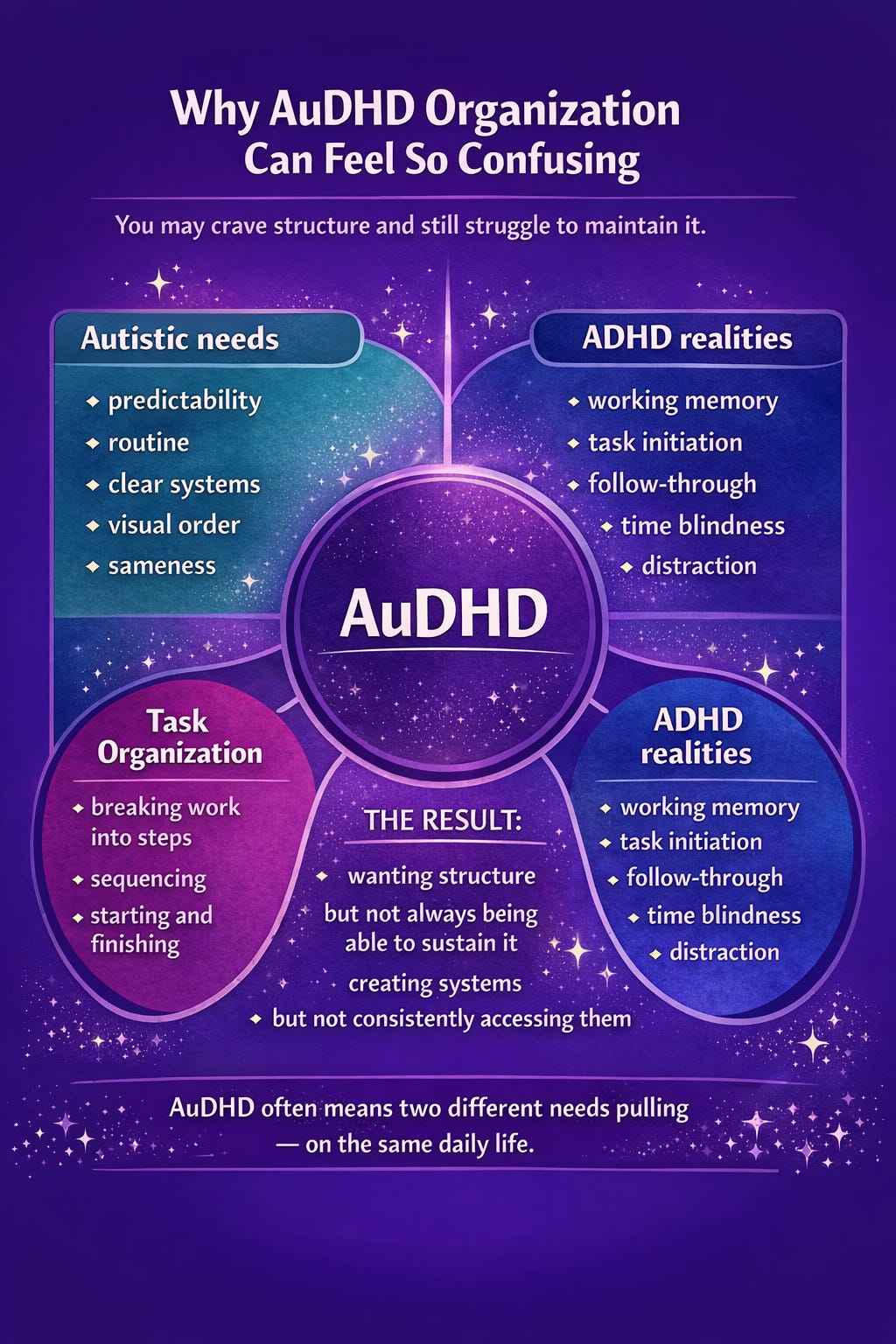
Because the truth is, a lot of us are not “bad at organization” in some cute quirky way. We are often trying to manage life with two different neurotypes tugging at the same steering wheel. One part of the brain may crave predictability, sameness, visual order, and systems. Another part may struggle to consistently initiate, sequence, sustain, prioritize, inhibit distractions, and follow through. So you can deeply want order and still be living inside what feels like a raccoon-led filing system. A spiritually meaningful one. But still chaos.
Research on co-occurring autism and ADHD shows this overlap is common, and executive functioning differences are a major part of the picture. In people with both, the profile is not just “autism plus ADHD pasted together.” The combination can create its own pattern of planning, inhibition, flexibility, and real-world regulation difficulties.
And that is where this conversation needs more nuance.
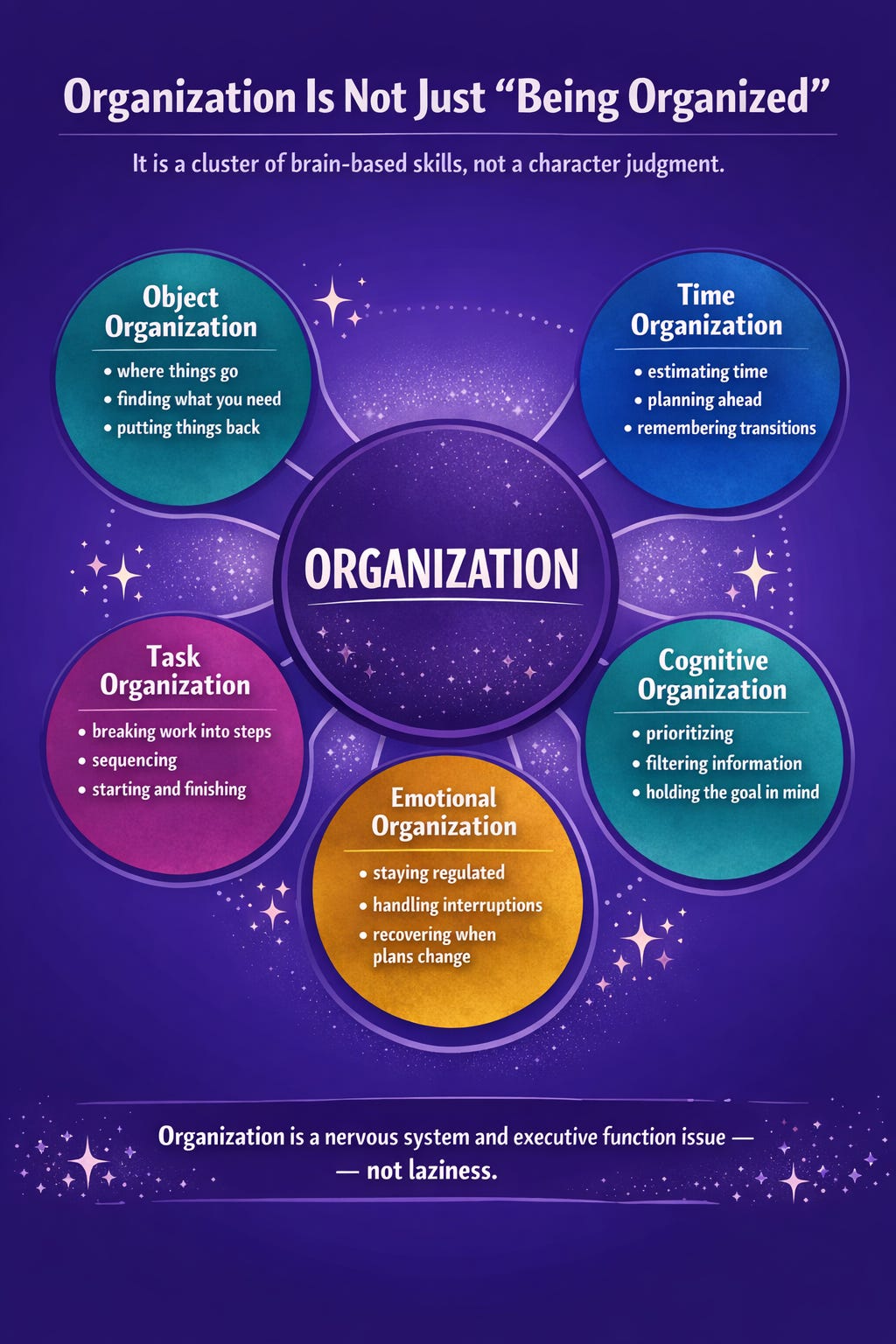
Because “organization” is not one skill. It is a whole constellation of brain-based processes. It is remembering what matters, filtering what does not, knowing where to start, shifting gears when needed, tolerating interruption, sequencing steps, estimating time, storing objects in a retrievable way, and then doing it all again tomorrow without your nervous system filing a formal complaint.
So let’s talk about AuDHD and organization the real way:
what organization actually includes, why so many AuDHD people struggle with it, how it can show up in kids and adults, and what supports actually help.
Organization is not one thing
When people say someone is “disorganized,” they usually mean one visible thing:
their room is messy, their backpack is a black hole, their calendar is a hostage situation, or they missed another deadline.
But organization is bigger than visible clutter.
It helps to think of it in layers.
1. Object organization
This is the classic one people notice first.
Where do things go?
Can you group materials logically?
Can you keep track of what you need?
Can you return items to the place where your future self can actually find them?
This is the backpack, desk, bedroom, kitchen counter, purse, glove box, junk drawer, email inbox, and desktop files problem.
In ADHD, organizational problems are strongly tied to executive function—especially working memory. If the brain has trouble actively holding information in mind while doing something else, it becomes much harder to keep track of materials, rules, and steps. Research in children with ADHD found working memory was closely linked to organizational skills difficulties reported by parents and teachers.
2. Time organization
This is where time blindness walks in wearing sunglasses and acting like it pays rent.
Time organization includes:
estimating how long something will take
planning backward from deadlines
pacing tasks
remembering transitions
leaving enough runway to get somewhere on time
understanding “later” as a real category and not a mythical kingdom
ADHD is deeply associated with executive function differences that affect planning, inhibition, and working memory, all of which can interfere with time management.
3. Task organization
This is the ability to break a task into parts and do them in a workable order.
For example, “clean the kitchen” is not one task. It is:
notice dishes
clear counters
throw away trash
load dishwasher
wipe surfaces
remember there is laundry in the washer
spiral into existential despair
come back to the sponge
Task organization relies heavily on planning and sequencing—skills that can be affected in both ADHD and autism, though sometimes in different ways. Reviews comparing autism, ADHD, and co-occurring presentations suggest that planning and flexibility difficulties are especially relevant in autism and AuDHD, while inhibition difficulties are often especially prominent in ADHD and AuDHD.
4. Cognitive organization
This is the invisible architecture.
Can you sort information?
Can you decide what is most important?
Can you ignore irrelevant input?
Can you hold the main goal while handling competing demands?
Can you retrieve what you know when needed?
This is why some AuDHD people sound incredibly insightful but struggle to explain things in a linear way under pressure. The thoughts exist. The filing system is just having a weather event.
Executive function research describes these kinds of abilities as involving working memory, inhibition, and cognitive flexibility—core processes that support goal-directed behavior.
5. Emotional organization
This one does not get talked about enough.
Can you stay regulated enough to use the systems you created?
Can you recover when a plan changes?
Can you tolerate the discomfort of unfinished tasks, clutter, interruptions, uncertainty, or transitions?
Because a lot of organization is not just logistical. It is regulatory.
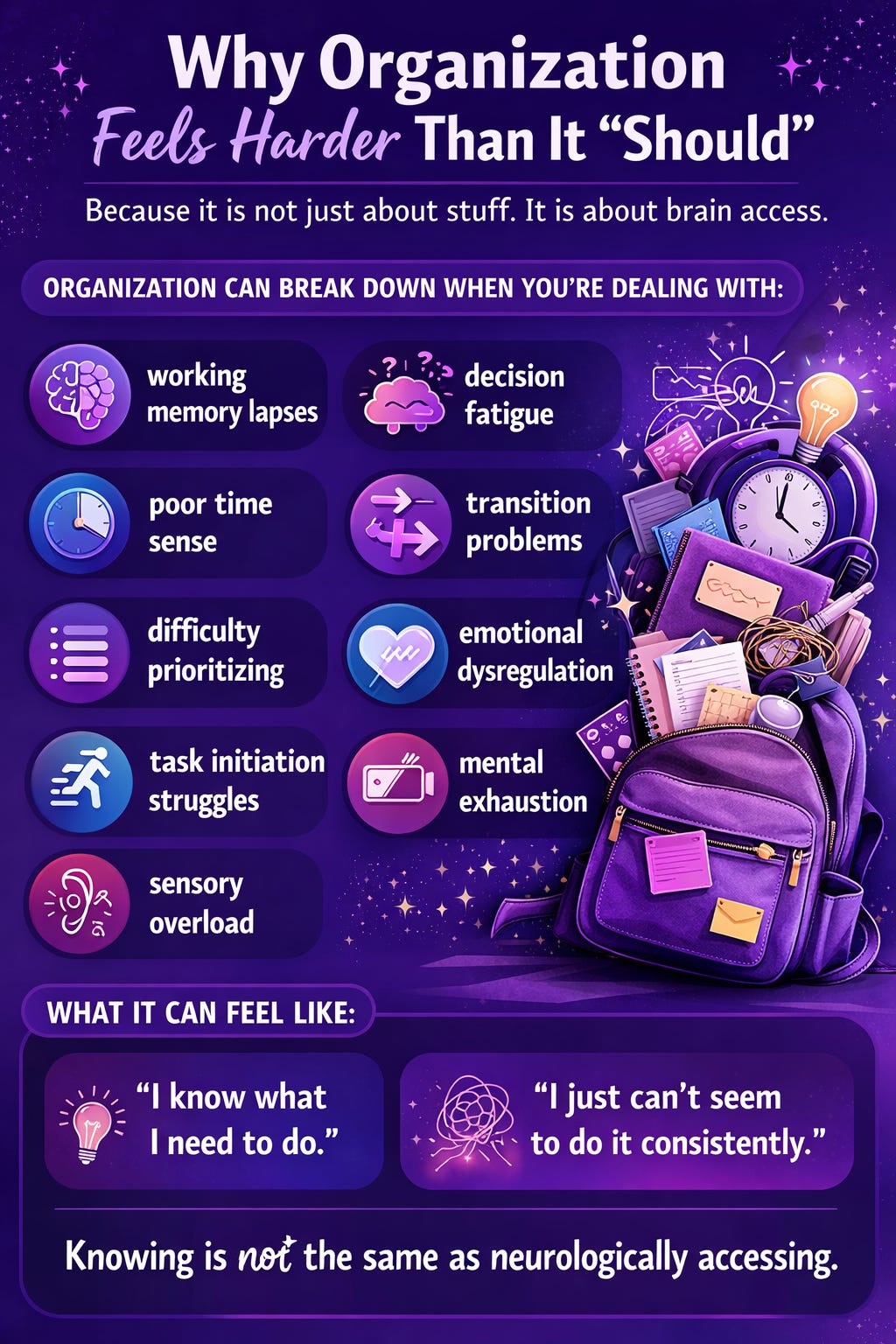
For many AuDHD people, “disorganization” is not a lack of caring. It is what happens when executive demands, sensory load, emotional strain, and decision fatigue all pile onto the same nervous system at once. Research on children with co-occurring ASD and ADHD suggests sensory processing and executive functioning are meaningfully related in this population, which matters because real-life organization rarely happens in a sensory vacuum.
Why AuDHD organization can feel so painfully inconsistent
This is the part that messes with people’s heads.
Because AuDHD organization often looks contradictory.
You might alphabetize your spices and still lose your insurance card.
You might keep your bookshelf immaculate and forget to pay a bill.
You might have a rigid morning routine and also a doom pile that could legally be classified as a landform.
You might need sameness, but also resist systems the second they start to feel too restrictive.
That contradiction is not fake. It is the point.
ADHD brings difficulty with executive access
ADHD is associated with differences in executive functioning, especially working memory, inhibition, and sustained goal-directed control. That means many people know what they need to do, may even have a good plan, and still cannot reliably access that plan in the moment. This is one reason organization advice that depends on “just be more consistent” lands like an insult wearing khakis.
A particularly important point from adult ADHD research: people with ADHD may be able to develop effective strategies, but have difficulty using them consistently over time. So the issue is often not knowledge. It is sustained access and implementation.
Autism can bring differences in flexibility, planning, and routine dependence
Autism research often points to executive function differences involving planning, shifting, and adapting, though the profile is heterogeneous and not every autistic person has the same pattern. Some studies have found a stronger relationship between ADHD symptom severity and EF difficulties, while others show meaningful EF differences in autism as well—especially in daily life and real-world functioning. The overall picture is: this is complicated, variable, and very real.
That matters because autistic organization may not look like “disorganization” in the stereotyped ADHD sense. It may look like:
needing specific systems and becoming distressed when they are disrupted
having strong organization in one area and major difficulty generalizing it to another
becoming stuck when a task has too many possible categories or no clear rule
shutting down when the environment becomes too unpredictable or overloaded
AuDHD can create a push-pull between craving structure and struggling to maintain it
This is the heartbreak of it.
The autistic part may want the comfort of order, routine, predictability, sameness, and categorization.
The ADHD part may struggle to maintain those systems consistently because of working memory lapses, initiation problems, distractibility, time blindness, and inconsistent follow-through.
So you can be someone who genuinely feels better with systems and still cannot sustain them in a linear, Pinterest-approved way.
That is not laziness. That is not a lack of maturity. That is neurobiology colliding with life demands.
Research comparing ASD, ADHD, and co-occurring groups suggests the combined presentation often includes deficits shared with both conditions, including planning/flexibility features more often seen in autism and inhibition-related difficulties more often seen in ADHD.
Sensory and environmental load quietly wreck organization
A lot of mainstream organization content pretends the brain exists in a clean white room with neutral lighting, no noise, no hunger, no social demands, and no one asking “where’s the form?” from across the house.
Must be nice.
But organization is deeply affected by the environment around the person. Sensory discomfort, visual clutter, noise, social stress, and transitions can all eat up cognitive resources that would otherwise go toward planning and remembering. Research in children with ASD+ADHD has found significant links between sensory processing and executive functioning, which fits what many AuDHD people already know in their bones: when the nervous system is overloaded, organization goes offline fast.
How organization struggles can look in AuDHD kids
In kids, organization problems do not always look like “messy child.”
Sometimes they look like:
always losing papers, folders, shoes, water bottles, library books, or lunch boxes
knowing the routine but not doing the routine without repeated prompts
getting overwhelmed by multi-step directions
melting down when materials are moved or routines change
stuffing everything into one backpack pocket like a tiny raccoon contractor
having a desk or cubby that looks like a paper-based crime scene
freezing when asked to clean up because the task is too open-ended
struggling to start independent work even when they know how
forgetting what they were doing halfway through
being able to organize favorite-category items beautifully but not general classroom materials
needing sameness in setup and becoming dysregulated if the setup changes
appearing “oppositional” when the real issue is overload, unclear sequencing, or transition difficulty
In school-age children with ADHD, organizational difficulties are common and can significantly affect academic functioning. Behavioral interventions specifically targeting organization, time management, and planning have been shown to improve skills, inattention, and academic performance.


In autism, executive functioning differences can also affect participation at school and home, particularly when tasks require planning, shifting, and flexible problem solving.
And here is the important human piece:
a child may look careless when they are actually overwhelmed.
They may look avoidant when they are actually confused.
They may look defiant when the demand is too vague, too many steps, too noisy, too fast, or too unpredictable.
Sometimes what adults call “won’t” is really “cannot access the skill in this moment.”
How organization struggles can look in AuDHD adults
Then those kids grow up.
And suddenly the organization problems are not just about backpacks and homework. They are about bills, jobs, kitchens, relationships, medications, paperwork, laundry, food planning, child care, appointments, taxes, digital clutter, and the 47 tabs open in both the browser and the soul.
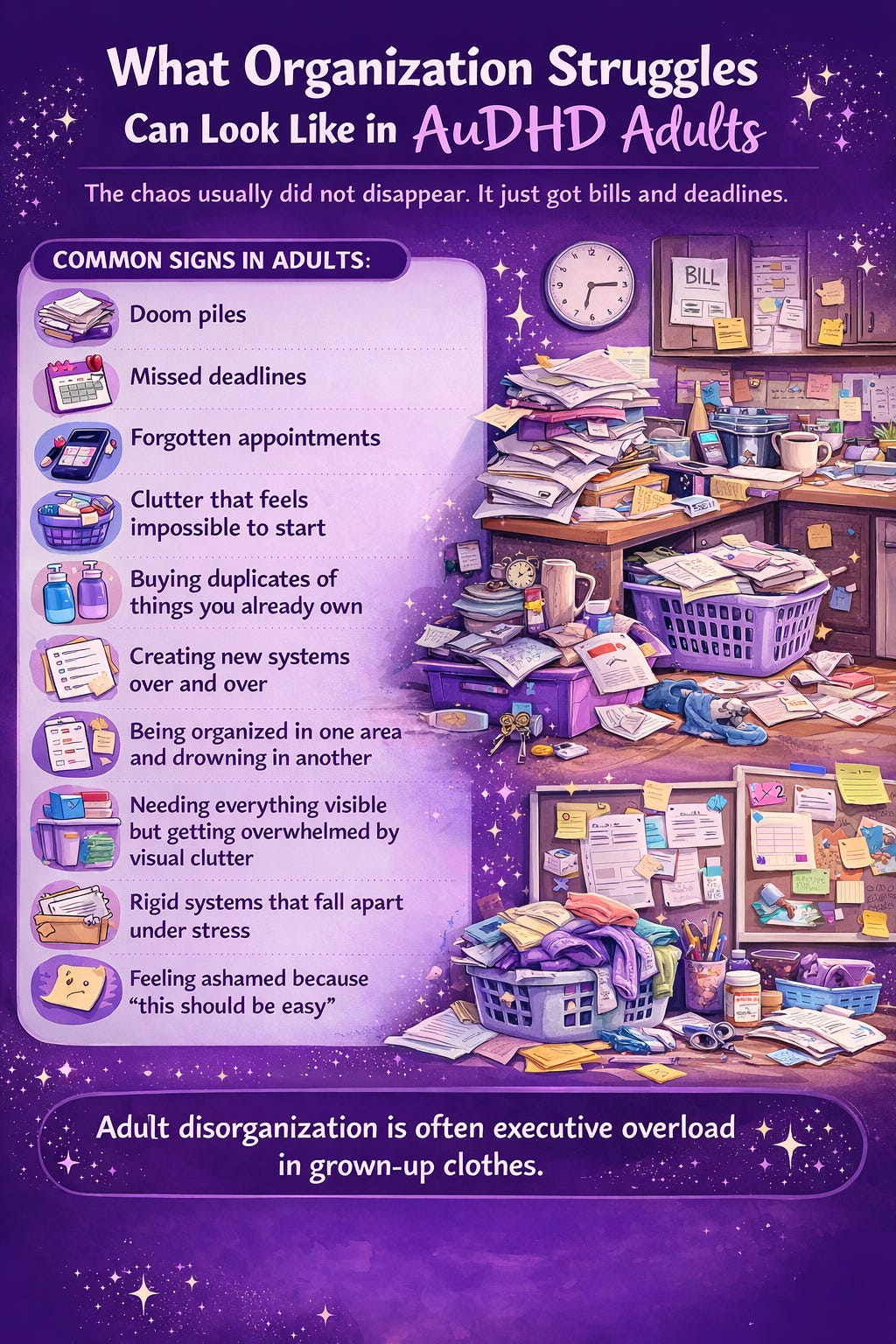
Adult AuDHD organization struggles can look like:
piles everywhere because “out of sight” becomes “gone from reality”
perfectionism that prevents starting any system at all
rigid micro-systems that collapse the second life gets complicated
forgetting what you own and accidentally buying duplicates
doom rooms, doom bags, doom corners, doom emails, doom portals
spending hours organizing one category while urgent tasks burn in the background
being unable to decide where something belongs unless the category is crystal clear
feeling deeply soothed by organizing and deeply incapable of beginning it
struggling more after work because regulation and executive fuel are already spent
repeatedly creating new planners, apps, labels, or routines that work for three days and then evaporate
needing visible reminders but also getting overwhelmed by too much visible input
keeping one area pristine and another area unmanageable
being told “you’re so smart, how can you not keep up with this?”
In higher education and adult contexts, daily executive functioning is strongly tied to real-world outcomes, including academic progress and workplace functioning. Research on autistic students found daily EF was a meaningful predictor of academic progress, and reviews of adult/workplace supports highlight the usefulness of environmental modifications and practical accommodations.
That matters because adult organization struggles are often moralized.
People see the missed deadline, the late fee, the clutter, the forgotten email.
They do not see the invisible costs:
the sensory drain, the effort of transitions, the working memory dropouts, the inhibition failures, the cognitive bottleneck, the hours spent trying to decide the “right” place for something, the panic that shows up when a task has no obvious entry point.
And that shame? It makes organization harder, not easier.
Why some AuDHD people seem “hyper-organized” in some areas and falling apart in others
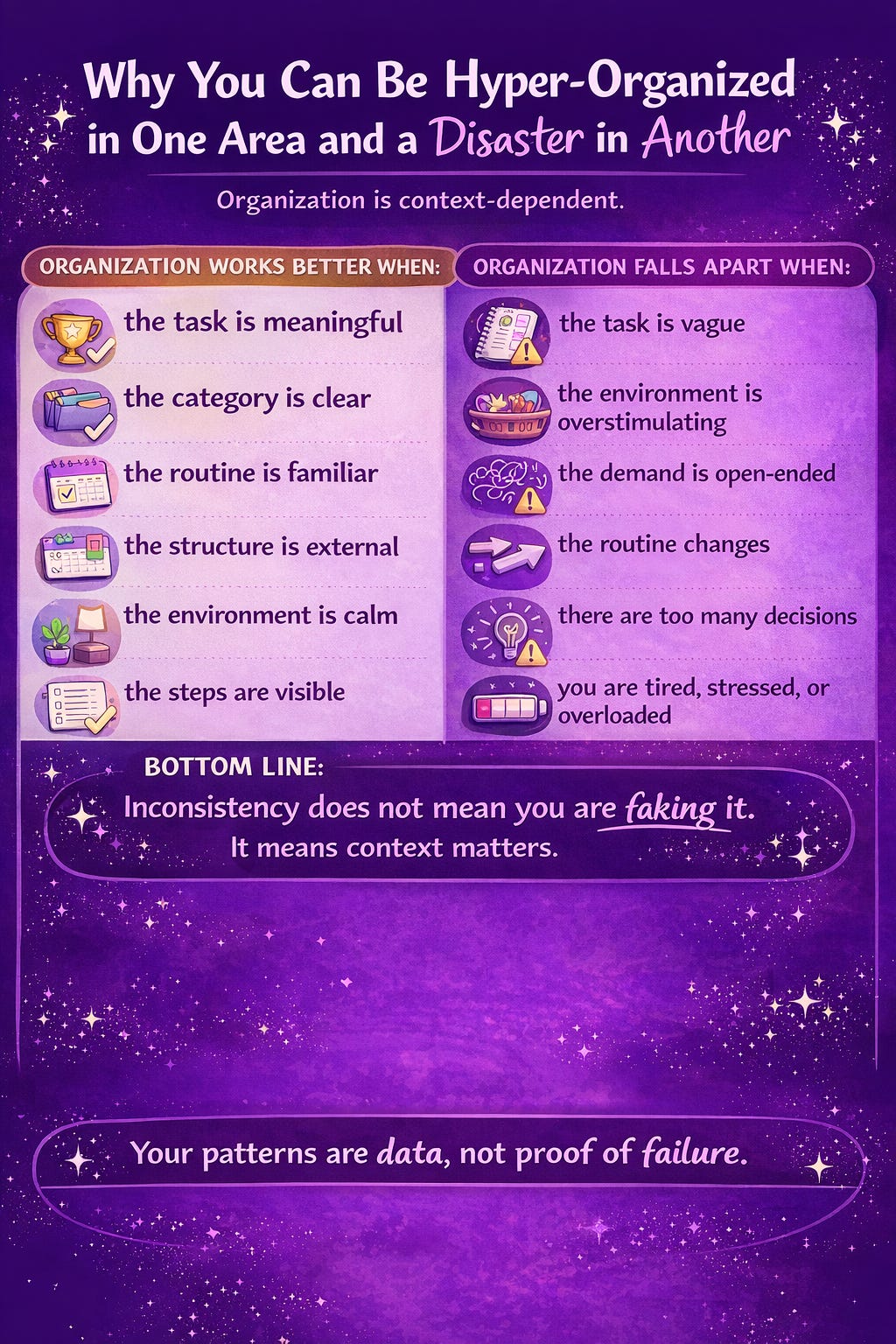
Because organization is context-dependent.
Executive function is not a fixed trait that turns on equally across all situations. It changes depending on motivation, stress, predictability, sensory environment, novelty, fatigue, and task design. Research across ADHD and autism repeatedly shows heterogeneity: not every executive function is equally affected, not every person has the same profile, and real-world ratings often capture difficulties that lab tasks miss.
So yes, you can:
run a color-coded classroom and still forget to refill your medication
maintain a beautiful spreadsheet and still live with floor piles
memorize intricate systems for a special interest and still miss your dentist appointment
be exceptional in structured environments and unravel in unstructured ones
This is not hypocrisy. It is a clue.
It means your organization is probably strongest when:
the category system is clear
the task is meaningful
the environment is regulated
the structure is externalized
the routine is familiar
the sensory load is manageable
the number of steps is visible
the demand is not too open-ended
That pattern tells us what support needs to look like.
What actually helps: tips and strategies for AuDHD organization
Not every strategy will fit every person. That is not failure. That is neurodiversity.
The goal is not to become a minimalist robot with a label maker and no needs.
The goal is to build systems your brain can actually access.
1. Make organization external, not internal
If your brain struggles to hold multiple pieces of information at once, stop asking it to.
Use:
clear bins
labels
visual schedules
written checklists
dry erase boards
visible calendars
hooks instead of drawers
transparent containers
recurring alarms
body-doubled task blocks
one home for the most important daily items
This fits the evidence that executive functioning differences—especially working memory—play a major role in organizational problems. External supports reduce the amount the brain has to juggle internally.
2. Reduce the number of decisions
A system that requires lots of micro-choices is a system that may quietly die.
Instead of:
“Put things away neatly”
Try:
one basket for daily meds
one tray for mail
one bin for chargers
one hook for keys
one launch pad by the door
one shelf category per task type
Fewer categories = less friction.
Less friction = higher follow-through.
3. Prioritize retrieval over perfection
A good system is not the prettiest one. It is the one you can use when tired, late, overstimulated, and mildly feral.
Ask:
Can I find it later?
Can I put it back quickly?
Can I maintain this on a bad day?
If the answer is no, the system is too fragile.
4. Use visual structure, but avoid visual overwhelm
Many AuDHD people need reminders in sight, but too much visible stuff becomes background noise or sensory chaos.
This is the annoying middle path, yes.
Try:
limiting visible reminders to a few high-priority items
using one command center instead of reminders in every room
grouping items by “next action” rather than by abstract category
using closed storage for low-priority items and open storage for must-remember items
5. Turn vague tasks into tiny sequenced steps
“Organize the room” is not a task. It is a threat.
Try:
pick up trash first
put dishes in sink
gather clothes
clear one surface
stop and reassess
Behavioral organizational interventions for children with ADHD work in part because they explicitly teach routines, steps, and reinforcement around organization rather than assuming the child will intuit the process.
That same principle helps adults too:
make the invisible steps visible.
6. Build for transitions, because transitions are where things go to die
A lot of organization falls apart not during the task, but between tasks.
Create transition supports:
end-of-day reset checklist
leave-the-house checklist
“closing shift” routine for the kitchen
Sunday preview for the week
backpack or bag packing the night before
a visual next-step note left where tomorrow-you will see it
This is especially helpful for people whose executive functioning drops during shifting, fatigue, or context changes.
7. Match the system to sensory reality
If a system feels physically unpleasant, your brain will avoid it.
Examples:
scratchy bins you hate touching
loud drawers
bright labels that overstimulate you
cluttered bulletin boards that become visual static
cramped closets that turn “putting things away” into a fight
Sensory processing and executive functioning interact. That means practical organization support has to include the body, not just the plan.
8. Use body doubling and collaborative structure
Sometimes the missing ingredient is not knowledge. It is activation.
Try:
cleaning alongside another person
shared work sessions
“I’ll do my pile while you do yours”
texting someone your first step
co-working silently on video
teacher/parent supported routines for kids
External structure is not cheating. It is scaffolding.
9. Expect inconsistency and plan for re-entry
This one is huge.
AuDHD systems often do not fail because they were bad. They fail because life changed, stress increased, energy dropped, school schedules shifted, illness happened, or the nervous system got overloaded.
So instead of asking,
“How do I stay perfectly consistent forever?”
Ask,
“How easy is it to restart this after disruption?”
That is a better question. A kinder one too.
10. Stop measuring organization by neurotypical aesthetics
This may be the most important one.
If the system works, it works.
Your folded towels do not need to become swans.
Your pantry does not need matching jars.
Your desk does not need to look like a startup founder’s apartment.
Your child does not need to clean in a way that pleases adults if they can functionally find, use, and return materials with support.
Function over performance.
Access over appearance.
Regulation over respectability.
For parents, teachers, and partners: what support sounds like
For kids:
“Let’s do the first step together.”
“Show me where this belongs.”
“Would a picture label help?”
“We’re going to clean by category.”
“First trash, then books, then clothes.”
“I’m not mad. I’m helping your brain make the steps visible.”
For adults:
“Do you want help deciding where this should live?”
“Should we make this easier to see?”
“What part of this system breaks down?”
“Is this a memory problem, a task-start problem, or an overwhelm problem?”
“Do you want company while you do it?”
That framing matters because support works better than shame. Every time.
Final thoughts
AuDHD organization is not just about being messy or forgetful.
It is about the daily negotiation between attention, memory, planning, sensory load, flexibility, emotional regulation, and the sheer effort of existing in systems that were not built with your brain in mind.
Some AuDHD people look chaotic.
Some look hyper-organized.
Most are some complicated, deeply human mix of both.
And that makes sense.
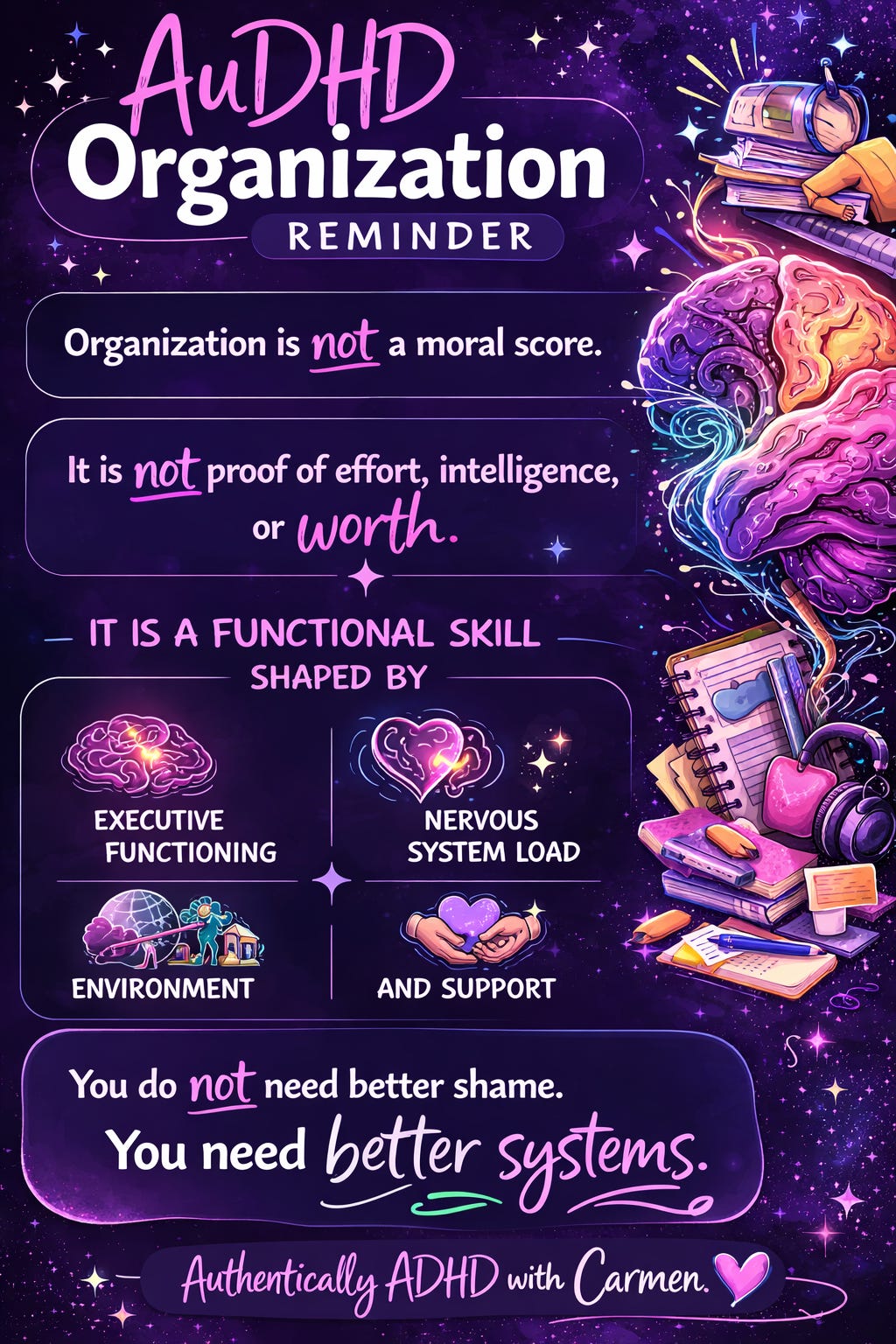
Because organization is not a moral score.
It is not evidence of intelligence.
It is not proof of effort.
It is not a measure of worth.
It is a functional skill set shaped by executive functioning, nervous system load, environment, and support.
So if organization has always felt weirdly hard for you—harder than it “should” be, harder than other people seem to understand—there is probably a reason.
Not an excuse.
A reason.
And reasons matter.
Reasons help us stop building our identity around struggle.
Reasons help us build support instead.
You do not need a prettier planner.
You need systems that respect your brain.
And honestly?
That is a much better place to begin.
