AuDHD & People-Pleasing: When “Being Easy” Costs You Everything
The Neuroscience of Fawning, Masking, and Finally Choosing Yourself

Let’s name the thing: people-pleasing can look like “kindness,” but feel like self-erasure
.
And if you’re AuDHD? People-pleasing often isn’t some cute little habit you picked up from Pinterest culture. It’s a full-body survival strategy—one you learned because the world trained you to believe that being palatable is safer than being real.
AuDHD folks are frequently told (directly or subtly):
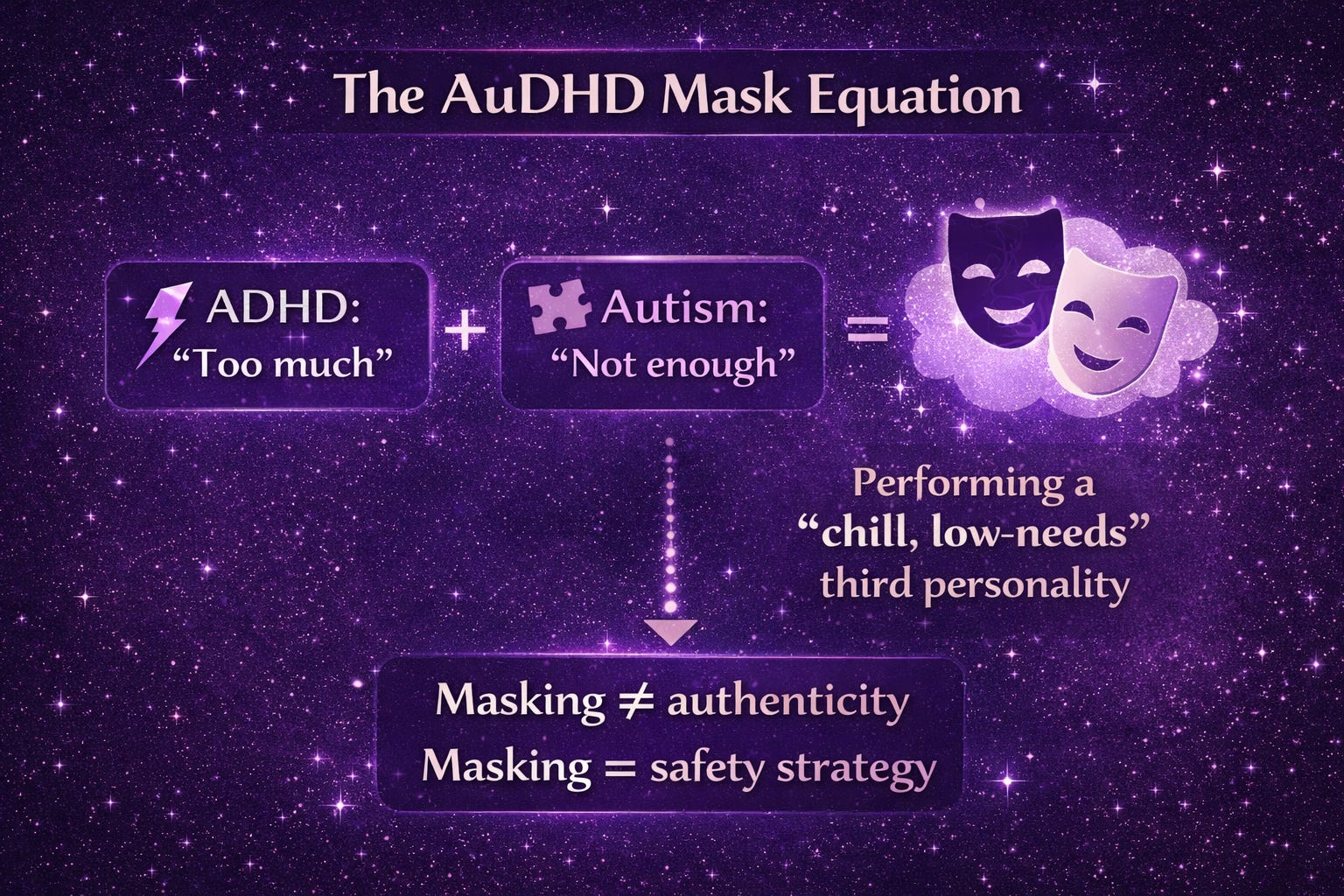
you’re “too much” (ADHD)
you’re “not enough” (autism)
and somehow you should fix both… by performing a magical third personality: the chill, agreeable, low-needs version of you.
That’s not a personality. That’s a mask with a pulse.
What is people-pleasing, really?
People-pleasing is a pattern where you prioritize other people’s comfort, approval, or expectations over your own needs, values, time, body cues, or truth—usually to avoid conflict, rejection, disappointment, or abandonment.
It can look like:
saying yes when your whole nervous system is screaming no
over-explaining (because “no” feels illegal)
scanning faces/tones for danger like it’s your second job
shape-shifting depending on who’s in front of you
doing emotional labor to “keep things smooth”
apologizing for existing in three dimensions
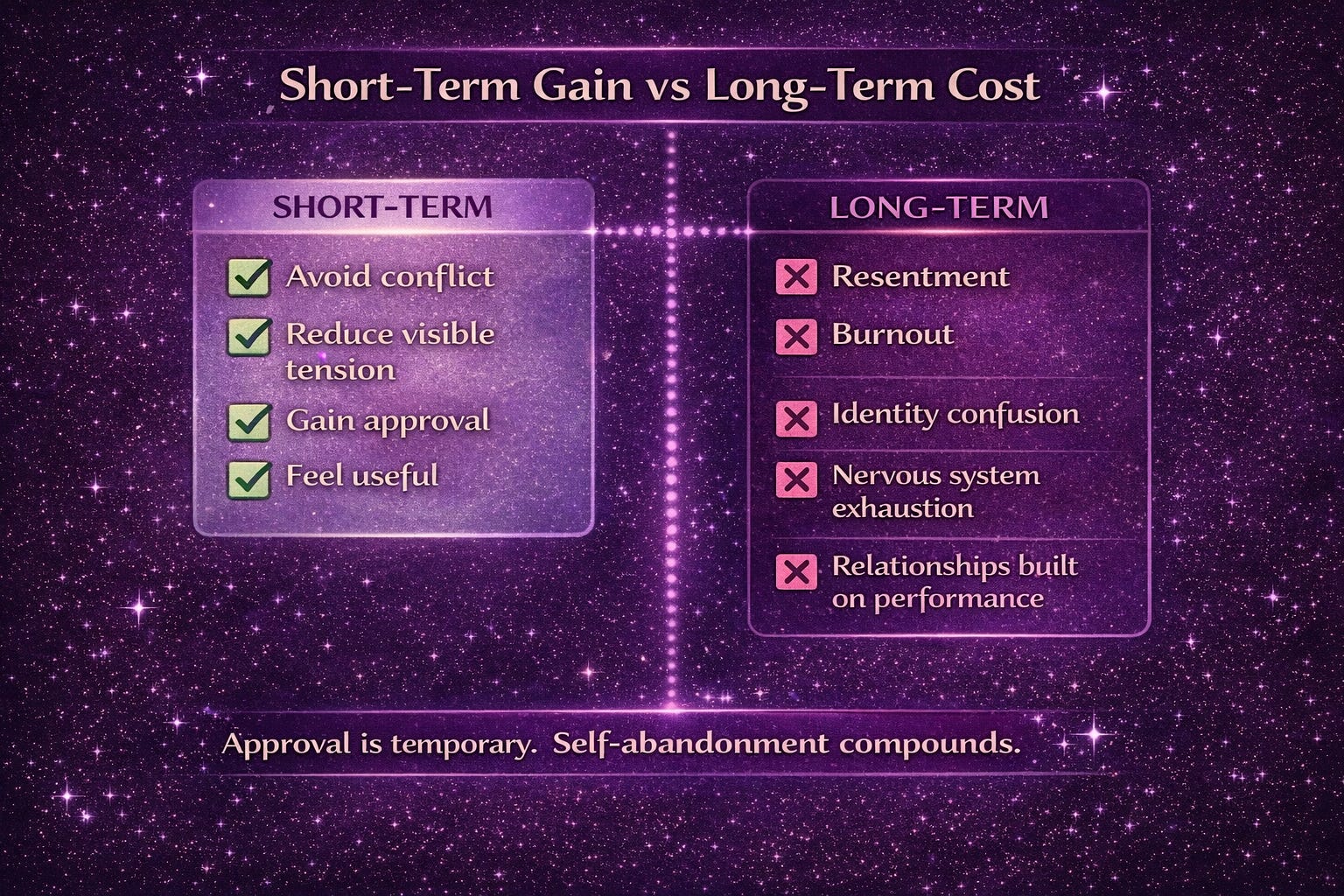
And here’s the brutal twist: people-pleasing works… short-term. It reduces conflict right now. It lowers visible risk right now. It gets you social points right now.
But long-term? It quietly bankrupts you.
Why AuDHD folks are extra vulnerable to people-pleasing
AuDHD is a mashup that can create a very specific trap:
1) Autism: masking as social protection
Autistic camouflaging (masking) is often about hiding traits or performing “acceptable” social behaviors to avoid negative outcomes. Research links higher camouflaging with increased mental health risks (like anxiety and depression).
So if you learned “when I act like myself, people react badly,” then your brain does the math:
Perform = safer.
Authentic = risky.
2) ADHD: emotional dysregulation + rejection sensitivity
Many ADHDers deal with emotional dysregulation—big fast feelings, intense threat signals, and a nervous system that hits “THIS IS AN EMERGENCY” over social cues. A major review describes how ADHD emotion dysregulation involves bottom-up reactivity (amygdala/striatal circuits) and weaker top-down regulation (prefrontal regions).
And then there’s rejection sensitivity / RSD language that a lot of ADHDers resonate with: perceived rejection can feel painful, not just “unpleasant.”
So your system learns:
Make them happy = reduce rejection risk.
Reduce rejection risk = reduce emotional pain.
3) The AuDHD combo: “I can’t read the room… so I try to control the room”
If autism makes social rules feel like a hidden rulebook, and ADHD makes feedback hit like a slap—people-pleasing becomes a control strategy:
If I’m perfectly helpful, nobody can be mad.
If I’m low-maintenance, nobody can leave.
If I’m useful, I’m safe.
That’s not vanity. That’s threat management.
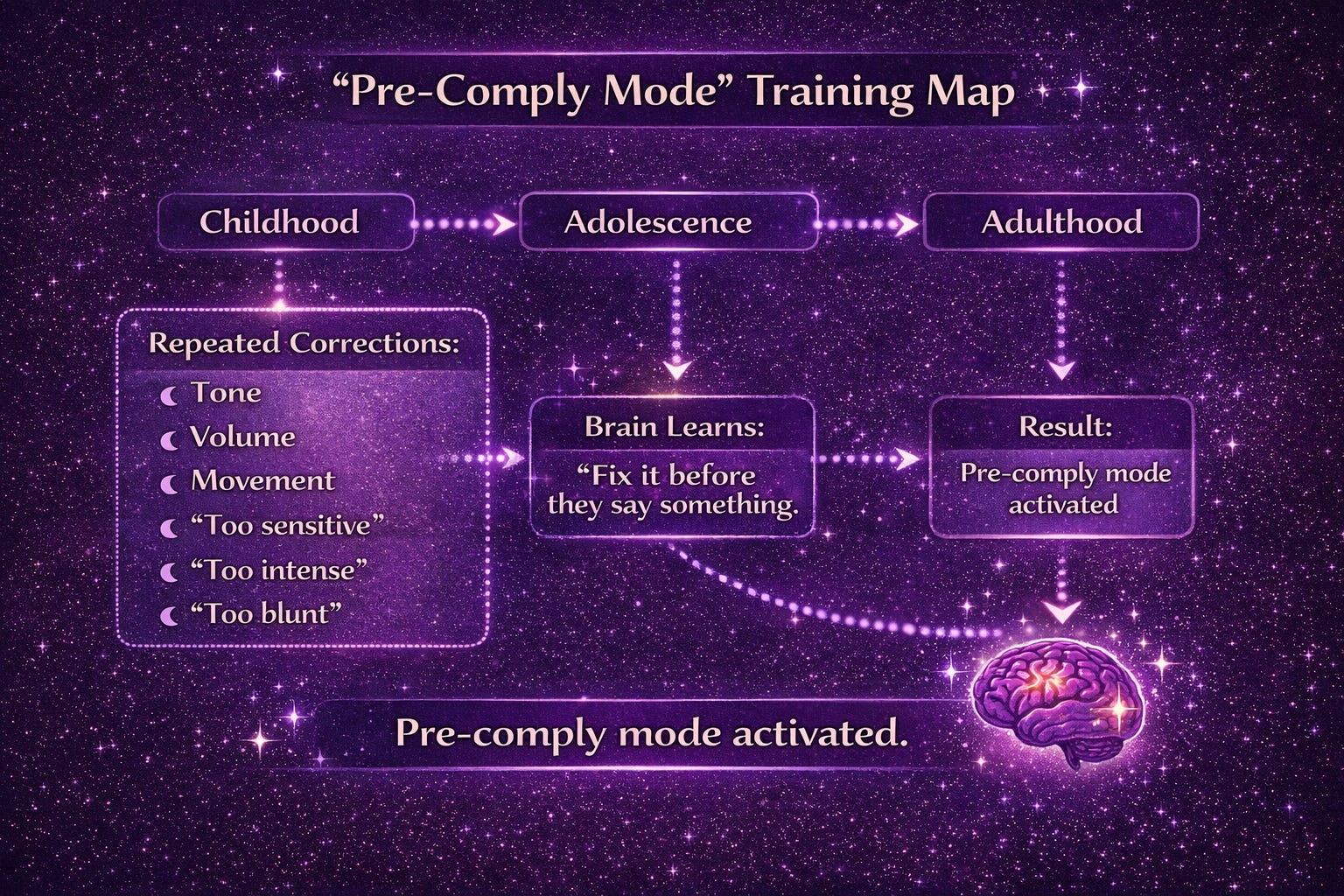
4) Lifelong “corrections” train the brain to pre-comply
A lot of neurodivergent adults grow up being corrected constantly—tone, volume, facial expression, movement, forgetting, interrupting, stimming, sensitivity, intensity, blunt honesty, “attitude,” “dramatic,” “lazy,” “weird.”
After enough “fix yourself” messages, your brain stops waiting for feedback and starts pre-complying.
You don’t just people-please.
You people-predict.
The neuroscience: what’s happening in the AuDHD brain
Here’s the clean, science-y translation without turning you into a biology textbook.
The people-pleasing loop is a threat loop
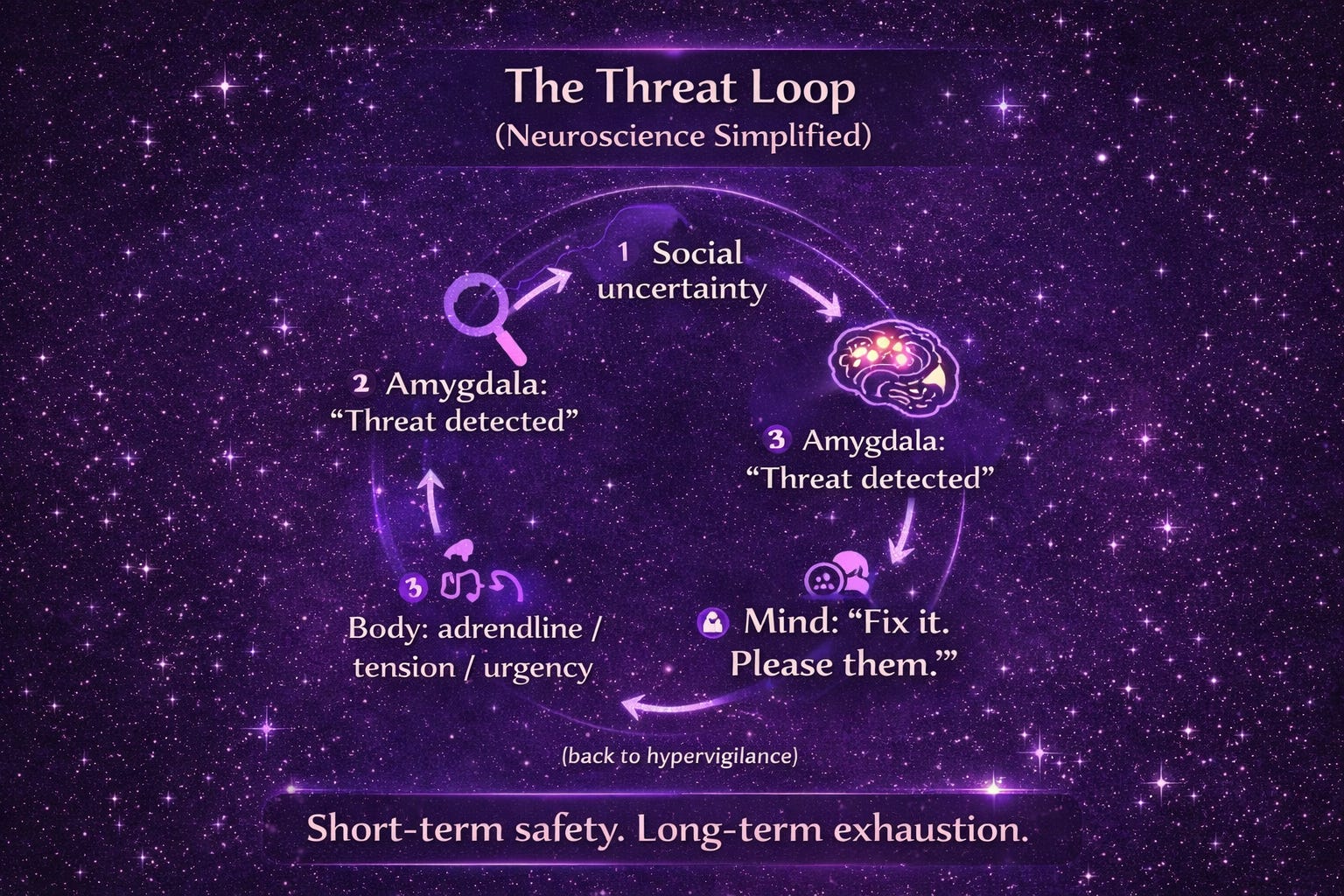
When you anticipate disapproval, your brain can interpret it as danger. ADHD emotion dysregulation research highlights a pattern: emotional signals can surge quickly (bottom-up systems) while regulatory control (top-down prefrontal systems) can lag.
So even mild social uncertainty can trigger:
amygdala: “possible threat detected”
body: adrenaline/cortisol vibes (tense, fast, vigilant)
mind: “Say the right thing. Fix it. Make it okay.”
And if you’re autistic and used to masking, your brain may also recruit high-effort “manual processing” to navigate social interactions—camouflaging can be cognitively costly and linked with distress.
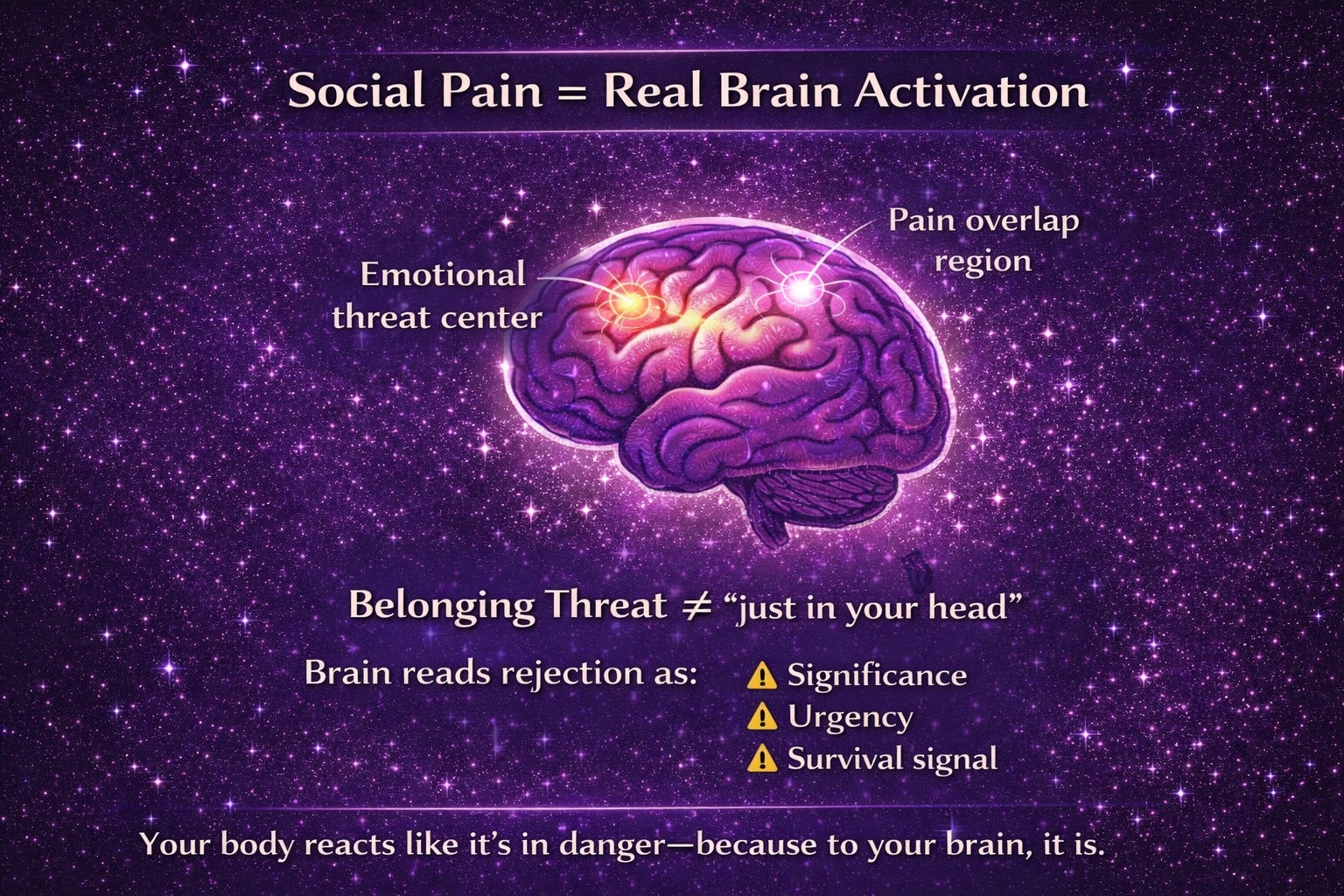
Social pain is real pain-adjacent
Humans are wired for belonging. When belonging feels threatened, the brain treats it as significant—your system mobilizes to repair the connection.
For many ADHDers who resonate with rejection sensitivity, the experience isn’t “I don’t like being disliked.” It’s “my body reacts like I’m in danger.”
Reward circuitry: approval can become dopamine
If praise/approval is one of the more reliable “rewards” you’ve gotten, your brain can chase it like a tiny hit of relief. (Not because you’re shallow—because your nervous system likes predictable safety.)
Rumination: the mind replays what the body felt
Afterward, your brain may loop:
What did they mean by that tone?
Did I talk too much?
Should I apologize?
Should I send a follow-up text?
Should I set myself on fire to keep the vibe warm?
That’s not overthinking. That’s a brain trying to prevent future threat.
People-pleasing vs. being kind: a quick gut-check
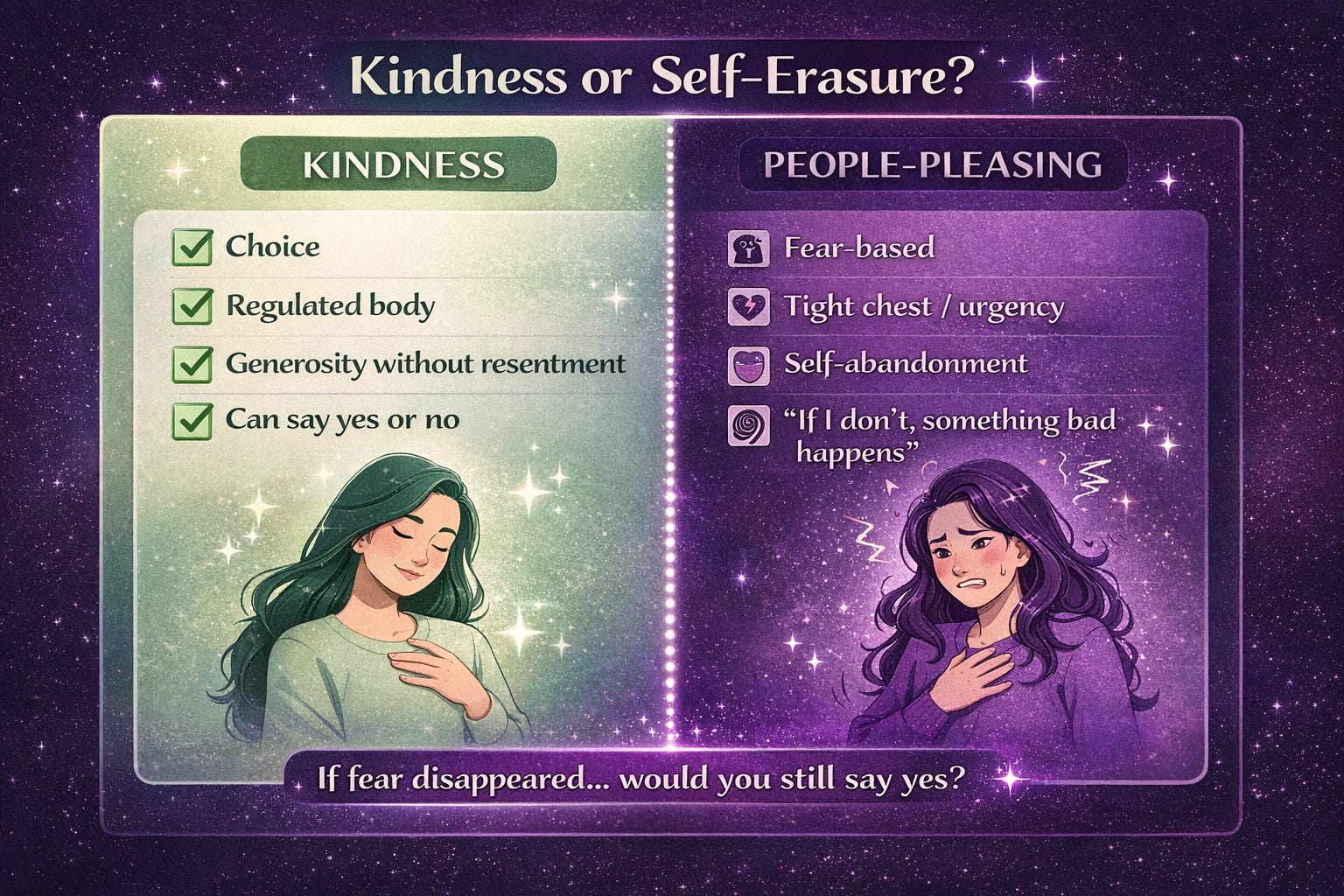
Kindness says: I choose generosity without abandoning myself.
People-pleasing says: I abandon myself to avoid consequences.
Try this litmus test:
If you removed fear from the decision—
would you still say yes?
If the answer is no, that’s not kindness. That’s compliance.
The “fawn” response and AuDHD: when pleasing is self-protection
Some clinicians describe people-pleasing as a form of “appease” behavior—sometimes called a fawn response—especially when it developed in environments where conflict felt unsafe.
Important nuance: not everyone who people-pleases has trauma. But many neurodivergent folks have chronic social threat exposure (bullying, rejection, punishment for traits, unstable feedback, shame-based parenting/teaching). The nervous system doesn’t care what we label it—it learns patterns.
Signs your people-pleasing is running your life (AuDHD edition)
You feel resentful… but also guilty for feeling resentful
You need “permission” to have needs
You can’t find your own opinion until someone else states theirs
You freeze when asked what you want
You over-explain boundaries like you’re defending a court case
You tolerate discomfort until your body forces a shutdown
You’re “easygoing” publicly and falling apart privately
If this is you: you’re not broken. You’re trained.
Tips & Strategies: Recovering from AuDHD People-Pleasing (for real, not in theory)
1) Regulate first. Boundary second.
If your nervous system is activated, you will default to old safety strategies.
Try:
long exhale (make the out-breath longer than the in-breath)
cold water on wrists/face
pressure (weighted blanket, tight hoodie, wall push)
90-second movement reset (shake, walk, stretch)
Then decide.
2) Use the sacred pause script (it’s boring… and that’s the point)
People-pleasing thrives on speed. Boundaries thrive on time.
Steal these:
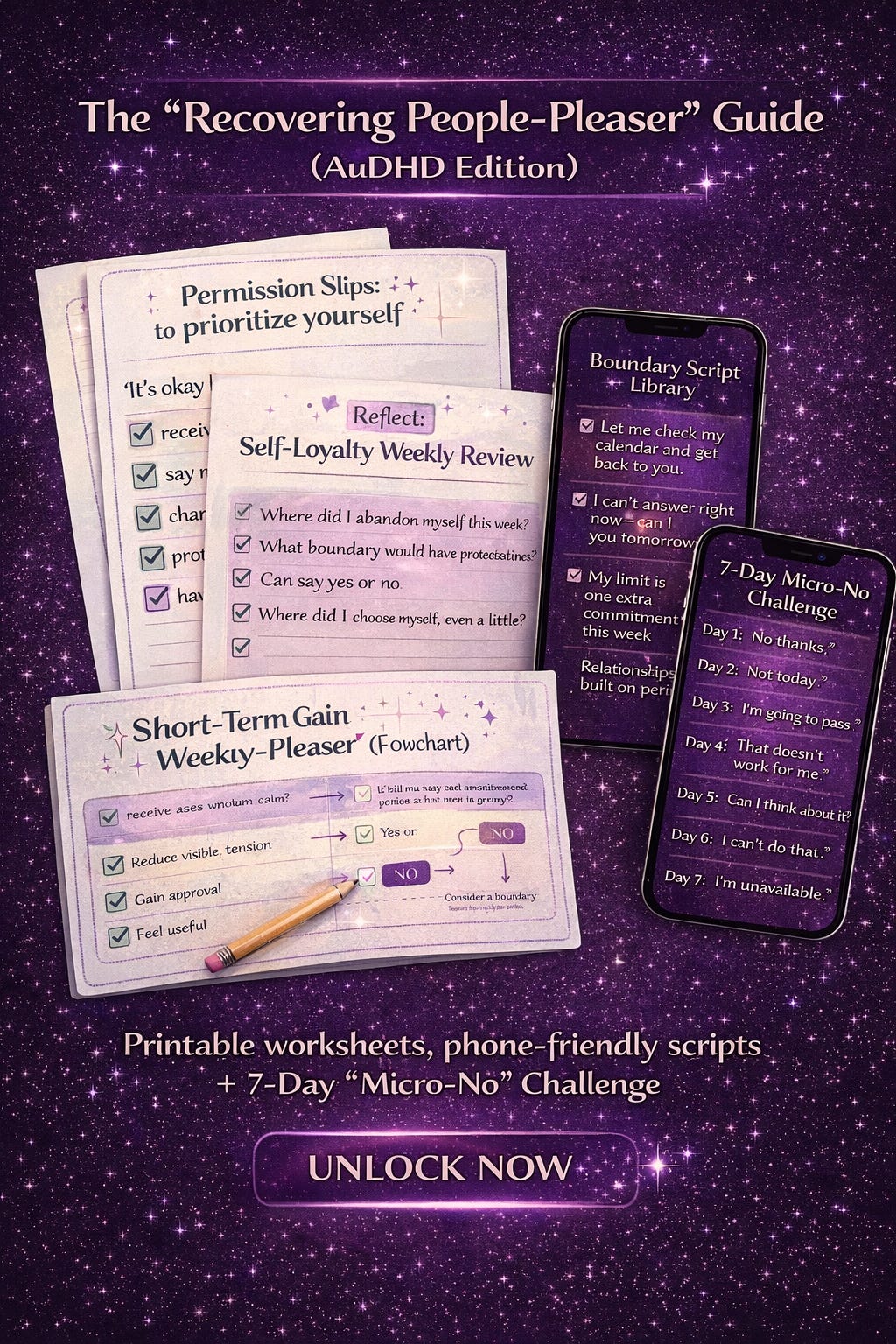
“Let me check my calendar and get back to you.”
“I can’t answer right now—can I tell you tomorrow?”
“I need a minute to think about what I can realistically do.”
3) Replace “No” with “My limit is…”
Sometimes “no” feels like stepping off a cliff. Try a bridge sentence:
“My limit is one extra commitment this week, and it’s already taken.”
“I can do X, but I can’t do Y.”
“I’m not available for that, but here’s what I can offer.”
4) Make boundaries default with decision rules
AuDHD brains do better with policies than constant emotional negotiations.
Examples:
“I don’t commit to plans day-of unless it’s a top priority person.”
“I don’t answer work messages after 6pm.”
“If I feel dread + urgency, I wait 24 hours before agreeing.”
5) Write your “values list” like it’s a menu
People-pleasing blurs your identity. Values sharpen it.
Pick 5 values that are yours (not aspirational, not what looks good on Instagram):
health, peace, honesty, creativity, family, autonomy, stability, faith, learning, play, etc.
Then ask:
Does this yes serve my values—or only their comfort?
6) Practice “micro-no’s” (because cold turkey is a lie)
Start tiny:
“No thanks.” (no explanation)
“Not today.”
“I’m going to pass.”
“That doesn’t work for me.”
Your nervous system needs reps. Like physical therapy… but for self-respect.
7) Expect discomfort. That’s the detox.
When you stop people-pleasing, two things happen:
your body panics (“we’re going to be rejected!”)
your relationships get honest
Some people will adapt.
Some people will reveal they liked you best when you were editable.
Both outcomes are information. Not failure.
Reflection Journal Prompts (AuDHD-friendly, not essay homework)
Pick 3. Do them messy.
Where did I learn that having needs is “too much”?
What does my body feel like right before I people-please? (tight chest, buzzy skin, nausea, urge to explain?)
What am I afraid will happen if I disappoint someone? What’s the actual probability?
Who benefits when I stay small? Who suffers?
What do I resent right now—and what boundary would prevent that resentment?
If I believed I’m worthy even when I’m inconvenient, what would change this week?
What’s one “policy” I want to adopt that protects my energy?
Where am I confusing kindness with self-erasure?
What relationships feel safer when I’m authentic? What relationships feel unsafe?
What would “self-loyalty” look like in one sentence today?
FAQ (because Google loves receipts)
Is people-pleasing common in autistic or ADHD adults?
It’s commonly reported, especially in contexts of masking, rejection sensitivity, and chronic negative feedback. Research on autistic camouflaging links it to mental health strain, suggesting the costs can be significant.
Is people-pleasing the same as masking?
They overlap, but aren’t identical. Masking/camouflaging is often about performing social norms; people-pleasing is specifically about prioritizing others’ approval/comfort—often at your expense. Camouflaging research supports the idea that sustained masking can be costly.
Is “fawning” a real trauma response?
Many clinicians use “fawn” to describe appeasement/people-pleasing as a protective strategy in unsafe relational environments, though terminology varies across frameworks.