
AuDHD & Resentment Build-up
When unmet needs pile up because we didn’t catch the early signs.

Resentment rarely walks in and introduces itself.
It just quietly stacks dishes in the sink of your nervous system until one small spoon clatters… and suddenly you’re “overreacting.”
If you’re AuDHD (Autistic + ADHD), resentment build-up can feel like this:
You didn’t notice you were getting overwhelmed.
You told yourself “it’s fine” a hundred times.
You kept saying yes because conflict feels worse than exhaustion.
Then one tiny thing happens and you’re DONE — with them, with this, with everything.
Let’s unpack what’s actually going on in your brain and body when unmet needs pile up, why early signs are easy to miss in AuDHD nervous systems, what this build-up looks like in real life, and how to catch it sooner — with practical strategies and reflection prompts.
1. What is resentment in an AuDHD nervous system?
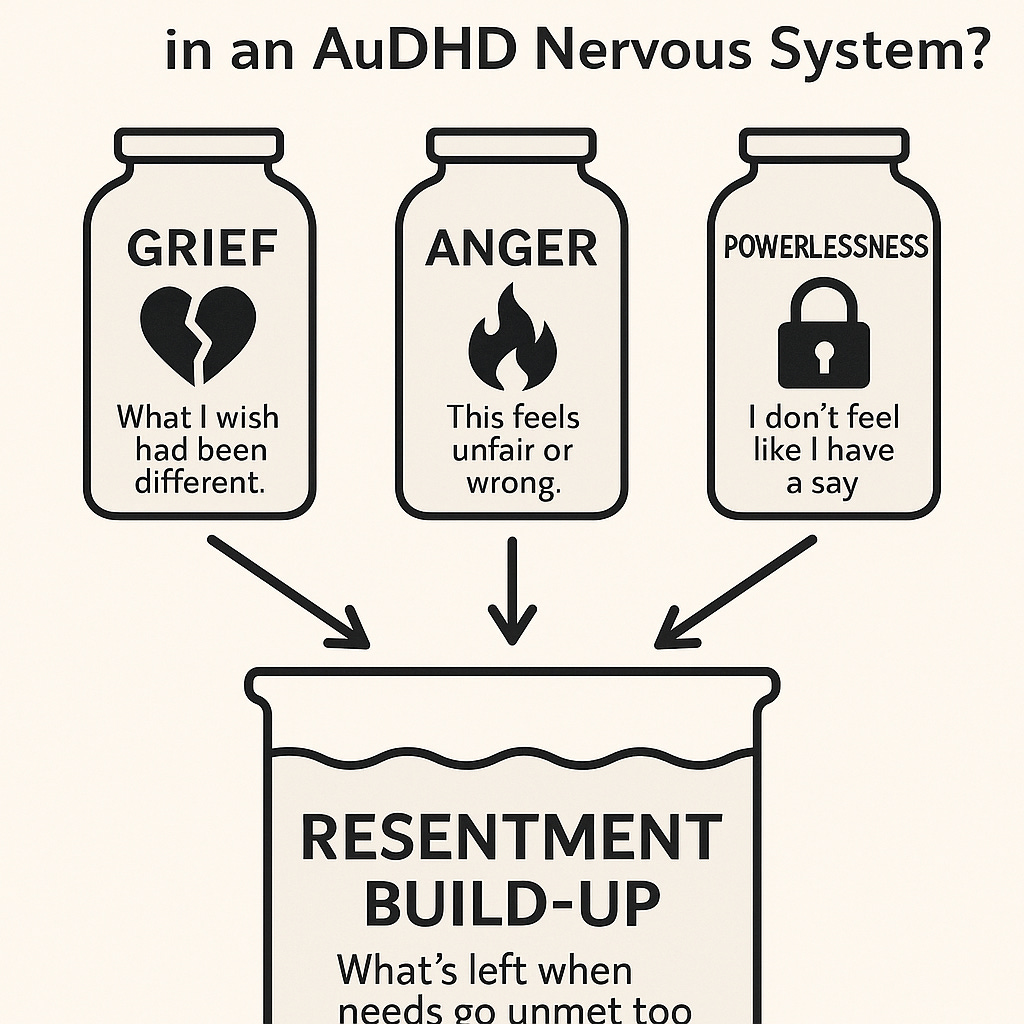
Resentment is basically grief + anger + powerlessness that’s been sitting in storage too long.
It builds when:
Your needs keep getting missed (by others and by you).
You swallow your “no” to stay safe, liked, or low-drama.
Your body is screaming “enough” but your brain can’t locate the exact problem.
You don’t feel like you’re allowed to have limits, so you sacrifice… quietly… repeatedly.
For AuDHD folks, this isn’t just “being touchy.” It’s a wiring + environment combo:
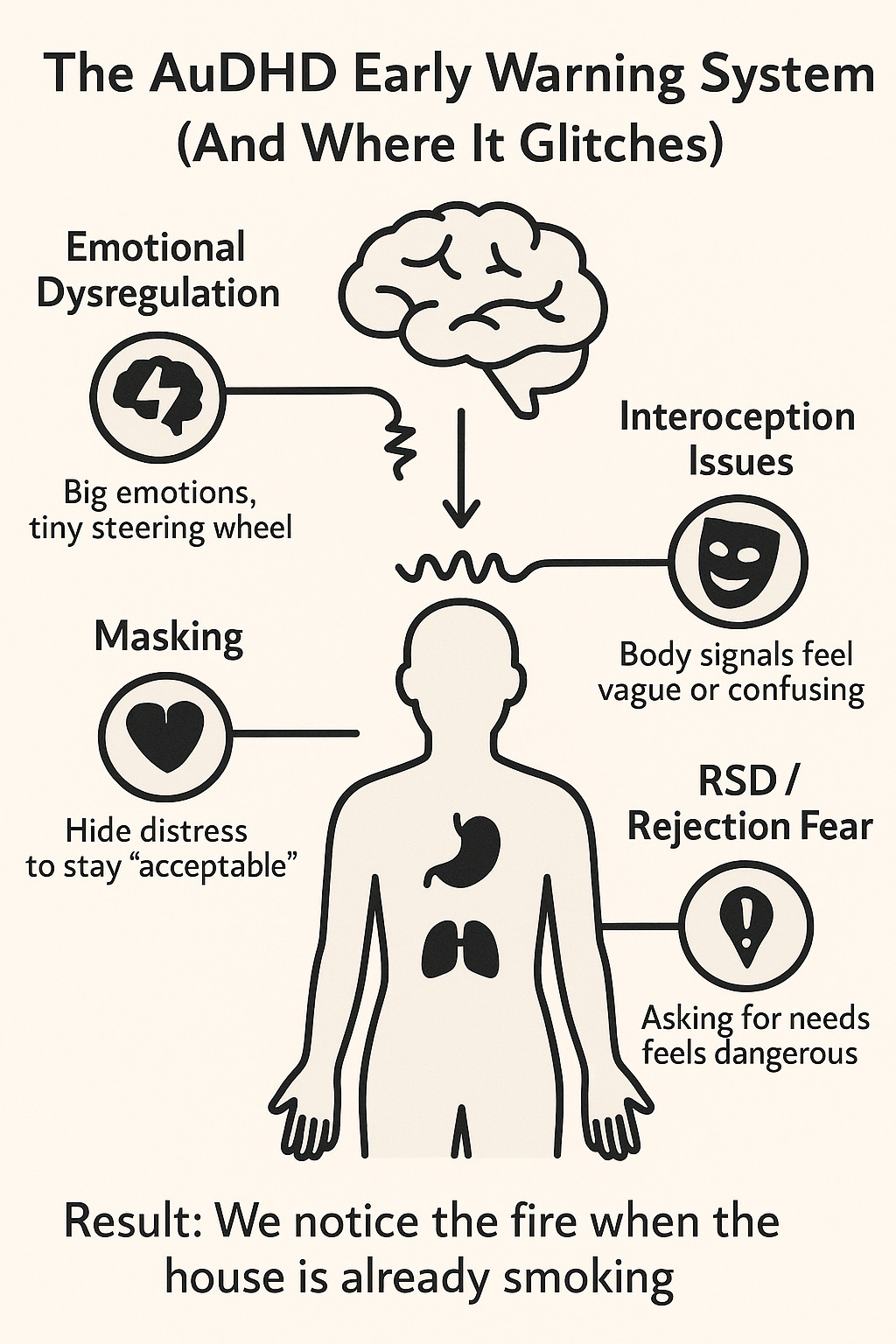
A brain that feels things intensely and struggles to regulate them (ADHD).
A body that often has interoception and alexithymia issues — difficulty noticing and naming internal states and emotions (common in autism).
A lifetime of masking and camouflaging to survive socially, often at the expense of your own needs.
A deep terror of rejection or criticism (RSD-like sensitivity) that makes boundaries feel dangerous.
Resentment is what’s left when your system has been saying “no” in tiny ways and no one — including you — could hear it.
2. Why AuDHD brains miss the early warning signs
You’re not dramatic. You’re not “too sensitive.”
You’re operating with a nervous system that makes early detection genuinely hard.
Let’s zoom in on a few key brain things.
2.1 Emotional dysregulation: big waves, tiny steering wheel
Research is increasingly clear that emotion dysregulation is a core part of ADHD, not a side feature. Brain imaging studies show differences in circuits involving the amygdala (emotion alarm system), ventral striatum (reward/motivation), and orbitofrontal cortex and other prefrontal regions (the “brakes” and decision-maker).
In plain language:
Your emotional alarm (amygdala) goes off quickly and loudly.
Your thinking brain (prefrontal cortex) that should help you name, contextualize, and down-regulate those feelings is less efficient.
When anger or hurt hits, your brain can go into fight/flight mode: the amygdala shouts, the body ramps up, and the prefrontal cortex goes a bit offline.
Result? By the time you consciously realize “I’m resentful,” your system is already in Defcon 2.
2.2 Interoception and alexithymia: “I don’t know what I feel, I just know I can’t anymore”
Interoception = your ability to sense internal body states: hunger, thirst, tension, heart rate, fatigue.
Alexithymia = difficulty identifying and describing feelings.
Both are very common in autistic folks, and research suggests that alexithymia (not autism itself) is often what predicts difficulty recognizing emotions in yourself and others.
What that means for resentment:
Your body may be giving signals: tight jaw, migraine, stomach knots.
Your brain may file it under: “idk, I’m tired/weird/off.”
You miss the moment where you could say: “Hey, this situation hurts and I need something different.”
By the time you understand that something’s wrong, you’re already in burnout territory — not early-warning mode.
2.3 Masking: the long con against your own needs
Masking/camouflaging — working hard to hide your autistic traits and “act normal” — is a survival strategy many autistic adults use.
But the cost? Studies and clinical reports link long-term masking to:
Exhaustion and autistic burnout
Anxiety and depression
Loss of sense of self and increased suicidality in some people
If part of your identity is “the capable one”, “the chill one”, “the flexible one,” your nervous system learns:
“It’s safer to abandon myself than to disappoint someone else.”
That’s a straight shot to resentment, because your authentic needs never even make it to the table.
2.4 RSD & people-pleasing: boundaries feel like rejection grenades
Rejection Sensitive Dysphoria (RSD) isn’t a formal diagnosis, but it’s widely used to describe the intense emotional pain some neurodivergent folks experience at even mild or perceived rejection.
So when you think about:
Saying “no”
Asking for accommodations
Telling someone “hey, that didn’t feel okay”
…your brain doesn’t just imagine “they might be slightly annoyed.” It imagines catastrophic rejection.
So you:
Say yes when you’re already drowning.
Downplay your own hurt: “they didn’t mean it,” “I’m too sensitive,” “it’d be worse to bring it up.”
Take responsibility for other people’s comfort and feelings, but not your own.
Each time you override your needs to avoid possible rejection, your inner resentment meter nudges upward another notch.
2.5 Executive function & time blindness: we can’t pace ourselves
Add in ADHD executive function:
Time blindness
Difficulty estimating capacity
Trouble switching tasks and prioritizing
You overbook, overcommit, and underestimate recovery time.
You say “sure, I can” before your body has even been consulted.
Then — when the bill arrives — you’re resentful at:
The people who asked
The system that demands so much
And yourself, for “doing this again”
But none of this is a moral failing. It’s the predictable outcome of the way your brain, body, and history collide.
3. What resentment build-up actually looks like in AuDHD life
Resentment doesn’t always look like obvious anger. Often, it’s sneaky.
3.1 The “sudden” blow-up
From the outside:
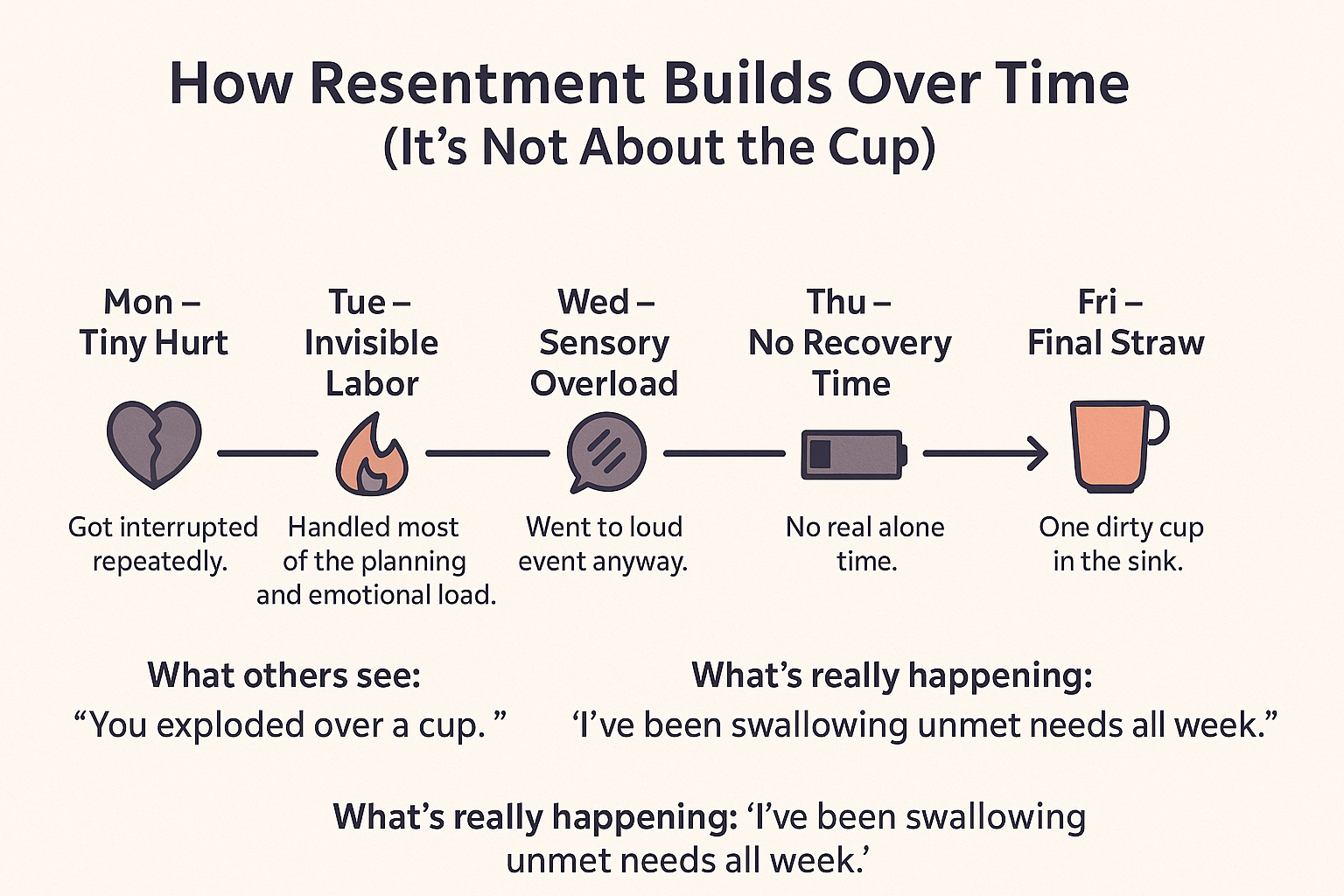
You’re “fine” all week, then lose it because your partner left one cup in the sink.
From the inside:
Monday: They spoke over you. You let it go.
Tuesday: You did 90% of the emotional labor for that family situation.
Wednesday: Your sensory system was fried but you went to the noisy event anyway.
Thursday: You got no real alone time.
Friday: One cup in the sink = final straw.
The resentment isn’t about the cup. It’s about the pattern — and the fact that your body has been overdrawn for days.
3.2 The frozen shutdown
For some AuDHD folks, resentment doesn’t show as yelling; it shows as disappearing.
Ignoring texts or emails
Cancelling plans indefinitely
Going emotionally flat around certain people
Avoiding tasks that remind you of the situation
It looks like apathy, but it’s really: “I’m so hurt and depleted that I can’t engage without falling apart.”
3.3 Quiet contempt toward yourself
Resentment can also aim inward:
“Why do I always let people treat me like this?”
“Everyone else seems fine — I must be broken.”
“I’m pathetic for needing so much.”
This self-directed resentment is often born from years of invalidation — where other people dismissed your needs, so you learned to do it first.
3.4 Micro-behaviors that say “I’m done”
Watch for these signals:
Joking-but-not-joking sarcasm that keeps circling the same wound.
Fantasizing about quitting everything and starting over in a cabin in the woods.
Feeling irrationally annoyed by someone’s basic existence.
Losing all motivation to help or collaborate in spaces where you used to over-function.
These are often late-stage signs of resentment, not early ones.
4. How unmet needs pile up: the “slow leak” model
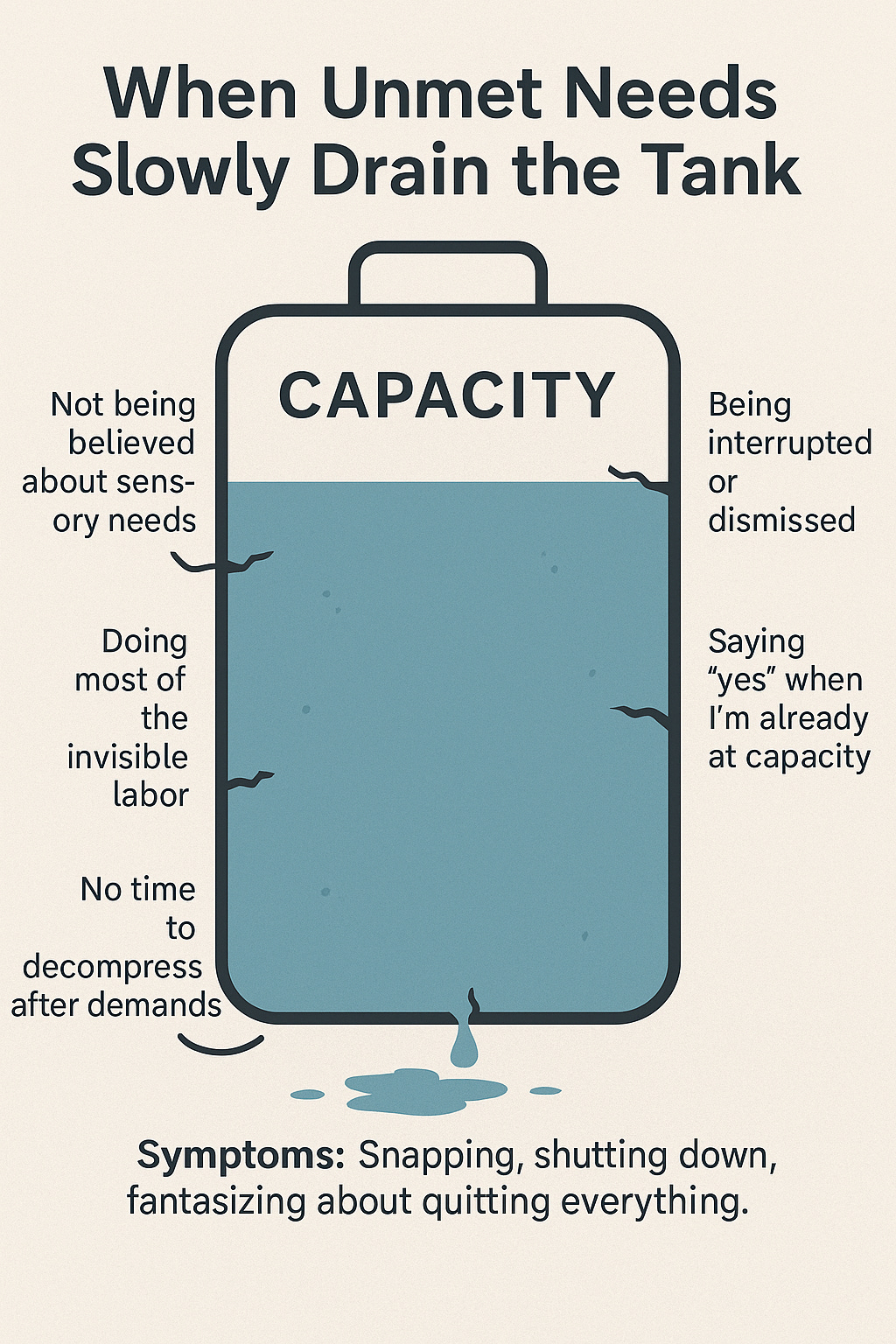
Think of your system as having a capacity tank. Each unmet need is like a tiny leak:
Not being believed about sensory discomfort → leak
Doing most of the invisible labor at home/work → leak
Being interrupted every time you speak → leak
Having your boundaries rolled over “as a joke” → leak
Forcing yourself through social events with no decompression time → leak
Because interoception and emotional clarity are wobbly, you may not notice how low the tank is until:
You snap
You shut down
You fantasize about burning your entire life to the ground
The goal isn’t “never feel resentment again” (that would be weird, honestly).
The goal is to notice the leak earlier, plug it faster, and repair what you can with less self-abandonment.
5. Strategies: How to catch resentment sooner & respond with care
We’re going practical now. These are not “just be more mindful” vibes — these are structured, AuDHD-friendly moves.
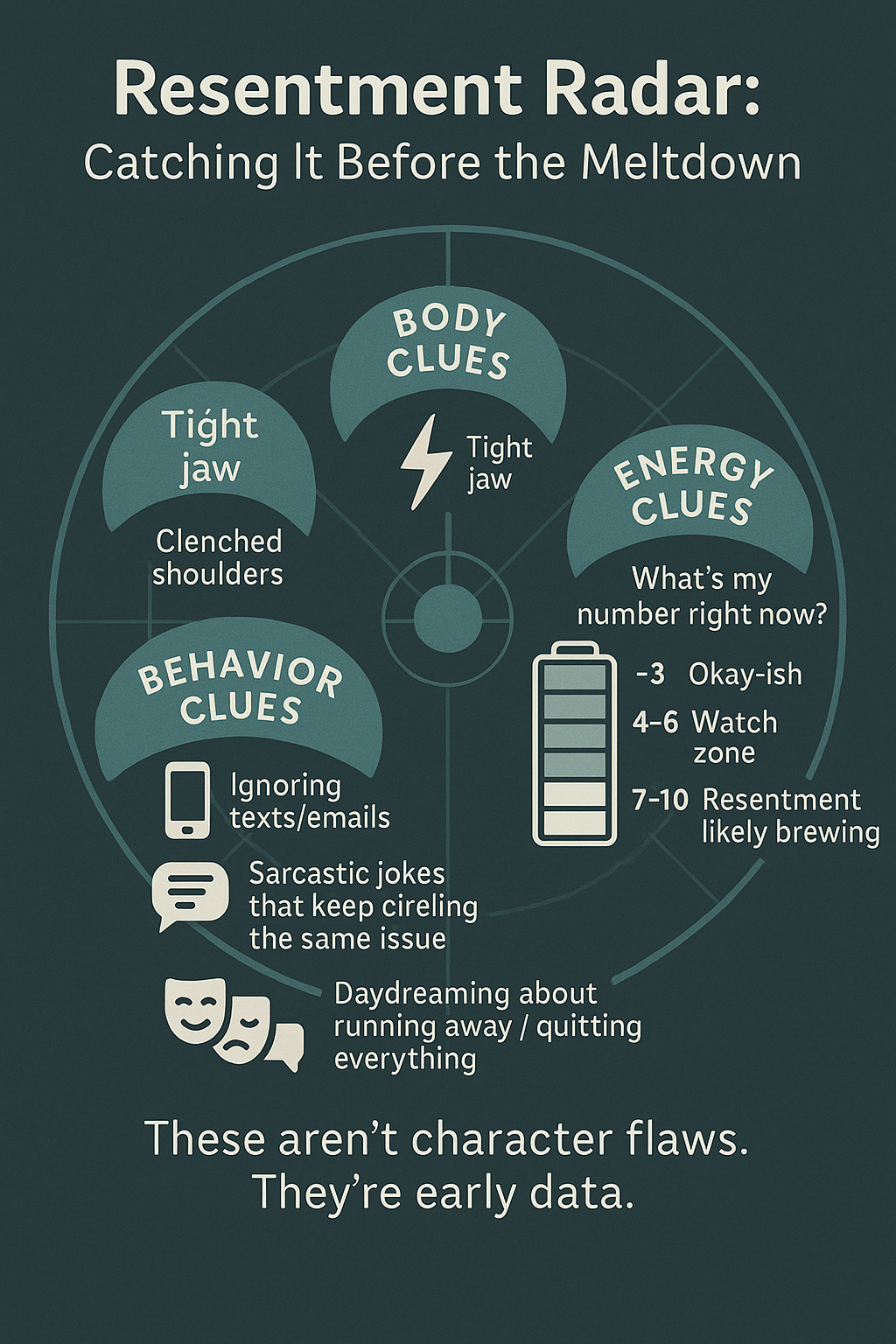
5.1 Build a “resentment radar” using your body
Because your interoception might be blurry, make it simple and visual.
Create a quick daily check-in (2–3x/day):
Ask yourself:
Body: Where am I tense or uncomfortable? Jaw, shoulders, chest, stomach, head?
Energy: On a 0–10 scale, how cooked am I? (0 = fresh-ish, 10 = toast)
Emotion: If I had to guess, what am I feeling? (Pick from a short list: mad, sad, scared, overwhelmed, numb.)
Write it in your notes app or a sticky.
You’re training your brain to see the build-up while it’s still a simmer, not just at boil.
5.2 Translate resentment into needs
Resentment is usually a neon sign for:
“I needed something and didn’t get it.”
Try this sentence stem:
“I feel resentful because I needed ______ and instead I got ______.”
Examples:
“I feel resentful because I needed support and instead I got criticism.”
“I feel resentful because I needed quiet and instead I got constant demands.”
“I feel resentful because I needed to be asked, and instead I was assumed.”
Then ask: Can any part of that need still be met now? Even 10%?
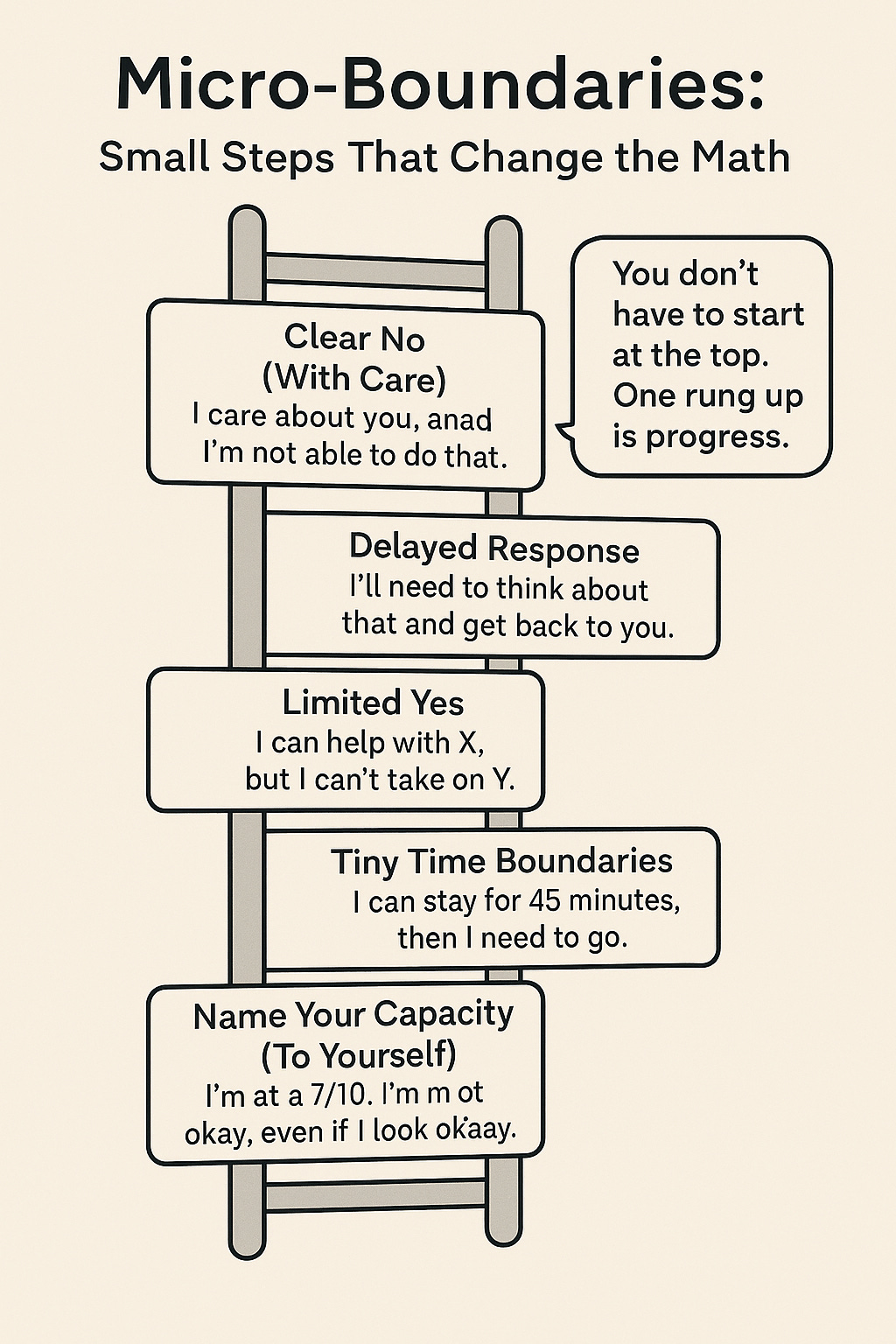
5.3 Practice micro-boundaries, not all-or-nothing ones
If full-on confrontations trigger your RSD, shrink the boundary.
Instead of:
“I can’t do this at all.”
Try:
“I can’t stay the whole time, but I can come for an hour.”
“I can reply tomorrow, I’m at capacity tonight.”
“I can help with X, but I can’t also do Y.”
Small boundaries still change the math on resentment.
5.4 Pre-plan scripts for hard moments
In fight/flight, words vanish. So write them now, while you’re relatively regulated.
Some options:
“I’m noticing I’m getting overwhelmed. Can we pause and come back to this?”
“I want to stay connected, but this pattern isn’t working for me.”
“I need some time to think about what I need here. Let’s revisit later.”
“I care about you, and I also need [quiet / a break / fewer surprises].”
You can store these in your phone under “Scripts” for easy access.
5.5 Design resentment-reducing routines
Not sexy, but wildly effective.
Examples:
A non-negotiable decompression block after social or work-heavy days (15–60 minutes of alone time, sensory reset, no demands).
Weekly “capacity check” where you look ahead and remove at least one thing.
Agreements with partners/family: “If I say ‘I’m at 8/10’, that means I need you to handle X without debate.”
You’re not being dramatic; you’re running preventative maintenance on a sensitive system.
5.6 Let yourself unmask a bit where it’s safe
Full unmasking may not be possible everywhere. But notice places where you could be 5% more honest:
Saying, “I’m overloaded and probably a bit snappy; it’s not about you.”
Admitting, “Crowded places really drain me; can we meet somewhere quieter?”
Telling a trusted friend, “I struggle to notice my limits until I’m past them. I’m working on it.”
Each small act of honesty reduces the gap between your real needs and your performed self — and that gap is where resentment thrives.
5.7 Support for the deep layers
Sometimes resentment is tangled with:
Trauma
Chronic invalidation
Abusive dynamics
Workplaces or families that genuinely don’t respect boundaries
This is where therapy or coaching with someone who understands ADHD + autism can help you:
Untangle what’s “me” vs “the system I’m in”
Build safer exits, choices, and coping strategies
Explore anger and grief without shame
You’re allowed to need help. You were never meant to rewire a lifetime of self-abandonment alone.
6. Reflection journal prompts: Making space for anger, grief, and needs
You do not have to answer all of these. Skim them, let one land, and start there. Screenshots, sticky notes, typed brain-dumps — whatever works for your AuDHD brain.
Past & patterns
When I think about resentment, who or what comes to mind first — and what is the oldest memory that feels connected to that?
As a kid, what happened when I said “no” or “I don’t like this”? What did I learn about boundaries from that?
Where did I learn that my needs were “too much,” “selfish,” or “dramatic”? Whose voice does that sound like?
Body & early signs
What are three physical signs that I’m edging toward burnout or resentment (even if I used to ignore them)?
If my body could speak in full sentences right now, what would it say about how I’ve been living?
Where in my day do I most often override my body’s signals? (Bathroom breaks, hunger, fatigue, sensory overload, etc.)
Relationships & roles
In which relationships do I feel most like “the responsible one” or “the flexible one,” and how does that affect my resentment levels?
What am I doing for others that no one asked me to do, but I feel like I “have to” to keep the peace?
Where am I quietly keeping score because I don’t feel safe asking for reciprocity out loud?
Boundaries & safety
If saying “no” felt completely safe, what is one thing I would change this month?
What’s one micro-boundary I could try this week that feels slightly uncomfortable but not terrifying?
How do I want people to respond when I say I’m at capacity? (Even if I’ve never said that out loud before.)
Self-compassion & repair
What would I say to a friend who felt as resentful and exhausted as I do right now? What would I never blame them for?
What apologies do I owe myself for the ways I’ve ignored or minimized my own needs to survive?
If resentment is a messenger, not a villain, what message might it be trying to deliver to me today?
Final note: You’re not broken for reaching your limit
Resentment is not proof that you’re ungrateful, dramatic, or bad at relationships.
It’s evidence that:
Your nervous system has been working overtime.
Your needs have been under-acknowledged — sometimes by others, often by necessity, and almost always by conditioning.
You are finally close enough to your truth that your body refuses to keep pretending.
You’re allowed to feel angry.
You’re allowed to grieve what you didn’t get.
You’re allowed to build a life where your needs are not the last ones considered.