
💭 AuDHD and Task-Intimacy Avoidance: When Doing the Thing Feels Too Vulnerable

There’s a peculiar paralysis many AuDHD adults describe:
You want to do the thing. You care deeply. You even think about it constantly.
And yet… you can’t start. Or worse—you start, get halfway through, and suddenly can’t bear to finish.
From the outside, it looks like procrastination.
But internally? It’s often something far more intimate: Task-Intimacy Avoidance — the invisible emotional friction between effort, identity, and vulnerability that makes certain tasks feel like too much of you is on the line.
What Is Task-Intimacy Avoidance?
Task-intimacy avoidance describes the emotional resistance that arises not because a task is hard, but because it matters.
It’s the paradox of caring too much — where finishing the task means exposing yourself to judgment, loss of interest, or potential failure.
For AuDHD (Autistic + ADHD) adults, this phenomenon hits with special intensity.
Autistic wiring brings deep emotional and sensory processing — every experience feels felt.
ADHD wiring adds emotional impulsivity, novelty-seeking, and vulnerability to rejection.
Together, they create an emotional equation that looks something like this:
High emotional investment × low dopamine regulation × fear of evaluation = paralysis.
You’re not avoiding the task. You’re avoiding the feelings that doing the task will unleash.
The Neuroscience Behind the Freeze
🧠 The Limbic Hijack
The limbic system — the brain’s emotional alarm system — is hyperactive in both ADHD and autism. When a task feels emotionally loaded (creative work, communication, paperwork tied to identity or worth), the amygdala fires signals of threat rather than opportunity.
This triggers task-related anxiety, even when there’s no “real” danger.
For AuDHD adults, sensory sensitivity and emotional depth amplify this. A simple email might activate the same circuits as public speaking — it’s felt as exposure.
🔋 The Dopamine Drought
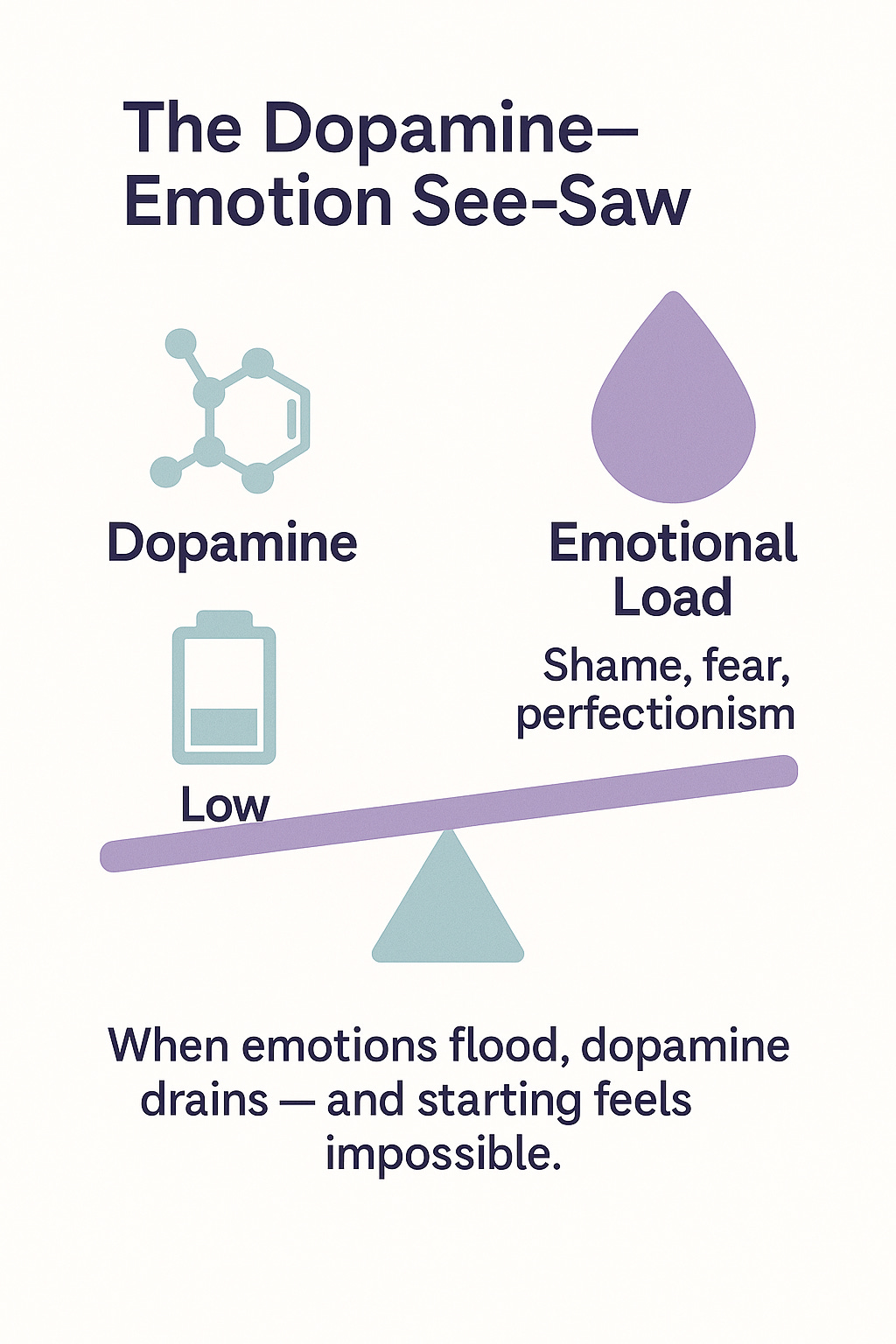
ADHD brains rely heavily on dopamine for motivation. Tasks that are emotionally vulnerable but offer delayed or uncertain rewards (like sending a job application or publishing artwork) trigger dopamine scarcity.
Without that anticipatory hit of dopamine, starting feels like dragging yourself through mud.
Autistic rigidity compounds it: once the emotional discomfort sets in, it’s hard to “switch gears” or “just do it.” The brain clings to safety through inaction.
💡 The Default Mode Network (DMN)
The DMN — active when the mind wanders or reflects — is overconnected in ADHD and underinhibited in autism. This means self-evaluative thoughts (“what if this isn’t good enough?”) echo louder and longer.
When your DMN runs the show, self-doubt becomes a background hum, and every unfinished task feels like a referendum on your worth.
How Emotions Intertwine with Task Avoidance
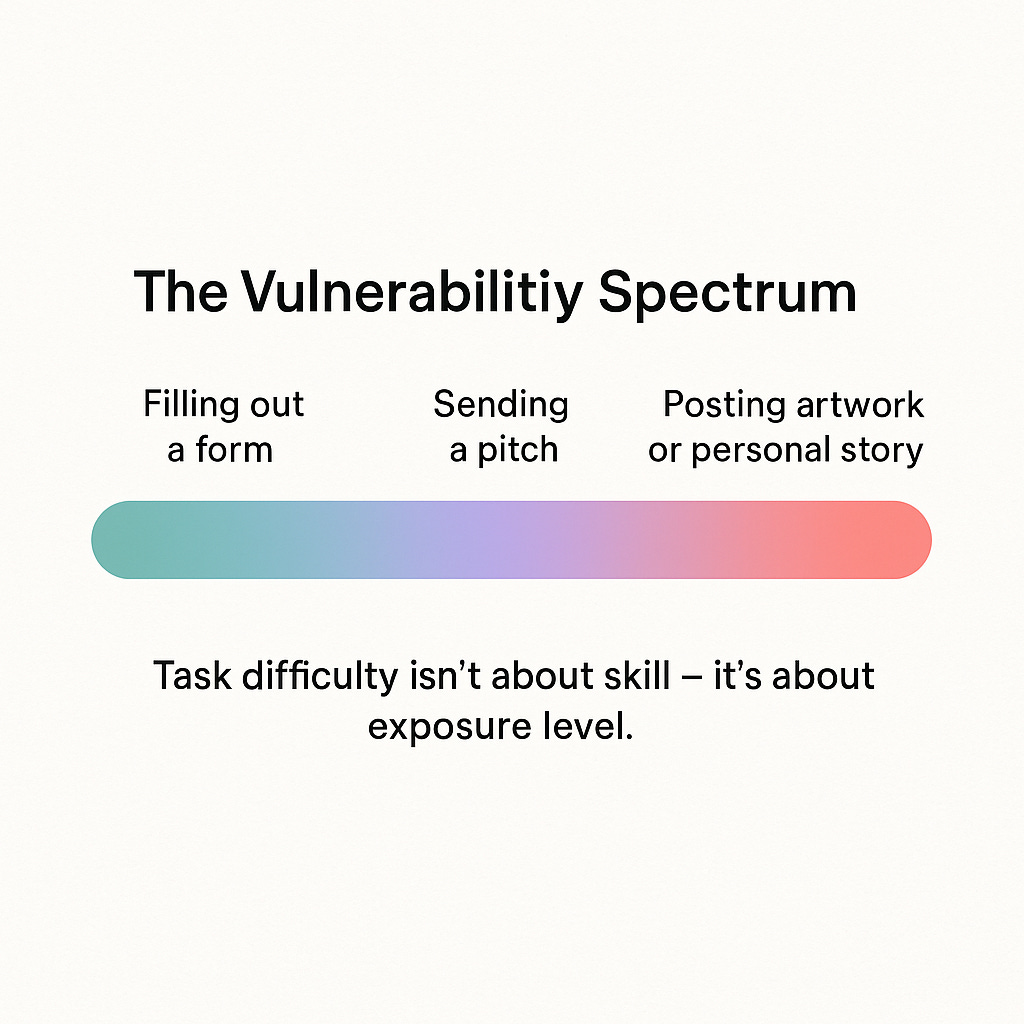
Task-intimacy avoidance isn’t about discipline; it’s about emotional exposure.
Every task holds emotional data: self-worth, rejection history, perfectionism, sensory overwhelm, or past failure. For AuDHD adults, who feel emotions deeply but process them slowly, these associations can flood the nervous system.
Common emotional undercurrents include:
Fear of Evaluation: “If I finish it, people can judge it — and me.”
Anticipatory Shame: “I’ll probably mess it up anyway.”
Attachment Sensitivity: “What if completing this means it’s over?”
Loss of Interest as Grief: “If I finish, I lose the excitement.”
Masking Fatigue: “Doing this means performing neurotypical again.”
Each emotional thread tugs at dopamine regulation, memory recall, and task-switching — turning what should be a simple “start and finish” into an existential debate.
4. The Dopamine–Emotion Loop
Here’s where it gets cyclical:
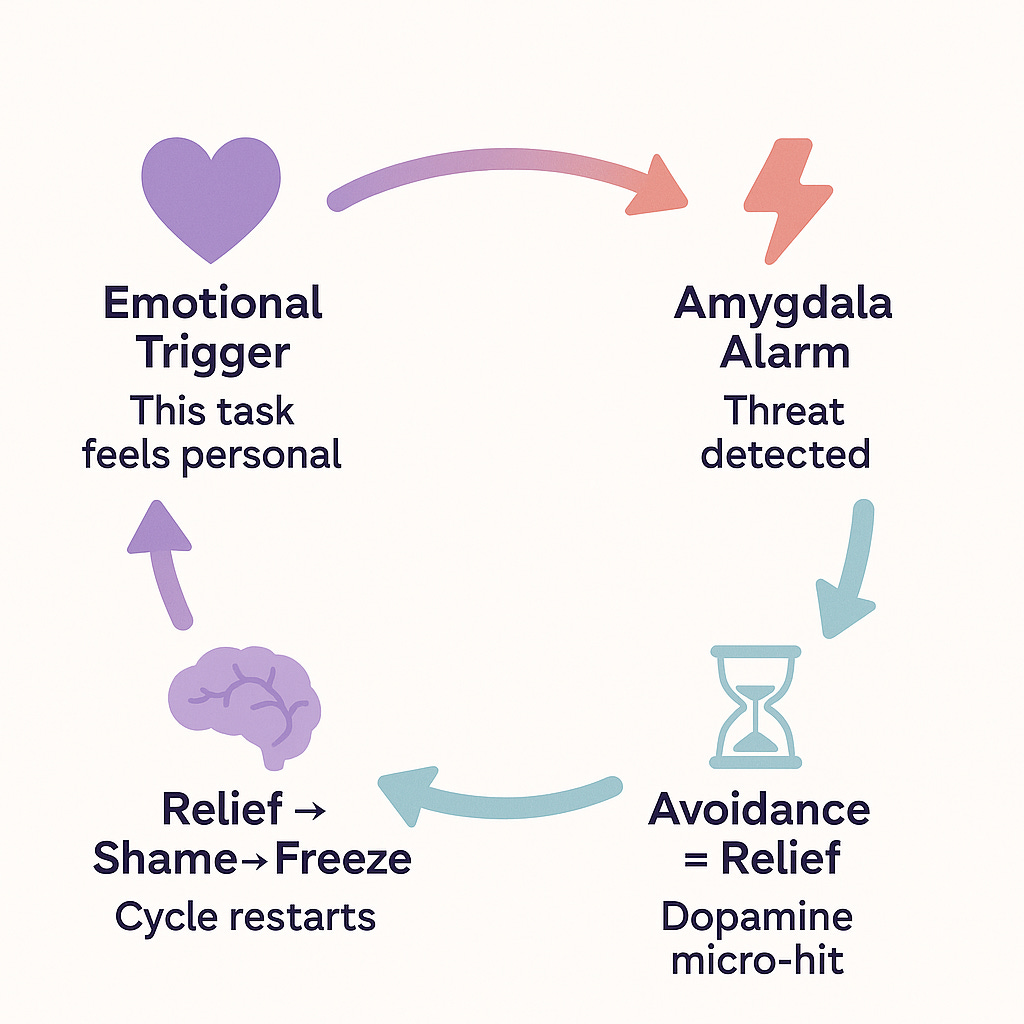
Anticipate task → emotional threat response.
Amygdala activates → stress hormones spike.
Cortisol suppresses dopamine → motivation tanks.
Avoidance brings relief → short-term dopamine reward.
Relief reinforces the avoidance pattern.
Your brain essentially says, “Avoidance = safety = reward.”
This neurochemical pattern builds the illusion of control while deepening shame and paralysis.
Breaking the Loop: Practical Strategies
🌿 1. Name the Emotional Layer
When you feel that familiar resistance, pause and ask:
“What feeling am I avoiding right now — not what task?”
Naming it activates the prefrontal cortex, quieting the amygdala’s threat response.
🔄 2. Create Emotional Separation
Use externalization: write, voice-note, or visualize the task as a separate entity.
Instead of “I need to write this email,” try “The email needs to be written.”
That small linguistic shift reduces self-attachment and reactivates problem-solving circuits.
⚙️ 3. Micro-Start Rituals
For ADHD brains, momentum breeds motivation.
Set up a ritual that primes dopamine before the task: a timer, song, scent, or small movement.
The goal isn’t “finish,” it’s “begin the beginning.”
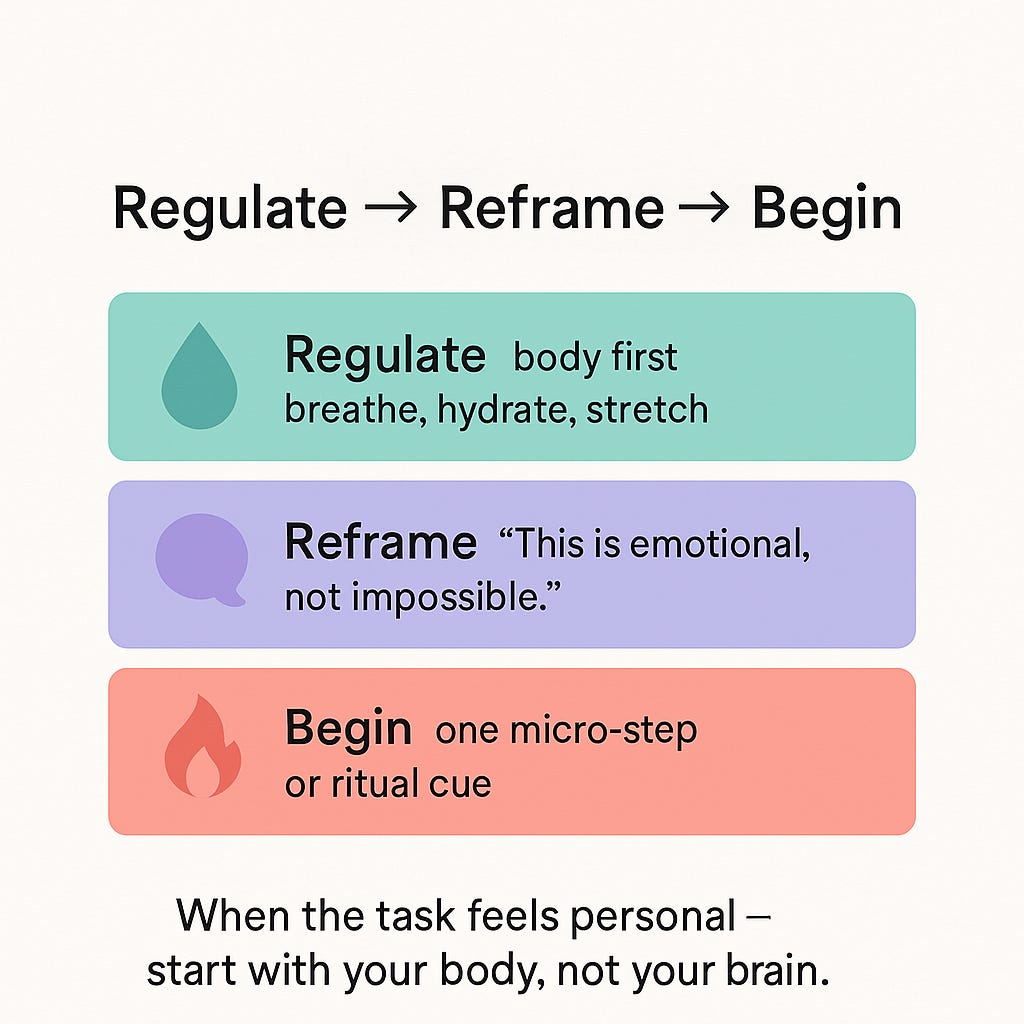
💬 4. Use Body-Based Regulation
Autistic nervous systems need body-first calm before cognitive effort.
Regulate first: deep pressure, movement, weighted blanket, warm drink, grounding breath.
Once the body feels safe, the mind follows.
💜 5. Redefine “Done”
Completion doesn’t have to mean perfection — it means release.
Set an intentional “good enough” boundary to prevent emotional spirals.
Sometimes 80% finished is 100% brave.
Reflection Journal Prompts
Use these to explore your own patterns gently — no pressure to fix, just observe:
When I avoid a task, what emotion am I actually protecting myself from?
Which types of tasks feel the most “intimate” or exposing to me — and why?
What does my body feel like when I want to start but can’t? Where do I feel it?
How does completion feel emotionally — relief, sadness, fear, emptiness?
If my brain were trying to keep me safe, what would it be protecting me from?
What gentle signal could I use to tell my brain, “We’re safe to begin”?
The Heart of It All
For AuDHD adults, task-intimacy avoidance isn’t laziness — it’s emotional armor.
It’s the nervous system saying: “This matters too much to risk.”
But each small act of gentle engagement — a breath, a micro-start, a self-compassionate reframe — rewires that loop. You teach your brain that safety and action can coexist.
The goal isn’t to become fearless; it’s to become curious about the fear.
Because sometimes, the hardest part of doing the thing isn’t the doing — it’s daring to be seen through it.