AuDHD & Why Does My AuDHD Brain Treat Bedtime Like a Threat?
Sleep, revenge procrastination, autistic anxiety, ADHD clocks, and the nightly circus nobody asked for

There is a special kind of betrayal that happens when you are exhausted all day, fantasizing about sleep like it is a luxury vacation, and then the second bedtime arrives your brain goes:
Actually, what if we reorganized our trauma, watched six videos about cult documentaries, remembered one embarrassing thing from 2011, and became emotionally invested in whether we own enough matching socks?

Because apparently my nervous system thinks bedtime is not for rest. Bedtime is for launching a congressional investigation into my entire existence.
And for a lot of AuDHD people, sleep is not as simple as “just go to bed earlier.”
Thank you, Karen. Revolutionary. Has science considered putting that on a mug?
The truth is: many autistic and ADHD brains struggle with sleep because our bodies, brains, sensory systems, circadian rhythms, anxiety loops, and dopamine needs are all trying to run the night shift at once. ADHD is strongly linked with sleep difficulties, including delayed sleep timing, insomnia, restless legs, sleep apnea, and medication-related sleep disruption. Autistic people also experience very high rates of sleep problems, with research showing sleep difficulties can affect a huge portion of autistic individuals.
This is not laziness.
This is not immaturity.
This is not you “not caring enough” about tomorrow.
This is your nervous system standing in the doorway at 11:47 p.m. whispering, “But did we ever get to be a person today?”
Name the Pattern
The pattern is this:
AuDHD sleep struggles often come from a collision between delayed body clocks, under-regulated attention, sensory sensitivity, anxiety, unmet autonomy, and a brain that does not transition gently unless bribed, tricked, or lovingly escorted.
In plain human language?
Your brain may be tired, but it is not necessarily sleepy.
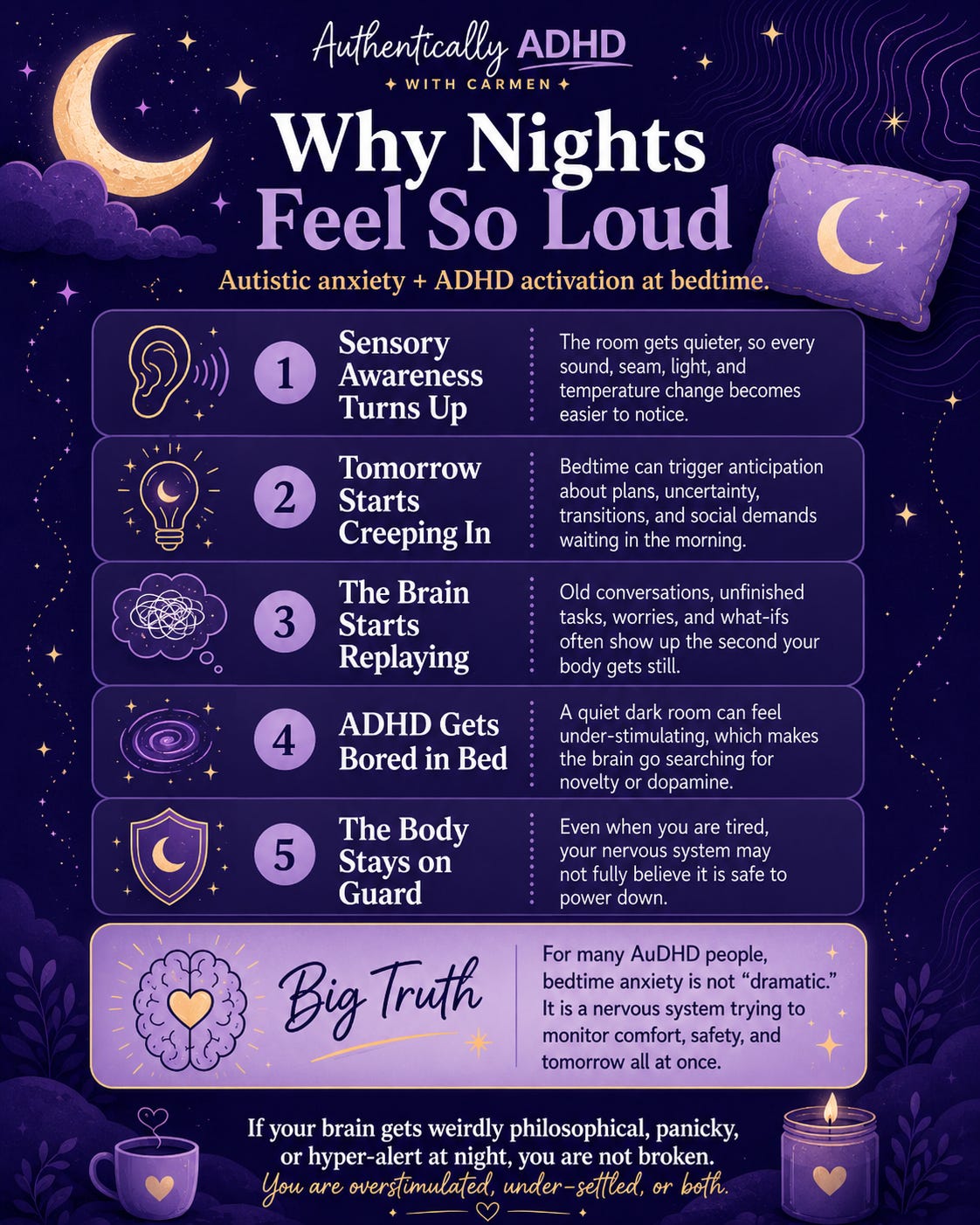
Your body may need rest, but your nervous system may not feel safe enough to power down.
Your schedule may say bedtime, but your dopamine-starved little raccoon brain may say, “No. Now we live.”
This is where revenge bedtime procrastination enters the chat wearing fuzzy socks and holding a phone at full brightness.
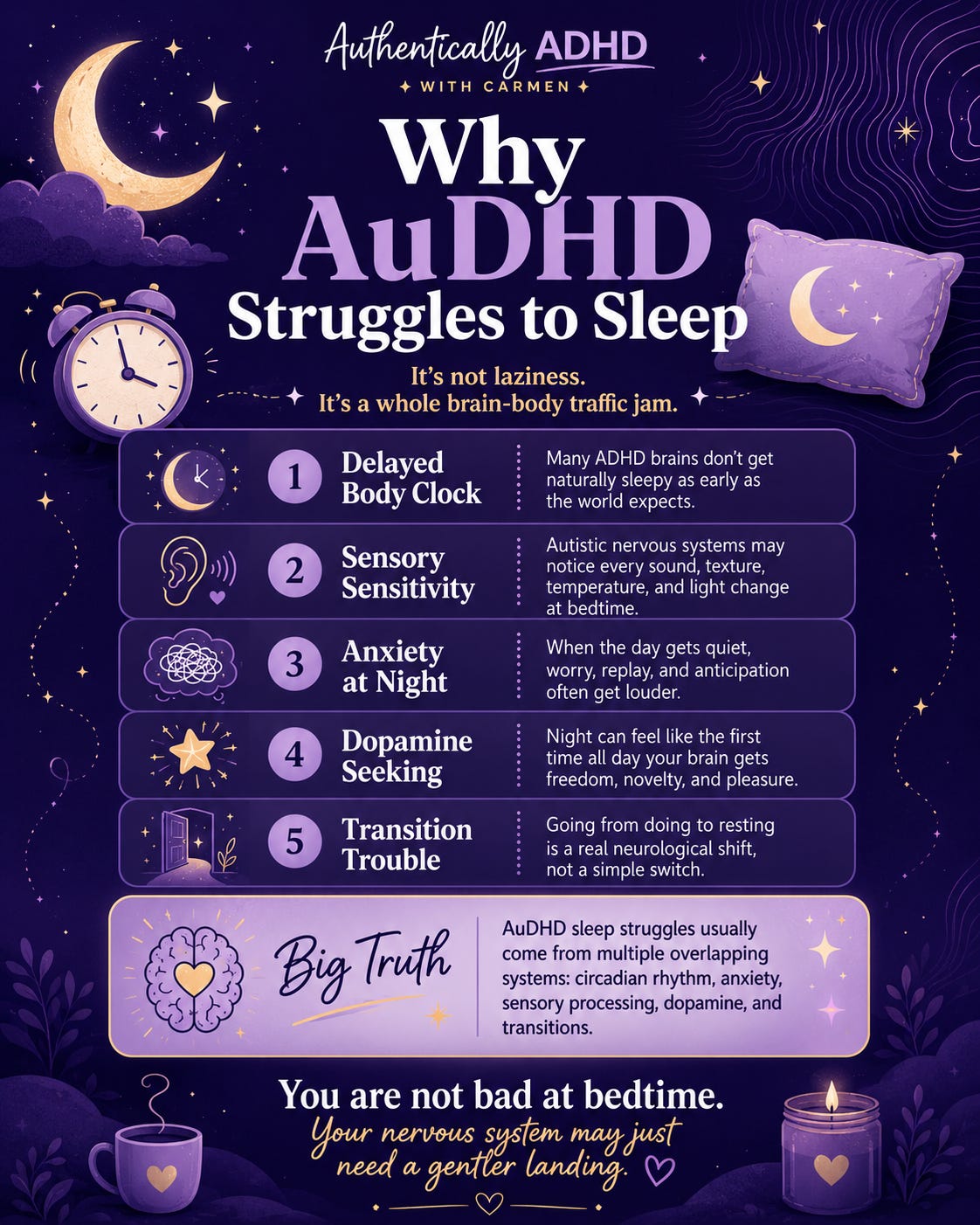
Bedtime procrastination is generally described as delaying going to bed despite knowing it may have negative consequences and despite no outside circumstance forcing the delay. Revenge bedtime procrastination adds the emotional flavor: staying up late because the day gave you no real freedom, joy, privacy, or control, so nighttime becomes your tiny rebellion.
It is not always “I want to ruin tomorrow.”
Sometimes it is:
“I finally feel alone.”
“I finally feel unstimulated.”
“I finally feel like nobody needs me.”
“I finally get to choose something.”
“I finally found a crumb of dopamine and I will defend it with my life.”
Which is deeply relatable.
Also deeply inconvenient.
Like emotional raccoon behavior, but with consequences.
Explain the Brain/Body Piece
1. ADHD brains often run on a delayed clock
Research increasingly suggests that ADHD is connected to circadian rhythm differences, especially delayed sleep-wake timing. One 2025 review describes evidence that many children and adults with ADHD show delayed sleep/wake cycles.
That means your natural “sleepy window” may show up later than society wants it to.
So when people say, “Just go to bed at 9,” your body might be like:
Cute. The internal moon has not approved this request.
This is why some ADHDers feel more awake at night than they did all day. The house is quiet. The demands are lower. The dopamine hunt begins. Suddenly you have the focus of a medieval monk copying a sacred text, except the sacred text is a Reddit thread about a celebrity divorce.
2. ADHD makes transitions harder
Sleep is not just an action. It is a transition.
And transitions are already spicy for AuDHD brains.
Going to bed requires stopping the current activity, shifting attention, tolerating boredom, changing sensory states, separating from dopamine, trusting tomorrow-you, and lying still in a dark room with your own thoughts.
That is not “basic self-care.”
That is a full neurological obstacle course. Where is my medal? Where is my tiny cape?
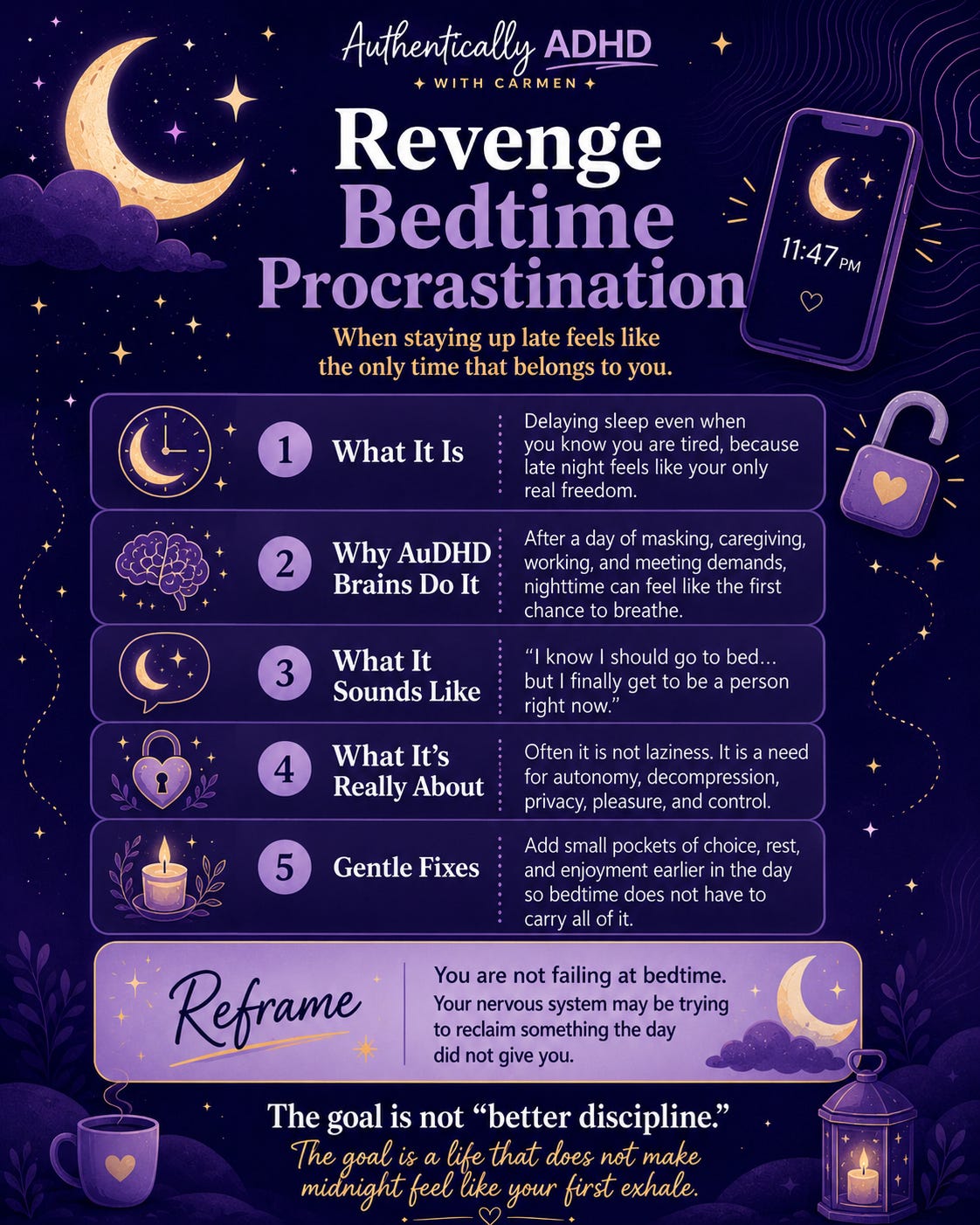
3. Autism can make bedtime feel unsafe or overstimulating
For autistic people, sleep problems can be tied to sensory processing, anxiety, routines, arousal, and difficulty settling the body. Research has linked autistic sleep problems with sensory processing differences, and one adult autism study found insomnia severity was associated with sensory hyper-reactivity.
So bedtime may not feel peaceful.
It may feel like:
The sheets are wrong.
The pillow is wrong.
The sound of the refrigerator is suddenly a villain origin story.
Your hair is touching your neck in a criminal way.
Your body is too hot, then too cold, then somehow both.
Your brain says, “What if tomorrow is terrible?”
Your nervous system says, “Great point. Nobody sleep.”
This is what I mean by autism-shaped anxiety. It is not always obvious panic. Sometimes it is a quiet internal surveillance system scanning for every possible discomfort, unpredictability, social demand, sensory threat, or tomorrow-problem.
Basically, your brain becomes a haunted security camera.
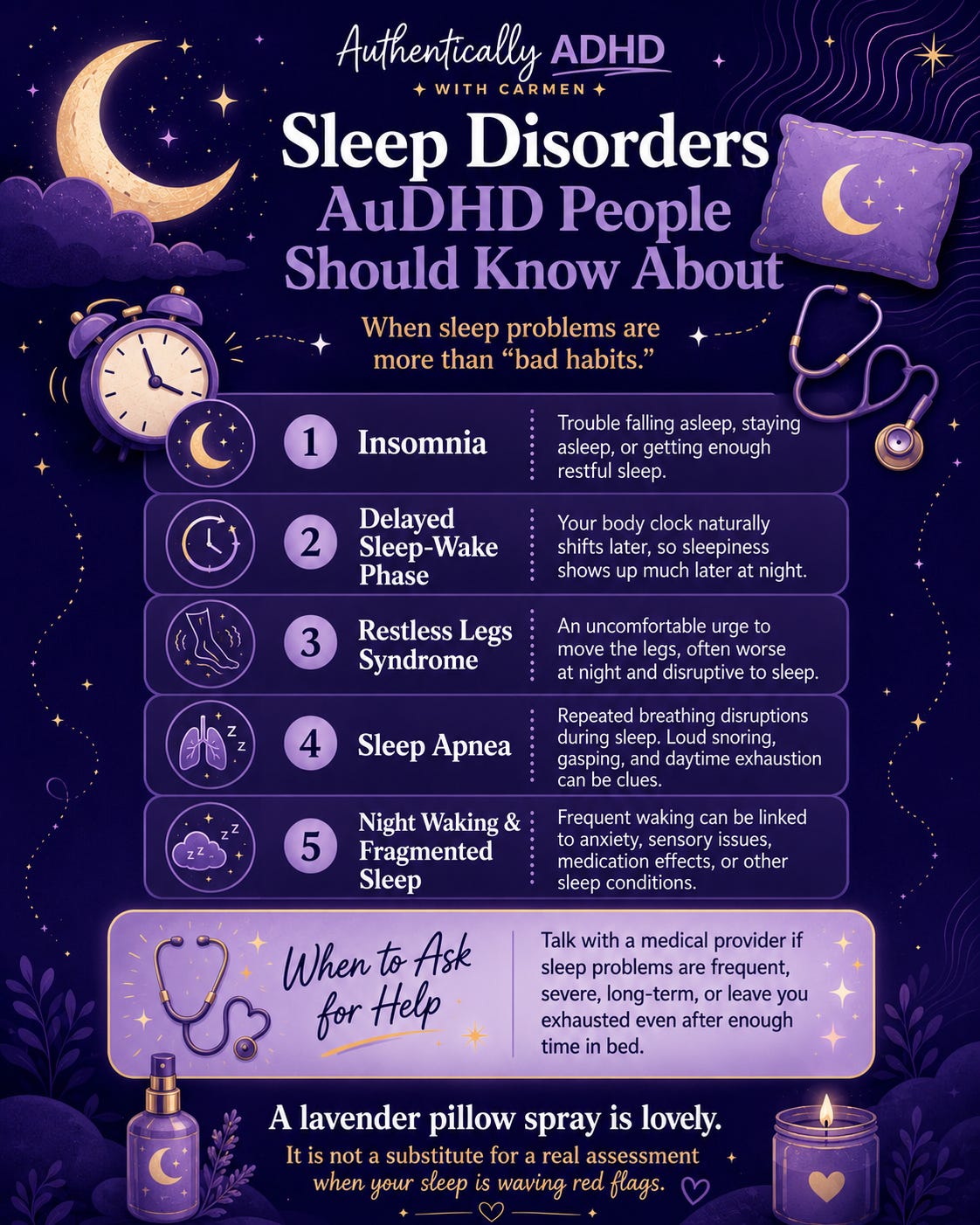
4. Sleep disorders are common and worth taking seriously
AuDHD sleep struggles are not always just “bad habits.” Sometimes there is an actual sleep disorder involved.
Common ones linked with ADHD and autism include:
Insomnia.
Delayed sleep-wake phase disorder.
Restless legs syndrome.
Periodic limb movement disorder.
Obstructive sleep apnea.
Night waking.
Early morning waking.
Medication-related sleep disruption.
Reviews of ADHD and sleep note links with sleep-disordered breathing, restless legs syndrome, obstructive sleep apnea, circadian rhythm sleep disorders, and insomnia.
So if sleep has been a lifelong war zone, please do not gaslight yourself into thinking you just need a prettier planner.
A lavender sleep spray cannot fix sleep apnea, babe.
I say that with love and science.
Real-Life Examples
Here is what AuDHD sleep struggle can actually look like:
You are exhausted at 6 p.m., but wired at 10:30 p.m.
You avoid bedtime because sleeping means waking up and waking up means facing tomorrow, and tomorrow has emails, expectations, pants, and probably someone asking “quick question.”
You keep scrolling because your brain finally feels unmasked, unbothered, and unobserved.
You stay up because the day was nothing but caregiving, working, masking, surviving, and being perceived against your will.
You climb into bed and suddenly your body becomes a sensory complaint department.
You feel anxious but cannot identify why, because your brain filed the reason under “vibes.”
You need the same bedtime routine every night, but ADHD makes consistency feel like trying to leash a cloud.
You are sleepy until the second you brush your teeth, then your brain activates like a cursed Furby.
You are bored in bed, and boredom to an ADHD nervous system can feel like being emotionally waterboarded by silence.
And then tomorrow you wake up tired, foggy, emotionally flammable, and vaguely betrayed by your own skeleton.
Good morning, bestie. Welcome to the consequences.
Offer Scripts/Tools
The goal is not to bully yourself into sleep.
The goal is to build a bedtime system that respects the fact that your nervous system is not a golden retriever. It will not simply “settle down” because you said so sweetly.
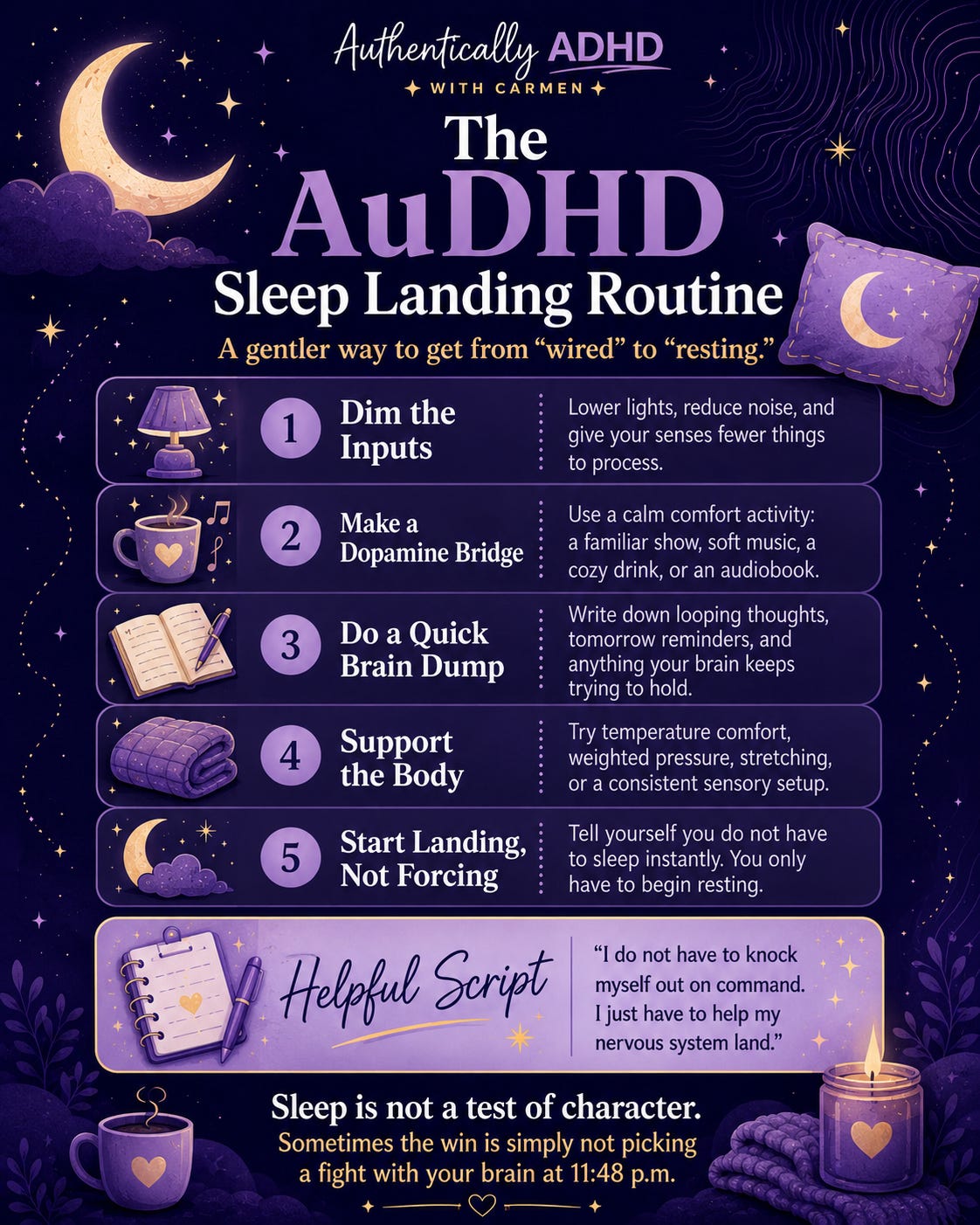
1. Replace “bedtime” with “landing time”
Bedtime sounds like a demand.
Landing time sounds like a nervous system transition.
Try saying:
“I do not have to fall asleep yet. I only have to begin landing.”
That one shift matters because pressure can make insomnia worse. The body does not relax well when the brain is standing over it with a clipboard yelling, “SLEEP NOW OR WE DIE POOR.”
2. Create a dopamine bridge
Do not rip away all joy at bedtime. That is how your brain starts a tiny union.
Instead, build a dopamine bridge:
A comfort show you have already seen.
A cozy audiobook.
A low-stakes puzzle.
A sleepy playlist.
A warm drink.
A soft light.
A calming scent.
A bedtime-only game that is boring enough to be safe but pleasant enough to prevent rebellion.
The key: it should soothe, not awaken the beast.
No true crime rabbit holes called “The Most Disturbing Case You’ve Never Heard Of.” That is not a bedtime routine. That is summoning cortisol with Wi-Fi.
3. Give revenge bedtime procrastination what it is actually asking for
Revenge bedtime procrastination is often a sign that your day had no protected ownership.
So ask:
“What did nighttime give me that daytime did not?”
Was it silence?
Autonomy?
Pleasure?
Privacy?
Creativity?
No one touching you?
No one needing you?
A sense of control?
Then try giving yourself a small piece of that earlier.
Even ten minutes of “nobody talk to me, I am a houseplant with legal rights” time can help.
Script:
“I am not bad at bedtime. I am underfed for autonomy. I need pleasure before midnight, not after it has become tomorrow’s problem.”
4. Make your sensory environment less rude
Your bedroom may need to become a tiny sensory cave.
Try experimenting with:
Weighted blanket or compression.
Cooling sheets or socks off.
Fan, white noise, brown noise, or earplugs.
Eye mask or blackout curtains.
Soft pajamas with no evil seams.
Same pillow setup every night.
Low lighting at least 30–60 minutes before bed.
Charging your phone across the room like it has committed crimes.
Because sometimes the issue is not that you lack discipline.
Sometimes your nervous system is simply saying, “This room has bad vibes and the blanket is touching me with disrespect.”
5. Use a “brain dump, body dump, tomorrow dump”
Before bed, write three tiny lists:
Brain dump: What is looping?
Body dump: What does my body need?
Tomorrow dump: What is one thing future-me needs to know?
Keep it short. This is not memoir time. We are not writing Eat, Pray, Spiral.
Example:
Brain: worried about appointment.
Body: shoulders tight, need heat pack.
Tomorrow: put keys by bag.
This tells your brain, “We caught the thought. You do not have to scream it at 1:12 a.m.”
6. Know when to get medical support
If you snore heavily, wake up gasping, have restless or painful legs at night, cannot fall asleep for hours most nights, wake frequently, or feel exhausted despite enough time in bed, it may be worth asking a doctor about sleep disorders.
Again: you are not weak. You may need assessment.
A sleep study is not failure. It is data. Sexy? No. Useful? Unfortunately, yes.
Closing
If sleep has always felt harder for you than it seems to be for other people, I need you to hear this:
You are not broken because your brain does not shut down on command.
You are not childish because bedtime brings up anxiety.
You are not irresponsible because your only free time starts when the world finally stops needing something from you.
You are an AuDHD human living in a body that may struggle with rhythm, transition, sensory safety, emotional regulation, dopamine, anxiety, and rest.
That is not a character flaw.
That is a nervous system with a lot of tabs open, a questionable manager, and absolutely no respect for business hours.
So tonight, do not aim for perfect sleep.
Aim for a softer landing.
Lower the lights.
Feed the need before it becomes rebellion.
Make your room less offensive to your senses.
Let your brain empty its pockets.
Give your body cues that tomorrow is not a bear at the cave door.
And if all you can do is get under the blanket and stop actively participating in the chaos?
That counts.
Rest does not have to be aesthetic to be real.
Sometimes healing looks like lying in the dark with one sock on, three comfort items, a fan pointed directly at your soul, and the brave decision not to start a new documentary at midnight.
Progress, my love.
Tiny, weird, holy progress.