
AuDHD + Executive Dysfunction
When Your Brain Hits “Buffering…” and You’re Still Expected to Perform

If you’re an adult with AuDHD (autism + ADHD), you probably know this scene by heart:
You want to do the thing.
You care about the thing.
You may even be stressed about the thing.
…and yet you’re standing in the kitchen, staring at a spoon, like the spoon just asked you to solve capitalism.
That “stuck” experience is real. It’s common. And no—it’s not laziness. It’s a brain-body traffic jam that happens when executive functions get overwhelmed, under-fueled, or hijacked.
Let’s break it down in plain language, with metaphors, and then get into strategies that actually work for an AuDHD nervous system.
What AuDHD Actually Feels Like
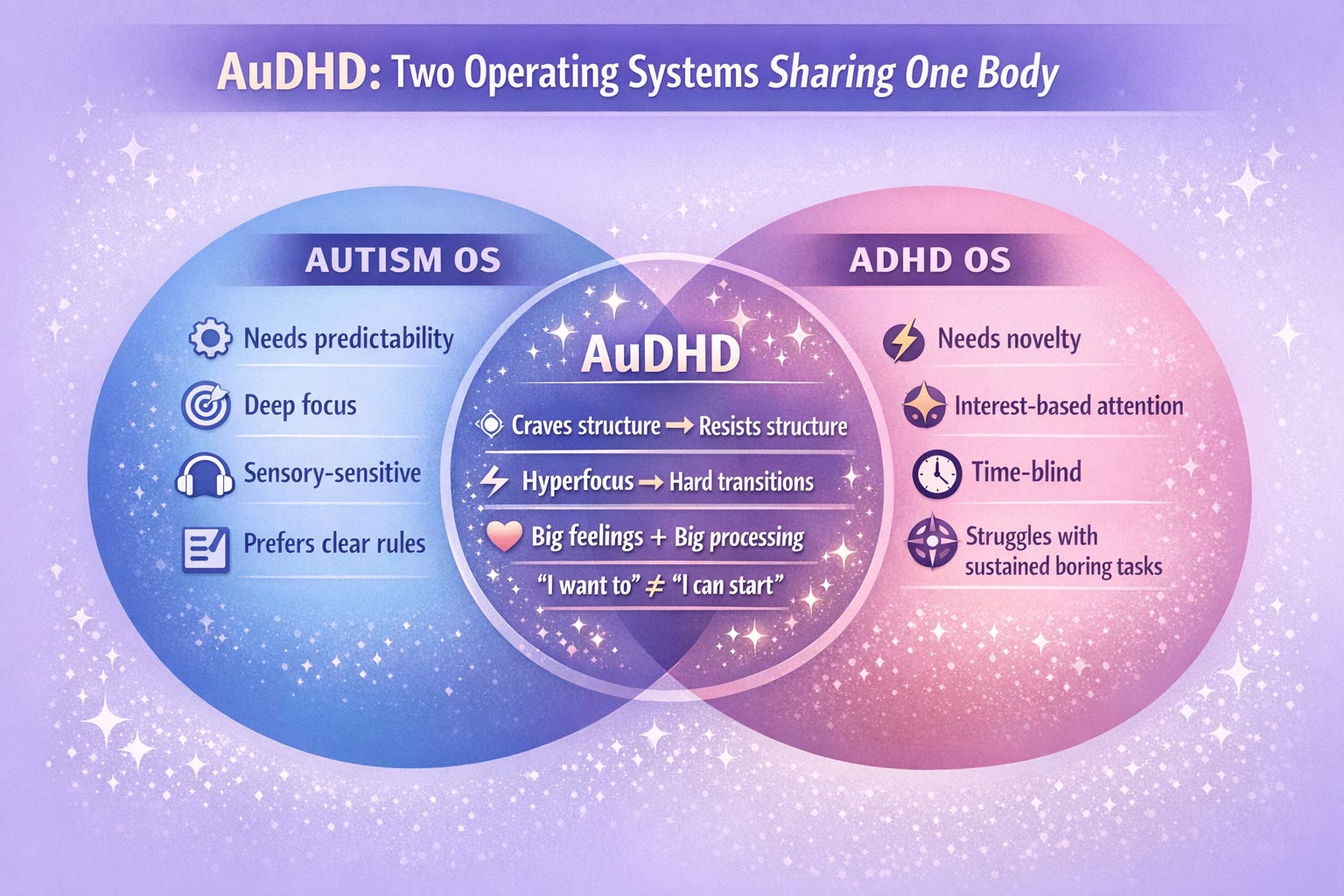
AuDHD isn’t an official diagnostic label in most systems—it’s a community shorthand for autistic + ADHD traits in the same person. And that combo can create a very specific kind of friction:
Autism often comes with a brain that likes predictability, clarity, sensory safety, and deep focus.
ADHD often comes with a brain that needs novelty, stimulation, urgency, and momentum.
So you can end up craving routine… while also feeling trapped by it. Wanting structure… while also bouncing off it. That internal tug-of-war can raise stress and functional difficulty, and research suggests co-occurring autism + ADHD is often associated with greater day-to-day impairment than either one alone.
Executive Dysfunction, Explained Like You’re a Human (Not a Robot)
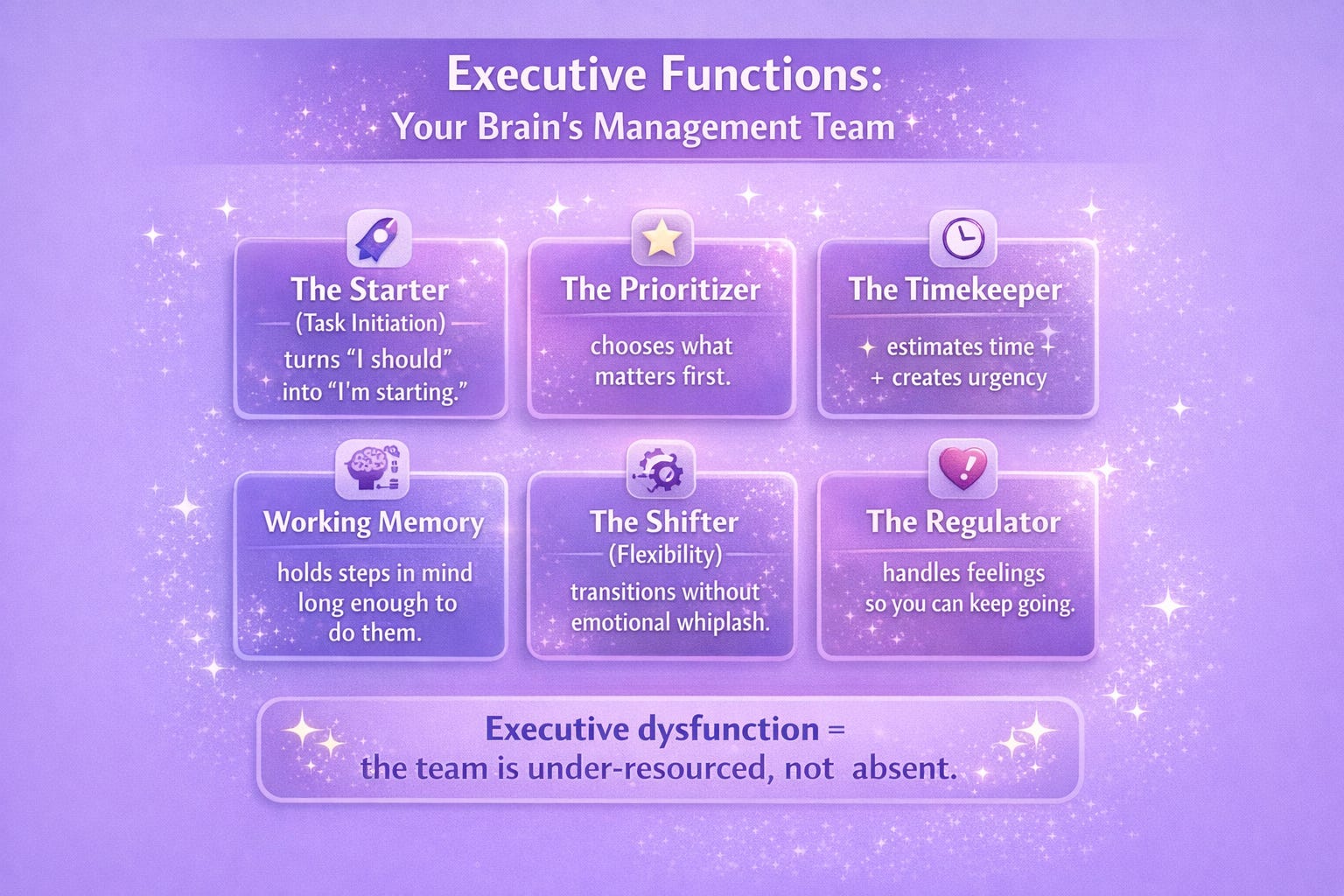
Executive functions are your brain’s “management system.” They help you:
start tasks (initiation)
choose what matters (prioritizing)
hold steps in mind (working memory)
shift gears (flexibility)
regulate emotions and impulses (self-regulation)
keep time from turning into soup (time management)
When people say “executive dysfunction,” they don’t mean “doesn’t know what to do.”
They mean: the knowledge is there, but access is unreliable.
Metaphor: The Air-Traffic Controller
Imagine your brain has an air-traffic controller whose job is to direct planes (tasks) safely onto runways (actions). Executive dysfunction is when:
the radio cuts out,
five planes request landing at once,
the lights flicker,
and someone keeps yelling “WHY AREN’T YOU LANDING THE PLANES” from the tower window.
You’re not refusing to land planes. You’re managing a system that’s momentarily on fire.
Neuroscience backs this up: executive functions rely heavily on networks involving the prefrontal cortex (PFC) and connected circuits that support attention, planning, and self-control. In ADHD, these circuits can be weaker or less efficiently regulated.
“ADHD Paralysis” (or Task Paralysis): The Freeze That Looks Like Nothing
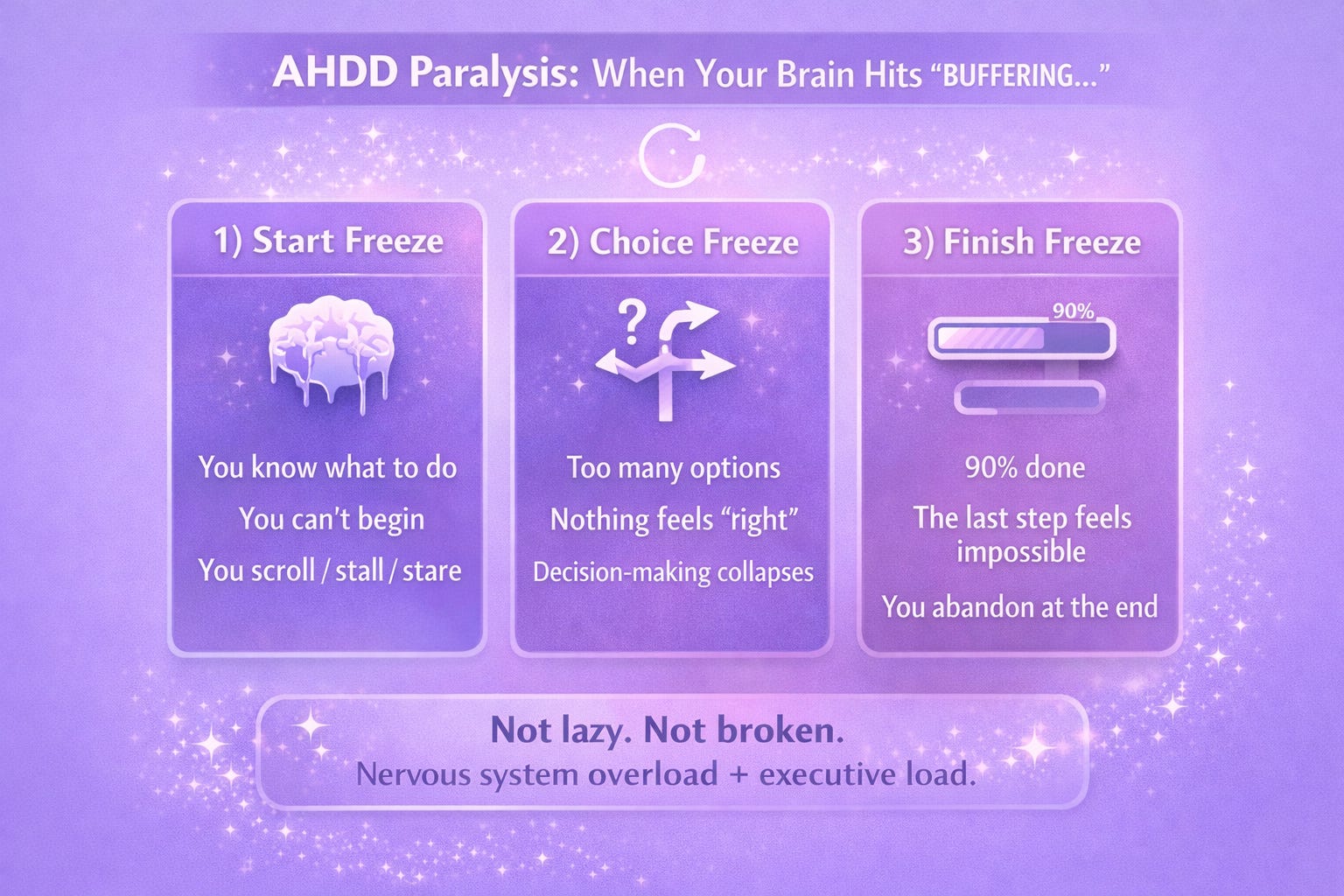
ADHD paralysis isn’t medical paralysis—it’s the felt sense of being frozen when faced with starting, choosing, or completing something.
It often shows up as:
staring at a to-do list while your brain goes blank
scrolling because moving feels impossible
doing “side quests” (wiping counters, reorganizing a drawer) to avoid the main thing
feeling flooded with urgency and still unable to start
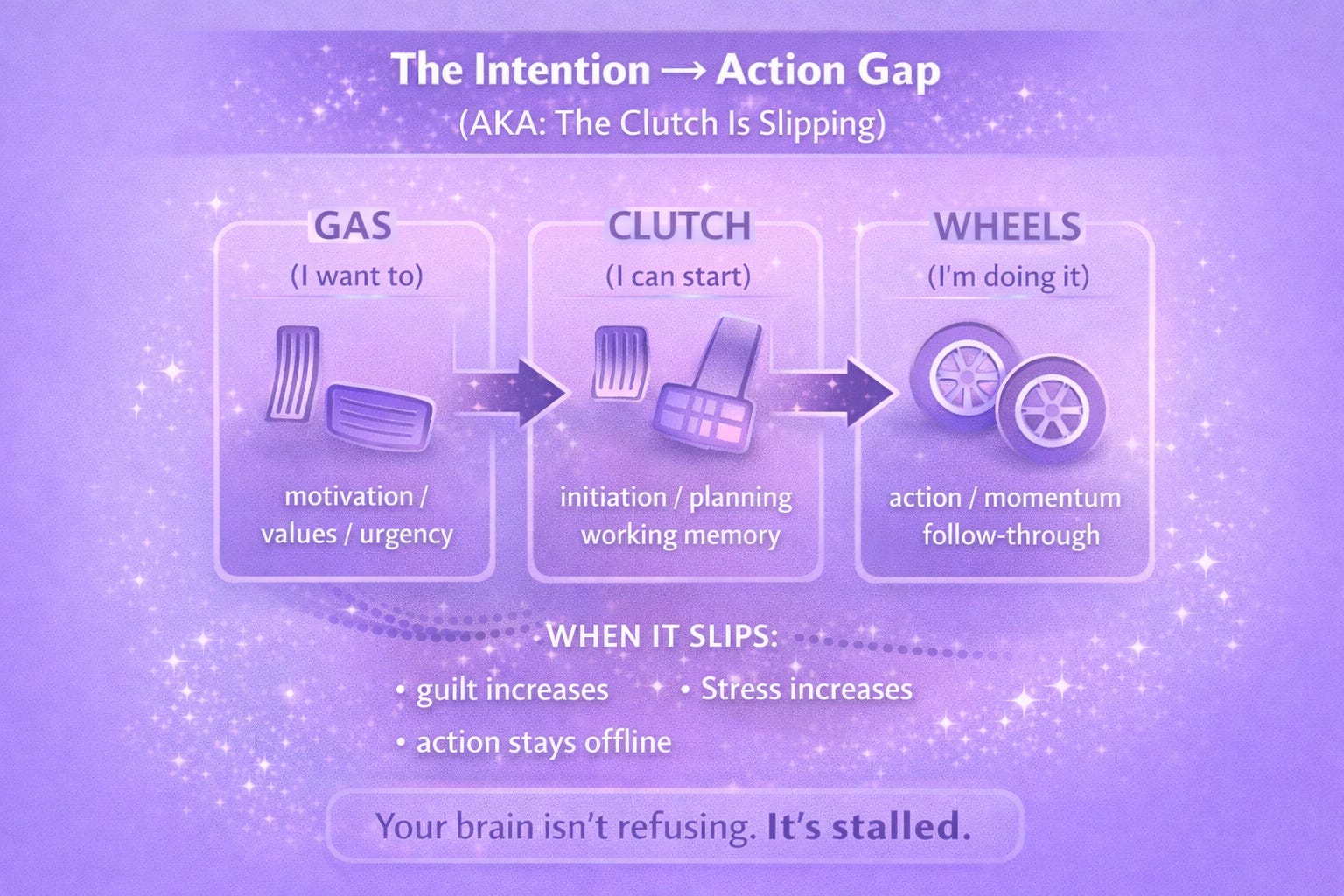
Metaphor: Your Brain’s Clutch Is Slipping
Your intention is the gas pedal. Your body is the engine. But the clutch (the “transfer” from wanting → doing) slips.
So you rev and rev and rev (stress, guilt, thinking), but the car doesn’t move.
That gap between intention and action is one of the most painful parts—because it’s not visible, and it’s easy to mislabel as “I’m broken.”
You’re not broken. You’re stalled.
The Neuroscience Angle: Why “Just Do It” Is Garbage Advice
Here’s the simplest way to understand it:
1) The PFC needs the right chemical conditions
The prefrontal cortex runs best within an optimal range of neurotransmitters like dopamine and norepinephrine—too low or too high (hello, stress) and executive functioning can drop.
2) Brain networks can get out of sync
Large-scale networks involved in executive control and attention regulation can show different connectivity patterns in ADHD, which relates to symptom change over time.
3) Emotion and executive function are glued together
Task initiation isn’t purely “motivation.” It’s also:
threat detection (“what if I fail?”)
sensory prediction (“this will be uncomfortable”)
identity pain (“I always mess this up”)
For many AuDHD adults, emotion regulation and executive function difficulties amplify each other—and research is increasingly treating EF + emotion regulation as intertwined, especially in autism/ADHD overlaps.
So when someone says “just start,” what they’re really saying is:
“Please override your neurobiology using vibes.”
Why AuDHD Can Make Executive Dysfunction Feel Extra Brutal
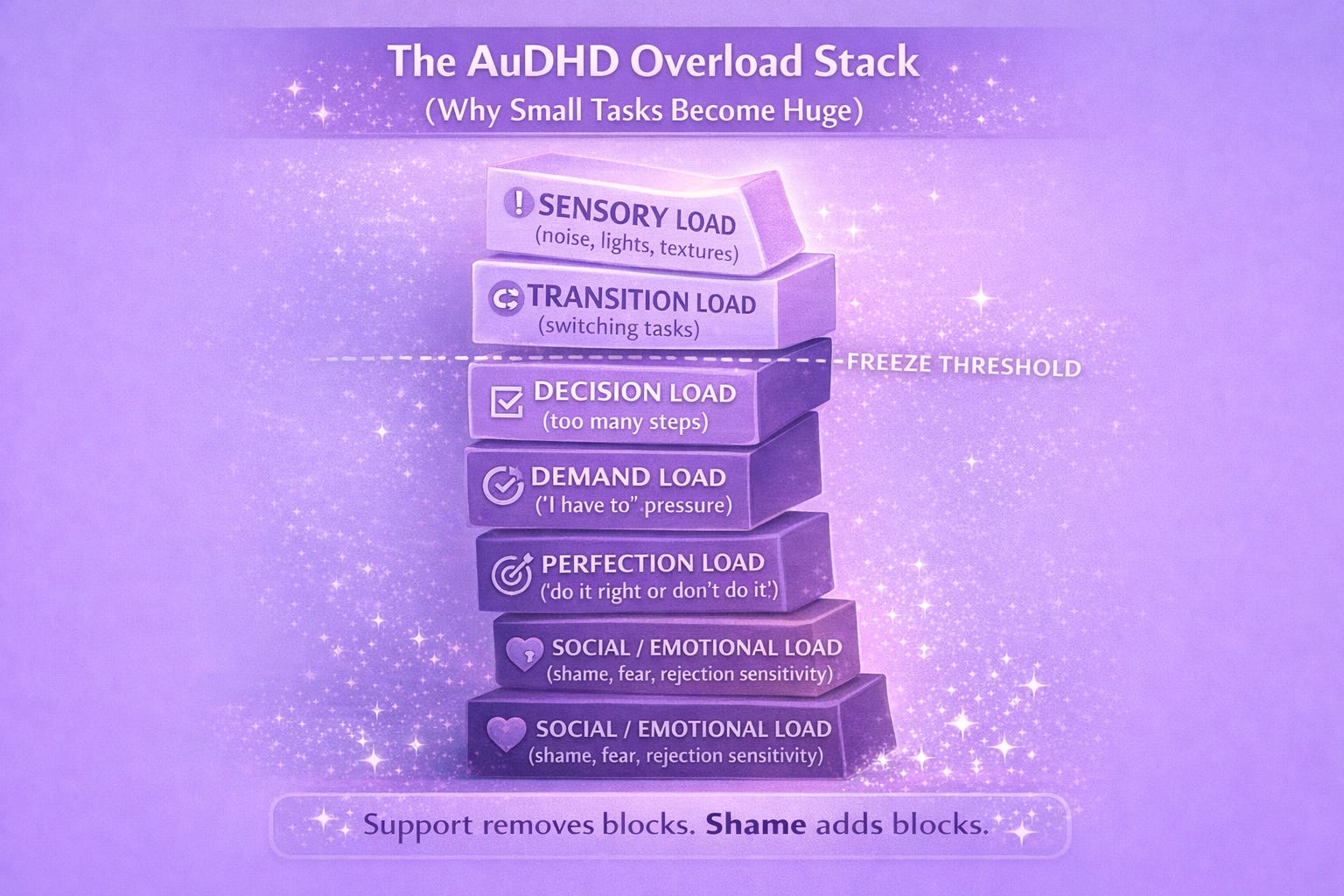
AuDHD often adds layers that turn “simple tasks” into multi-system events:
Sensory load
If your environment is loud, bright, itchy, chaotic, or unpredictable, your nervous system may prioritize survival over spreadsheets.
Transitions are heavier
Switching tasks can feel like ripping Velcro off your brain. Autism can make transitions feel disruptive; ADHD can make transitions feel slippery and hard to sustain.
Perfectionism + demand pressure
Autistic patterning can create “do it correctly or don’t do it.” ADHD can create “I can’t access consistency.” The result? Freeze.
Decision fatigue
More variables = more cognitive load. AuDHD brains often run deep analysis while also struggling to “select and proceed.”
“Real Life” Examples of AuDHD Task Paralysis
Here are a few extremely typical, painfully relatable scenarios:
The email vortex
You open your inbox → see 37 messages → your brain can’t decide which one matters → you close it → feel guilty all day.
The shower that requires a committee meeting
Not because you don’t want to be clean. Because it includes:
temperature change, transitions, sensory input, time uncertainty, and post-shower steps.
The “I have free time” trap
You finally have time to work on a project you care about—then you freeze because there’s no external urgency, and choosing a starting point feels impossible.
The house task that becomes an identity crisis
Dishes aren’t dishes. Dishes are:
proof you can’t keep up, sensory grossness, interrupted routines, and a million micro-steps.
The Part I’ll Say Loud: This Is A Support Problem, Not A Character Problem
A lot of AuDHD adults were trained to treat support needs like moral failures.
But executive dysfunction improves fastest when you stop trying to “fix your personality” and start engineering your environment.
That’s not weakness. That’s strategy.
Tips & Strategies That Actually Work for AuDHD Brains
Below are practical approaches drawn from ADHD skills treatments (like CBT/meta-cognitive approaches and coaching) that target time management, organization, planning, and follow-through.
(And yes, you can absolutely use these without turning your life into a color-coded prison.)
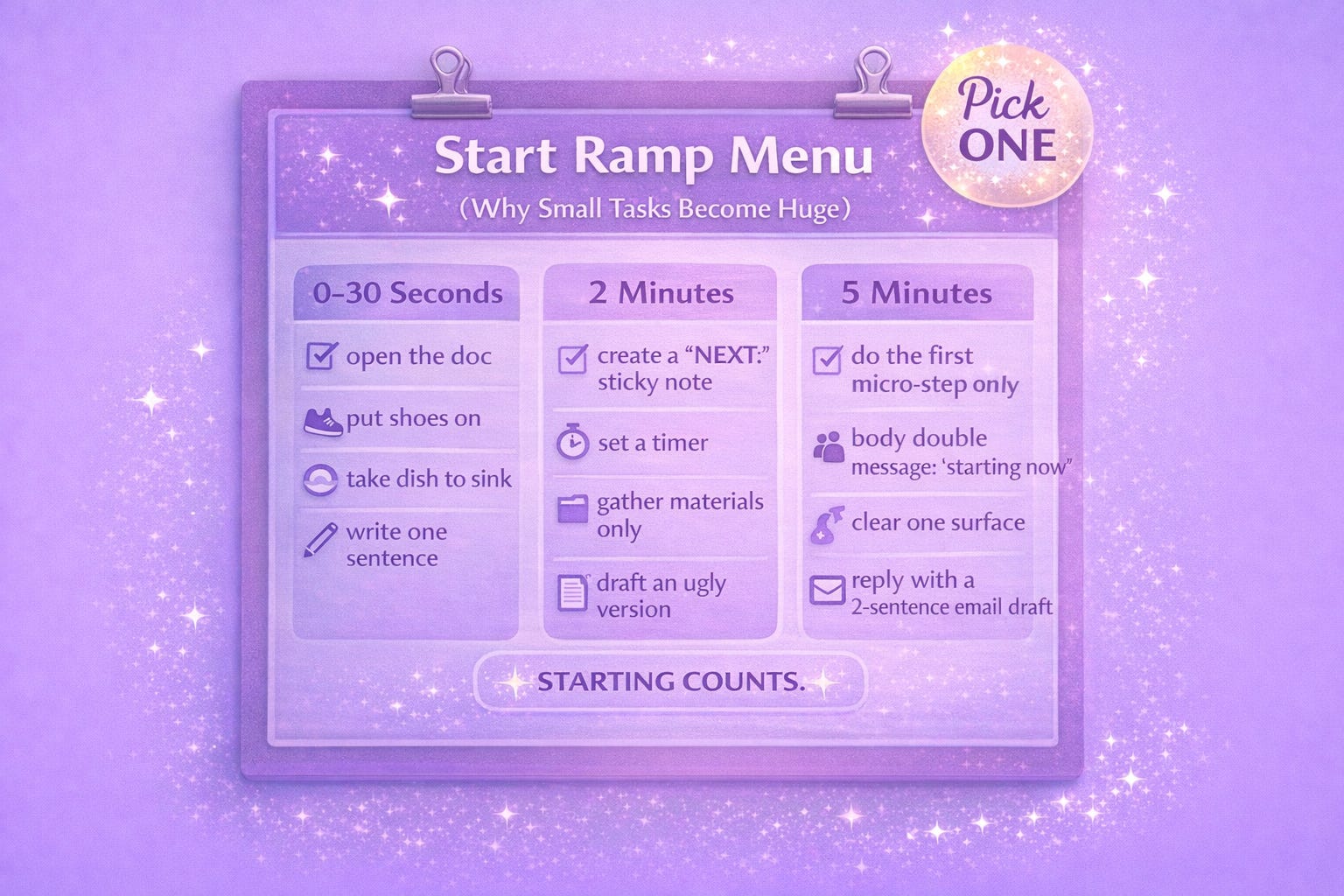
1) Build a “Start Ramp,” Not a Willpower Test
Goal: make starting so small it’s almost silly.
Examples:
“Open the document” (not “write the report”)
“Put one dish in the sink”
“Set a 3-minute timer and stop when it ends”
If you start, you’ve already won. Momentum is the point.
2) Externalize the executive function
AuDHD brains do better when the “manager” isn’t trapped inside your skull.
Try:
sticky note: “NEXT: ____” (one step only)
a visible checklist (short!)
a timer you can see
body doubling (someone else present, in person or virtual)
3) Use “If–Then” scripts to reduce decision load
When you’re frozen, decisions are the tax.
Examples:
If I’m stuck, then I set a 5-minute timer and do the tiniest step.
If I avoid an email, then I write a 2-sentence reply draft (not send).
If I can’t choose, then I pick the task that reduces tomorrow’s stress.
4) Regulate first, then initiate
Sometimes you’re not unmotivated—you’re dysregulated.
Try a 90-second reset:
drink water
change temperature (cool face/wrists)
stand up + shake out arms
one song + move
Then re-approach with a start ramp.
5) Make “boring” doable by pairing it with stimulation
ADHD brains often need interest, novelty, challenge, or urgency to engage.
Pairing ideas:
dishes + podcast
admin + favorite drink
boring task + “only for 7 minutes”
chores + gamified points (“earn 1 point per micro-task”)
6) Shrink the task until it fits your nervous system
A task that’s too big becomes a threat.
Instead of “clean the kitchen”:
clear one surface
throw away trash only
run hot water + soap and stop
“Partial” is not failure. Partial is how progress happens.
7) Use compassionate structure, not punishment structure
If your system relies on shame, it will eventually stop working—because your brain will associate tasks with pain.
Try:
gentle accountability (coach/friend/body double)
rewards for starting, not finishing
a “good enough” definition written down
8) Consider professional supports
If you have access, ADHD-focused therapy/coaching can be effective for building skills and scaffolds.
And if you’re exploring medication, that’s a clinician conversation—but it’s worth saying: you deserve support that’s not just “try harder.”
Reflection Journal Prompts
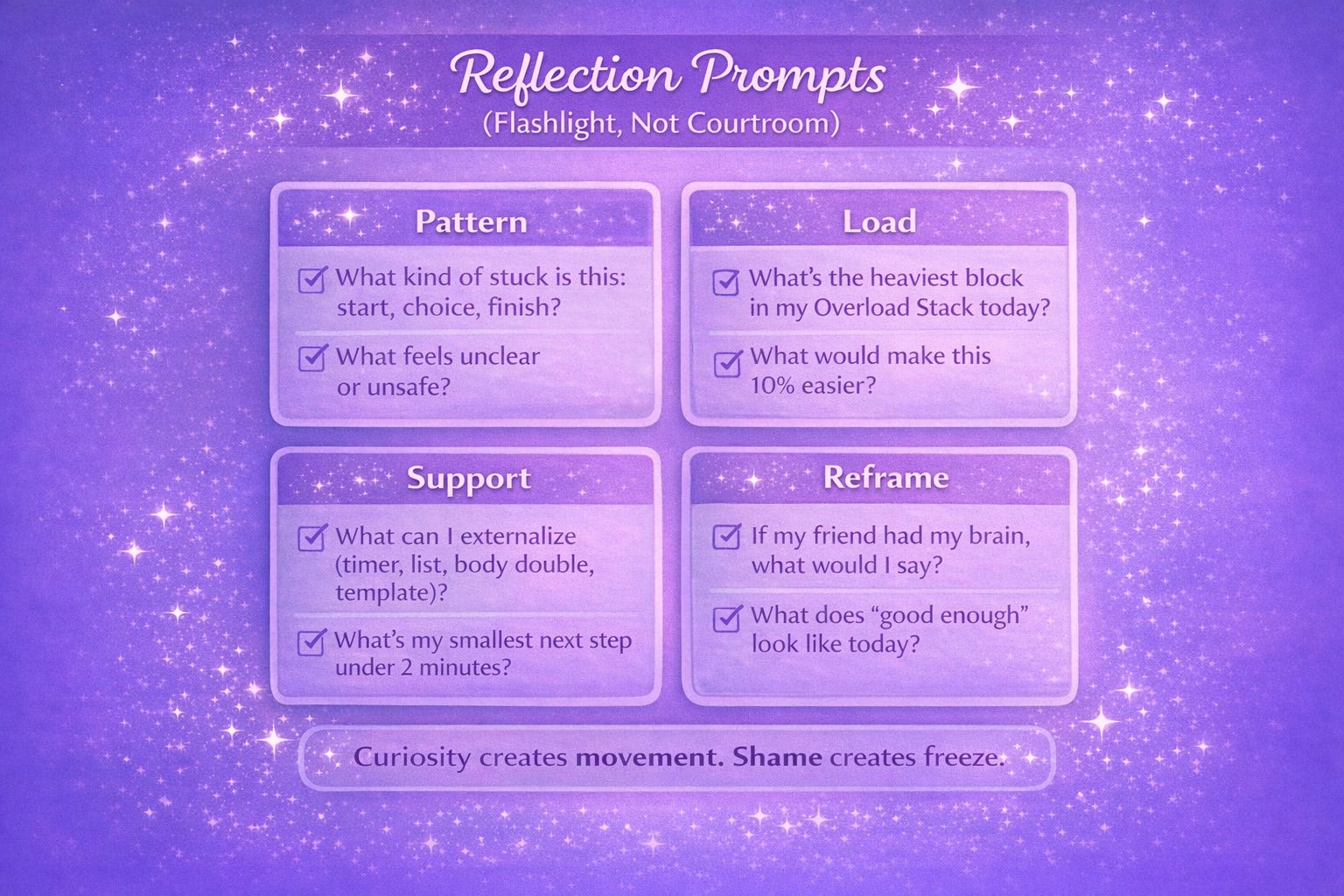
Use these like a flashlight, not a courtroom.
Understanding your paralysis pattern
When I get stuck, what’s usually underneath it—overwhelm, boredom, fear, sensory discomfort, uncertainty, perfectionism?
What part of this task feels unclear or unsafe to my brain?
If this task were 80% smaller, what would it look like?
Designing better supports
What “executive function” am I asking myself to perform right now (initiation, prioritizing, switching, working memory, emotion regulation)?
What’s one way I could externalize that function (timer, list, body double, visual cue, template)?
What would make this task easier by 10%—not perfect, just lighter?
Rewriting the story
If my friend had my brain and my day, what would I say to them right now?
What’s a kinder interpretation of my “stuck” moment that still respects reality?
What proof do I have that I can build systems that work for me—even if they’re unconventional?
Tiny next step (the closer)
What is the smallest next action I can take in under 2 minutes?
What would “good enough” look like today?
What support do I wish I had—and how can I approximate 20% of it?