
AuDHD + Rejection Sensitivity
when “maybe they’re mad” turns into a five-alarm fire

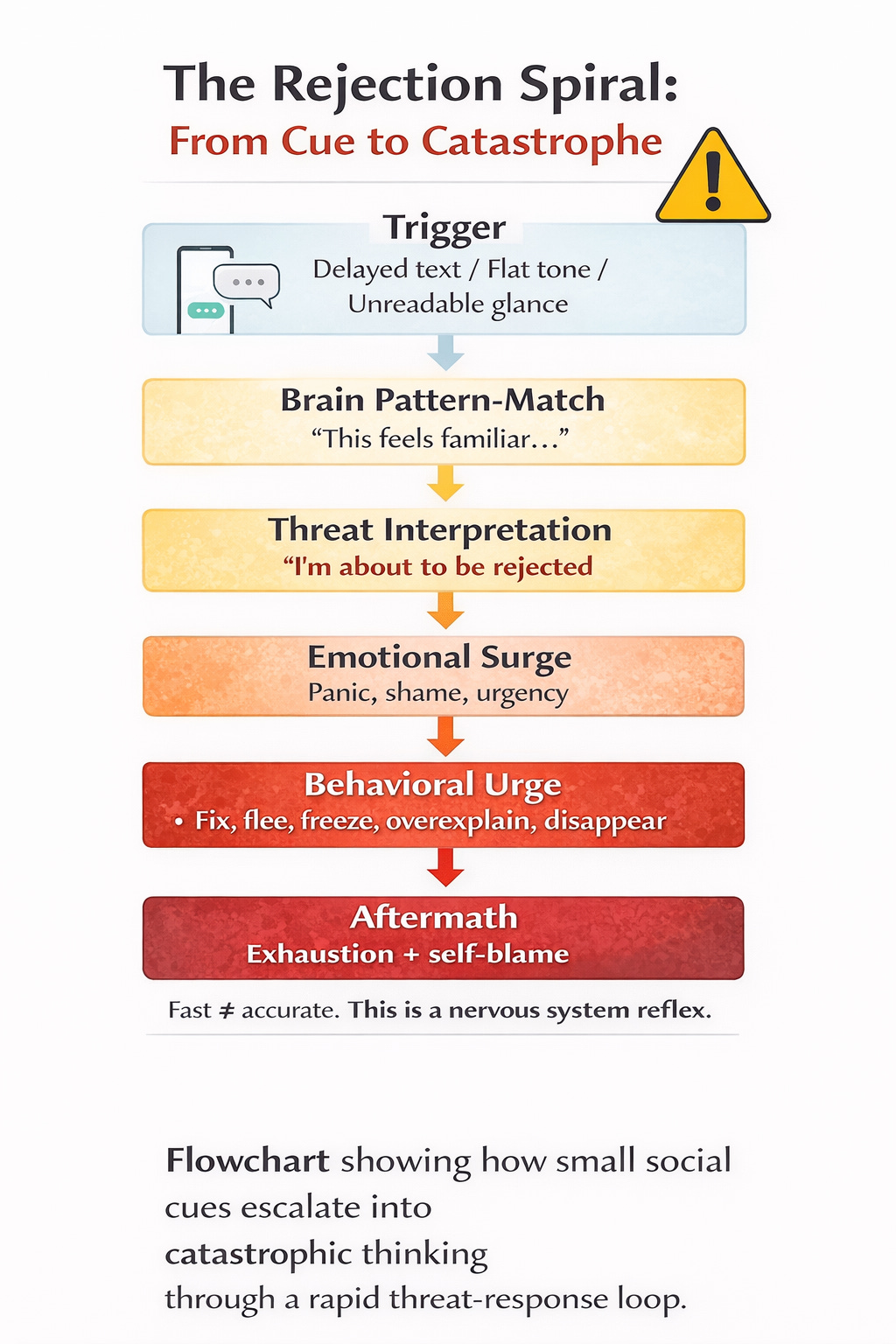
You know that moment when someone’s tone shifts slightly—a delayed text, a “k.”, a glance you can’t decode—and your brain instantly opens sixteen tabs titled:
They hate me
I’m about to get fired
Everyone finally realized I’m a fraud
I should disappear forever and also deep-clean the baseboards
That’s rejection sensitivity for a lot of AuDHD adults: not a mild sting, but a full-body threat response that feels urgent, personal, and absolute.
Let’s talk about what it is, why neurodivergent people so often carry it, how self-trust is the missing keystone, and how to build a life where rejection doesn’t run your nervous system like a corrupt little CEO.
What rejection sensitivity is (and what it isn’t)
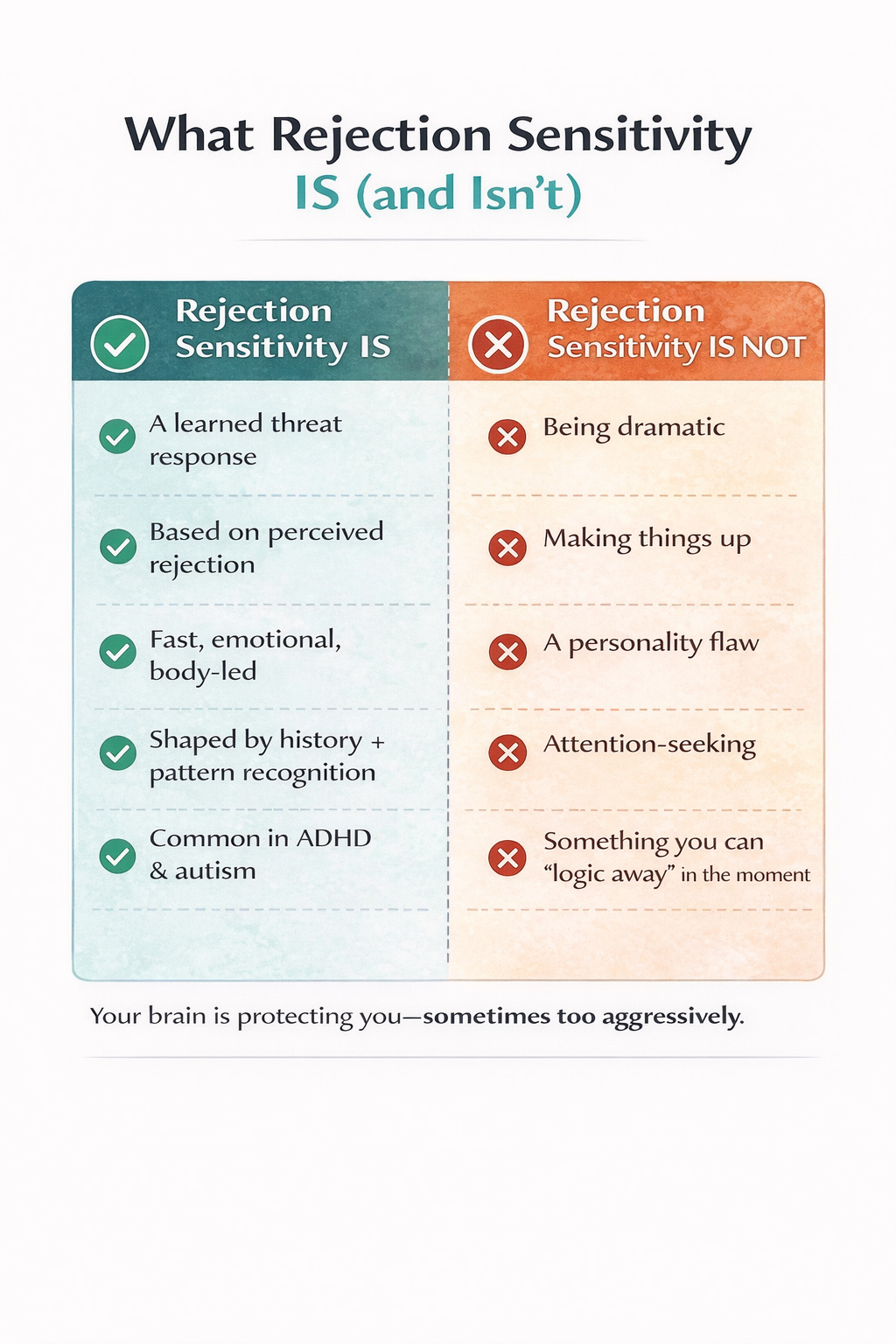
In research, rejection sensitivity (RS) is commonly described as a cognitive–affective pattern: you anxiously expect rejection, readily perceive it, and then react intensely to it.
Online, people often use the phrase “rejection sensitive dysphoria (RSD)” to describe the same lived experience—especially in ADHD spaces. Worth noting: “RSD” isn’t a formal diagnosis in the DSM, and the term is used more clinically in some circles than others. But the experience—intense emotional pain in response to real or perceived rejection—maps tightly onto the rejection sensitivity literature and ADHD emotional dysregulation discussions.
The key thing: perceived rejection counts
Rejection sensitivity isn’t “making stuff up.” It’s your brain doing what brains do under threat: pattern-matching fast and asking questions later (if ever).
And AuDHD brains are often running:
higher emotional intensity / faster emotional ignition (ADHD)
plus heavier social-cue uncertainty, masking, and chronic “did I do that right?” monitoring (autism)
plus a lifetime of feedback that your natural settings are “too much,” “not enough,” or “wrong.”
The neuroscience: why rejection can feel like physical pain
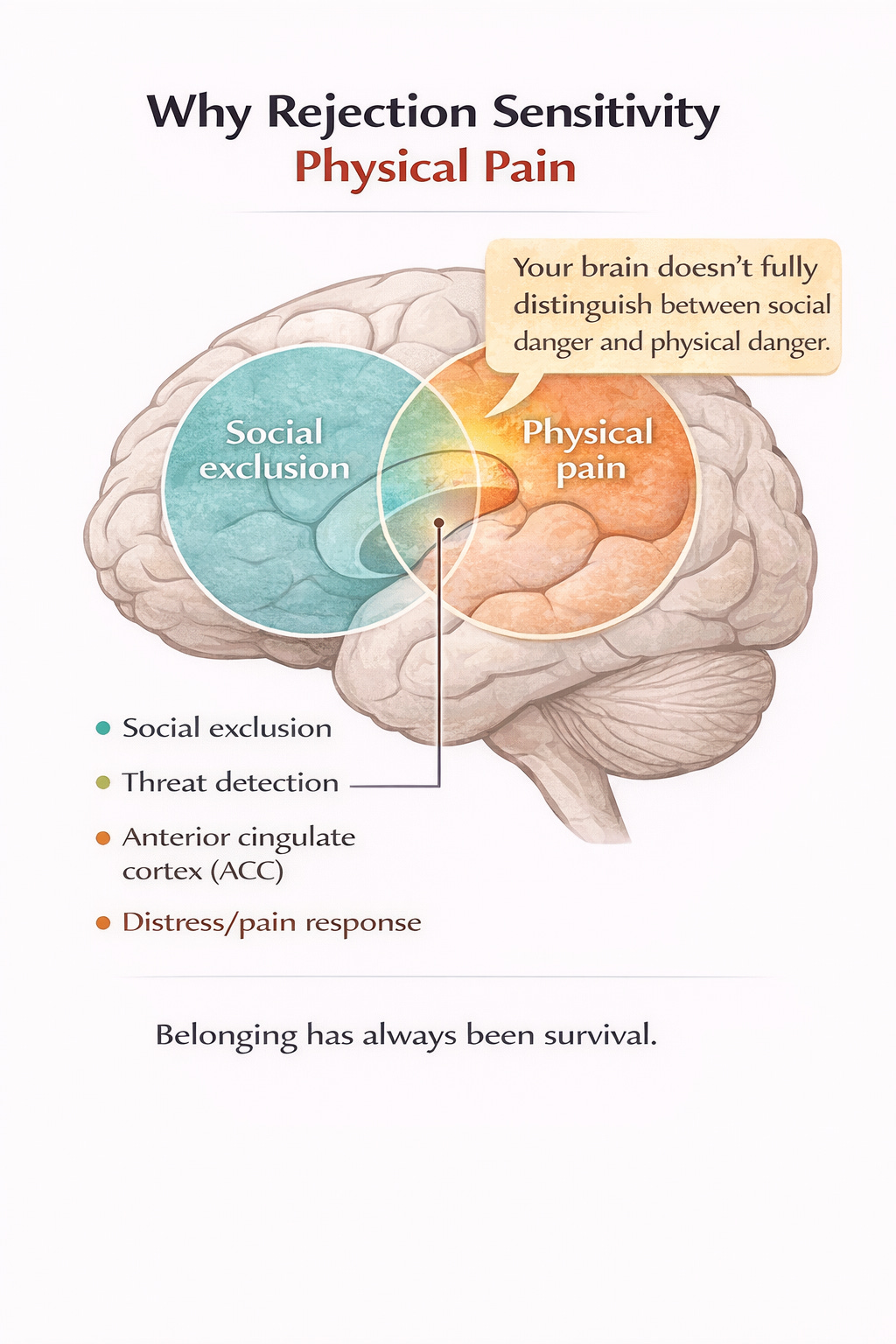
Social connection isn’t a cute bonus feature. For humans, belonging has always been survival.
Brain imaging studies show that social exclusion activates brain regions involved in distress/pain processing, including the anterior cingulate cortex (ACC), and the distress people report lines up with that activation.
Translation: your nervous system can interpret “I might be disliked” like “danger—do something NOW.”
So when someone says, “Why are you so sensitive?” the most honest answer is:
Because my brain treats disconnection like a threat, not a comment section.
Now layer in ADHD + autism, and you often get:
faster emotional spikes + harder braking (emotion regulation challenges are widely discussed as part of ADHD)
more frequent social ambiguity (“Was that sarcasm? Are we good? Did I miss a rule?”)
masking/camouflaging pressure, which is strongly tied to trying to avoid rejection and discrimination—and it’s exhausting
Why neurodivergent people often “learn” rejection from childhood onward
Rejection sensitivity doesn’t usually come from one dramatic event. It’s more like death by a thousand papercuts, and the papercuts start early.
1) Being corrected more, and praised less (especially for how you are)
Many AuDHD kids grow up getting constant feedback like:
“Stop interrupting.”
“Use a better tone.”
“Calm down.”
“Why can’t you just…?”
“You’re smart but you don’t apply yourself.”
Even when adults mean well, that steady drip teaches the nervous system:
love + belonging are conditional.
2) Bullying, exclusion, and social whiplash
Autistic people report masking partly to avoid social exclusion and bullying, and research links masking/camouflaging to social pressures and stigma.
So your system learns:
I must monitor constantly to stay safe.
3) Inconsistent outcomes (the ADHD chaos tax)
If your performance is variable—because executive function is variable—you can’t predict outcomes reliably. That unpredictability is rocket fuel for anxiety and hypervigilance:
“If I forget one thing, will I be ‘in trouble’?”
“If I’m late, will they think I don’t care?”
“If I say it wrong, will I lose the relationship?”
4) “Misread” sensory and nervous system responses
AuDHD people often get punished for regulation needs:
leaving a loud room
needing quiet
shutting down
asking for clarity
needing time to process
And then you internalize:
my needs = inconvenience = rejection risk.
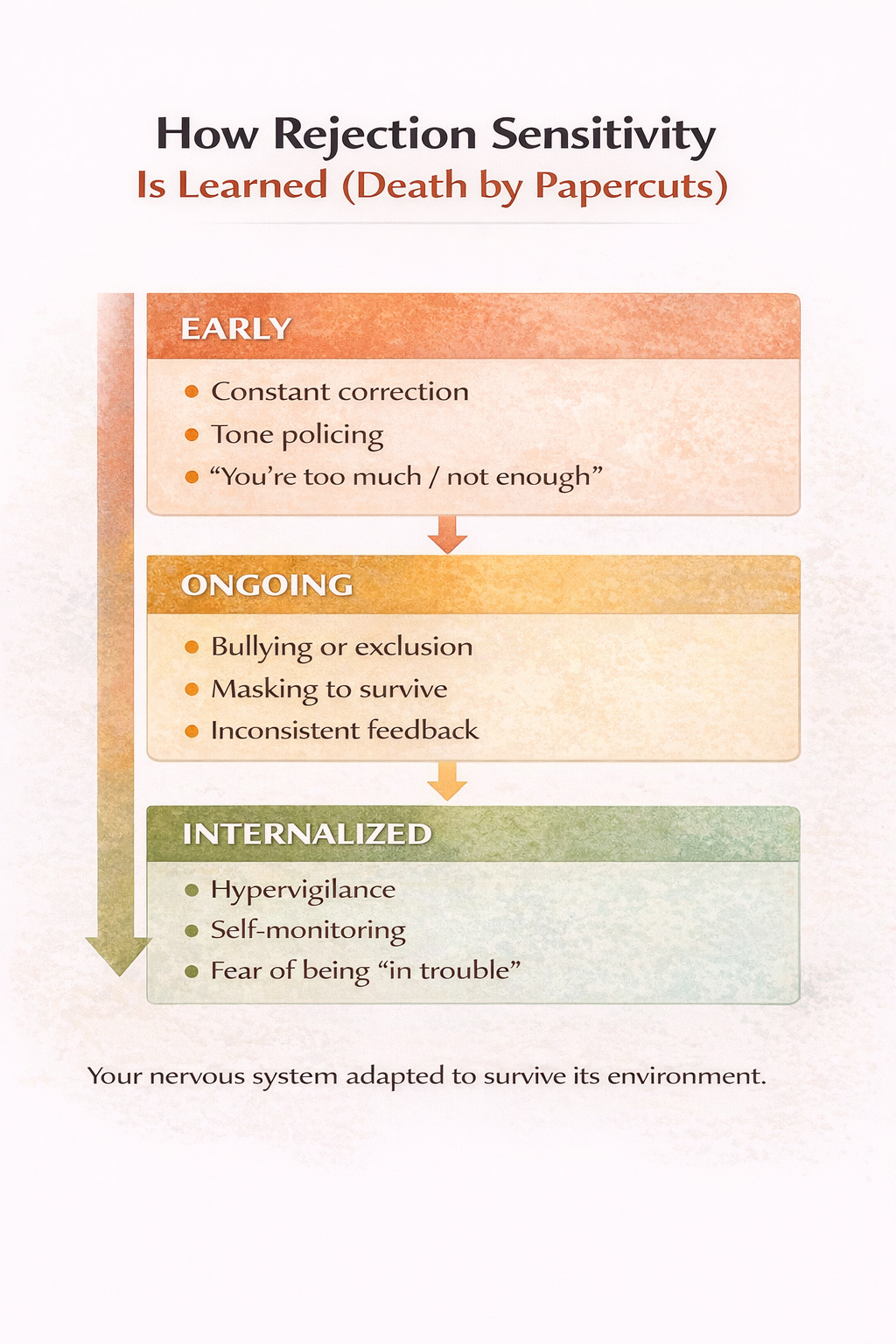
The self-trust connection: rejection sensitivity is often a self-trust injury
Here’s my hot take: rejection sensitivity isn’t only about other people.
It’s also about what happens when you don’t trust yourself to survive social friction.
If your history taught you:
“When I mess up, I lose love.”
“When I’m confused, I get shamed.”
“When I’m honest, I’m ‘too much.’”
…then your brain starts outsourcing safety to other people’s reactions.
So a delayed text doesn’t just feel like “huh.”
It feels like proof you are unsafe.
Self-trust is the internal voice that says:
“Even if they are upset, I can handle it. I can ask. I can repair. I can survive discomfort.”
Without self-trust, your nervous system treats uncertainty like verdict.
Real-life AuDHD examples (aka: the emotional jump-scare compilation)
Example 1: The boss email with no emoji
Email: “Can you stop by my office when you have a minute?”
Your brain:
“I’m fired. They’ve discovered I’m incompetent. I should pre-grieve my paycheck.”
Reality:
They want to ask where the stapler is.
Example 2: Friend takes 10 hours to text back
Your brain:
“They’re done with me. I was too intense. I should never speak again.”
Reality:
They were working, dissociating, napping, or simply living their human life.
Example 3: Partner sighs while doing dishes
Your brain:
“I’m a burden. They resent me. This relationship is collapsing in real time.”
Reality:
Their back hurts and the sponge is gross.
Example 4: Group chat joke lands weird
Your brain:
“I have humiliated myself publicly. I must move states.”
Reality:
Two people were busy, one didn’t get it, and nobody is thinking about it as much as you are.
If any of these feel familiar, you’re not dramatic. You’re patterned.
The big reframe: your nervous system is doing threat math, not “truth”
Rejection sensitivity is often a protective algorithm built from:
past social pain
unpredictable feedback
chronic misunderstanding
and a brain that’s extremely good at fast pattern recognition
But trauma-informed truth:
A protective response can be understandable and still be inaccurate.
So the goal isn’t “stop feeling.”
It’s teach your nervous system that uncertainty is not emergency.
Strategies that actually help (AuDHD edition)
1) Name it in the moment (reduce fusion)
Try:
“My rejection alarm is going off.”
Not “I’m unlovable.” Not “This is fact.” Alarm.
2) Regulate first, interpret second
Social pain lights up threat circuitry.
So do body-first tools before you decide what anything “means.”
Pick one:
long exhale (make the exhale longer than inhale)
cold sip / cold water on wrists
pressure (weighted blanket, tight hoodie, squeeze pillow)
3–5 minutes of steady movement (pace, wall push-ups)
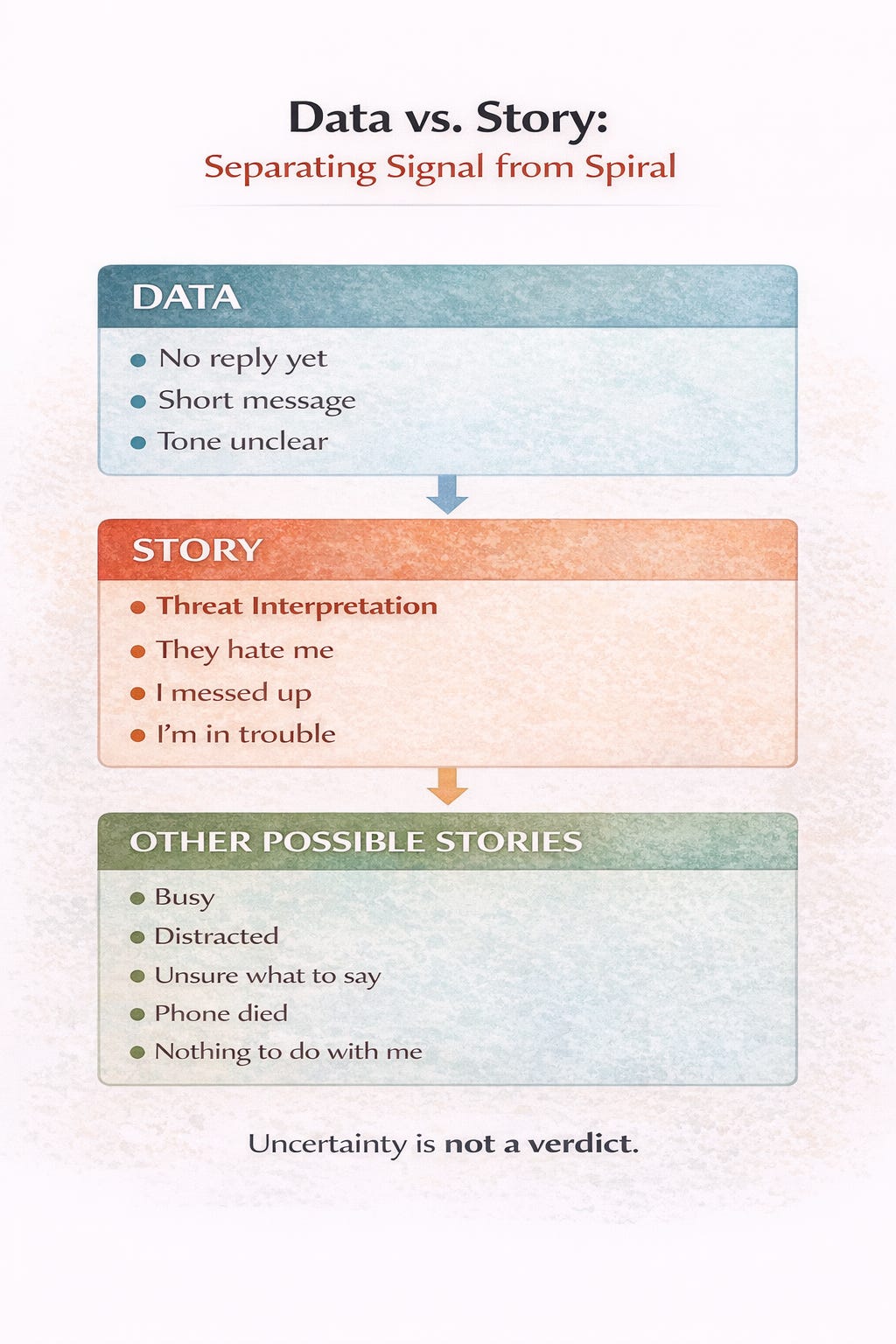
3) Separate data from story
Write two lines:
Data: “They haven’t replied.”
Story: “They hate me.”
Then add a third line:
Other plausible stories: “Busy. Distracted. Unsure what to say. Phone died.”
4) Install a “no sudden moves” rule
When activated, do not:
send the paragraph text
“just check in” five times
delete all your social accounts
break up, quit, or confess your sins
Make a 20-minute buffer. Your future self deserves that pause.
5) Use clarity scripts (because mind-reading is not a superpower)
Try:
“Hey—my brain is doing the thing. Are we okay?”
“Quick check: was my tone off earlier? I’m not upset with you.”
“If something’s wrong, I’d rather know directly.”
This is self-advocacy, not neediness.
6) Build a “self-trust receipt file”
Your brain forgets stability when it’s panicking. Give it evidence.
Keep a note called: “Times I Thought I Was Rejected and I Wasn’t.”
You’re not gaslighting yourself—you’re building internal grounding.
7) Reduce masking where you can
Masking/camouflaging is tied to social pressure and stigma, and it can erode well-being over time.
Choose one low-risk place to be 10% more you:
a friend who gets it
a neurodivergent community
a therapist/coach who’s affirming
Less masking = less constant rejection-monitoring.
8) Practice repair, not perfection
A lot of rejection fear is really fear of “no way back.”
So create a repair template:
“I got activated and I’m sorry.”
“Here’s what was happening in my head.”
“Here’s what I actually need next time.”
Repair is a skill. Not everyone learned it growing up.
9) Don’t confuse criticism with catastrophe
Yes, feedback can sting. But feedback is not exile.
Which leads to the mic-drop ending you asked for:
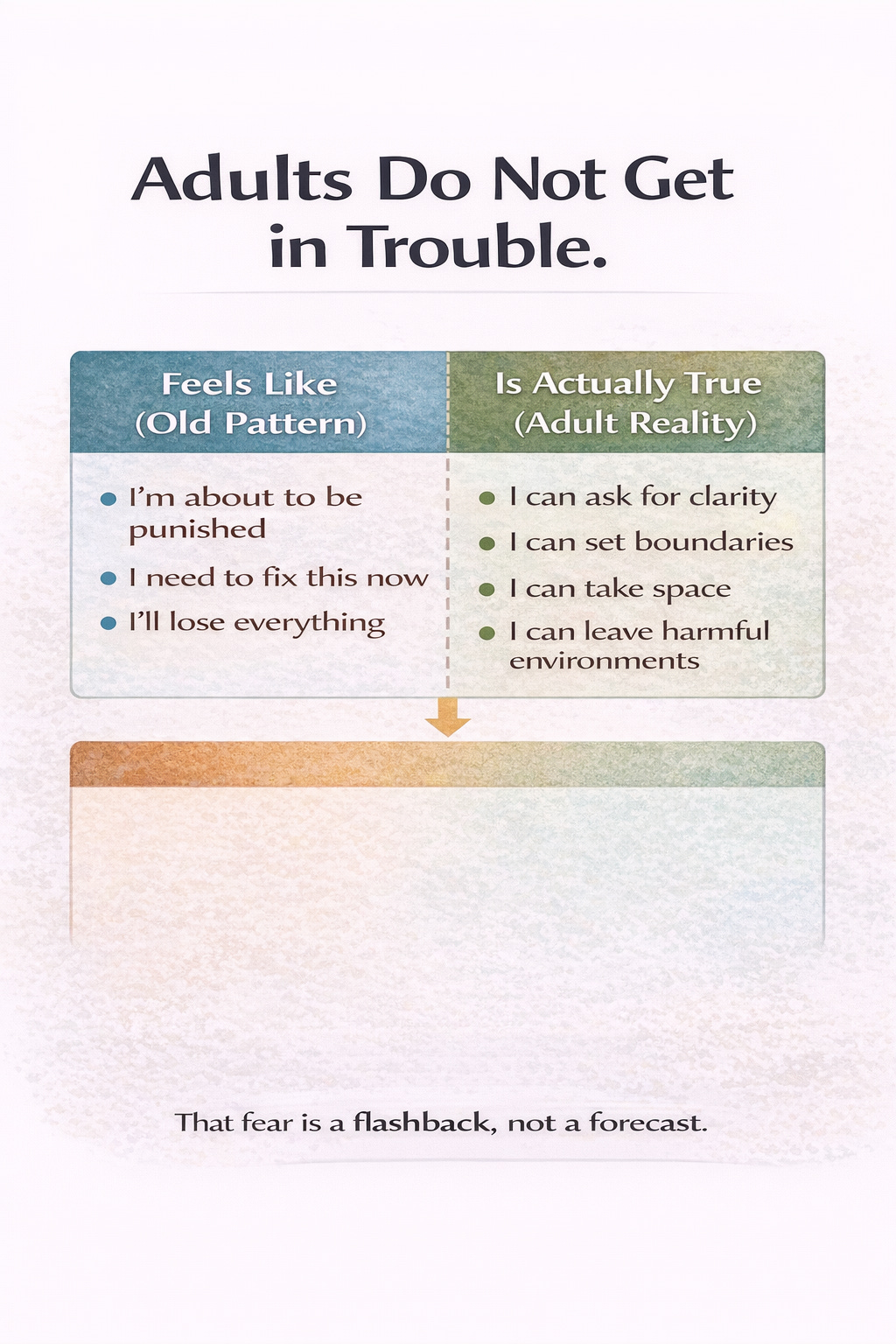
Adults do not get in trouble
Read that again.
You might feel like you’re about to be punished, grounded, shamed, kicked out of the tribe.
But you are not eight. You are not trapped in someone else’s mood. You are not at the mercy of a teacher’s disappointed sigh.
As an adult, you can:
ask for clarification
set boundaries
take space
choose better relationships
leave environments that repeatedly harm you
The feeling of “I’m in trouble” is often a nervous system flashback.
The truth is: you have options now.
Journal prompts for reflection (pick 1–3, not all—this isn’t homework)
When my rejection alarm goes off, what does it usually say?
What kinds of “rejection cues” hit me hardest (tone, silence, facial expression, correction, being ignored)?
What did I learn about mistakes and belonging as a kid?
Who taught me (directly or indirectly) that love is conditional?
What are three neutral explanations I can practice defaulting to?
When I feel rejected, where do I feel it in my body first?
What regulation tools actually lower the intensity by even 10%?
What’s one small way I can practice self-trust this week (ask directly, pause before reacting, write the “data vs story”)?
What relationships make me feel safe enough to be imperfect? What patterns show that safety?
Where am I masking the most—and what would “10% less” look like?
What boundary would reduce my rejection load (time, access, communication expectations)?
If I fully believed “adults do not get in trouble,” what would I do differently the next time I feel rejected?
Paid Subscriber Add-On:
“Your Nervous System Has Favorites” — How Relationship Safety Shapes Rejection Sensitivity
