
Define Done Before the Task Defines You: The AuDHD Hack for Tasks That Never Feel Finished
For the drawer-cleaners who accidentally reorganize the spice cabinet, their childhood trauma, and one emotionally loaded junk box from 2014.

There is a specific kind of AuDHD chaos that starts with one innocent thought:
“I’m just going to clean this drawer real quick.”
Cute. Adorable. A tiny productivity fairy tale.
Three hours later, you’re sitting on the floor surrounded by batteries, expired coupons, hair ties, an instruction manual for an appliance you no longer own, and one emotional support paperclip. Somehow the drawer is empty, the kitchen is worse, your nervous system has left the group chat, and you are now questioning whether you ever learned object permanence or if capitalism personally attacked your frontal lobe.
Welcome to the land of tasks that do not come with edges.
And this is why we need to talk about one of the most deceptively simple, deeply annoying, wildly helpful productivity hacks for AuDHD brains:
Define Done.
Not “do it perfectly.”
Not “finish everything adjacent to it.”
Not “accidentally become the CEO of domestic operations.”
Just define what done means before you start.
Because for many AuDHDers, the problem is not that we refuse to do the task.
The problem is that the task is a fog machine wearing a trench coat.
We cannot start because we cannot see the end.
We cannot finish because the finish line keeps moving.
We cannot rest because our brain is like, “Technically, there is still dust behind the refrigerator, so joy is illegal.”
Define Done is how we give the task a fence.
And honestly? Some of our tasks need a leash, a bell, and maybe a court-appointed guardian.
The Problem: Open-Ended Tasks Are AuDHD Bear Traps
Some tasks are clear:
“Put the cup in the sink.”
“Take the meds.”
“Send the text.”
“Feed the dog before they begin writing their memoir about neglect.”
But other tasks are cursed little portals:
“Clean the kitchen.”
“Organize your desk.”
“Work on your blog.”
“Get your life together.”
“Be better.”
“Fix your routines.”
“Respond to emails.”
“Declutter.”
Excuse me, what does that mean?
Clean the kitchen could mean:
Put dishes in the dishwasher.
Wipe the counters.
Scrub the sink.
Take out trash.
Sweep.
Mop.
Clean the microwave.
Organize the pantry.
Match every lid to every container.
Cry over the one container that has no lid because apparently even Tupperware has abandonment wounds.
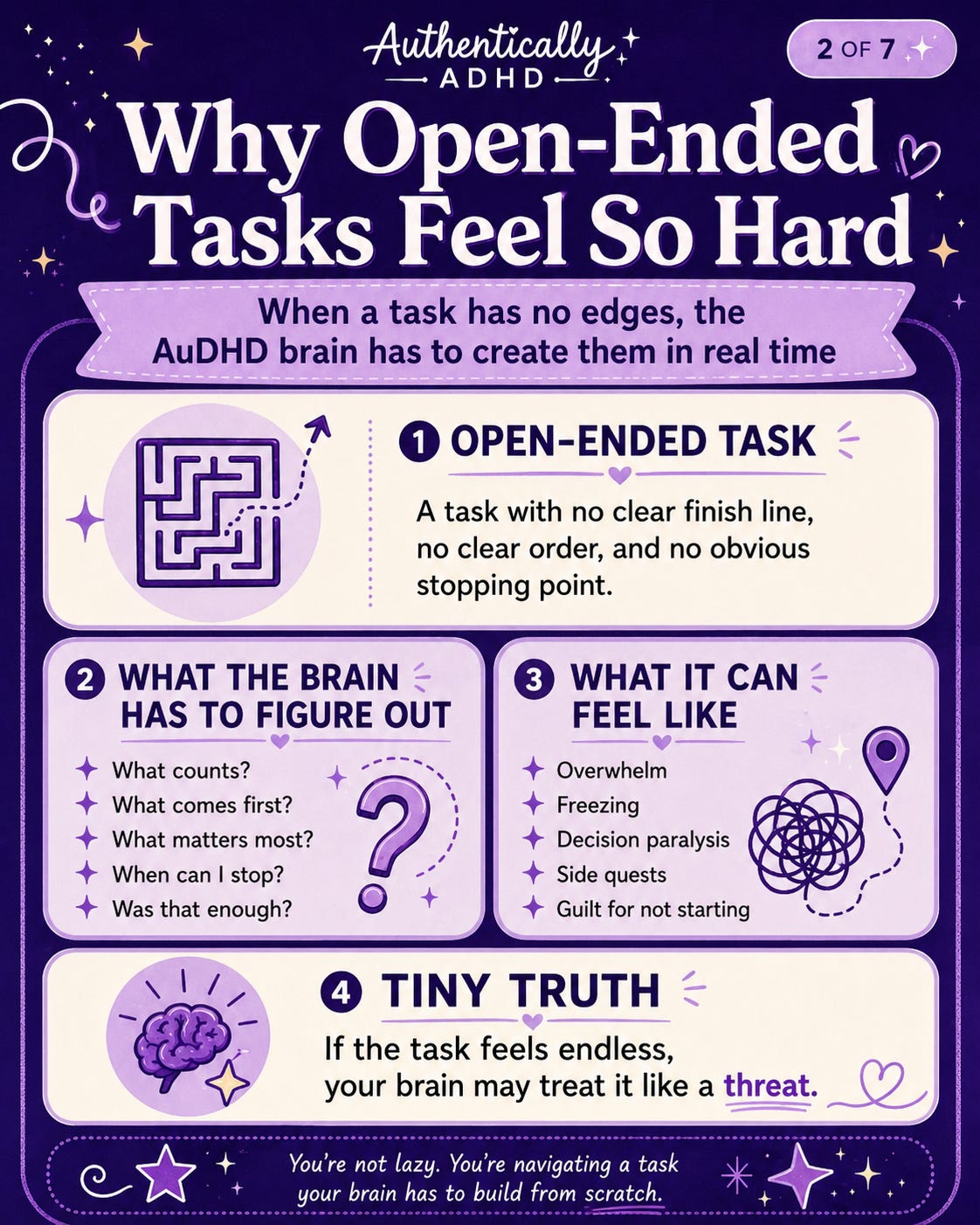
For an AuDHD brain, open-ended tasks are not “simple.” They are decision avalanches.
Every step creates another step.
Every choice creates another choice.
Every room contains sixteen side quests.
Every side quest is wearing a tiny cape and screaming, “But I’m important too!”
And because ADHD impacts executive functioning — planning, prioritizing, sequencing, working memory, inhibition, time management — the brain can struggle to build the task map while also walking the task road.
Meanwhile, the autistic side may want clarity, completion, correctness, order, and predictability. So now we have one part of the brain yelling, “Start anywhere!” and another part yelling, “Absolutely not, we need the sacred correct order, a laminated flowchart, and possibly a blood oath.”
And there you are, frozen in front of a drawer.
Not lazy.
Not dramatic.
Just trying to mentally solve a 5D puzzle while your nervous system is being chased by bees.
Active Processing Check-In
What tasks in your life feel “too big” because they don’t have a clear ending?
Is it cleaning? Writing? Emails? Laundry? Planning? Parenting tasks? Work projects? Life admin? Existing in a human body with subscription fees?
Write down one task that always expands like a haunted accordion.
Why “Done” Feels So Slippery for AuDHD Brains
For many AuDHDers, “done” is not a natural feeling. It is a rare mythical creature, like a unicorn, affordable rent, or a printer that works on the first try.
We may finish something and still feel like it is unfinished because our brain continues scanning for:
mistakes
missing steps
better ways
what other people might judge
whether we did enough
whether we did it “right”
whether we should have done more
whether this task somehow connects to every other task we have ever avoided
This is where perfectionism enters the chat wearing heels and holding a clipboard.
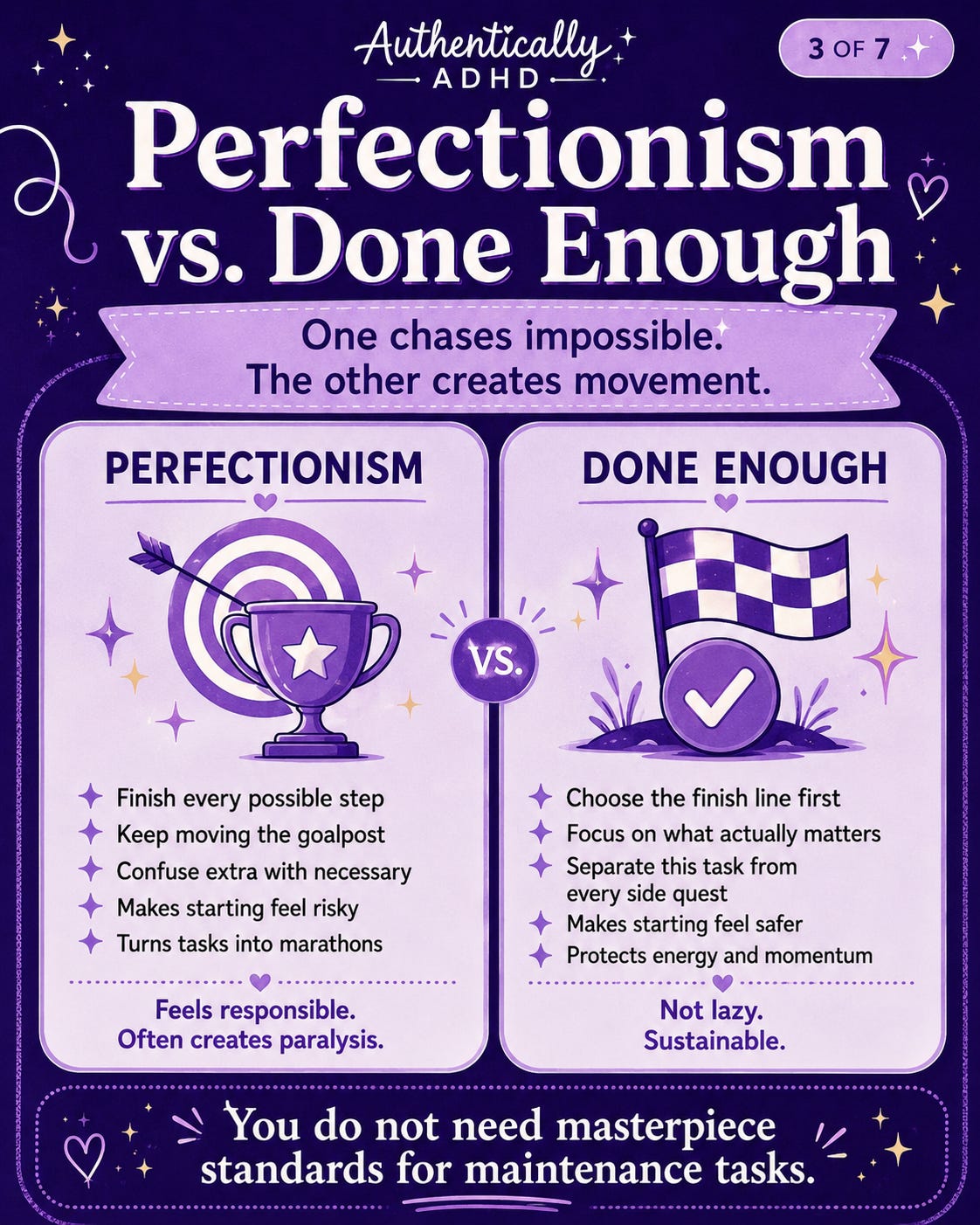
Perfectionism is often framed like, “Oh, you just have high standards.”
No, beloved.
For many AuDHDers, perfectionism is not luxury. It is not sparkle ambition. It is not “I just care too much.”
Sometimes perfectionism is trauma in a blazer.
It can come from years of being corrected, misunderstood, rushed, shamed, called lazy, called too much, called careless, called dramatic, called smart-but-not-trying, called “so capable” while silently drowning.
So the brain learns:
“If I do it perfectly, maybe I won’t be criticized.”
“If I prepare for every outcome, maybe I won’t be surprised.”
“If I finish every possible piece, maybe I can finally relax.”
“If I make it flawless, maybe nobody will notice how hard this was.”
Spoiler: perfectionism does not create peace.
It creates a hostage situation.
Because if the only acceptable version of done is perfect, then done becomes impossible. And if done is impossible, starting becomes terrifying. And if starting is terrifying, we avoid. And then we feel shame. And then the task grows teeth.
A simple task becomes a haunted forest.
You came here to fold laundry.
Now you are confronting your entire identity as a person who owns socks.
The Brain Science, But Make It Human
Your brain is not a moral failure machine.
It is a prediction machine, a pattern machine, a threat detector, a dopamine seeker, a sensory processor, and occasionally a raccoon in a trench coat holding a to-do list.
Executive functioning is the brain’s management system. It helps with things like:
starting
stopping
planning
sequencing
shifting attention
holding steps in working memory
choosing what matters most
ignoring distractions
knowing when “enough” is enough
For AuDHDers, these systems can be inconsistent. Not absent. Not broken. Inconsistent.
Meaning one day you can build an entire content calendar, clean the kitchen, answer messages, research the neuroscience of dopamine, and make a color-coded graphic before lunch.
The next day, brushing your teeth feels like applying for a mortgage in a burning building.
That inconsistency is one of the most misunderstood parts of neurodivergent functioning. People see your high-capacity days and assume your low-capacity days are a character flaw.
They are not.
They are nervous system weather.
And “Define Done” works because it reduces how much invisible thinking the brain has to do during the task.
Instead of asking your brain to constantly decide:
“Is this enough?”
“What next?”
“Should I also do that?”
“What counts?”
“Can I stop?”
“Am I a trash goblin if I stop here?”
You decide before the task starts.
You give your brain a finish line.
And the nervous system whispers, “Oh thank God, a map. I was about to start chewing through the furniture.”
Active Processing Check-In
When you avoid a task, is it because you don’t want to do it — or because you don’t know what “finished” is supposed to look like?
What would change if you were allowed to stop at “done enough”?
Define Done: The Fence Around the Task
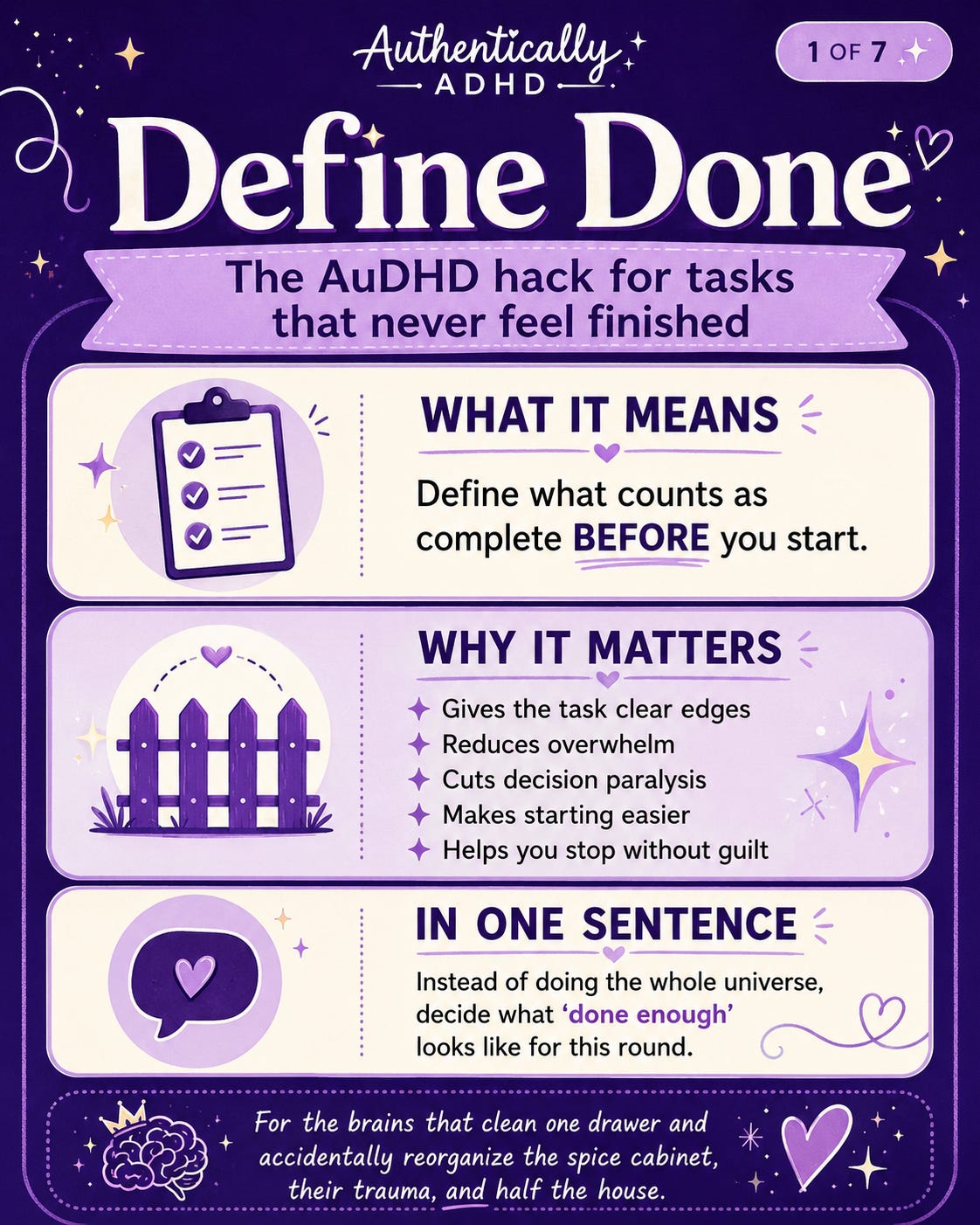
Define Done means you decide, in advance, what counts as complete.
Not what counts as perfect.
Not what counts as impressive.
Not what counts as “my mother-in-law could lick the baseboards and survive.”
Complete.
A good “done” definition is:
specific
visible
realistic
time-aware
energy-aware
tied to the actual goal
free of surprise side quests
For example:
Vague task: Clean the bedroom.
Defined Done: Clothes in hamper, trash in bag, dishes to kitchen, clear nightstand. Stop.
Vague task: Work on blog.
Defined Done: Write messy intro, create 5 section headers, add 3 bullet points under each. Stop.
Vague task: Organize desk.
Defined Done: Throw away obvious trash, put pens in cup, stack papers in one pile, clear keyboard area. Stop.
Vague task: Do laundry.
Defined Done: Wash one load and move it to dryer. Folding is a separate task because I am not trying to meet God today.
Vague task: Answer emails.
Defined Done: Reply to the three time-sensitive emails. Archive obvious junk. Stop after 20 minutes.
Do you see the magic?
You are not lowering the standard.
You are removing the fog.
You are telling your brain: “This is the mission. Not the entire war. Just this mission.”
Because AuDHD brains do better when the task has edges.
Edges reduce ambiguity.
Edges reduce decisions.
Edges reduce shame.
Edges reduce the chance that cleaning one drawer becomes a full psychological excavation sponsored by Target baskets.
Why This Helps With Starting
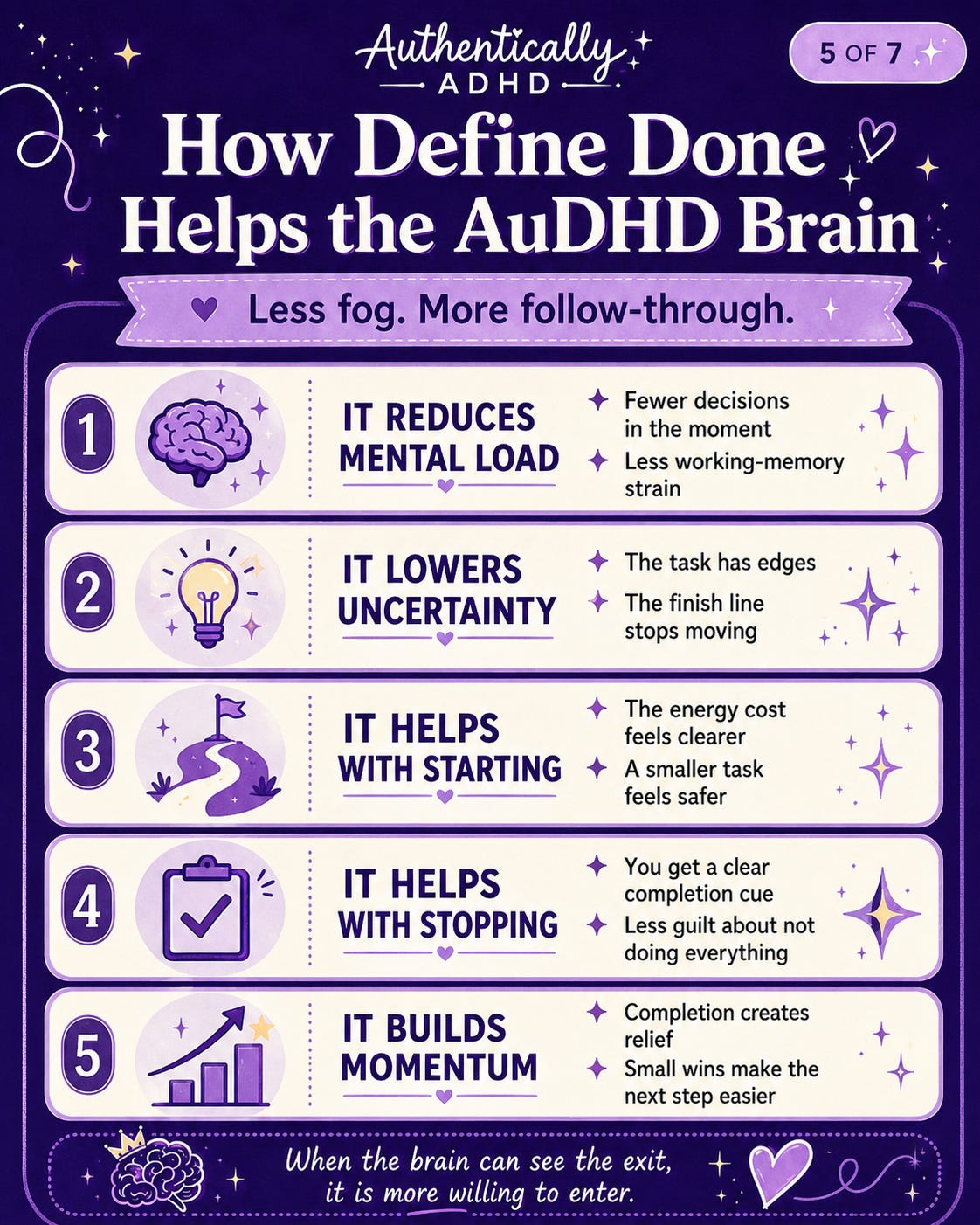
Starting is hard when the brain does not know how much the task will cost.
An undefined task is basically a mystery bill.
Your brain is like, “How much energy are we spending here? Ten minutes? Three hours? Our will to live?”
No answer.
So the brain delays.
Not because you are lazy.
Because the task has no price tag.
Define Done puts a price tag on the task.
It says:
“This will take 10 minutes.”
“This only includes the counter.”
“This does not include the pantry.”
“This only needs to be readable, not Pulitzer-worthy.”
“This is a first draft, not a public execution.”
That matters because task initiation often depends on perceived effort. If the brain predicts a task will be endless, punishing, boring, emotionally loaded, or impossible to complete correctly, it may throw the emergency brake.
Avoidance is not always “I don’t care.”
Sometimes avoidance is your brain saying:
“I cannot enter a task with no exit sign. That is how horror movies start.”
Define Done gives the brain an exit sign.
And once your brain sees the exit, it is often more willing to enter.
Active Processing Check-In
What task are you avoiding because it feels endless?
What is the smallest version of “done” that would still meaningfully move it forward?
Not impressively.
Meaningfully.
There is a difference.
Why This Helps With Finishing
AuDHDers can struggle with stopping for two opposite reasons:
Distractibility: We wander away before the task is finished.
Hyperfocus/perfectionism: We cannot stop because suddenly the task must become a masterpiece, a lifestyle brand, and a redemption arc.
Define Done helps both.
If you are prone to wandering, the defined finish line pulls you back:
“Right. I only need trash in the bag and clothes in the hamper.”
If you are prone to overdoing, the defined finish line gives you permission to stop:
“Right. I said I would clear the nightstand. I did not say I would reorganize every memory attached to this room.”
The finish line has to be chosen before the emotional spiral begins.
Because once you are in the task, your brain may start making deals like a cursed little productivity demon:
“Well, since we’re already here, we should also clean the closet.”
“And since the closet is open, we should try on old clothes.”
“And since we are trying on old clothes, we should question our entire body image history.”
“And since we are already sad, maybe we should reorganize the photos.”
“And since we are touching photos, let’s relive middle school.”
No.
Absolutely not.
We are cleaning the nightstand, not summoning every ghost from 2007.
Define Done is how we lovingly but firmly tell the brain:
“Put down the shovel. We are not digging there today.”
The Dark Humor Truth: Your Brain Will Try to Add DLC
Tasks come with downloadable content.
You start one task, and suddenly your brain unlocks bonus levels:
Laundry: The Sock Sorting Expansion Pack
Dishes: The Cabinet Reorganization DLC
Email: The Inbox Shame Cinematic Universe
Budgeting: The Existential Dread Season Pass
Cleaning: The “Why Am I Like This?” Director’s Cut
Writing: The “This Has To Heal Everyone Who Has Ever Suffered” Deluxe Edition
Define Done prevents task creep.
Task creep is when the original task slowly mutates until it is no longer a task. It is a hydra. You complete one piece and three more heads appear, each wearing a tiny name tag that says “urgent.”
This is why “done enough” is not laziness.
“Done enough” is a containment strategy.
It is nervous system harm reduction.
It is saying, “I am allowed to complete the actual task without adopting every orphaned responsibility in the room.”
Because listen.
The spice cabinet can wait.
Your childhood trauma can wait.
The drawer does not need a thesis statement.
Define Done Examples for Real Life
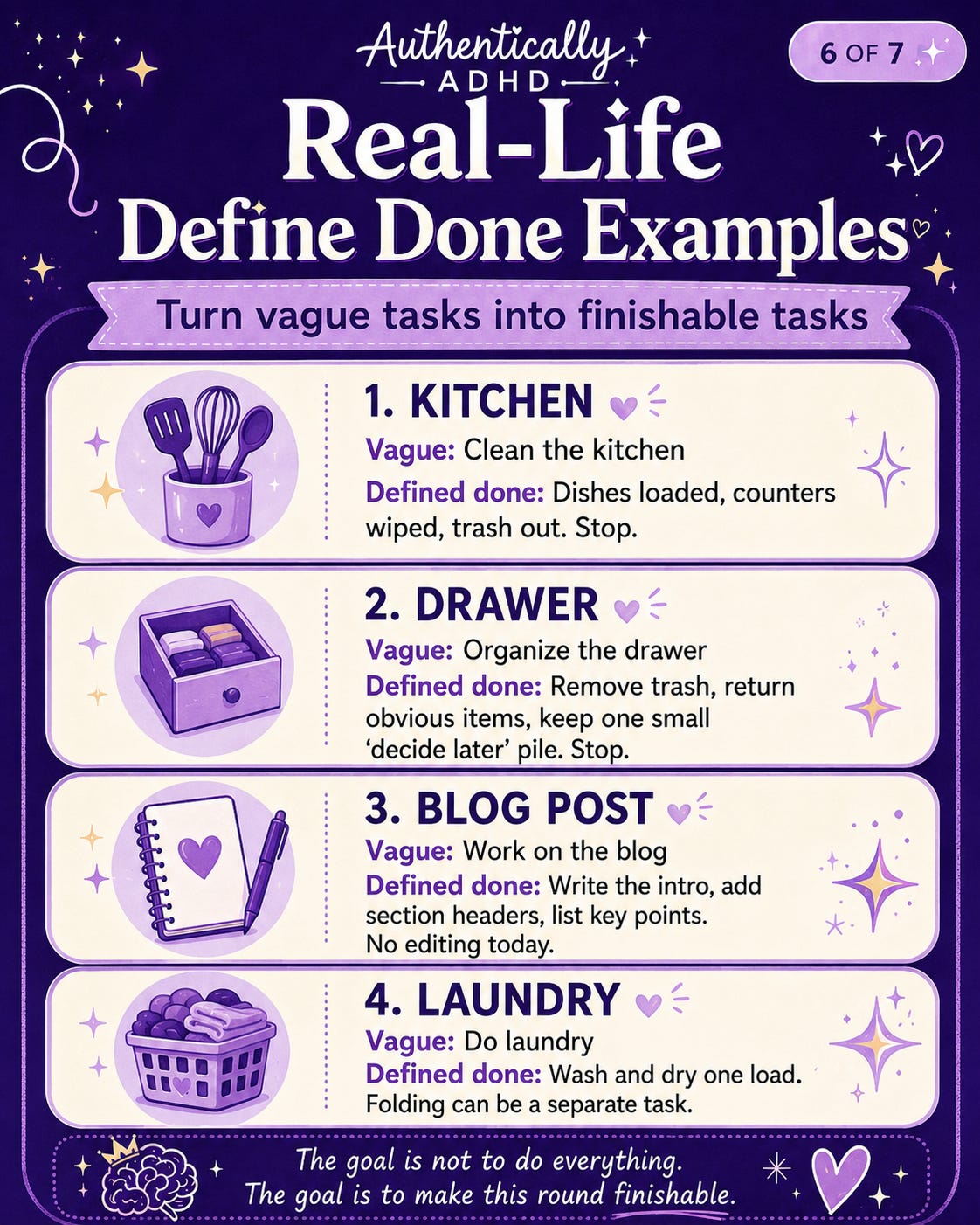
1. Cleaning the Kitchen
Too vague: Clean kitchen.
Define Done:
Dishes loaded or stacked by sink
Counters wiped
Trash taken out if full
Floor ignored unless sticky enough to qualify as a crime scene
Done enough statement:
“The kitchen is functional and not actively summoning pests. Done.”
2. Decluttering a Drawer
Too vague: Organize drawer.
Define Done:
Remove trash
Put obvious items where they belong
Keep uncertain items in one small “decide later” container
Stop after 15 minutes
Done enough statement:
“The drawer opens without emotional resistance. Done.”
3. Writing a Blog Post
Too vague: Work on blog.
Define Done:
Pick title
Write messy intro
Create section headings
Add bullet notes under each heading
No editing today
Done enough statement:
“This is a skeleton. Skeletons are allowed to be ugly. Done.”
4. Laundry
Too vague: Do laundry.
Define Done:
Start one load
Move one load
Put clean clothes in a basket
Folding is tomorrow’s demon
Done enough statement:
“Clean clothes exist. They do not need to be in a drawer to be morally valid. Done.”
5. Emails
Too vague: Catch up on email.
Define Done:
Reply to three urgent messages
Delete obvious junk
Flag anything that needs more brain
Stop after 25 minutes
Done enough statement:
“The inbox is less on fire. Done.”
6. Resetting a Room
Too vague: Reset the living room.
Define Done:
Trash out
Dishes to kitchen
Blankets on couch
Toys/items in one basket
Lights off
Done enough statement:
“The room is no longer yelling at me. Done.”
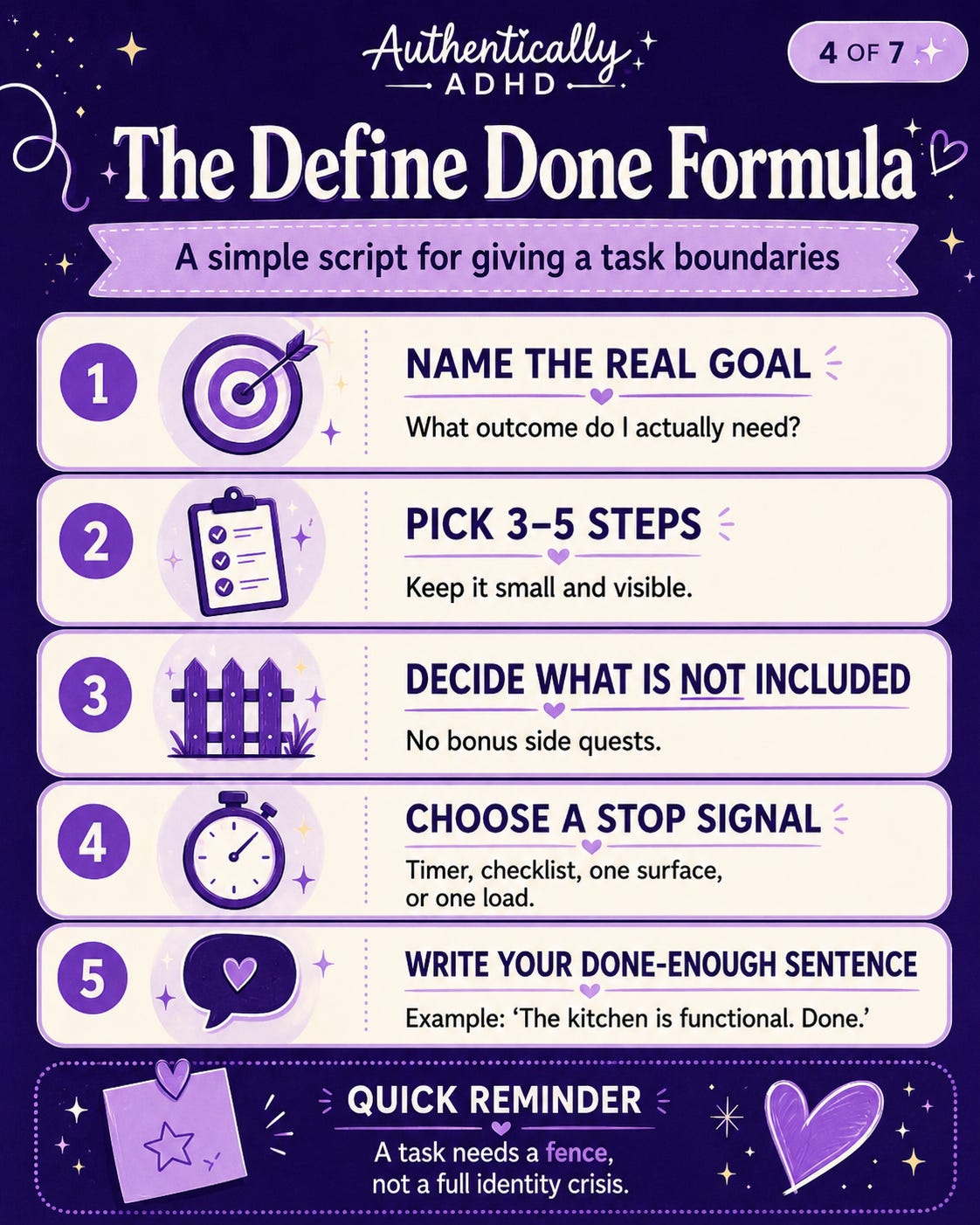
The Define Done Formula
Before you start, ask:
1. What is the actual outcome I need?
Not the fantasy outcome. The actual one.
Do I need the room spotless, or do I need to walk through it without stepping on a Lego and seeing the face of God?
Do I need the blog perfect, or do I need a workable draft?
Do I need the drawer aesthetic, or do I need to find batteries without entering spiritual warfare?
2. What are the required steps?
Keep this tiny.
If your list has 47 steps, that is not a task. That is a government program.
Pick three to five.
3. What is excluded?
This is the secret sauce.
Define what you are not doing.
“I am cleaning the counter, not reorganizing cabinets.”
“I am drafting, not editing.”
“I am sorting papers into piles, not solving every paper today.”
“I am washing laundry, not folding.”
“I am planning dinner, not reinventing my relationship with nutrition.”
Exclusions protect the task from becoming a swamp.
4. What is my stop signal?
How will you know to stop?
Examples:
timer goes off
checklist is complete
one basket is full
three emails answered
one surface cleared
one paragraph written
energy drops below “human-ish”
5. What does done enough look like?
This is the mercy line.
Not “perfect.”
Not “Pinterest.”
Not “neurotypical influencer with matching beige containers.”
Done enough.
Functional.
Safe.
Usable.
Clearer.
Started.
Moved forward.
Less awful.
Sometimes “less awful” is a legitimate productivity metric.
Put it on a mug.
Active Processing: Build Your Own Define Done
Pick one task you have been avoiding.
Now answer:
What is the task?
What is the actual goal?
What are 3–5 steps that count?
What is NOT included?
How long will I spend?
What is my stop signal?
What sentence will I say when I am done?
Example:
Task: Clean desk.
Actual goal: Be able to use my laptop and find my planner.
Steps: Throw away trash, put cups in kitchen, stack papers, clear keyboard space.
Not included: Sorting every paper, decorating, reorganizing drawers.
Time: 15 minutes.
Stop signal: Timer or clear laptop space.
Done statement: “My desk is usable. Done.”
That is the spell.
You’re welcome, tiny productivity witches.
But What If I Stop and It Still Feels Unfinished?
Oh, it might.
Let’s not lie to the people.
Your brain may still itch.
Especially if you are used to pushing past your limits, chasing perfect, or only allowing yourself to rest when everything is complete.
The first few times you practice done enough, your nervous system may act like you abandoned a baby in a parking lot.
You did not.
You left a drawer slightly imperfect.
No one call Dateline.
When “done enough” feels wrong, try saying:
“This task met the definition I chose.”
“More can be done later, but this round is complete.”
“Stopping is part of the plan, not a failure of the plan.”
“I am practicing completion, not perfection.”
“The discomfort of stopping is not proof that I did it wrong.”
“My brain wants more certainty. I can offer it a boundary instead.”
This matters because perfectionism often disguises itself as responsibility.
But there is a difference between being responsible and being consumed.
There is a difference between caring and self-erasing.
There is a difference between doing a task well and feeding your nervous system to the productivity gods.
Define Done helps you practice ending.
And ending is a skill.
Especially when your brain is allergic to transitions and closure feels fake unless every loose end is tied, laminated, and blessed by a committee.
The “Done Enough” Reframe
Done enough is not:
lazy
careless
giving up
half-assing your life
letting chaos win
proof you are failing adulthood
Done enough is:
capacity-aware
sustainable
realistic
nervous-system friendly
a boundary
a bridge
a way to keep going without burning down your own village
The goal is not to lower your standards until nothing matters.
The goal is to stop applying masterpiece standards to maintenance tasks.
Not every task deserves your whole soul.
Some tasks deserve 10 minutes and a “good enough, babe.”
You do not need to deep clean the bathroom like the Queen is arriving with a UV flashlight.
You need the sink usable.
You do not need to write the final version of your blog in one sitting while channeling every ancestor.
You need a messy draft.
You do not need to create the perfect morning routine with 19 steps and a sunrise ritual.
You need one repeatable action that gets you from goblin mode to semi-human.
That is enough.
And enough is not a dirty word.
Tips & Strategies: How to Actually Use Define Done
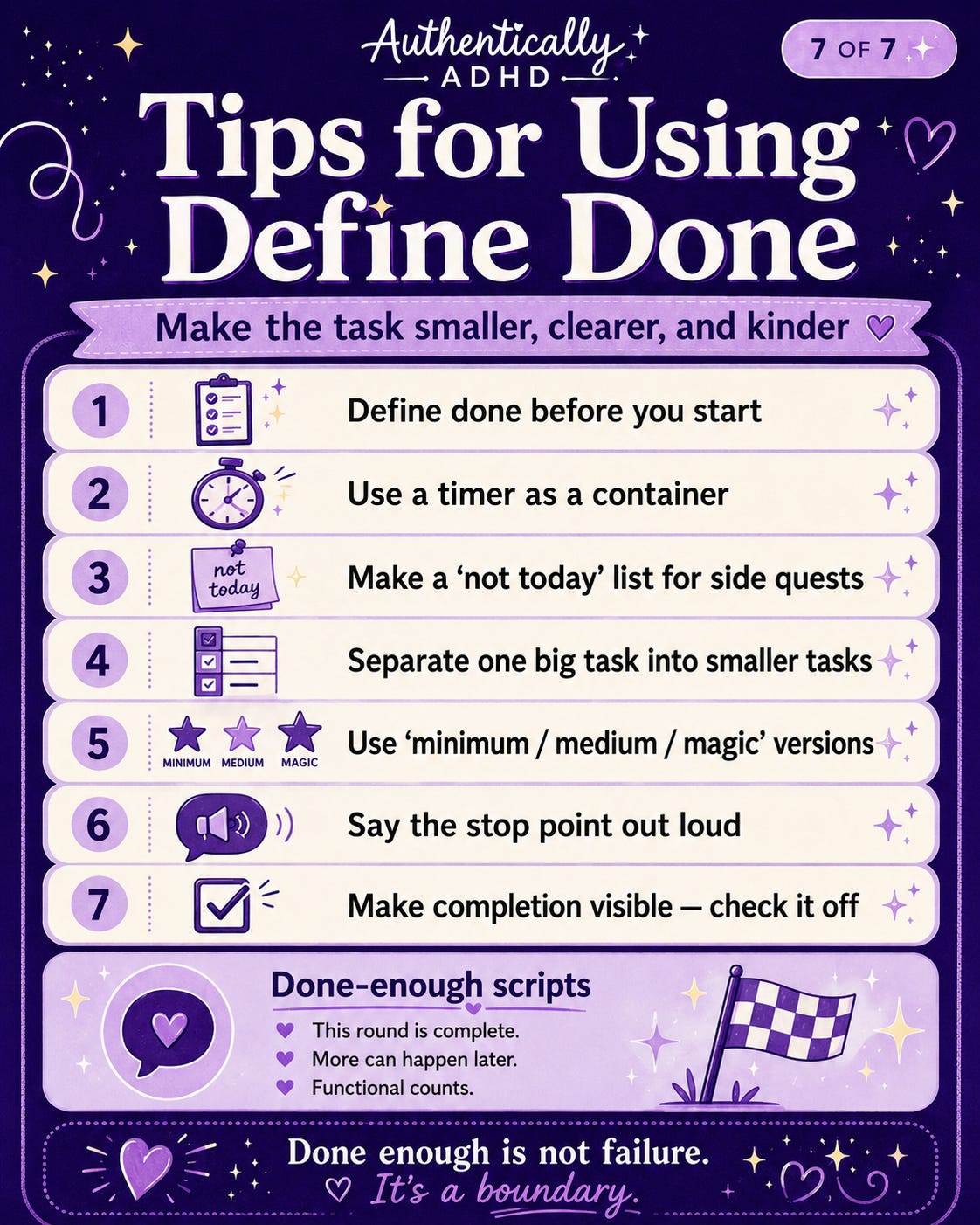
1. Define done before you touch the task
Once you start, your brain will negotiate.
Do not negotiate with the raccoon.
Write the finish line first.
2. Use a timer as a boundary, not a threat
A timer is not there to bully you.
It is there to create a container.
Try: “I am doing 15 minutes of kitchen reset. When the timer ends, I stop or reassess.”
3. Make a “not today” list
When side quests pop up, write them down instead of following them into the woods.
Example:
organize pantry — not today
clean microwave — not today
sort junk drawer — not today
research whether I need a new personality — absolutely not today
4. Separate tasks that pretend to be one task
Laundry is not one task.
Laundry is:
gather clothes
wash
dry
fold
put away
Those are different tasks wearing one trench coat.
Define which one you are doing.
5. Use “minimum, medium, magic”
Give yourself three versions.
Minimum: Trash out.
Medium: Trash out + counters wiped.
Magic: Trash out + counters + dishes + sweep.
Minimum still counts.
Magic is optional.
Do not make magic the entry fee.
6. Decide what “future you” needs
Not what imaginary perfect you would do.
What does actual future you need?
Future you may not need a spotless room.
Future you may need:
a clean shirt
a visible planner
lunch packed
a clear path to the bed
fewer mystery smells
Serve her.
Not the fantasy version. The real one.
7. Practice stopping on purpose
This will feel illegal at first.
Stop anyway.
You are teaching your brain that stopping at a boundary is safe.
The task can be incomplete globally but complete for this round.
That distinction is everything.
8. Use body doubling or narration
Say out loud:
“I am clearing the table. I am not cleaning the whole kitchen.”
“I am replying to this email. I am not reorganizing my inbox.”
“I am folding towels. I am not confronting the entire laundry ecosystem.”
Narration gives the brain a rail to ride.
9. Make completion visible
Cross it off. Put a sticker. Say “done” out loud. Text a friend. Tap the counter twice like a tiny goblin ritual.
Your brain needs proof of closure.
Make the ending visible.
10. Build a Done Enough Menu
Keep a list of common tasks with pre-written definitions.
Examples:
Bathroom reset: trash, sink, toilet, towels. Stop.
Kitchen reset: dishes, counters, trash. Stop.
Desk reset: trash, cups, paper pile, laptop space. Stop.
Blog draft: title, intro, headings, rough bullets. Stop.
Laundry round: wash and dry one load. Stop.
When your brain is overloaded, do not make it invent the plan from scratch.
That is rude. It’s also not reality.
Final Thought: You Are Allowed to Finish Small
The AuDHD brain can be brilliant, intense, creative, pattern-seeking, justice-sniffing, emotionally deep, and wildly capable.
It can also turn “clean one drawer” into a full archaeological dig through every identity you have ever worn.
Both can be true.
Define Done is not about becoming a productivity robot.
Gross. No thank you.
It is about creating enough structure that your brain can stop drowning in possibility.
It is about giving tasks edges.
It is about choosing a finish line before shame moves it.
It is about learning that completion does not have to be dramatic to count.
Sometimes done is a spotless room.
Sometimes done is a trash bag by the door.
Sometimes done is one paragraph.
Sometimes done is putting the clean laundry in a basket and deciding that wrinkles are just fabric with a past.
You are allowed to define done in a way that honors your capacity.
You are allowed to stop before collapse.
You are allowed to call “less awful” progress.
You are allowed to finish small.
And you are allowed to be proud of that.
Because done enough is still done.
And honestly?
That drawer was getting too powerful anyway.
Define Done Before the Task Defines You FREE RESOURCE
A Short AuDHD Companion Guide + Workbook

For tasks that keep multiplying like gremlins with access to your nervous system.
Welcome, Beautiful Overthinky Goblin
This workbook is for the AuDHD brain that starts with:
“I’ll just clean this one drawer.”
And somehow ends up:
reorganizing the spice cabinet
sorting photos from 2011
questioning your entire childhood
finding one mysterious key
becoming emotionally attached to a paperclip
and still not knowing whether the drawer is technically “done”
This guide is here to help you build one tiny but powerful skill:
Defining done before you start.
Because when a task has no edges, your brain has to invent the edges while also doing the task, managing sensory input, regulating emotion, remembering the steps, fighting perfectionism, ignoring side quests, and pretending to be a functional adult.
No wonder we short-circuit.
This workbook will help you turn vague, haunted tasks into clear, finishable tasks.
Not perfect.
Finishable.
Tiny sparkle difference. Huge nervous system difference.
Part 1: What “Define Done” Means
Define Done means deciding what counts as complete before you begin.
Not after you are already overwhelmed.
Not once the task has grown tentacles.
Not when your brain is standing in the kitchen whispering, “Maybe we should reorganize every cabinet and become a new person.”
Before.
A “done definition” gives your task:
a clear goal
a limited scope
a stopping point
permission to be enough
protection from side quests
a way to end without guilt
The Core Idea
Instead of asking:
“How do I finish everything?”
Ask:
“What does done enough look like for this round?”
Because this round matters.
You do not have to complete the entire life-category of cleaning, writing, planning, laundry, self-improvement, healing, and becoming a person who owns matching containers.
You are allowed to complete one round.
Active Processing Question
What task in your life currently feels endless?
Write it here:
Task that feels endless:
Why does it feel hard to finish?
☐ It has too many steps
☐ I don’t know where to start
☐ I keep finding side quests
☐ I want it to be perfect
☐ I don’t know what counts as enough
☐ I feel guilty stopping
☐ I underestimate how long it takes
☐ I get overwhelmed and freeze
☐ Other: ___________________________________________
Part 2: The Open-Ended Task Trap
Open-ended tasks are tasks with no clear finish line.
Examples:
Clean the house
Organize my room
Work on content
Catch up on emails
Declutter
Plan my week
Get my life together
Fix my routine
Be better
Rude. Vague. Suspicious.
An AuDHD brain often struggles with open-ended tasks because it has to figure out too many invisible things at once:
What counts?
What comes first?
What matters most?
What can wait?
How long should this take?
What does finished look like?
When am I allowed to stop?
Am I a bad person if I stop before it is perfect?
And then the brain does the logical thing:
It freezes.
Or starts twelve side quests.
Or enters hyperfocus and emerges four hours later with a reorganized closet, no lunch, and a soul that feels like static.
Open-Ended Task Decoder
Choose one vague task and break it down.
My vague task is:
Example: “Clean the kitchen.”
Now list every possible thing your brain thinks this task could include:
Look at that list.
That is not one task.
That is a tiny unpaid internship.
Now circle or star only the parts that truly matter for this round.
Part 3: The Define Done Formula
Use this formula before starting a task.
Step 1: Name the Real Goal
Ask:
What outcome do I actually need?
Not the fantasy outcome.
Not the Pinterest outcome.
Not the “I will become an entirely different person by 3:00 PM” outcome.
The real one.
Examples:
Task: Clean kitchen
Real goal: Make the kitchen functional enough to cook dinner.
Task: Work on blog
Real goal: Create a rough draft skeleton.
Task: Laundry
Real goal: Have clean clothes available tomorrow.
Task: Desk reset
Real goal: Clear enough space to use my laptop.
Your Turn
Task:
The real goal is:
Step 2: Pick 3–5 Steps
Keep it small. Keep it visible. Keep it realistic.
If your list has 27 steps, congratulations, you have accidentally created a beast. Put it back in the cage.
My 3–5 Steps Are:
Reminder: You are not listing every possible step.
You are listing what counts for this round.
Step 3: Decide What Is NOT Included
This is the spicy little magic piece.
Defining done is not only about what you are doing.
It is also about what you are not doing.
This protects you from side quests.
Examples:
Kitchen reset does NOT include:
organizing the pantry
scrubbing the oven
matching every container lid
emotionally processing why I own six spatulas
Blog draft does NOT include:
final editing
SEO
graphics
rewriting every sentence until my soul exits my body
Laundry does NOT include:
folding every load
putting everything away
cleaning the closet
becoming a capsule wardrobe influencer
My “Not Included” List
For this task, I am NOT doing:
Tiny truth:
“Not included” is not failure. It is a boundary.
Step 4: Choose a Stop Signal
Your stop signal tells your brain, “This round is complete.”
A stop signal can be:
a timer
a checklist
one clear surface
one full bag
one completed load
one paragraph
one email batch
one basket
one body cue
My Stop Signal Is:
☐ Timer: ______ minutes
☐ Checklist complete
☐ One surface cleared
☐ One basket filled
☐ One load finished
☐ One section drafted
☐ Energy drops below: _____________________________
☐ Other: _________________________________________
My exact stop signal:
Step 5: Write Your Done-Enough Sentence
This is the sentence you say when the task is complete for this round.
It helps create closure.
Not fake closure.
Not toxic positivity closure.
Real, practical, “we are not feeding the perfectionism demon today” closure.
Examples:
“The kitchen is functional. Done.”
“The draft has a skeleton. Done.”
“Clean clothes exist. Done.”
“The desk is usable. Done.”
“The inbox is less on fire. Done.”
“This round is complete. More can happen later.”
“Functional counts.”
“Done enough is allowed.”
My Done-Enough Sentence:
Part 4: Minimum / Medium / Magic
This is one of my favorite AuDHD-friendly ways to define done.
Because some days you have main-character energy.
Other days you have “haunted Victorian child in a blanket” energy.
Both deserve a plan.
Minimum
The smallest version that still counts.
Medium
The helpful version if you have a little more capacity.
Magic
The bonus version if your brain has suddenly opened a productivity portal.
Important:
Minimum still counts.
Magic is not the entry fee.
Minimum / Medium / Magic Template
Task: ___________________________________________
Minimum Version
What is the smallest useful version?
Medium Version
What would be a solid, realistic version?
Magic Version
What would be amazing if I have extra capacity?
Today, I am choosing:
☐ Minimum
☐ Medium
☐ Magic
Why?
Part 5: Side Quest Parking Lot
Side quests are not always bad ideas.
They are just not always today’s ideas.
Your brain may offer helpful little chaos suggestions like:
“Clean the drawer.”
“Actually, reorganize the whole kitchen.”
“Actually, research new storage bins.”
“Actually, redo your entire morning routine.”
“Actually, start a podcast series on the psychology of spoons.”
“Actually, what if we healed every wound before lunch?”
No, sweet raccoon.
Write it down. Park it. Come back later.
Side Quest Parking Lot
When a side quest appears, write it here instead of following it into the forest.
After the original task is done, ask:
☐ Does this actually need to happen?
☐ Does it need to happen today?
☐ Can it become its own defined task?
☐ Can I delete it from my life like emotional spam?
Part 6: Real-Life Define Done Examples
Kitchen Reset
Vague: Clean the kitchen.
Defined Done:
dishes loaded or stacked
counters wiped
trash taken out if full
floor ignored unless sticky enough to qualify as a crime scene
Done-enough sentence:
“The kitchen is functional. Done.”
Laundry
Vague: Do laundry.
Defined Done:
wash one load
dry one load
put clean clothes in basket
Not included: folding, putting away, reorganizing drawers, crying over socks.
Done-enough sentence:
“Clean clothes exist. Done.”
Blog Post
Vague: Work on blog.
Defined Done:
choose title
write messy intro
add section headers
bullet key points
Not included: editing, SEO, graphics, becoming the Shakespeare of neurodivergent productivity.
Done-enough sentence:
“The draft has bones. Done.”
Desk Reset
Vague: Organize desk.
Defined Done:
throw away trash
cups to kitchen
stack papers
clear laptop space
Not included: sorting every paper, buying new supplies, redesigning your entire work identity.
Done-enough sentence:
“My desk is usable. Done.”
Email Catch-Up
Vague: Catch up on email.
Defined Done:
reply to 3 time-sensitive emails
delete obvious junk
flag anything that needs more brain
Not included: reaching inbox zero, rewriting every response 14 times, spiraling about tone.
Done-enough sentence:
“The inbox is less on fire. Done.”
Part 7: My Define Done Planner
Use this page anytime a task feels too big, vague, or haunted.
Task Name
Why This Task Matters
What will this help with?
Real Goal
What outcome do I actually need?
Done Means These 3–5 Things
Not Included
Stop Signal
Time/Energy Boundary
I will spend:
☐ 5 minutes
☐ 10 minutes
☐ 15 minutes
☐ 20 minutes
☐ 25 minutes
☐ Other: _____________
My energy limit is:
☐ Stop when I feel irritated
☐ Stop when I feel foggy
☐ Stop when I start adding side quests
☐ Stop when my body says “absolutely not, bestie”
☐ Other: _________________________________________
Done-Enough Sentence
Part 8: After-Task Reflection
This is not for judgment.
This is data.
We are gathering clues, not building a courtroom.
What did I complete?
Did I follow my defined done?
☐ Yes
☐ Mostly
☐ No, I got side-quested
☐ No, perfectionism hijacked the vehicle
☐ I started, and that still counts
What helped?
☐ Timer
☐ Checklist
☐ Smaller steps
☐ Saying the boundary out loud
☐ Body doubling
☐ Music
☐ Writing down side quests
☐ Choosing minimum instead of magic
☐ Other: _________________________________________
What got in the way?
☐ Task was still too big
☐ Too many decisions
☐ Sensory overwhelm
☐ Perfectionism
☐ Shame spiral
☐ Time blindness
☐ Hunger/thirst/fatigue
☐ I forgot the plan existed because brain
☐ Other: _________________________________________
What would I change next time?
One thing I’m proud of:
Tiny note:
Starting counts.
Stopping counts.
Learning your patterns counts.
Done enough counts.
Part 9: Done-Enough Scripts
Use these when your brain wants to argue with your boundary.
When the task feels unfinished:
“This round is complete.”
“More can happen later.”
“I finished what I defined.”
“The discomfort of stopping does not mean I failed.”
“This is done enough for now.”
When perfectionism shows up:
“Perfect is not the price of being allowed to stop.”
“I do not need masterpiece standards for maintenance tasks.”
“Extra is not always necessary.”
“I can care without overfunctioning.”
“Done enough protects my future energy.”
When side quests appear:
“Great idea. Not today.”
“That belongs in the parking lot.”
“Different task. Different round.”
“I am not following the raccoon into the woods.”
“The spice cabinet can remain spiritually unhealed.”
When shame gets loud:
“I am not lazy. I am reducing ambiguity.”
“My brain does better with edges.”
“Small completion builds trust.”
“Functional is valid.”
“I am practicing sustainable follow-through.”
Part 10: My Done-Enough Menu
Create your own quick-reference list for common tasks.
Kitchen
Done enough means:
Bedroom
Done enough means:
Laundry
Done enough means:
Desk / Workspace
Done enough means:
Writing / Content
Done enough means:
Emails / Messages
Done enough means:
Planning My Week
Done enough means:
Self-Care Task
Done enough means:
Final Reminder
You are allowed to make the task smaller.
You are allowed to decide what counts.
You are allowed to stop before collapse.
You are allowed to finish one round without solving the entire universe.
You are allowed to choose functional over flawless.
You are allowed to be proud of “less awful.”
Because sometimes progress looks like a spotless room.
And sometimes progress looks like:
one cleared surface
one sent email
one trash bag
one paragraph
one washed load
one brave little “done”
Done enough is not failure.
It is a boundary.
It is a nervous system accommodation.
It is a way of saying:
“I am allowed to complete tasks without sacrificing myself on the altar of perfection.”
And honestly?
That drawer was getting too powerful anyway.
Quick One-Page Define Done Cheat Sheet
Task: ___________________________________________
Real goal:
Done means:
Not included:
Stop signal:
Time boundary: _________________________________
Done-enough sentence:
Side quests to park:
After-task note:
What worked?
What would I change next time?
One thing I’m proud of: