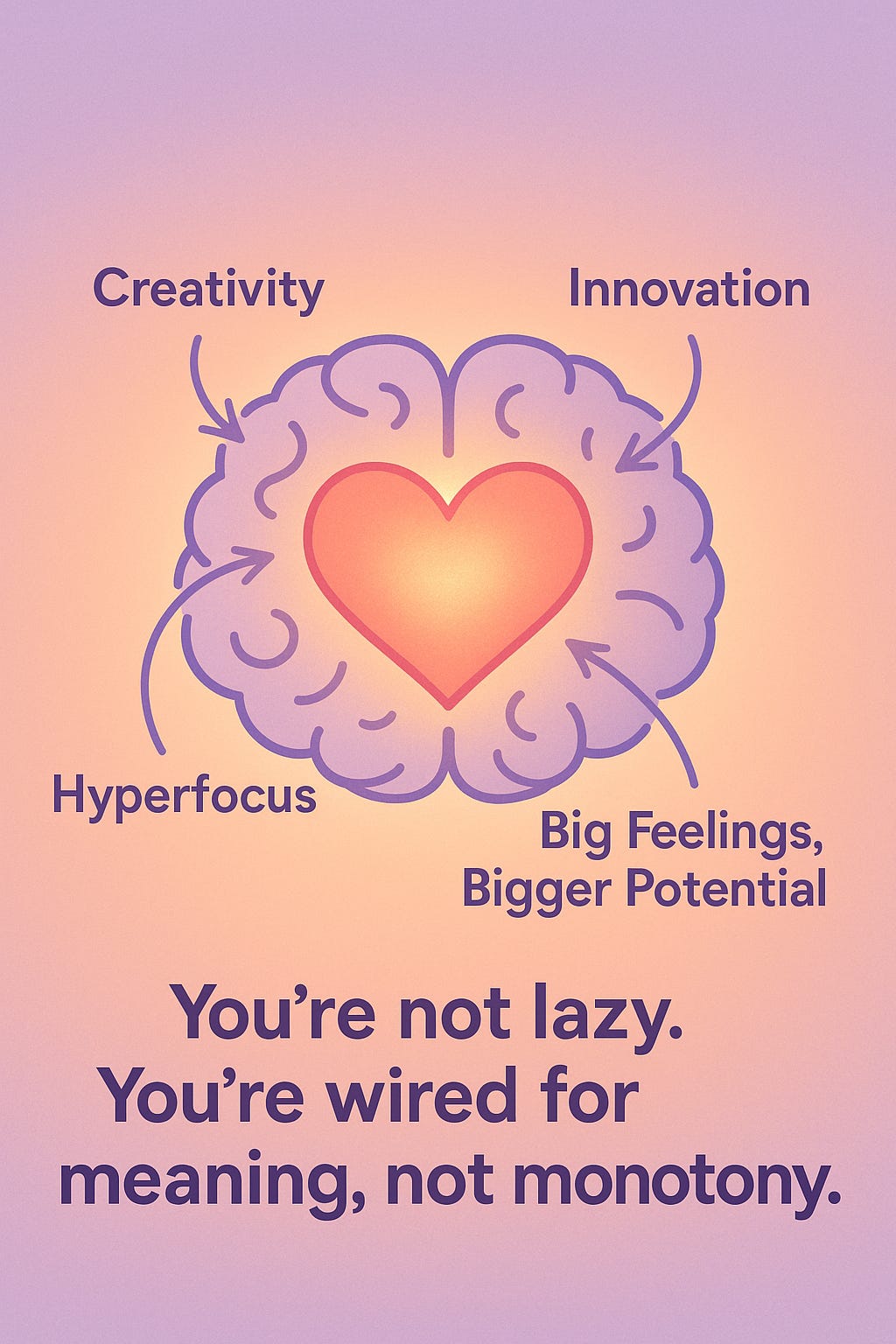
Executive Dysfunction Explained
Like You’re Talking to a Friend

You ever open your laptop to “get stuff done,” and next thing you know, you’re deep-diving into the history of bubble wrap instead of answering that email? Yeah, me too.
Welcome to the world of executive dysfunction — the invisible force field between you and the thing you want to do.
Let’s unpack what’s really going on in that gloriously overactive brain of yours — with a little neuroscience, a lot of compassion, and some honest, real-life examples that make this make sense.
🧠 What Is Executive Dysfunction, Really?
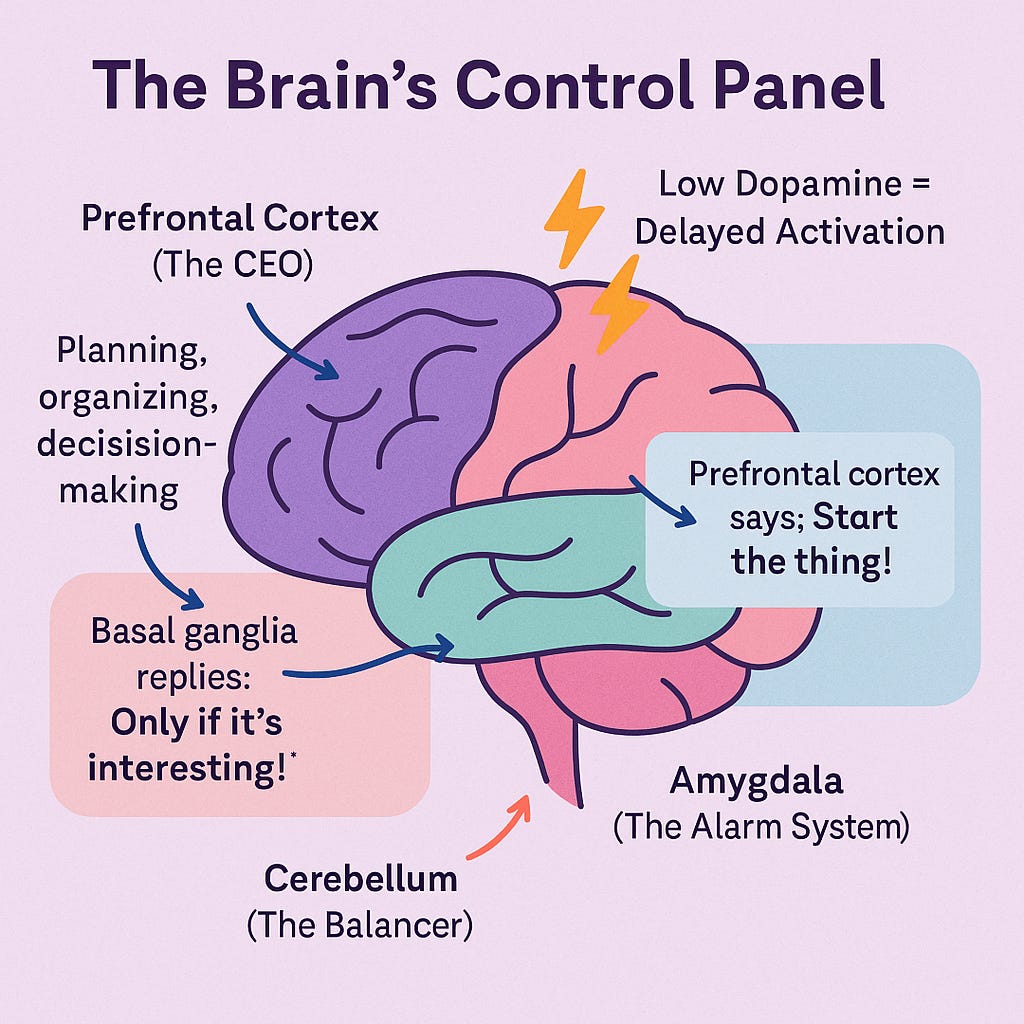
Think of your brain’s executive functions as the CEO of your life. They’re the mental managers that:
Plan what needs to be done
Prioritize what’s most important
Hold goals in working memory
Regulate emotions when things go sideways
Help you start (and finish) the dang thing
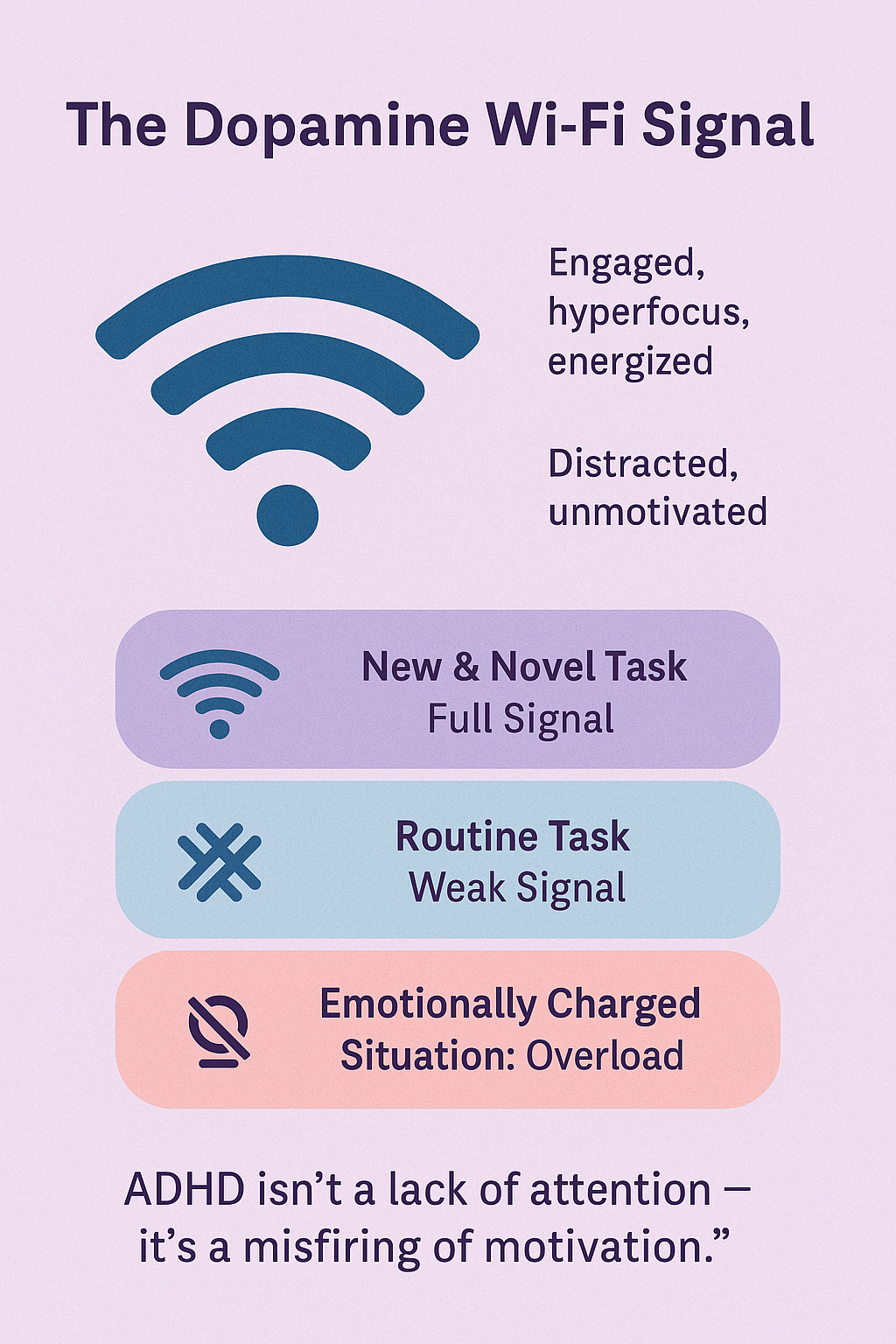
In ADHD brains, the “executive suite” — located in the prefrontal cortex — runs on a different kind of fuel: dopamine. And dopamine, my friend, is like emotional Wi-Fi for motivation.
When it’s low, the signal drops. The tasks that should feel urgent don’t register. The boring ones feel physically painful. And suddenly, we’re scrolling, daydreaming, or doing literally anything else.
Neuroscience tells us ADHD brains have differences in dopamine transmission and prefrontal connectivity (Barkley, 2020). That means the systems responsible for self-regulation, prioritization, and future planning aren’t broken — they’re just wired for now, not later.
⚙️ Why We Struggle
Let’s break down what’s happening behind the curtain:
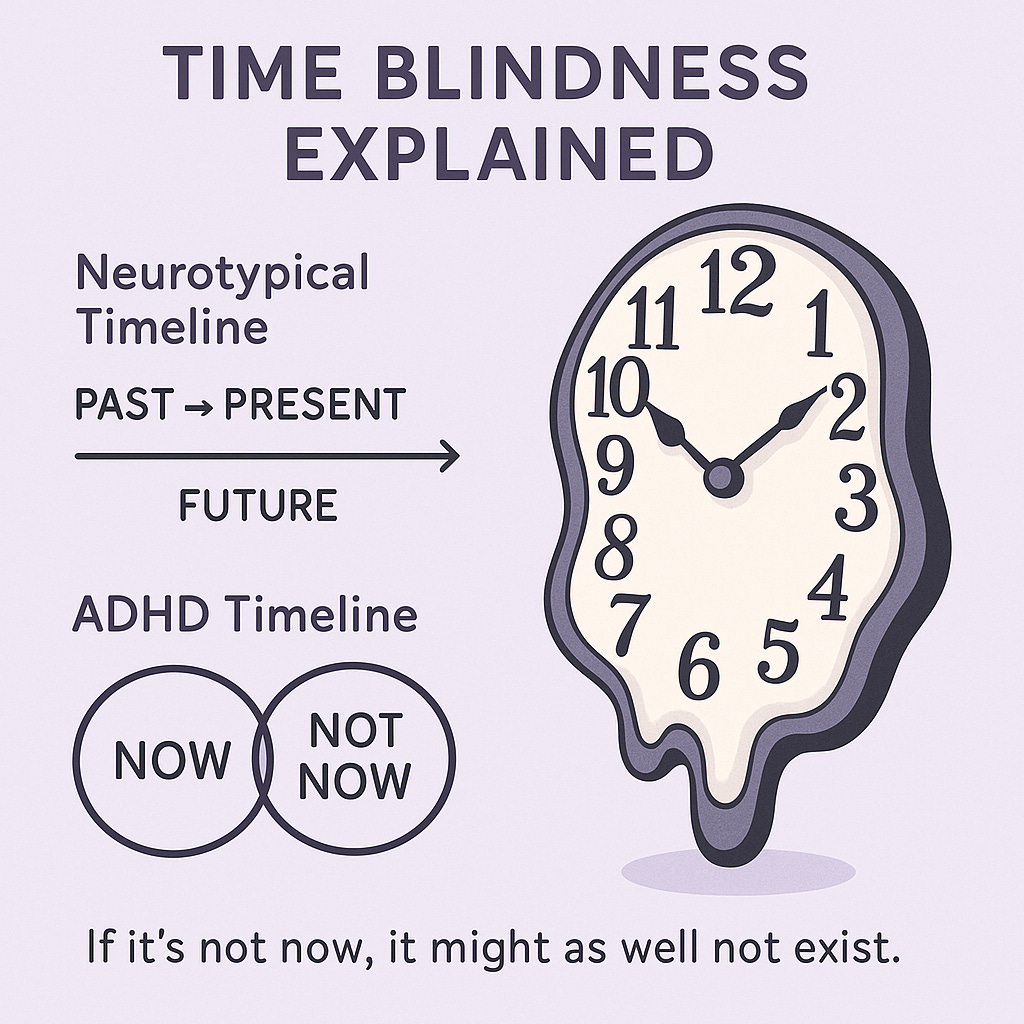
1. Time Blindness
ADHD brains don’t “feel” time the same way. We do not develop an internal clock the way our neurotypical peers do. The future isn’t a ticking clock — it’s an abstract fog.
That’s why “later” turns into “oops, yesterday.” Our brain doesn’t naturally keep a sense of when things are due, so we live in two modes: Now and Not Now.
2. Emotional Flooding
When stress hits, the limbic system (the emotional brain) hijacks the prefrontal cortex. Logic checks out. Executive function takes a nap.
That’s why a small mistake can feel like the world’s ending, or a simple task becomes impossible when you’re anxious.
3. Task Initiation Paralysis
It’s not laziness — it’s a neurological freeze. When a task doesn’t spark dopamine (read: isn’t interesting, urgent, or new), the brain can’t generate enough activation energy to start.
4. Working Memory Gaps
Working memory is your brain’s sticky note. In ADHD, that sticky note is... well, not very sticky.
You can know what to do, but if it’s not right in front of you, poof — gone.
5. Motivation Misfires
Dopamine drives interest-based motivation, not importance-based. So your brain doesn’t care that the task is urgent — it cares if it’s interesting, novel, or emotionally rewarding.
💥 What It Looks Like in Real Life
Let’s bring it down to earth. Executive dysfunction shows up like this:
You start cleaning your desk and end up reorganizing your childhood photos at 2 a.m.
You know you need to make that appointment but feel a physical resistance to picking up the phone.
You write “laundry” on your to-do list six days in a row because it never makes it off the list.
You hyperfocus on something random (hello, new hobby deep dive) while ignoring everything else.
You feel constant guilt for “not doing enough,” even though your brain is running a marathon just trying to organize itself.
Sound familiar? You’re not broken. You’re living with a brain that’s wired for creativity, big-picture thinking, and passion — but struggles with the boring in-between.
🌈 How to Outsmart Executive Dysfunction (Not Fight It)
Here’s the truth: you can’t “discipline” your brain into functioning differently.
But you can design your environment and routines to work with your brain, not against it.
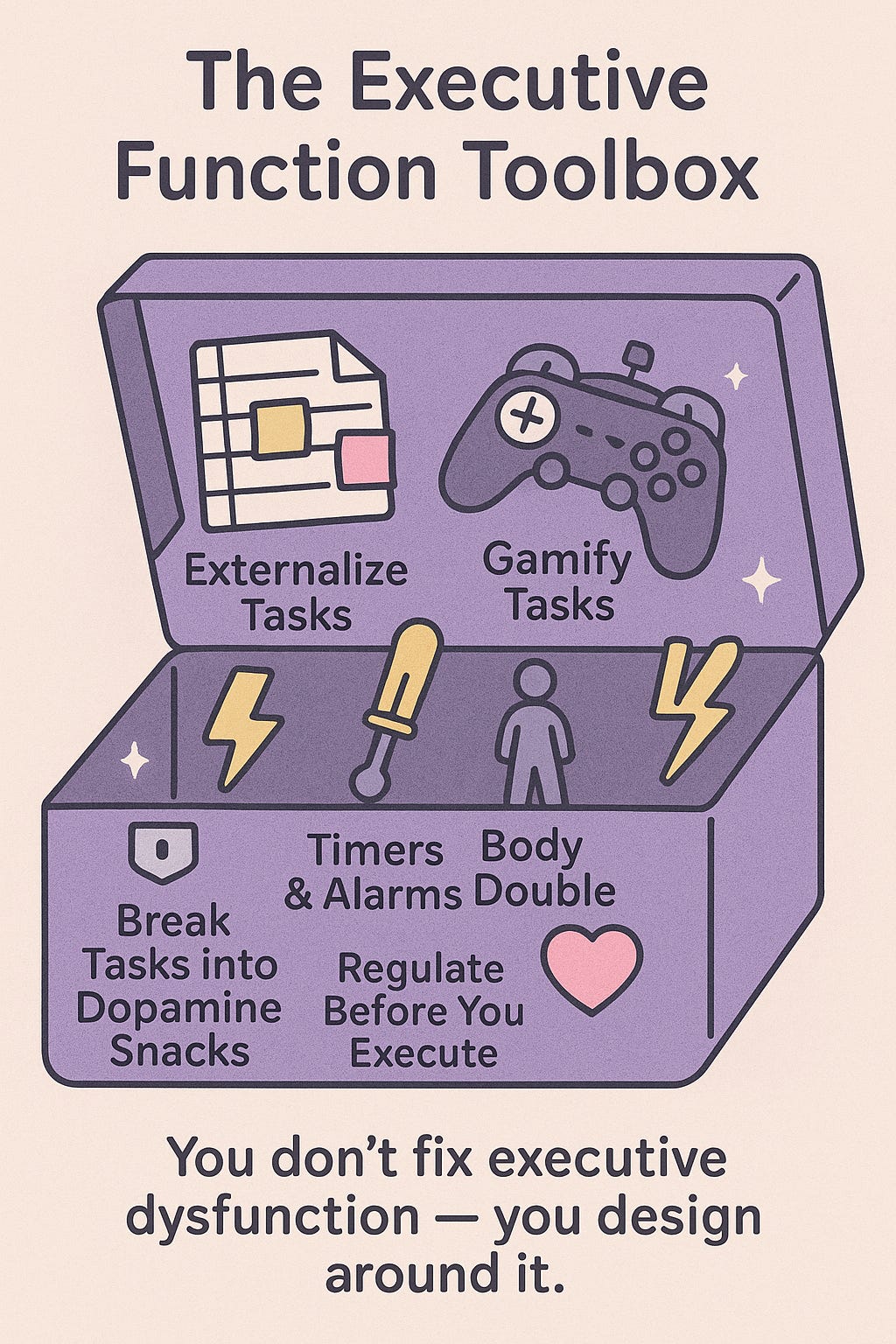
🔹 1. Make It External
Your brain is a cloud system — externalize everything.
Use whiteboards, sticky notes, reminders, visual timers.
What’s visible becomes actionable.
🔹 2. Break Tasks Into Dopamine Snacks
Instead of “clean the kitchen,” try “clear the counter” → “start the dishwasher” → “wipe table.”
Each mini-win releases dopamine, creating a feedback loop of progress.
🔹 3. Gamify Boring Stuff
Set a timer and see how much you can get done in 10 minutes.
Race yourself. Play music. Use color, sound, or reward systems to turn the mundane into a mini dopamine hit.
🔹 4. Body Double
Work next to someone — even virtually. The presence of another person acts like scaffolding for focus.
This isn’t weakness; it’s using social regulation to balance brain chemistry.
🔹 5. Schedule Energy, Not Time
Notice when your focus naturally spikes (morning? evening?).
Plan high-demand tasks for those windows. Rest is not a reward — it’s fuel.
🔹 6. Practice Emotional Regulation First
When you’re flooded, the thinking brain can’t work.
Try deep breathing, sensory grounding (hold ice, stretch), or journaling before diving into tasks.
✍️ Executive Function Self-Assessment
Rate each statement from 1 (rarely true) to 5 (almost always true).
Add up your scores at the end — it’s not diagnostic, just insight.
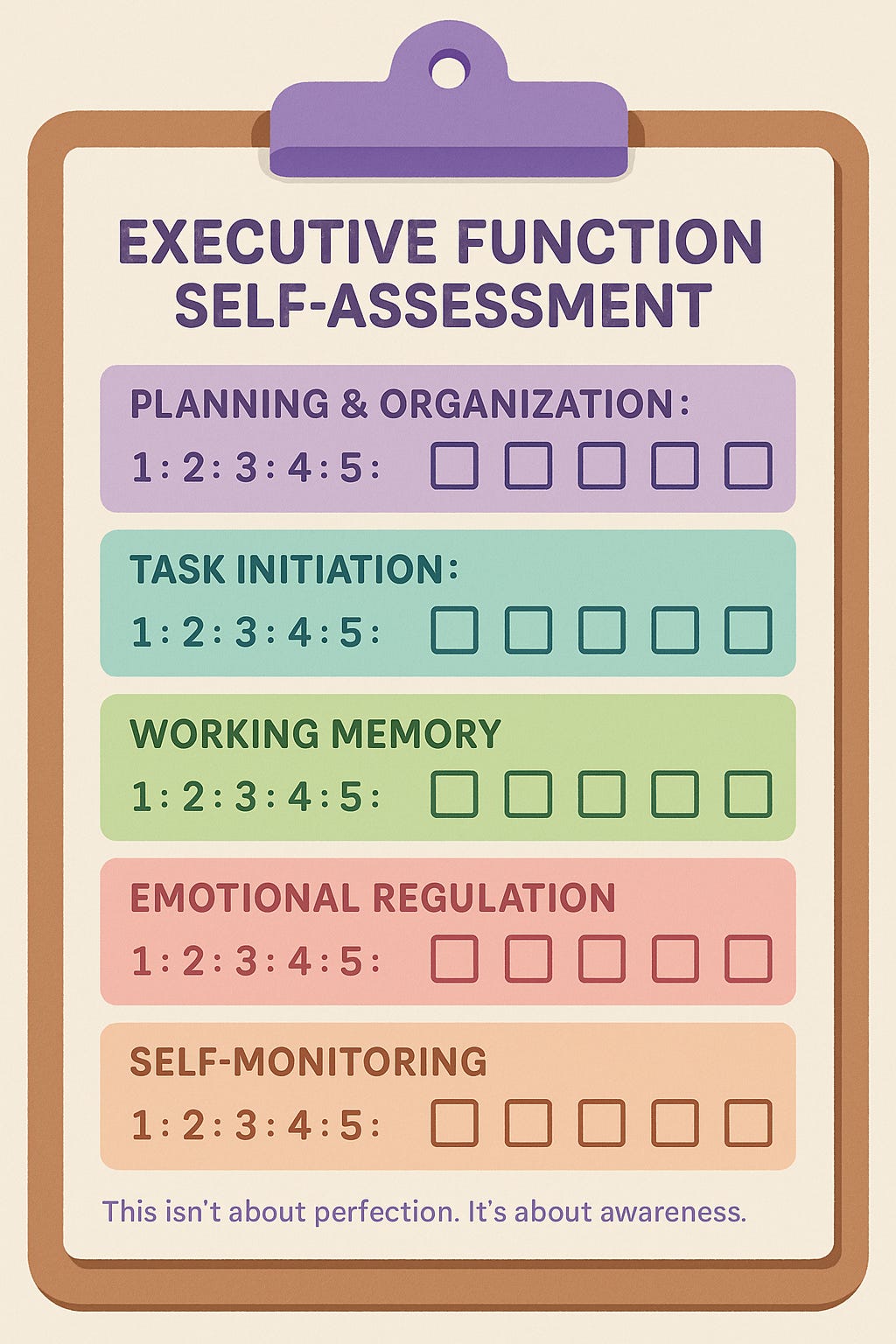
Planning & Organization
I often underestimate how long things will take.
My workspace or digital space feels chaotic or unfinished.
I have multiple “started” projects and few completed ones.
Task Initiation
I procrastinate even when I want to start something.
I need pressure or deadlines to activate.
I get stuck deciding where to begin.
Working Memory
I forget what I was doing mid-task.
I lose track of details or steps easily.
I struggle to hold multiple things in mind at once.
Emotional Regulation
Small frustrations feel overwhelming.
I have trouble switching tasks after being interrupted.
I often feel shame or guilt about productivity.
Self-Monitoring
I’m unaware of how much time I’ve spent on something.
I struggle to see when I’m going off-track.
I overcommit or underestimate my limits.
If your total is high — congratulations, you’re human with ADHD tendencies.
If your total is low — congrats again, you’ve likely built external systems that support your executive functions. Either way, awareness is step one.
💬 Final Thought: You’re Not Lazy, You’re Wired Differently
Executive dysfunction is not a character flaw.
It’s a mismatch between how your brain’s reward system functions and how the modern world demands consistency.
You don’t need to “try harder.” You need to try differently — with compassion, creativity, and curiosity.
The truth? You’re already doing the hard work every day. You’re navigating life with a brain that runs on passion instead of pressure. That’s not failure — that’s resilience.