
Executive Dysfunction Tug-of-war in AuDHD brains

The Executive AuDHD & Function Tug-of-War: When Your Brain Is Both “Let’s Go!” and “Absolutely Not.”
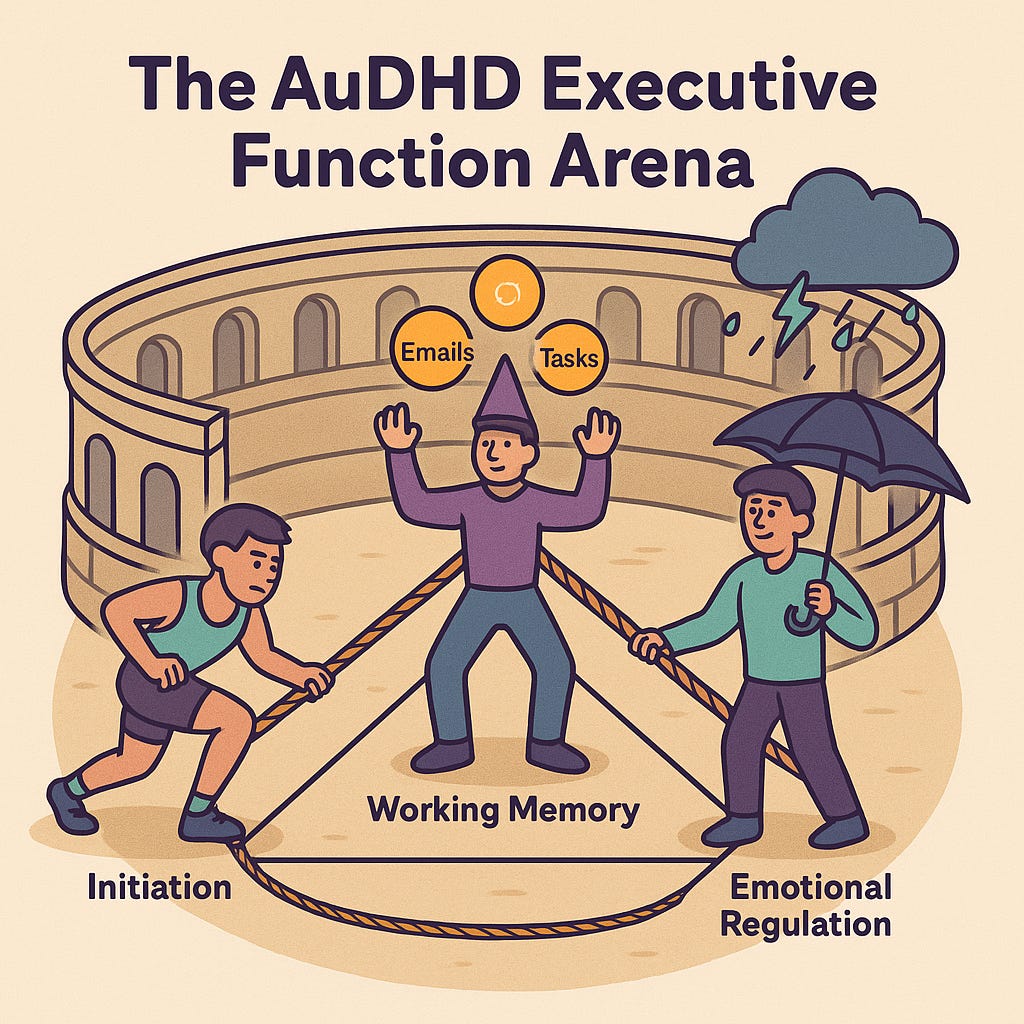
Imagine your brain as a crowded arena. In one corner, Initiation charges forward, eager to get things done. In another, Emotional Regulation stands firm, warning “Not so fast!” (or sometimes flipping to “Too much!” when feelings surge). Above them balances Working Memory, a juggler desperately trying to hold all the balls (your thoughts and plans) aloft. This isn’t a circus — it’s a poetic brawl inside the AuDHD (Autism + ADHD) mind. These roles are all executive functions – higher-level “brain management” skills that let us plan, focus, and self-regulate. When they fight, even simple tasks become monumental
.
Executive functioning is like the brain’s air-traffic control system. It includes planning, starting tasks, holding information in mind, pausing before acting, shifting gears, and managing emotions. Think: planning out a project, starting it without procrastinating, remembering your steps (working memory), resisting distractions, adapting if things change, and keeping calm when stress hits. Neurodivergent brains often have unique profiles of these skills. In fact, an estimated 70–80% of autistic individuals struggle with EF challenges, and it’s very common in ADHD. When EF is weak, we might look lazy or defiant, but often we’re just grappling with the “how” of getting things done.
The Starter’s Dilemma: Initiation
Initiation is the spark that gets a task moving. In everyday life, it answers: “Do I start cleaning my room now… or later… or never?” For many with AuDHD, pressing “go” is surprisingly hard. Paradoxically, some days your mind may be bouncing off the walls, but directing that energy into a task feels like trying to push a boulder. In ADHD, even an interesting task can be hard to begin – distractions instantly lure attention away, or an overwhelming project feels like too much to tackle. As one source notes, “Task initiation is more difficult when you have ADHD. Distractions can easily dominate… making even simple tasks difficult to start”. Even excitement doesn’t always help: if you’re not pumped about the task, you might stall or procrastinate. Added to that, worries about doing it perfectly can freeze you in place, another common block.
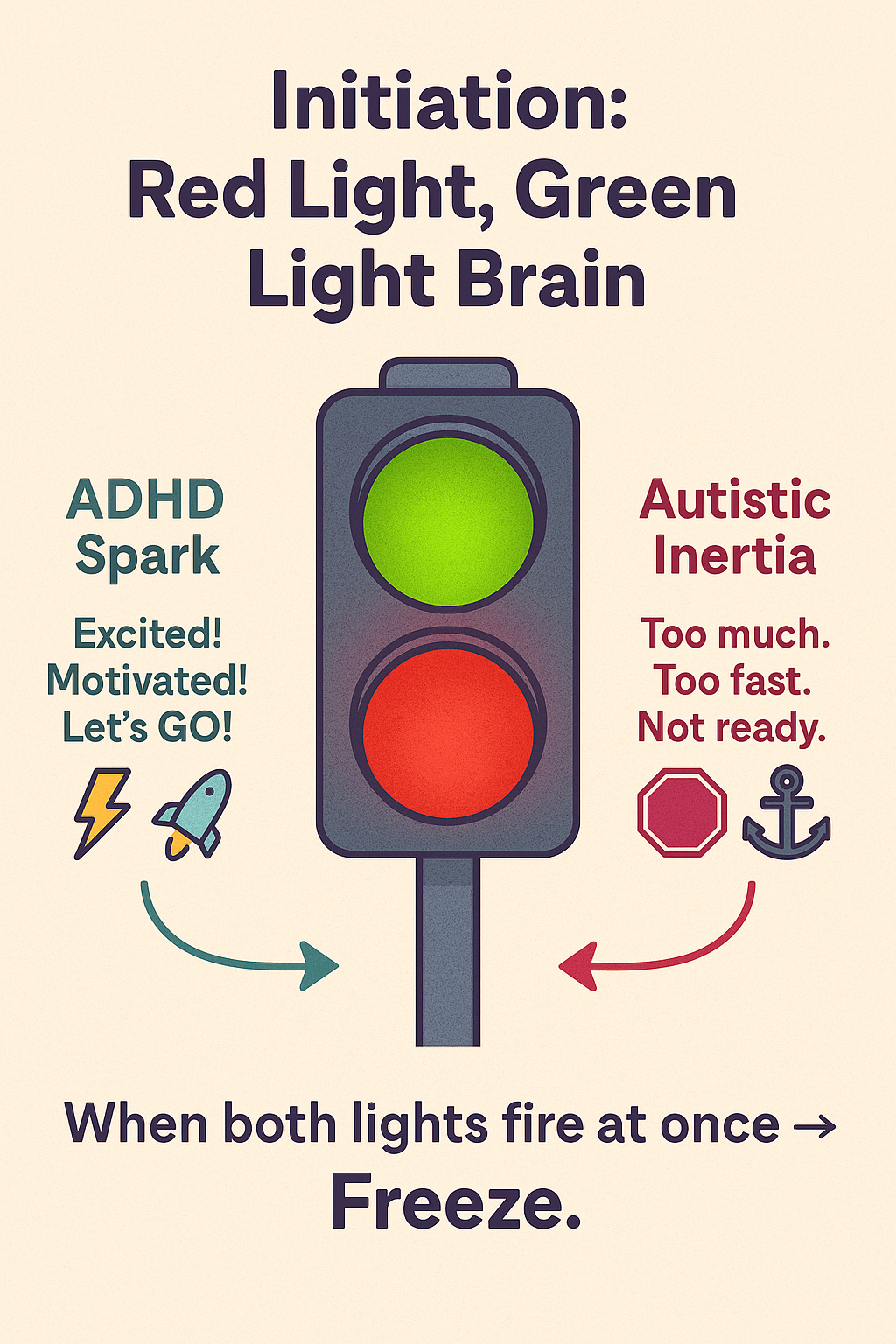
Autism brings its own twists. The term “autistic inertia” has emerged in autistic communities to describe how starting or stopping any activity can feel impossible. Imagine the brain’s traffic light showing both red and green: one part of you wants to go, and another part screams stop. Hari Srinivasan (APS) explains that for many autistic people, “struggle to start tasks… is not about laziness; it’s a reflection of executive function differences”. Even once you’re moving, shifting gears is hard – one autistic writer likens changing tasks to “high-friction launch,” where even writing an email can feel like dragging your thoughts uphill. Sensory overload (bright lights, loud noises) can further intensify this inertia, locking you in place. In short, initiation in AuDHD often becomes a standoff: part of you yells “Let’s go, do it now!”, while another part feels overwhelmed and refuses, saying “Absolutely not — not yet.”
In practice: You might sit at your desk, knowing there are papers to grade or bills to pay, but find yourself suddenly compelled to organize your pens or rewatch a show instead. This is not simply being willfully lazy – it’s your executive functions tangled. On different days, either the ADHD side grabs the wheel (“I have 5 minutes, I’ll do it!”) or the autistic/emotional side slams on the brakes (“Nope, too chaotic…”), and your brain is caught in the middle.
The Juggler’s Struggle: Working Memory
While Initiation pulls the starting trigger, Working Memory keeps the pieces in play. It’s the mental scratchpad that holds your to-dos, instructions, and ideas just long enough to use them. (Think remembering a phone number while dialing it.) For many with ADHD, working memory is notoriously shaky. ADHD brains often forget steps mid-task or get derailed when juggling multiple instructions. Research supports this: children with ADHD perform significantly worse on both verbal and visual working memory tasks than children with autism. In fact, studies find 62–85% of kids with ADHD show working memory deficits.
Why does this matter day-to-day? Imagine cooking a recipe: someone tells you to slice onions, then add spices. If your working memory falters, you might slice the onions, get distracted, and forget to add the spices. In the ADHD brain, that “mental to-do list” often vanishes. As one counselor puts it, people with ADHD have to work extra hard to listen, remember, and respond in real time.
Autism brings nuance: some autistic individuals may have hyper-attention to certain details (even exceptional memory for specific interests), but still struggle when many bits of information swirl at once. The result is often the same kind of chaos – steps get missed, thought-trains dissolve, and you end up wrestling with tasks you intended to do. Working Memory really is like a juggler’s act. Drop a ball (forget a step) and the whole process can topple.
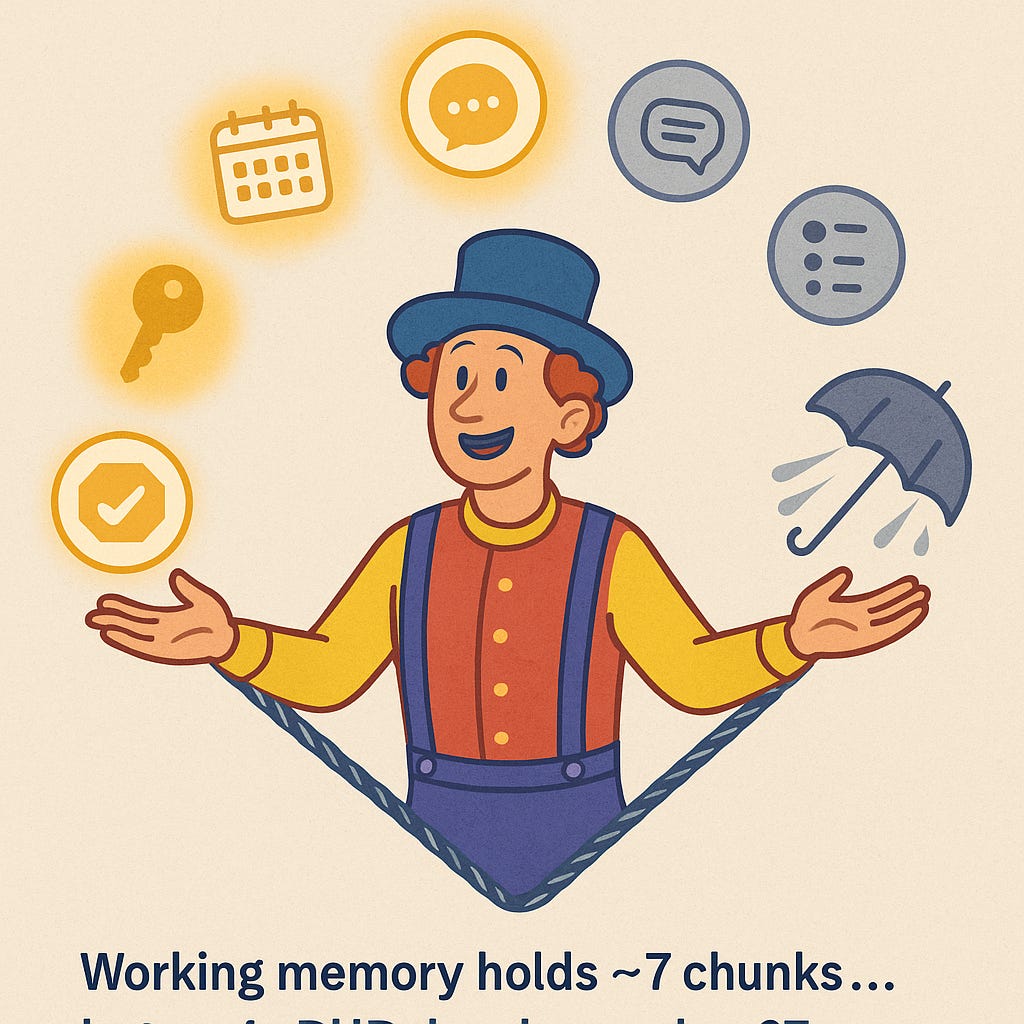
Daily life example: You’ve planned to start laundry, feed the cat, and pay a bill. As you start laundry, a song on the radio triggers a vivid memory, leading you down an unrelated mental rabbit hole. Suddenly the laundry’s done, but you’ve lost track of the cat’s food or the bill details. This “out of sight, out of mind” is a classic executive glitch. Keeping track of more than a couple of things is demanding; as one resource notes, our working memory holds about seven chunks of info at once. Once those slots fill, everything else is at risk of dropping.
The Storm Within: Emotional Regulation
Meanwhile, Emotion stirs the pot. Emotional regulation is the ability to manage feelings so they don’t overwhelm us. In AuDHD brains, emotions often arrive like sudden thunderstorms. ADHD in particular is known for intense, fast-moving emotions — irritability, anger, or hyper-excitement can flare quickly and take a long time to settle. In fact, about half of kids with ADHD show clinically significant emotion dysregulation. Think of it like driving a car without a proper brake: the amygdala (the brain’s “fear/emotion center”) in ADHD tends to fire off easily. One imaging study found adults with ADHD often have smaller amygdala volumes and abnormal activation, which correlates with “less control of impulsivity” and lower emotional processing. In plain terms, big feelings tend to hijack an ADHD brain rapidly.
Autism, too, can involve strong emotions, though sometimes in different ways. Many autistic individuals experience high anxiety and intense reactions to sensory or social stressors. Neuroscience even shows altered amygdala growth in autism, linked to anxiety and distinct emotional profiles. UC Davis researchers report that amygdala dysregulation is “implicated in anxiety” and that autistic people often have atypical amygdala development. So when sudden fear or stress hits, it can be a real avalanche.
Both ADHD and ASD brains often struggle to smooth out these emotional storms. Instead of riding an even keel, moods can swing fast. One therapist notes, “ADHD impacts executive functions like impulse control, working memory, and emotional regulation. This means emotions arrive quickly, stay longer, and hit harder”. The outcome? You might find yourself enraged by a minor annoyance or sobbing from overstimulation, seemingly out of proportion. These emotional waves then collide with your task plans. A looming deadline can feel terrifying, causing a freeze (the “Absolutely not!”). Or unexpected elation
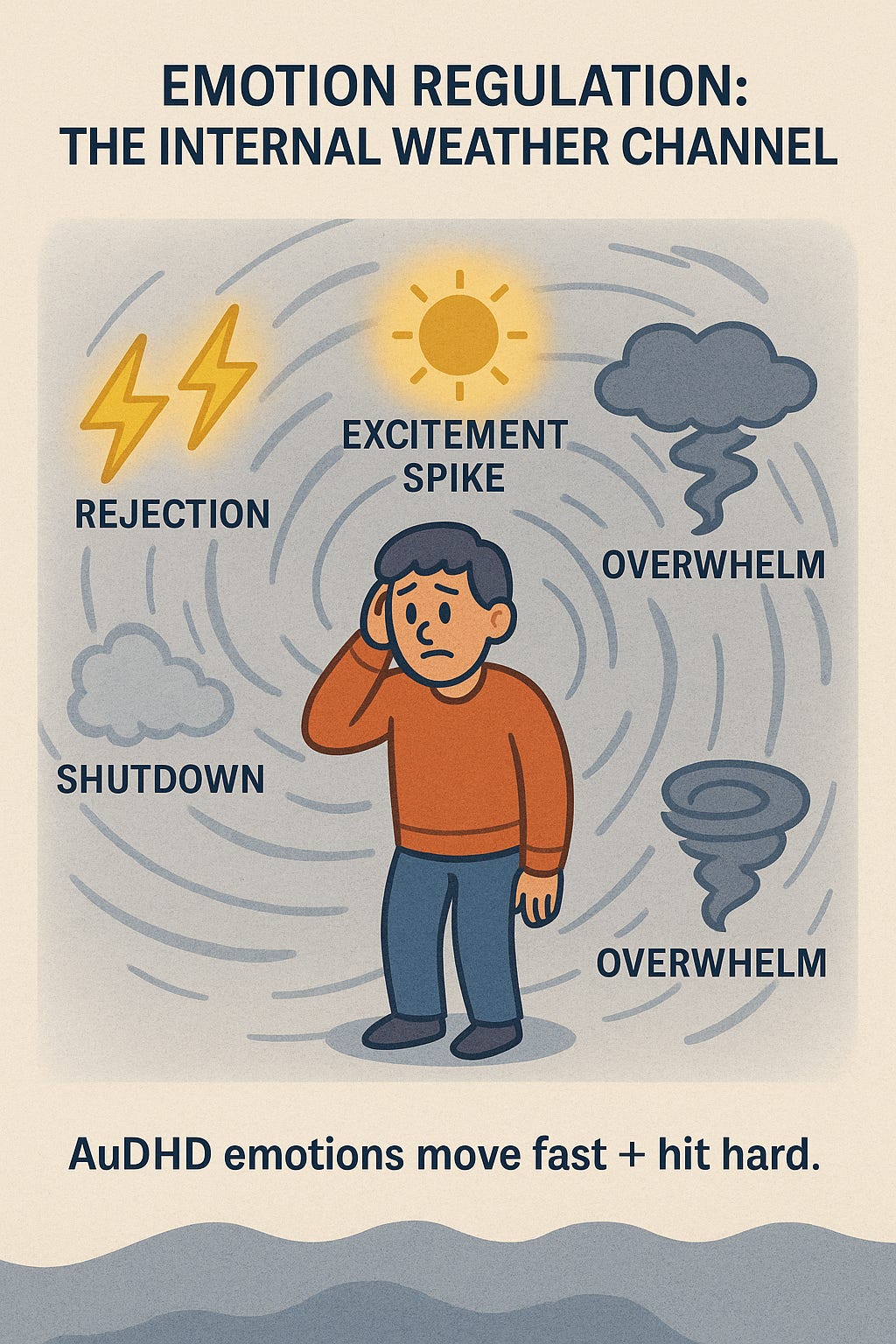
may cause you to abandon your plans and chase that buzz (“Let’s go!” but into something else).
What it feels like: You’re working quietly when someone criticizes your idea. Instantly you’re boiling with anger or hurt, and everything stops — you’re unable to continue the task. Or the opposite: You get an exciting idea and impulsively jump into a new project, forgetting what you were doing. Both scenarios show how emotion regulation tussles with initiation and memory. In fact, research shows: “Difficulties with emotion regulation are seen in both ADHD and autism…and are intensified when both conditions co-occur”. In AuDHD, that fight is tripled — the push of ADHD, the caution of ASD, and the ups-and-downs of mood all in one.
The Daily Tug-of-War
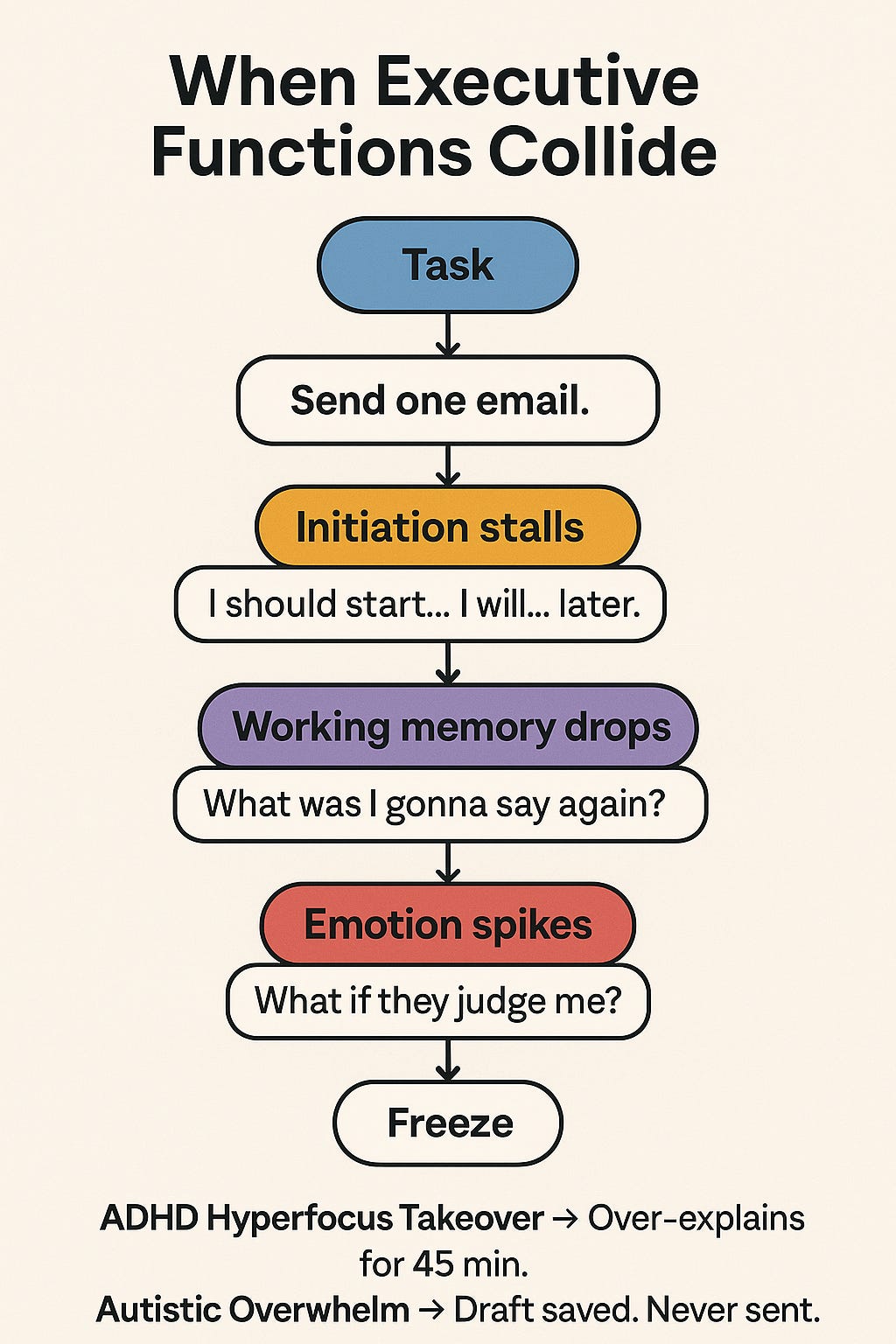
Taken together, initiation, memory, and emotion create a constant tug-of-war in daily life. Even routine tasks can turn into odysseys. For example, making a grocery list (planning), remembering the items (working memory), leaving the house on time (initiation), and dealing with the stress or excitement of being out (emotional regulation) demand all three executives at once. In AuDHD, “struggles with working memory, task initiation, or managing emotions can make even simple … tasks overwhelming”. It’s like facing a mountain for every grocery trip or email.
Imagine waking in the morning: part of you is hyped to start the day (ADHD spark), but another part feels frozen by anxiety or overstimulation (ASD reserve). Your working memory tries to track “wake up, brush teeth, dress, feed cat,” but distractions (or internal debates) knock items off the mental clipboard. You might find yourself walking to the bathroom without toothbrush, or halfway to work without your lunch. Meanwhile, if a sudden emotion – say, anger at spilled coffee – hits, it might completely derail everything. The result is often hours or days that feel unpinned — you know you want to do X, Y, Z, but can’t consistently connect them. The net effect: tasks take longer, plans shift, and you cycle between hyperfocus and freeze.
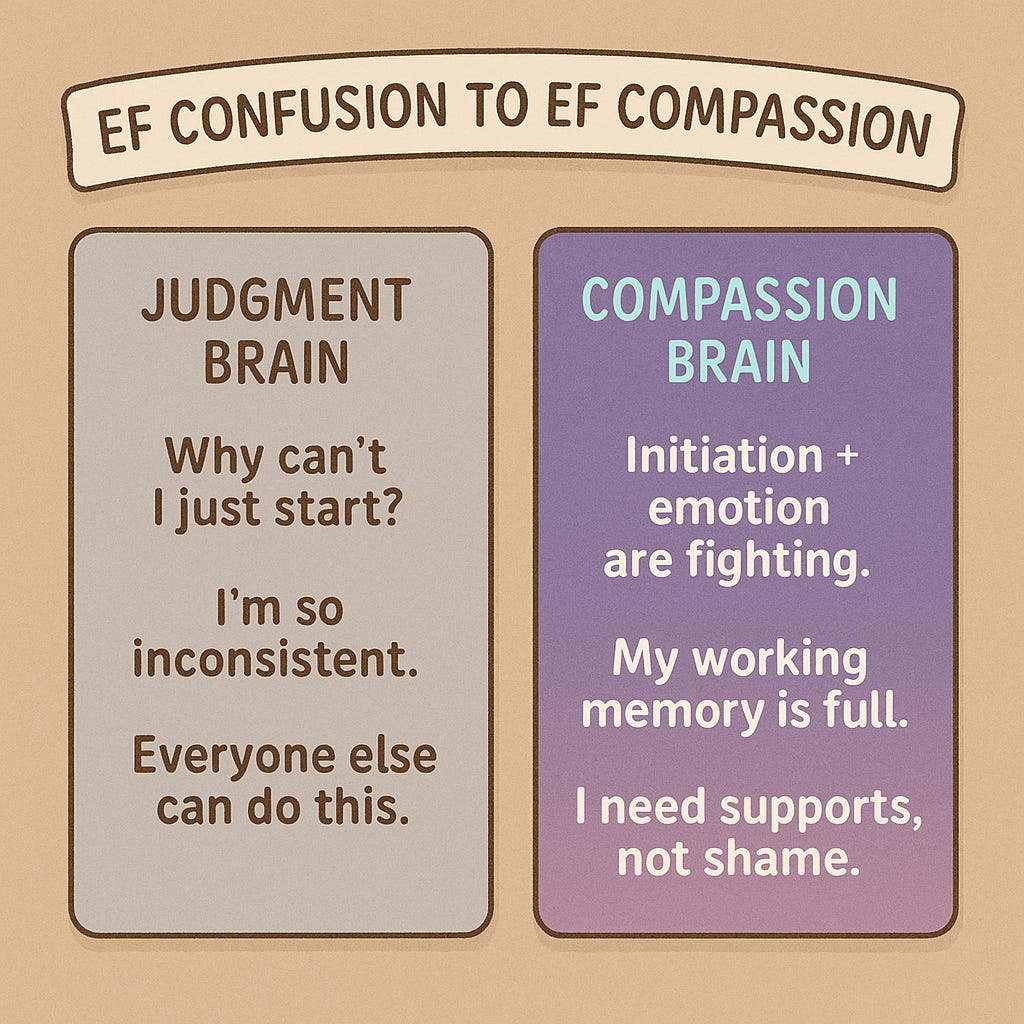
Professionals note that when EF struggles, others might label it defiance or laziness. However, it’s really the brain’s wiring. As autistic scholars emphasize, viewing these challenges as brain-based, not character-based, is crucial. In the AuDHD brain, each small decision (“should I start this?” “was that step done?” “How do I feel about this?”) is loaded with hidden complexity – dozens of micro-decisions – making everyday life feel like a strategic chess game while the board is shaking.
Tips & Strategies for the Tug-of-War
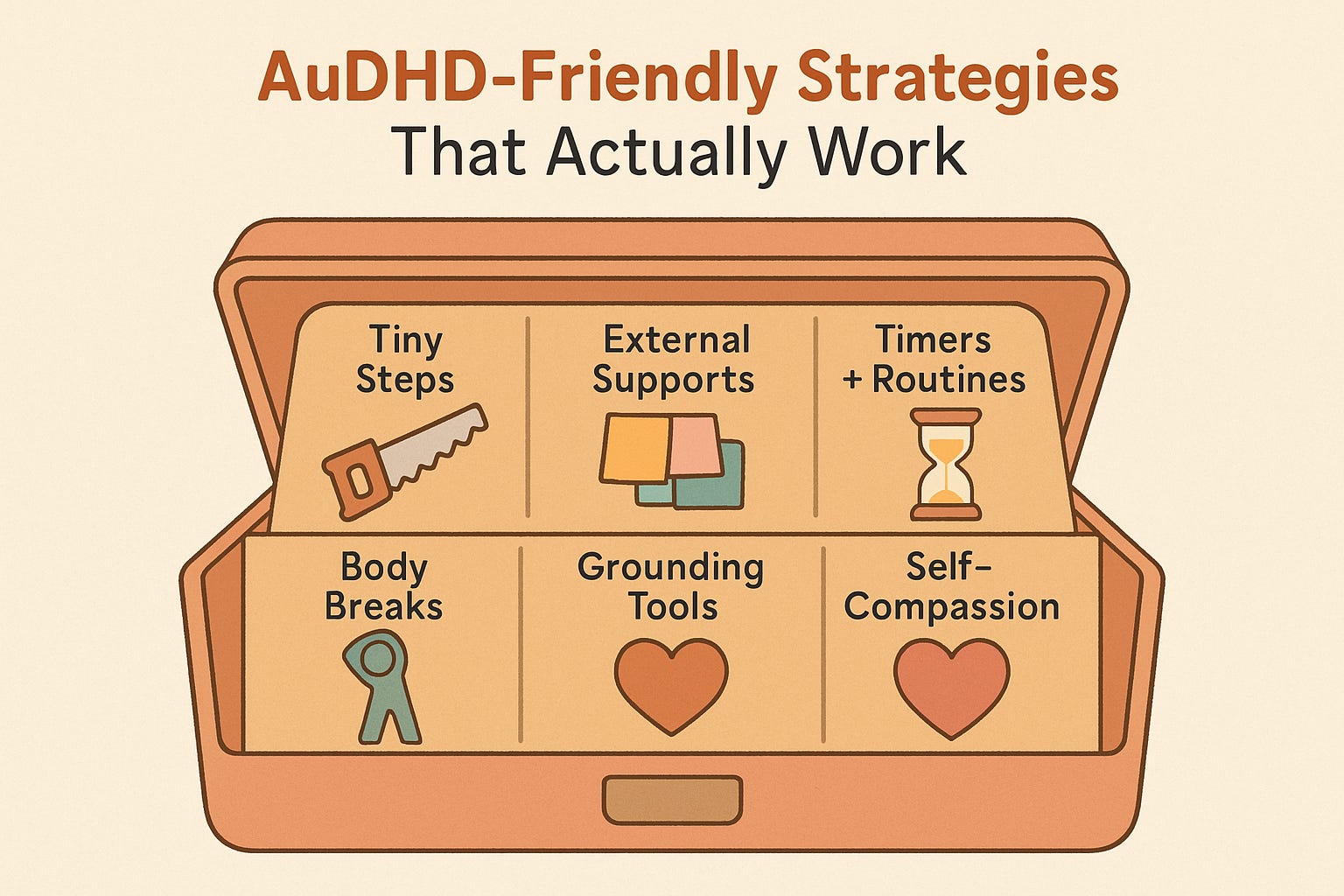
Fighting this battle is hard, but there are tools to tip the scales. Below are practical strategies grounded in neuroscience and experience, aimed at making initiation easier, supporting memory, and calming emotions:
Podcast Recc:
Break tasks into tiny steps. Large projects can paralyze any brain. Cut tasks into very small “microsteps” (e.g. “open email,” then “read first sentence,” then “write reply,” etc.). Checking off each mini-step builds momentum. One ADHD program recommends committing just 5–25 minutes at a time (Pomodoro Technique) to break the inertia. Often, starting is the hardest part, and once you’re a few minutes in, you feel capable of going further.
Externalize everything. Use calendars, alarms, timers, lists, or apps so your brain doesn’t have to hold all details. Organizing tasks in an external system is “the #1 executive functioning helper”, because it dumps the load off your mind. For example, set multiple alarms (e.g. one hour before an event to prep, and 5 min before it starts). Write every step down on sticky notes or in a notebook as it comes to you. Even doodling tasks or using voice memos can act as “working memory on paper,” freeing mental space.
Use visual timers and routines. Time blindness is common in ADHD/ASD. A visual countdown (like a sand timer app or colored clock) makes time more tangible, helping trigger the next action. Also, anchor tasks to routines (“after breakfast comes doing dishes”). If switching context is hard, try environmental cues (like working near natural light or playing gentle instrumental music to reset focus). Even moving to a slightly different chair can jolt a brain into gear.
Brain-dump frequently. When your mind is buzzing with to-dos, let it pour out. Keep a notebook by your bed, in the shower (waterproof pen), or carry a notes app. Writing down thoughts clears working memory: “taking things out of your working memory and putting it on paper frees up the energy… [and] opens up more space”. This also lowers stress – what’s written won’t be forgotten.
Name and tame big emotions. When feelings intensify, pause if you can and label them (“I feel really angry/upset/anxious right now”). A quick Name, Frame, Tame technique helps: acknowledge the emotion, remind yourself it’s temporary, and then do a regulating action (deep breaths, stretching, grabbing a sensory object like a fidget or soft fabric). Even a 2-minute breathing break or stepping outside can reset your brain’s chemistry. Scheduled “feelings check-ins” (quick mindfulness or journaling) can prevent emotions from spiraling.
Ground with movement or breaks. Physical activity recalibrates the brain’s stress and reward systems. Short walks, stretches, or a bit of yoga can burn off adrenaline and release dopamine, helping recalibrate focus and mood. Similarly, plan regular breaks (set a timer every 60–90 minutes to stand up, walk around, hydrate). A little break often prevents big breakdowns later.
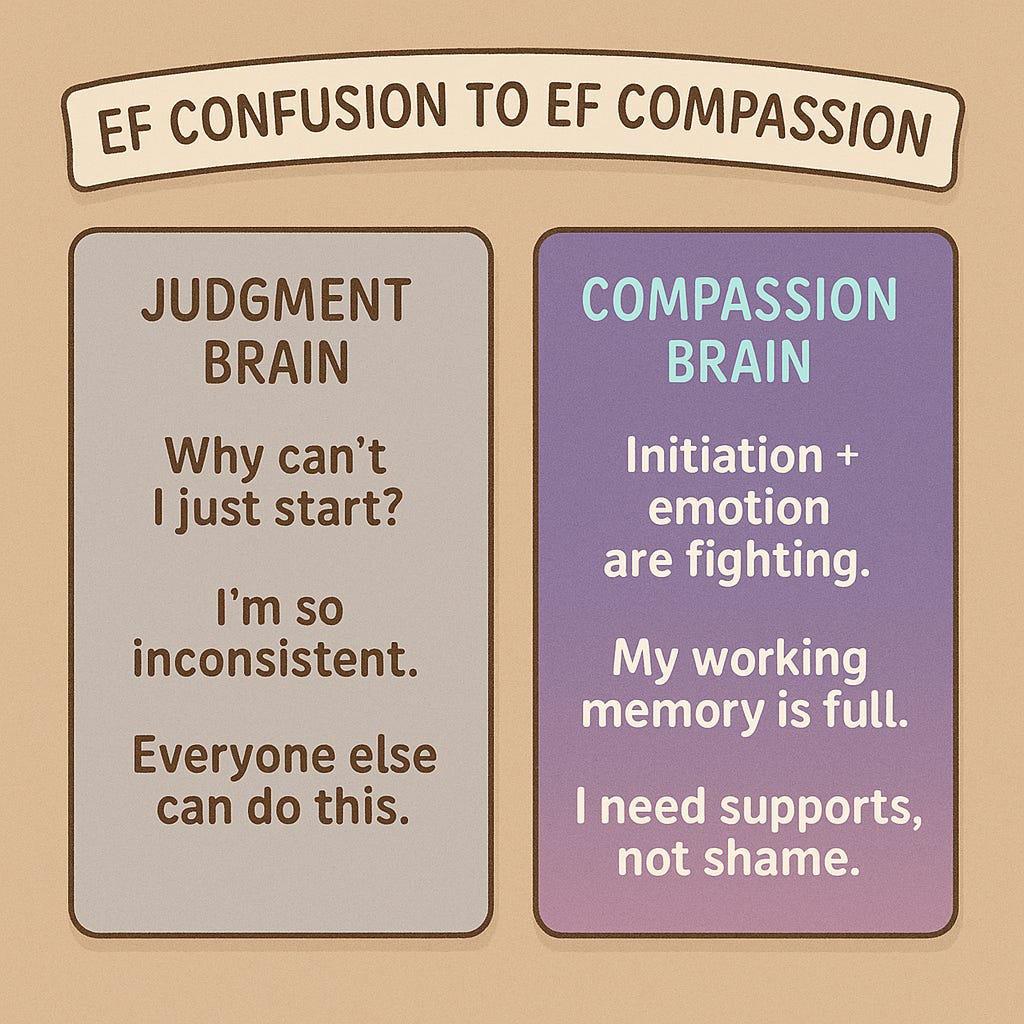
Practice self-compassion. Remember, this isn’t about willpower or character — it’s brain wiring. As one autism resource reminds us, EF struggles “are brain-based, not character-based,” and assuming laziness only hurts motivationttac.odu.edu. Celebrate every little win (started a task, remembered something important, calmed down after a spell). Positive self-talk (e.g. “I am trying my best with a tricky brain”) can reframe these battles from personal failures into neurodivergent realities.
Enlist social support or structure. Sometimes another person’s presence or accountability helps ignite action. (One study found autistic students better initiate tasks when someone else is in the room.) Share your plan with a friend and ask them to check in, or join a group doing the same task (study halls, cleaning teams, accountability apps). Structure and deadlines can make initiation easier by externalizing the “start” trigger.
Reflection Journal Prompts
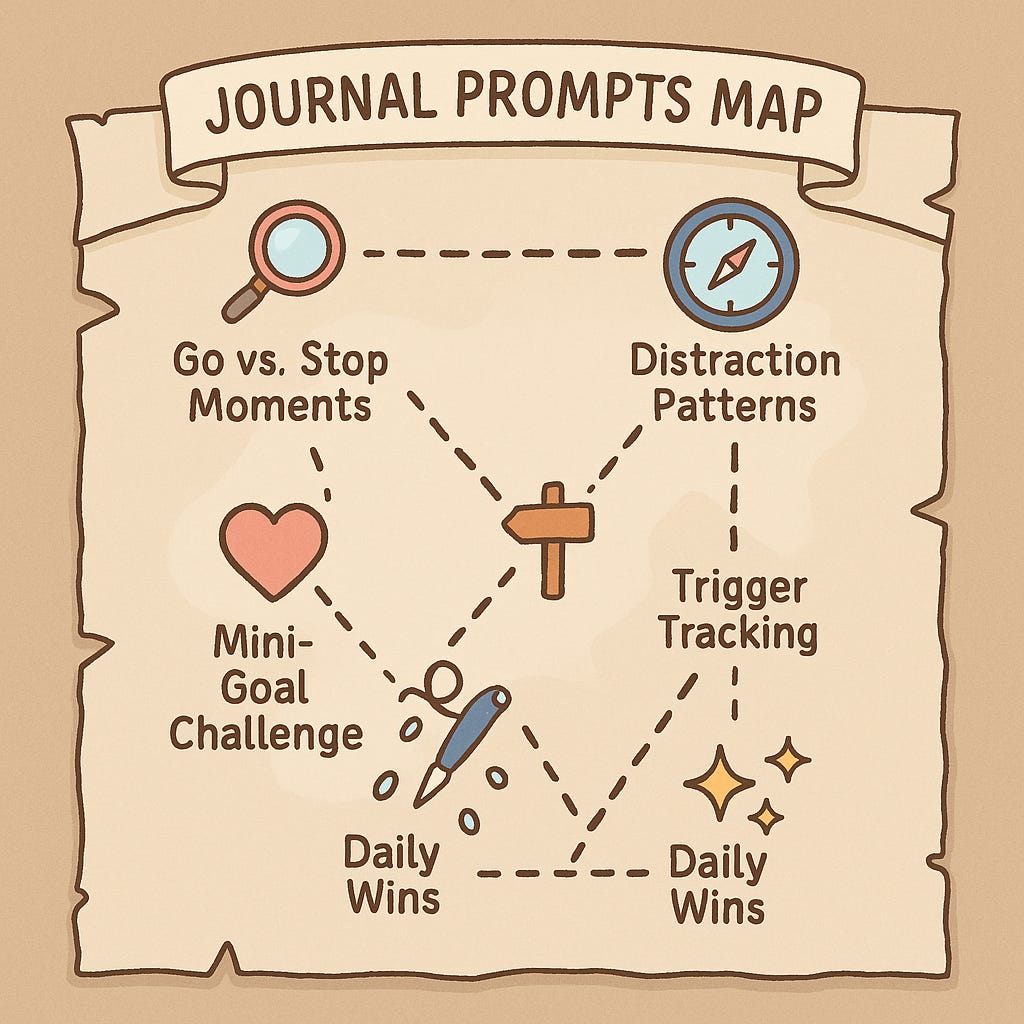
A powerful tool in this tug-of-war is awareness. Here are some prompts to journal or reflect on – they can help you spot patterns and brainstorm personal strategies:
Recall a ‘go’ vs ‘stop’ moment. Think of a recent time you felt torn: one part of you wanted to start or continue something, and another part resisted. What were you trying to do? What did your working memory and emotions do? How did the conflict resolve?
Identify common distractions or stalls. Write down the last three times you got derailed or postponed a task. What specifically pulled your attention away? (E.g. “I opened my phone to check time, then scrolled social media.”) Now imagine one tweak that might have helped (set phone to airplane mode, put a note on it, etc.).
Track your triggers. Over a day or week, note moments when your emotions spiked or you felt “too tired/nervous/excited” to act. What happened just before? (Noise, hunger, criticism, etc.) Mapping out triggers (even crudely: “Feeling X often follows Y”) can reveal ways to manage or prepare for them.
Mini-goal challenge. Pick one task you’ve been avoiding. Break it into five tiny steps and check them off one by one. Journal how this felt – did starting with a “five-minute action” make it easier? Which step was hardest, and why?
Celebrate the small stuff. At the end of each day, jot down at least one thing you did well, no matter how small (even “I put the dishes away” or “I smiled at a stranger”). This reframes your mindset to see progress over perfection.
Gentle mantra. Create a short affirmation that resonates (e.g. “My brain works differently, and that’s okay” or “Even little progress is success”). Repeat it when the tug-of-war feels heavy.
Podcast :
Understanding these internal wrestles helps turn confusion into clarity. Remember that everybody’s brain is unique. By recognizing when Initiation, Working Memory, and Emotion are clashing, you can lean on strategies or supports that tip the balance. With patience and practice, those daily battles can feel a little less like a fight and more like a dance — and you’re the conductor learning the steps.
Sources:
We’ve drawn on neuroscience and lived experience of neurodiversity throughout. (Executive functions include task-initiation, working memory, emotion control, etc.ttac.odu.edu;
ADHD often means weaker inhibition and memory
journals.plos.orgattncenter.nyc; autism commonly involves rigidity and intensified anxietypsychologicalscience.orghealth.ucdavis.edu.
Emotion dysregulation affects ~50% of ADHD individualsfrontiersin.org, and both ADHD and ASD brains show amygdala differences linked to impulse control and anxietypubmed.ncbi.nlm.nih.govhealth.ucdavis.edu.)
These insights underscore that the “tug-of-war” is real — but also navigable with understanding and the right tools.