
Hyperfocus Exit Ramps: How to Stop Before Your Body Files a Complaint
Because hyperfocus is not the enemy — unsupported hyperfocus is.

Let’s talk about hyperfocus: the AuDHD superpower that can help you write a full blog post, reorganize your entire closet by sleeve texture, research the mating habits of seahorses at 1:47 a.m., or clean one corner of your desk so intensely that suddenly you are emotionally processing your 2009 personality choices.
Hyperfocus gets romanticized a lot, especially by people who only see the finished product.
They see the article.
They see the deep dive.
They see the creative magic.
They see the “wow, you’re so productive when you care about something!”
They do not see the part where your water bottle is untouched, your bladder is writing a strongly worded email to corporate, your shoulders are fused to your ears, and your last meal was technically “vibes and half a granola bar.”
Hyperfocus is not the villain.
Unsupported hyperfocus is.
Hyperfocus is like fire. With a fireplace, it warms the room. Without a fireplace, it burns down the emotional village and takes your nervous system with it.
And for AuDHD brains, we need exit ramps — gentle, planned ways to come out of deep focus before our body has to send an emergency flare that says, “Ma’am. We live here too.”
What Hyperfocus Actually Is
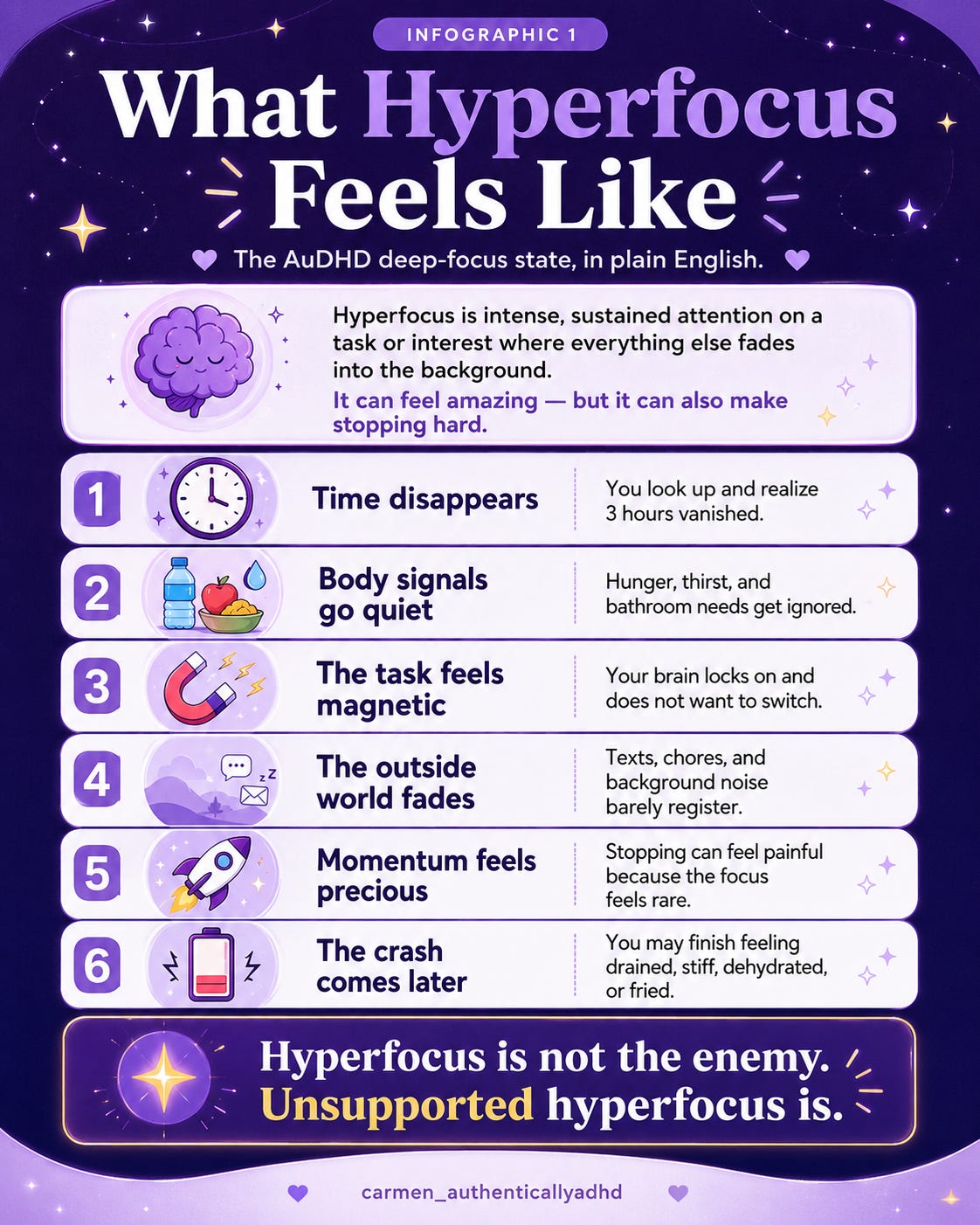
Hyperfocus is an intense state of absorption where your attention locks onto something so strongly that everything else fades into the background.
Time? Gone.
Hunger? Muted.
Thirst? A rumor.
Other responsibilities? Deleted from the server.
The text you were supposed to answer? May she rest in peace.
It can feel amazing.
For many AuDHDers, hyperfocus feels like finally getting access to the secret room in your brain where the lights work, the Wi-Fi is strong, and the executive function gremlin has briefly left the premises.
You are not scattered.
You are not fighting yourself.
You are not dragging your brain across broken glass just to start.
You are in it.
The task becomes magnetic. Your brain narrows the beam. The dopamine starts acting like it remembered it has a job. The world gets quiet in a way that can feel almost sacred.
And honestly? That can be beautiful.
Hyperfocus can help us create, solve, build, write, clean, design, learn, organize, connect, and do the kind of work that looks impossible until suddenly we’ve done it with dramatic flair and mild dehydration.
The problem is not that we can focus deeply.
The problem is that we often struggle to exit.
Active Processing Question:
When you hyperfocus, what disappears first: time, hunger, bathroom signals, pain, messages, or the concept of being a human mammal?
Why Hyperfocus Can Be So Intense in AuDHD Brains
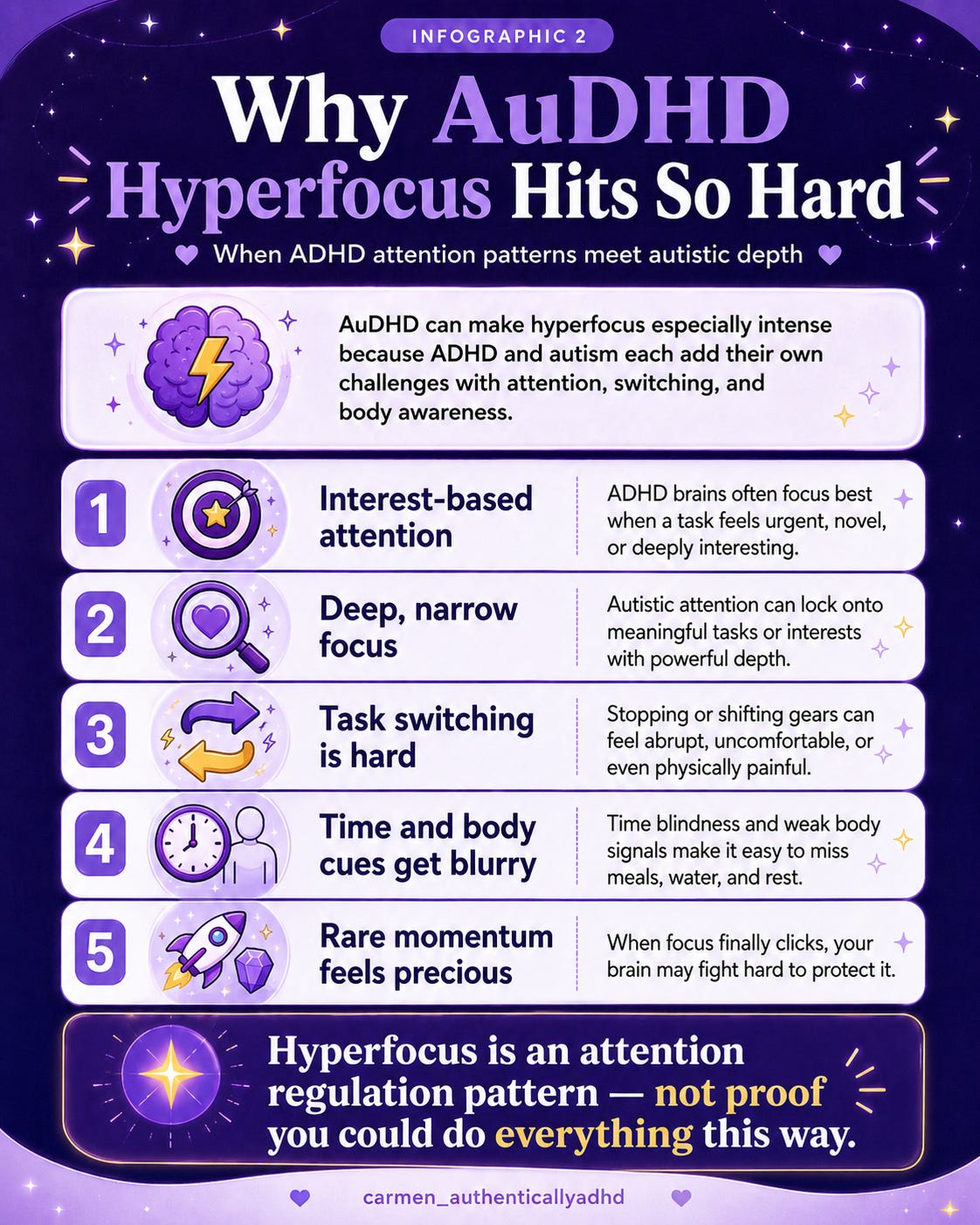
AuDHD is the combination of autism and ADHD, which can create a very spicy nervous system cocktail.
ADHD often brings challenges with attention regulation, reward, working memory, time awareness, and task initiation. Not “I can’t pay attention,” but more like, “I cannot always choose where the attention spaceship lands, and sometimes it lands on a spreadsheet for four hours instead of feeding me.”
Autism can bring deep interest-based attention, sensory intensity, pattern detection, monotropism-like focus, and difficulty with transitions. Once the brain locks onto something meaningful, important, interesting, or unresolved, switching away can feel like trying to rip Velcro off your soul.
So when ADHD interest-based attention meets autistic depth and inertia, hyperfocus can become a whole neurological weather system.
You are not being dramatic.
Your brain is not casually switching tabs. It is running a full internal operating system that may resist interruption because interruption feels like danger, loss, chaos, or cognitive whiplash.
Stopping can feel physically uncomfortable.
Not because you’re lazy.
Not because you’re irresponsible.
Not because you “lack discipline.”
Because your brain has entered a high-immersion state, and transitions require energy, prediction, inhibition, body awareness, emotional regulation, and executive function.
Cute. Love that for us. Very simple. No notes. Except all the notes.
Hyperfocus and Late Diagnosis
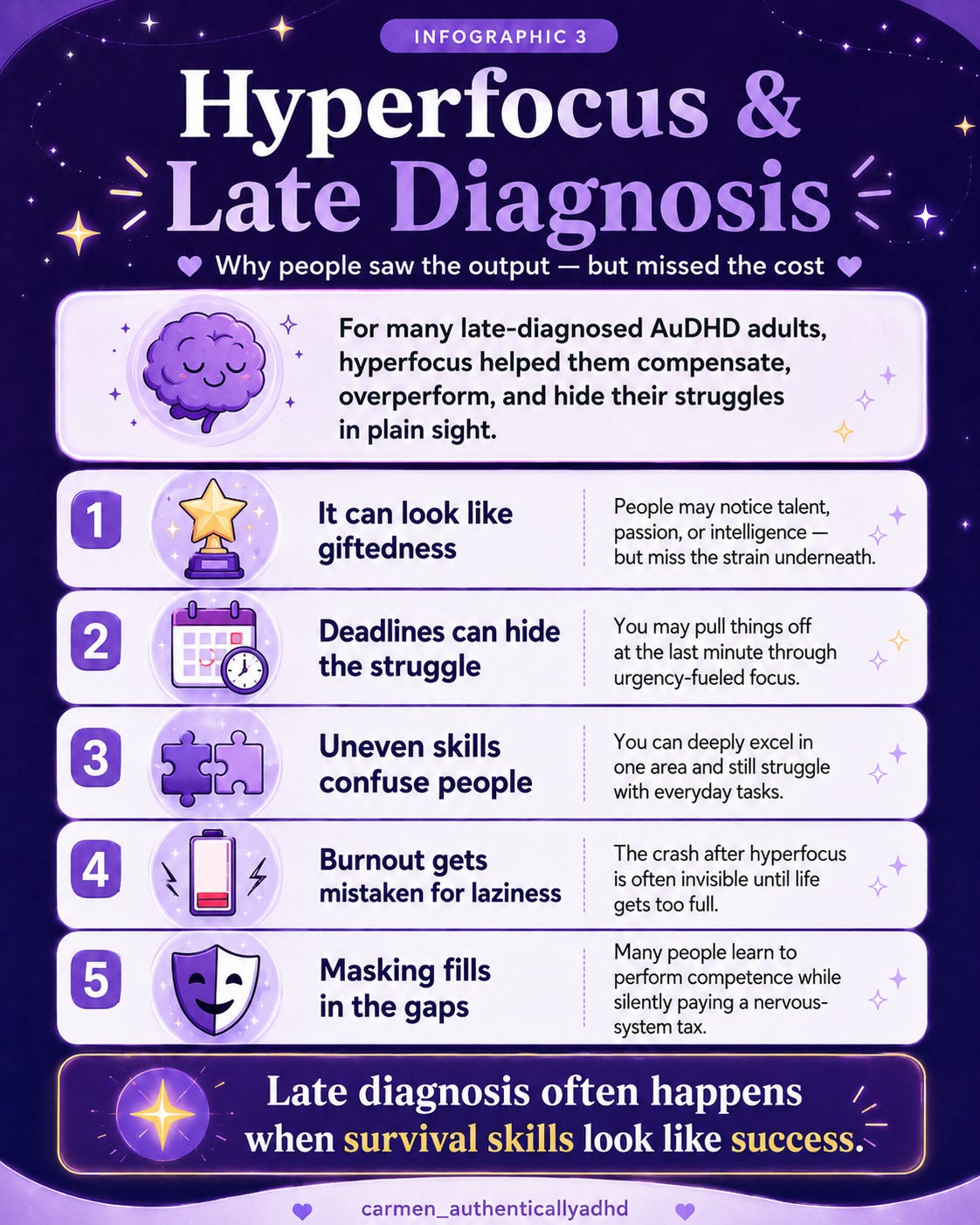
For late-diagnosed AuDHDers, hyperfocus can be one of the reasons we were missed.
Because from the outside, hyperfocus can look like “functioning.”
You got good grades because you could hyperfocus before deadlines.
You built systems because chaos was eating you alive.
You became the reliable one because panic turned into productivity.
You learned everything about your job because uncertainty felt unbearable.
You looked “gifted,” “intense,” “passionate,” “high-achieving,” “creative,” “too sensitive,” or “a little much.”
Meanwhile, inside, you were surviving on pressure, shame, urgency, masking, and the occasional nervous system exorcism.
People saw the output and missed the cost.
That is a huge part of late diagnosis grief.
Because many of us were not “fine.” We were just unsupported and impressive at the same time.
Hyperfocus may have helped us compensate. It may have helped us hide. It may have helped us overperform in some areas while silently falling apart in others.
And then adulthood arrived with bills, jobs, relationships, parenting, appointments, laundry, groceries, emails, health, dishes, taxes, and the audacity of the human body needing maintenance every single day.
Suddenly hyperfocus was not enough.
Suddenly the system cracked.
Not because we became broken.
Because the scaffolding was never there.
Active Processing Question:
Where did hyperfocus help you survive before you knew you were neurodivergent? And where did it quietly charge interest?
The Body Files a Complaint Eventually
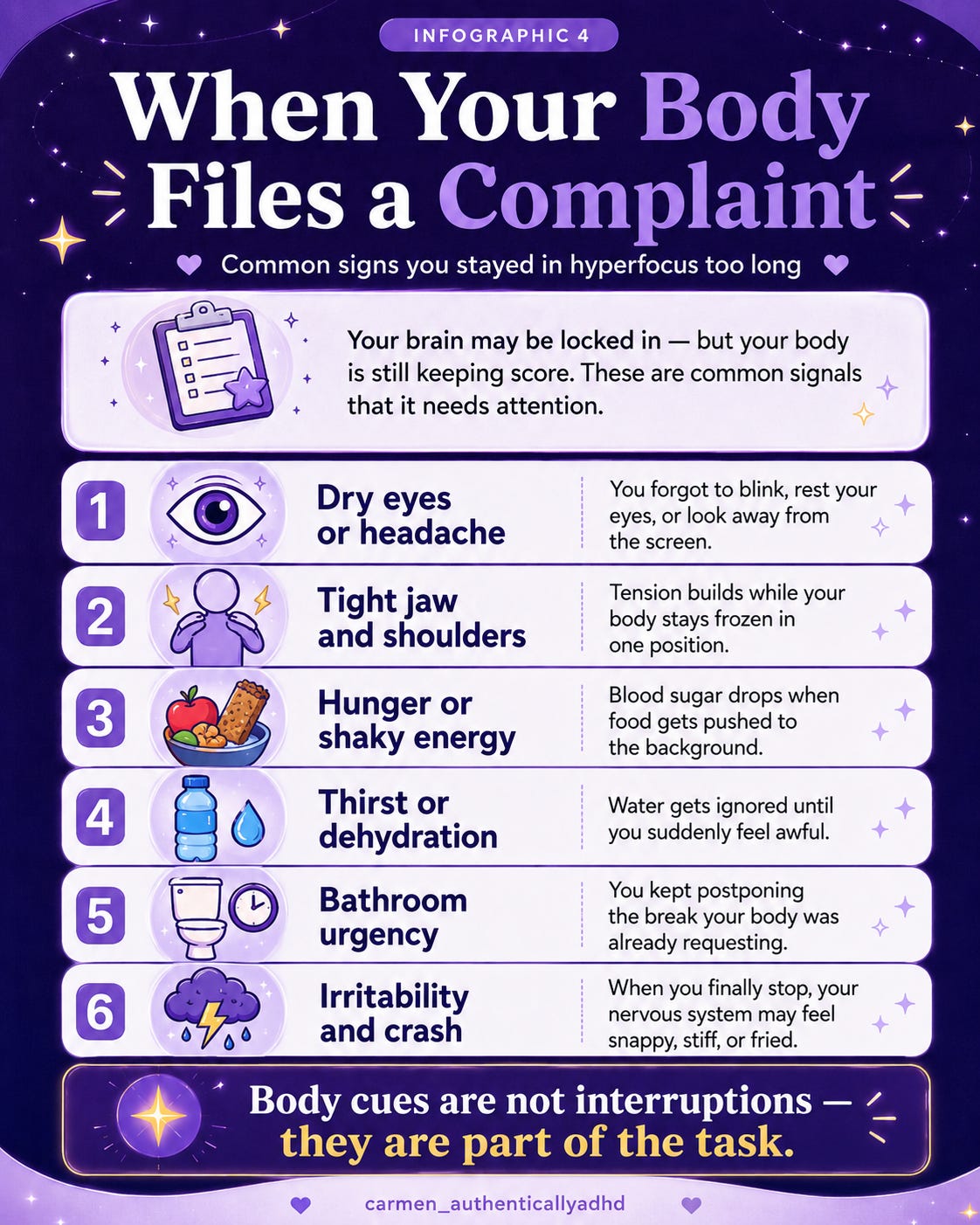
Here’s the rude truth: your body keeps score even when your brain is having a productivity rave.
You may not notice the signals at first.
Your neck tightens.
Your jaw clenches.
Your eyes dry out.
Your stomach gets weird.
Your hands get cold.
Your heart rate changes.
Your bladder starts blinking like a dying dashboard light.
Your blood sugar drops and suddenly everyone is annoying, including the furniture.
By the time you finally stop, you don’t feel proud.
You feel feral.
You come out of hyperfocus like a raccoon exiting a dumpster behind a Michelin-star restaurant: confused, dehydrated, oddly triumphant, and possibly holding evidence.
This is why exit ramps matter.
They are not punishments.
They are not productivity hacks for becoming a soulless corporate robot.
They are body-rescue systems.
They let us use hyperfocus without letting it use us.
Exit Ramp #1: Alarms That Don’t Just Scream at You
Alarms are helpful, but let’s be honest: one alarm is usually not enough for an AuDHD brain in full dragon mode.
One alarm says, “Stop now.”
Our brain says, “No.”
And then we swipe it away like we are deleting a spam email from our own nervous system.
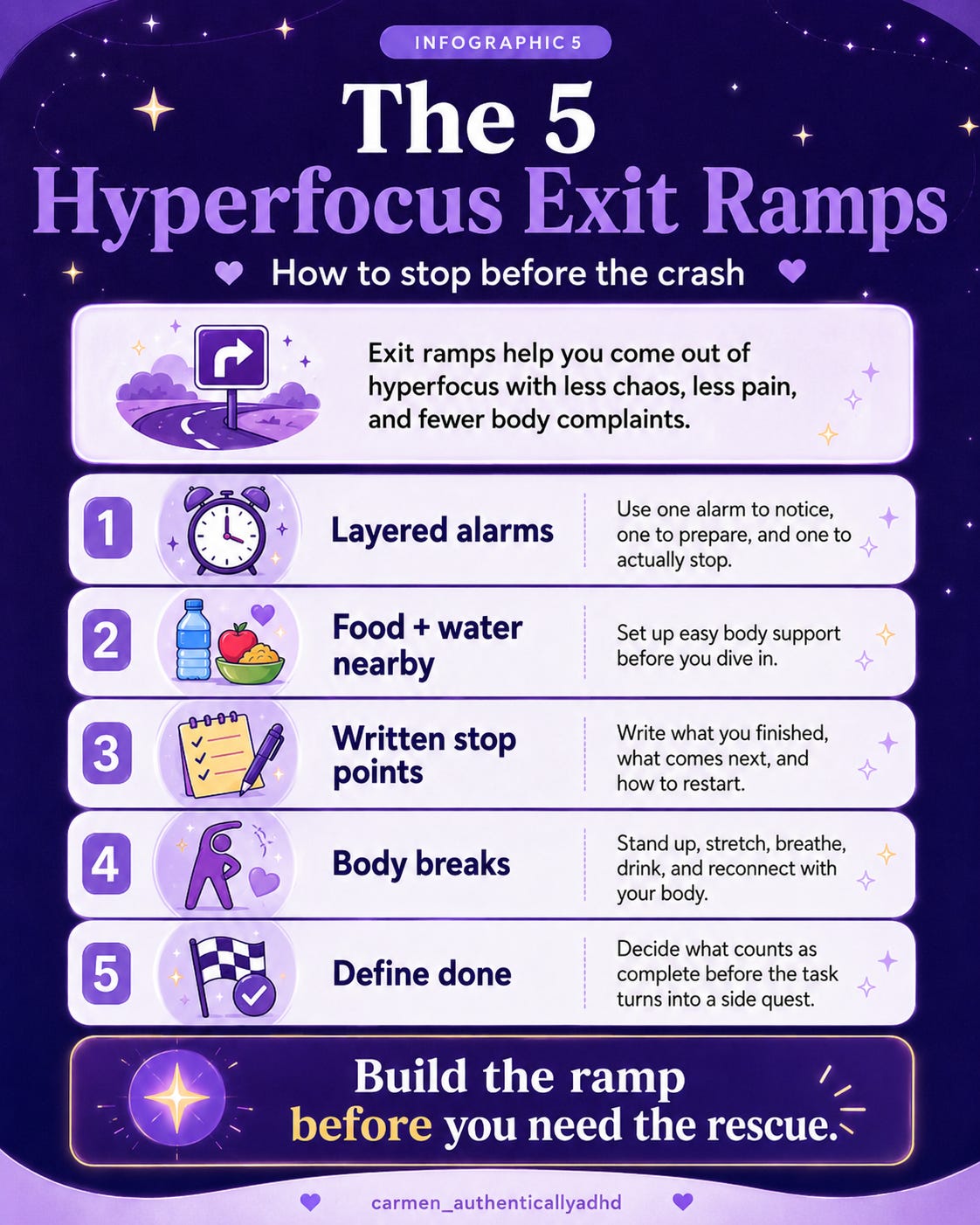
Instead, use layered alarms.
Think of them as a transition runway:
Alarm 1: The Awareness Alarm
“Hey, you are in hyperfocus. Notice your body.”
Alarm 2: The Prepare-to-Stop Alarm
“You have 10 minutes. Start landing the plane.”
Alarm 3: The Stop Point Alarm
“Write down where you are. Close the loop.”
Alarm 4: The Body Alarm
“Stand up. Water. Bathroom. Food. Unclench your jaw before it becomes a fossil.”
The goal is not to violently eject yourself from focus. The goal is to create a ramp.
Brains do not love being thrown from a moving vehicle. Shocking, I know.
Try using alarm labels that are specific and kind:
“Drink water, goblin.”
“Save your work before the laptop becomes a crime scene.”
“Bathroom break. You are not a houseplant.”
“Done enough. Back away slowly.”
“Feed the body or prepare for emotional jazz hands.”
Active Processing Question:
Do your alarms currently help you transition, or do they just yell at you until you resent time itself?
Exit Ramp #2: Keep Food and Water Nearby
This sounds basic because it is basic.
Unfortunately, basic does not mean easy.
Many AuDHDers struggle with interoception, which is the ability to notice internal body signals like hunger, thirst, temperature, fatigue, pain, and needing the bathroom.
Sometimes we don’t feel hungry until we are nauseous.
Sometimes we don’t feel thirsty until our brain is a raisin.
Sometimes we don’t notice pain until we stand up and our skeleton sends a resignation letter.
So no, “just listen to your body” is not always helpful advice.
Sometimes my body is whispering in Morse code from a basement.
This is why we need environmental support.
Before starting a hyperfocus-prone task, build your little survival nest:
Water bottle
Electrolytes if helpful
Easy snack with protein
Something crunchy or sensory-friendly
Meds/supplements if they’re part of your routine
Lip balm
Eye drops if needed
A blanket, hoodie, or sensory item
Timer visible nearby
This is not “being extra.”
This is accessibility.
You are building a tiny nervous system command center.
And honestly? Iconic.
Exit Ramp #3: Written Stop Points
A huge reason stopping feels awful is that the brain fears losing the thread.
When you are deep in a task, your working memory may be holding a fragile little spiderweb of ideas. If someone says, “Just stop,” your brain hears, “Please drop this entire mental ecosystem into a swamp.”
No thank you.
That is why written stop points are magic.
A written stop point tells your brain:
“We are not abandoning the task. We are bookmarking it.”
Before you stop, write:
What I just finished:
What I was about to do next:
Where to restart:
Any open tabs/thoughts:
First tiny step when I come back:
Example:
What I just finished: Drafted the intro and section on alarms.
Next: Add examples for food/water setup.
Restart step: Open doc and read last paragraph only.
Important thought: Use raccoon metaphor. Obviously.
This lowers the panic of stopping because the task is not floating away into the void wearing a tiny hat.
It is parked.
Active Processing Question:
What makes stopping hard for you: fear of losing momentum, fear of forgetting, perfectionism, time blindness, demand avoidance, or the ancient curse of “but I’m almost done”?
Exit Ramp #4: Body Breaks That Are Actually Body Breaks
A body break is not scrolling TikTok for 47 minutes while your spine slowly becomes punctuation.
A body break means you reconnect with the body you accidentally left running in the background.
Try a 3-minute reset:
Stand up.
Put both feet on the floor.
Take three slow breaths.
Drink water.
Use the bathroom.
Stretch your neck, jaw, wrists, and back.
Look at something far away to rest your eyes.
Ask: “What does my body need before I continue?”
Body breaks work best when they are concrete.
Not “take a break.”
That is too vague. My brain hears that and immediately opens six apps, a trauma portal, and Etsy.
Try:
“Stand up and refill water.”
“Walk to the bathroom and back.”
“Eat five bites.”
“Stretch for one song.”
“Go outside for three minutes.”
“Put food in microwave.”
“Lie on the floor like a Victorian ghost.”
The floor reset is elite, by the way. Humbling, but elite.
Exit Ramp #5: Define Done Before You Start
This is the big one.
Defining done is one of the most powerful AuDHD task hacks because open-ended tasks are basically haunted houses.
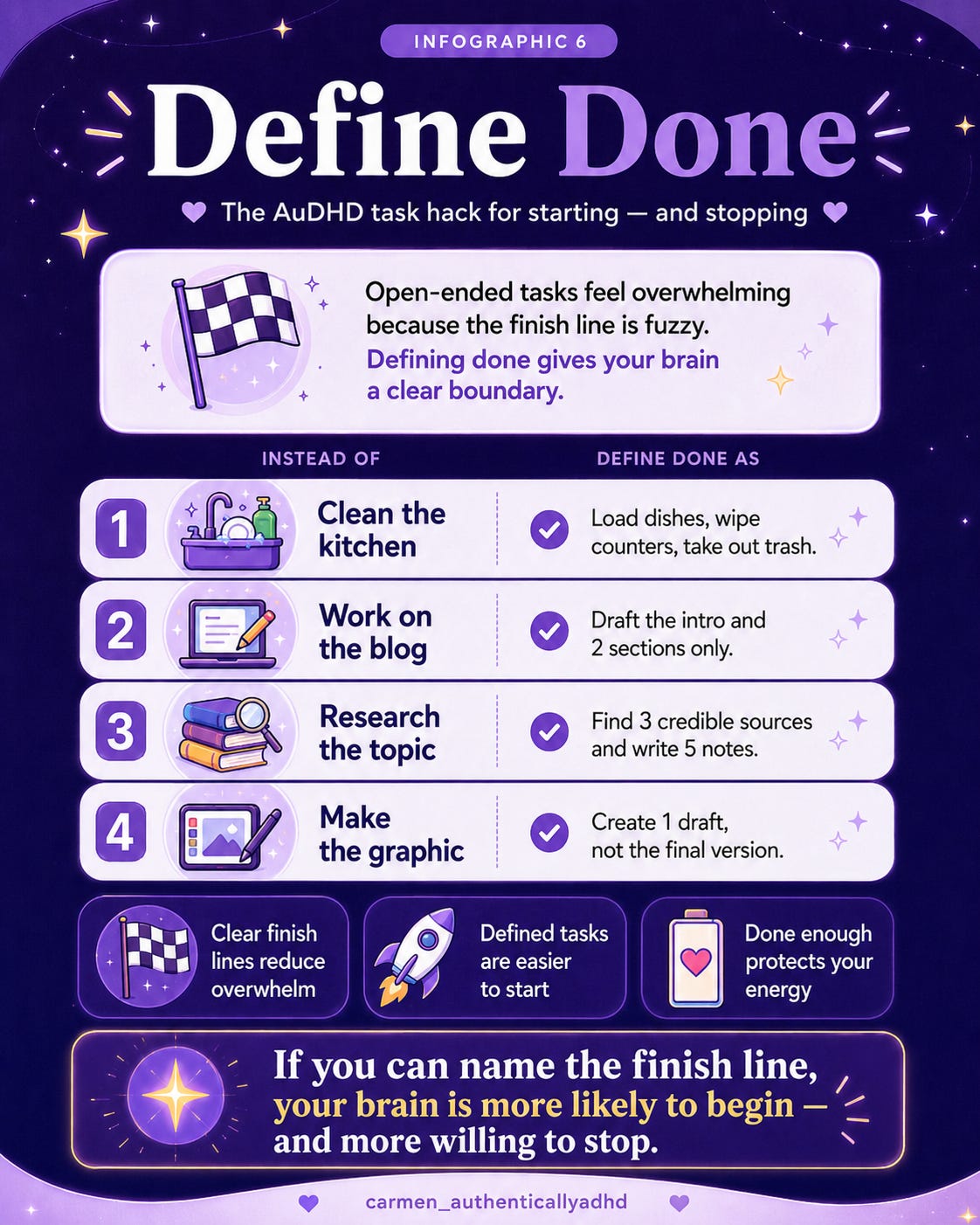
“Clean the kitchen” is not a task.
It is a portal.
Does that mean dishes? Counters? Floors? Fridge? Pantry? The emotional archaeology of the junk drawer? Suddenly you’re holding an expired ranch packet from 2021 wondering who you were before capitalism got weird.
Open-ended tasks create overwhelm because the brain cannot see the finish line.
No finish line means no clear start.
And no clear start means the task becomes a fog monster wearing Crocs.
Defining done gives the brain a boundary.
It says:
“This is what counts.”
“This is where we stop.”
“This is enough.”
“This is not a moral trial.”
“This task does not get to eat the whole day.”
For hyperfocus, defining done is not just about starting.
It is about stopping.
Because AuDHD brains often struggle with “just a little more.”
Just one more paragraph.
Just one more drawer.
Just one more edit.
Just one more source.
Just one more design tweak.
Just one more tiny improvement that somehow becomes a hostage negotiation with perfectionism.
Define done before your brain gets drunk on momentum.
Examples:
Instead of: “Work on blog.”
Define done: “Write rough draft sections 1–3. Stop after adding active processing questions. No editing today.”
Instead of: “Clean bedroom.”
Define done: “Put laundry in hamper, clear nightstand, throw away trash. Do not reorganize closet like you are auditioning for a trauma-informed HGTV reboot.”
Instead of: “Make graphics.”
Define done: “Create 3 Canva drafts. They do not need to be final. Purple sparkles allowed, perfectionism not invited.”
Instead of: “Research medication topic.”
Define done: “Collect 5 credible sources and write bullet notes. Stop before reading comments from strangers with medical confidence and no punctuation.”
“Done enough” is not laziness.
Done enough is a nervous system boundary.
Done enough is how we stop turning every task into a doctoral dissertation with snacks missing.
Active Processing Question:
Before you start your next task, can you define what “done enough” looks like in one sentence?
Why Defining Done Helps Us Start
When a task has no clear ending, starting feels dangerous.
Your brain knows the task might expand.
It knows you might get trapped.
It knows “quick project” can become six hours and a personality crisis.
So the brain avoids it.
Not because you don’t care.
Because your brain is trying to protect you from an undefined demand.
Defining done reduces uncertainty.
It turns the task from:
“Enter the swamp and good luck, babe.”
into:
“Walk to that tree, pick up the basket, come back.”
That matters for AuDHD brains because we often need more clarity, more structure, and more transition support than people assume.
Defining done gives the brain a map.
And sometimes the map is the difference between starting and staring at the task until you become furniture.
Why Defining Done Helps Us Stop
Stopping can feel like failure when perfectionism is driving.
Stopping can feel unsafe when momentum is rare.
Stopping can feel impossible when your brain says, “But we finally got access to the good focus! Do not waste it!”
I get it.
When focus finally shows up, it feels rude not to use every drop. Like a dopamine coupon that expires at midnight.
But using every drop is how we end up exhausted, dysregulated, and unable to function tomorrow.
Defining done protects tomorrow-you.
And tomorrow-you deserves not to wake up inside the consequences of today-you’s unsupervised productivity spiral.
A stop point is not quitting.
It is pacing.
It is saying, “I am allowed to use my focus without sacrificing my body on the altar of output.”
Put that on a mug. Or a warning label.
The Hyperfocus Exit Ramp Formula
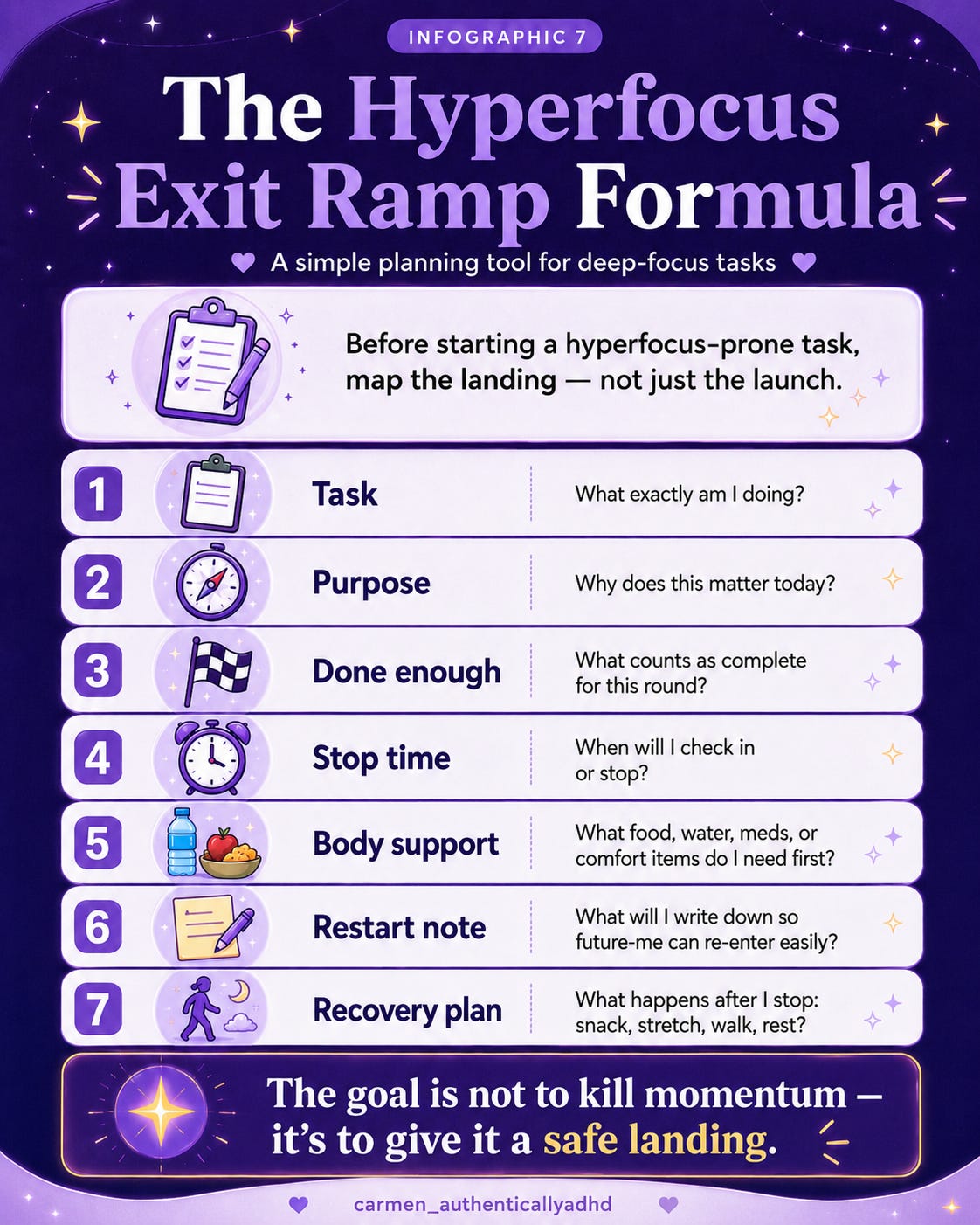
Before you start a task that might swallow you whole, write this down:
Task: What am I doing?
Purpose: Why does this matter?
Done enough: What counts as complete for today?
Stop time: When do I stop or check in?
Body support: What food/water/body needs do I set up first?
Restart note: Where will I write my stopping point?
Recovery plan: What happens after I stop?
Example:
Task: Draft blog post.
Purpose: Help AuDHDers understand hyperfocus without shame.
Done enough: Full messy draft, no final editing.
Stop time: 90-minute check-in.
Body support: Water, protein snack, bathroom first.
Restart note: Write next step at bottom of doc.
Recovery plan: Walk, stretch, eat actual food like a person with organs.
This is not overplanning.
This is building a guardrail on a mountain road.
Nobody calls guardrails dramatic.
They call them “the reason we didn’t launch into a ravine.”
Real-Life Hyperfocus Exit Ramp Examples
Example 1: Writing
You sit down to write “just a few notes” and suddenly you have 2,000 words, dry eyes, and no idea what year it is.
Exit ramp:
Set a 45-minute awareness alarm and a 60-minute stop alarm. Keep water nearby. Define done as “messy draft only.” Before stopping, write the next sentence you would have written.
Example 2: Cleaning
You start with the dishes and somehow end up sorting childhood photos, wiping baseboards, and questioning every storage bin you’ve ever loved.
Exit ramp:
Define done as “dishes loaded, counters wiped, trash out.” Put a sticky note on the cabinet: “Do not start a side quest.” Set a timer. When done, leave the room like it owes you money.
Example 3: Research
You need one source. One. Suddenly you have 23 tabs open and know too much about the history of diagnostic bias.
Exit ramp:
Define done as “find 3 credible sources and write 5 bullet points.” Use a tab limit. Copy links into a document. Close the browser before it breeds.
Example 4: Creative Projects
You’re making one graphic and then your brain decides the font needs to match the emotional texture of neurodivergent grief.
Honestly, relatable.
Exit ramp:
Define done as “create one draft, not final.” Use version names: Draft 1, Draft 2, Final-ish. Stop when the message is clear, not when perfectionism is satisfied, because perfectionism is a raccoon with a clipboard.
Active Processing Question:
Which task category traps you most often: writing, cleaning, research, creative work, organizing, gaming, social media, or “I was only going to check one thing”?
The Dark Humor Truth
Hyperfocus can feel like magic.
But without support, it can also become:
productivity with a hangover
creativity with dehydration
focus with joint pain
ambition with no lunch
“I’m fine” sponsored by dissociation
a nervous system credit card with a 47% interest rate
We are not trying to destroy hyperfocus.
We are trying to stop letting it run the house unsupervised.
Hyperfocus can stay.
But it needs snacks, timers, boundaries, and a legal guardian.
Tips & Strategies: Hyperfocus Exit Ramps That Actually Help
1. Create a “Before I Start” Ritual
Before deep work, ask:
Did I pee?
Do I have water?
Do I have food nearby?
Is my phone/alarm set?
Do I know what done means?
Do I know when I’m stopping?
Do I have a restart note ready?
Yes, it feels ridiculous.
So does realizing you forgot to drink water for five hours because you were formatting a worksheet. Choose your ridiculous.
2. Use Two Timers
One timer to notice.
One timer to stop.
The first timer is a tap on the shoulder.
The second timer is the exit sign.
Bonus: make the alarm label specific. “Body scan” works better than “alarm,” because “alarm” gives emergency, and we already have enough internal sirens.
3. Write the Stop Point Before You Stop
Never rely on memory during hyperfocus.
Memory is a raccoon in a trench coat pretending to be a filing system.
Write the next step down.
Even one sentence helps:
“Next time, start by editing the section about body breaks.”
That sentence is a bridge back in.
4. Define Done in Observable Terms
“Work on project” is fog.
“Write three bullet points” is visible.
“Clean room” is a black hole.
“Clear floor and put laundry in basket” is doable.
Use verbs you can see:
write
send
wash
fold
choose
list
draft
save
close
schedule
If you cannot tell when it is done, your brain cannot land the plane.
5. Build Body Care Into the Task
Do not make food and water separate tasks if you know you’ll forget them.
Attach them.
“Every time I finish a section, I drink water.”
“When the timer rings, I eat three bites.”
“Before I open Canva, I fill my water bottle.”
“After I save the draft, I stretch for one song.”
Attach the body need to the task like a little emotional support barnacle.
6. Use “Done Enough” Language
Try saying:
“This is complete for today.”
“This version is allowed to be imperfect.”
“I can come back later.”
“Stopping now protects my next round of focus.”
“Done enough is still done.”
“My body is part of the project.”
That last one matters.
Your body is not an inconvenience to your productivity.
Your body is the house your brilliance lives in.
Annoying that it needs protein? Yes.
Still true? Also yes.
7. Plan the Landing
After hyperfocus, do not expect yourself to immediately become a fully functioning citizen.
Build a decompression bridge:
bathroom
water
snack/meal
stretch
sensory reset
short walk
low-demand transition
write tomorrow’s first step
Coming out of hyperfocus can feel like surfacing from underwater. Give yourself a minute to breathe before life starts throwing emails like dodgeballs.
Final Thought
Hyperfocus is not a character flaw.
It is not proof that you “can focus when you want to,” and therefore all your struggles are fake. That argument can go directly into the trash wearing tap shoes.
Hyperfocus is not the opposite of ADHD. It is part of attention regulation differences.
For AuDHDers, hyperfocus can be a portal into creativity, meaning, pattern, problem-solving, and deep joy.
But portals need doors.
They need handles.
They need exit signs.
They need someone standing nearby with water saying, “Bestie, your body is filing paperwork.”
So no, we are not shaming hyperfocus.
We are supporting it.
We are giving it structure so it can become a gift instead of a tiny productivity demon with a glitter pen.
Define done.
Set the ramp.
Feed the body.
Write the stop point.
Come back tomorrow.
You are allowed to be brilliant without abandoning yourself.
That’s the whole hack.
That’s the whole revolution.