
Stuck Between Tabs: AuDHD, Transitions, and Autistic Inertia
Why switching tasks can feel like ripping Velcro off your nervous system while your brain files a formal complaint

There is a very specific kind of rage that happens when someone says, “Just switch gears.”
Excuse me, Brenda, but my gears are not switching. My gears are currently fused together with anxiety, dopamine glue, sensory static, and a tiny raccoon in the control room screaming, “WE WERE NOT DONE WITH THE FIRST THING.”
For AuDHD brains, transitions are not simply “moving from one task to another.”
They are not one task.
They are a whole invisible obstacle course wearing a trench coat pretending to be one task.
A transition might look like this from the outside:
“Stop watching the show and go shower.”
But inside the neurodivergent brain, that transition may actually include:
Stop the current sensory input.
2. Pause the storyline.
3. Emotionally detach from the current state.
4. Predict the next state.
5. Find body momentum.
6. Stand up.
7. Tolerate temperature change.
8. Choose clothes.
9. Start water.
10. Manage all the steps of showering.
11. Handle wet hair, cold air, skin sensations, and post-shower existence.
12. Then re-enter the world as if you were not just spiritually rebooted like a haunted laptop.
So when people say, “It’s just a shower,” what they often mean is, “I have no idea how many invisible tabs your brain has open.” Most of the time a “simple transition” is so much more than they think.
And honestly? Must be peaceful.
Couldn’t be us.
What Are Transitions, Really?
A transition is any shift from one state, task, environment, expectation, body position, sensory input, or mental focus to another.
That means transitions are not just:
“Leave the house.”
They are also:
Starting the day.
Stopping scrolling.
Getting out of the car.
Switching from work mode to home mode.
Going from quiet to noisy.
Going from alone to perceived by other humans. Tragic.
Ending a preferred activity.
Starting a boring activity.
Moving from planning to doing.
Moving from doing to stopping.
Going from “I know what’s happening” to “surprise, chaos.”
For autistic and ADHD brains, transitions often require heavy executive function support: working memory, inhibition, planning, sequencing, attention shifting, emotional regulation, and cognitive flexibility. Executive function differences are well documented in autism research, especially around set shifting, flexibility, and adapting to changing demands. ADHD research also shows challenges with flexible attention shifting and task-switching demands, especially when attention must move between different kinds of information.
Translation: transitions are not “small.” They are neurologically expensive.
They are the Costco receipt of cognitive demands.
The AuDHD Transition Problem: Two Operating Systems Fighting Over the Steering Wheel
AuDHD is the shorthand many of us use for the overlap of autism and ADHD. And transitions can get extra spicy here because the ADHD side and the autistic side may want completely different things.
The ADHD brain often craves novelty, stimulation, urgency, reward, and interest. The autistic brain often craves predictability, sameness, depth, routine, and nervous system safety.
So a transition might create an internal civil war:
ADHD brain: “I’m bored. New thing. New thing. New thing.”
Autistic brain: “Absolutely not. We just adjusted to this thing.”
ADHD brain: “But dopamine.”
Autistic brain: “But survival.”
Body: “I have chosen paralysis.”
Nervous system: “Everyone shut up, we are now a statue.”
And that is how you end up sitting on the edge of the bed for 37 minutes, holding one sock, wondering whether you are lazy, broken, possessed, or simply buffering.
Spoiler: buffering.
Why Transitions Feel So Hard: The Neuroscience Without the Goblin Fog
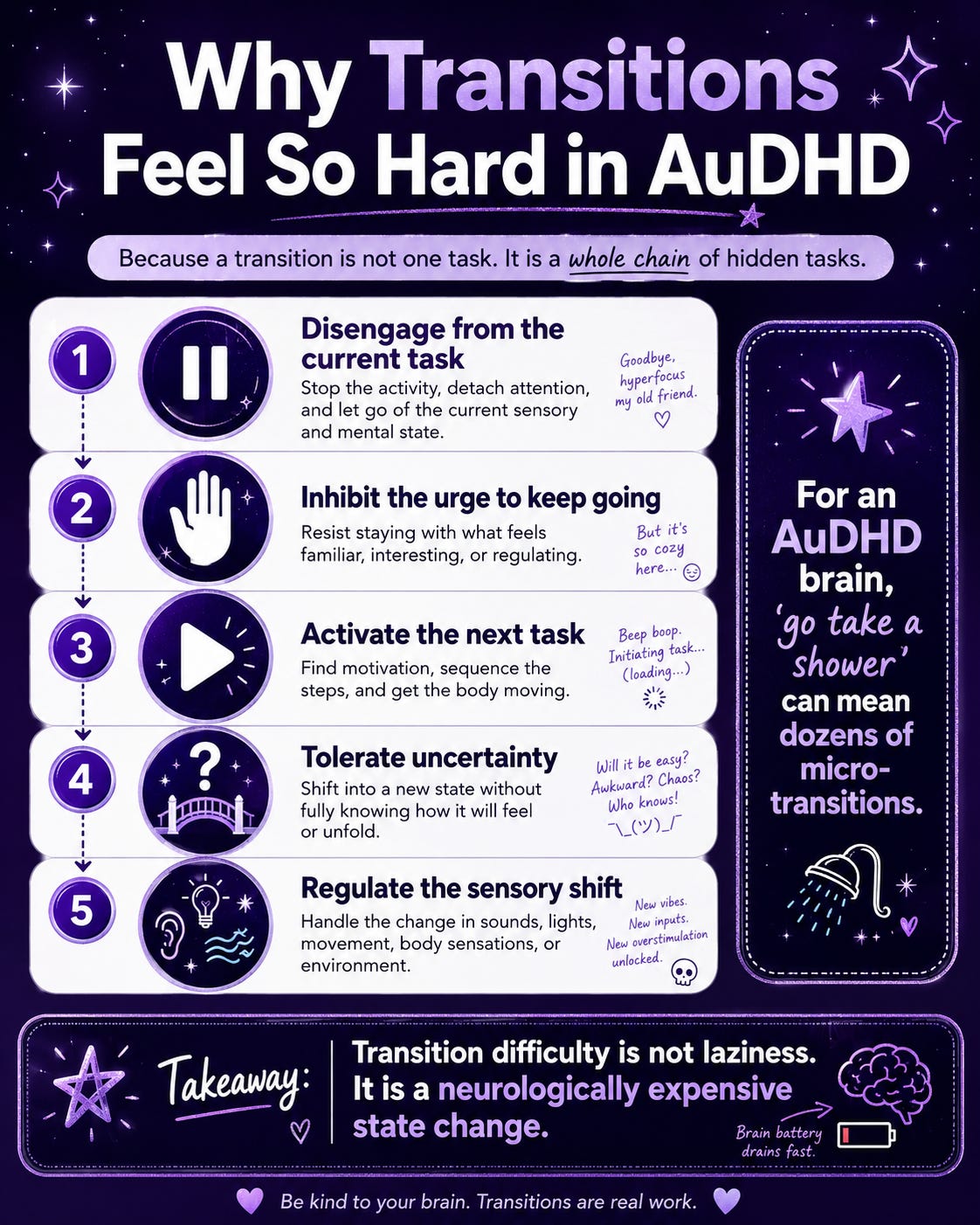
Transitions require the brain to do several things at once.
First, the brain has to disengage from the current task or state. This is harder when the current thing is interesting, regulating, predictable, or immersive.
Second, the brain has to inhibit the pull to continue. That means suppressing the urge to stay with the current activity, thought, sensory pattern, or routine.
Third, it has to activate the next task. That means gathering motivation, sequencing steps, predicting what comes next, and telling the body to move.
Fourth, it has to tolerate uncertainty. Even tiny uncertainties can feel huge when your nervous system already lives like a smoke detector with trust issues.
Fifth, it has to regulate the sensory shift. Going from bed to bright bathroom light? From quiet car to crowded store? From pajamas to real pants? That is not a transition. That is a hostage situation with denim.
Research on executive function describes mental flexibility, inhibition, and working memory as core skills that help us shift, organize, and respond to changing demands. These are exactly the systems that can be affected in ADHD and autism, which helps explain why “just switch tasks” can feel like asking the brain to do an Olympic vault after three hours of sleep and one sad granola bar.
And when ADHD is part of the picture, dopamine and reward pathways matter too. ADHD research has linked reduced dopamine-related markers in reward pathways with symptoms of inattention, which helps explain why low-reward transitions — like laundry, hygiene, paperwork, dishes, emails, or leaving the warm goblin nest — can feel physically impossible until urgency, novelty, or external pressure kicks in.
This is why “motivation” advice often fails.
It is not that you do not care.
It is that your brain does not always convert “I care” into “I can initiate movement now.”
Rude design flaw. No stars.
What Is Autistic Inertia?
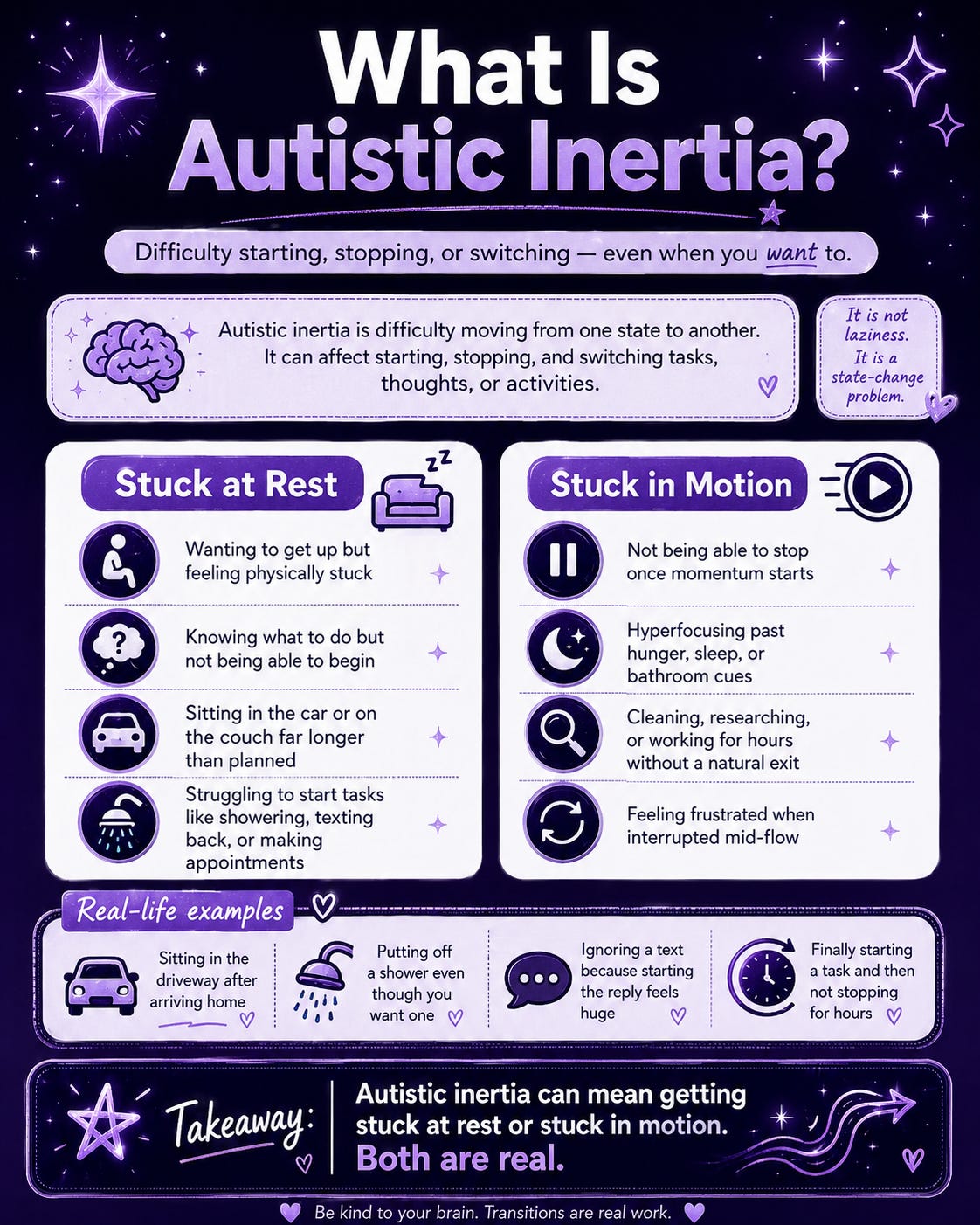
Autistic inertia is the difficulty with starting, stopping, or switching tasks or states, even when you want to.
It can look like being stuck at rest:
You want to get up, but you cannot initiate movement.
You want to shower, but your body feels offline.
You want to text back, but the message sits there like a cursed artifact.
You want to begin the project, but your brain treats the first step like it requires a blood oath.
It can also look like being stuck in motion:
You cannot stop researching.
You cannot stop cleaning once you finally start.
You cannot stop writing, even though you have to pee, eat, sleep, and possibly remember you are a mammal.
You stay in hyperfocus until your body sends a strongly worded letter through pain, hunger, or sudden existential dread.
Researchers have described autistic inertia as a common autistic experience of remaining in a state of rest or motion until something interrupts or changes that state. In a qualitative study of autistic adults, participants described inertia as difficulty moving from one state to another, affecting daily life, while also noting that the same “staying in motion” quality can support deep immersion or flow.
That last part matters.
Autistic inertia is not always “bad.” It can be disabling, yes. It can also be part of why some autistic people can go deeply into a passion, project, special interest, creative work, research rabbit hole, or system-building mode with the intensity of a Victorian ghost solving a murder.
The problem is not the depth.
The problem is when the world demands abrupt switching like we are emotional Roombas with unlimited battery.
Autistic Inertia Examples in Real Life
Autistic inertia can show up in ways that look confusing from the outside and deeply frustrating from the inside.
1. Sitting in the car after arriving home
You are technically home. You are safe. The drive is over.
And yet you sit there.
Not because you love your driveway. Not because your seatbelt is emotionally fulfilling. But because transitioning from “car body” to “house body” requires a full state change.
You have to gather your stuff. Open the door. Face temperature. Enter the house. Encounter people, pets, chores, lights, decisions, and the suspicious smell in the kitchen.
So you sit.
A parked little cryptid.
2. Not being able to start a task you actually want to do
This is the part that really messes with self-trust.
You want to write.
You want to record the podcast.
You want to go on the walk.
You want to shower.
You want to make the appointment.
You want to start the thing.
But desire does not always equal initiation.
That gap between wanting and doing is where shame loves to move in, unpack its ugly little suitcase, and start redecorating.
3. Not being able to stop once you finally start
This one gets praised sometimes, which is sneaky.
“You’re so productive!”
Thank you. I have not eaten in six hours, my jaw is clenched, and I am cleaning baseboards like a Victorian orphan preparing for inspection.
Autistic inertia can mean once momentum begins, stopping feels just as hard as starting. Your brain finally found the track and now refuses to exit the train.
4. Meltdown or shutdown after sudden changes
A sudden transition can feel like someone yanked the power cord out of your nervous system.
A plan changes.
Someone adds an unexpected stop.
A meeting gets moved.
A person says, “Actually, we’re leaving now.”
The schedule gets violated by chaos wearing shoes.
From the outside, the reaction may look “too big.”
Inside, the brain is trying to rapidly re-map reality while the nervous system screams, “We had a plan, Janet.”
5. Getting stuck between steps
You started the laundry, but now it sits in the washer.
You opened the email, but did not respond.
You put on workout clothes, then accidentally became furniture.
You made the list, but the list did not magically become action. Deeply inconsiderate.
This is because every step is its own transition.
“Do laundry” is not one task. It is a cursed relay race.
Transitions Are Not One Task — They Are a Stack of Micro-Tasks
This is the part I want tattooed on the forehead of every productivity bro who says, “Just build discipline.”
A transition is rarely one move.
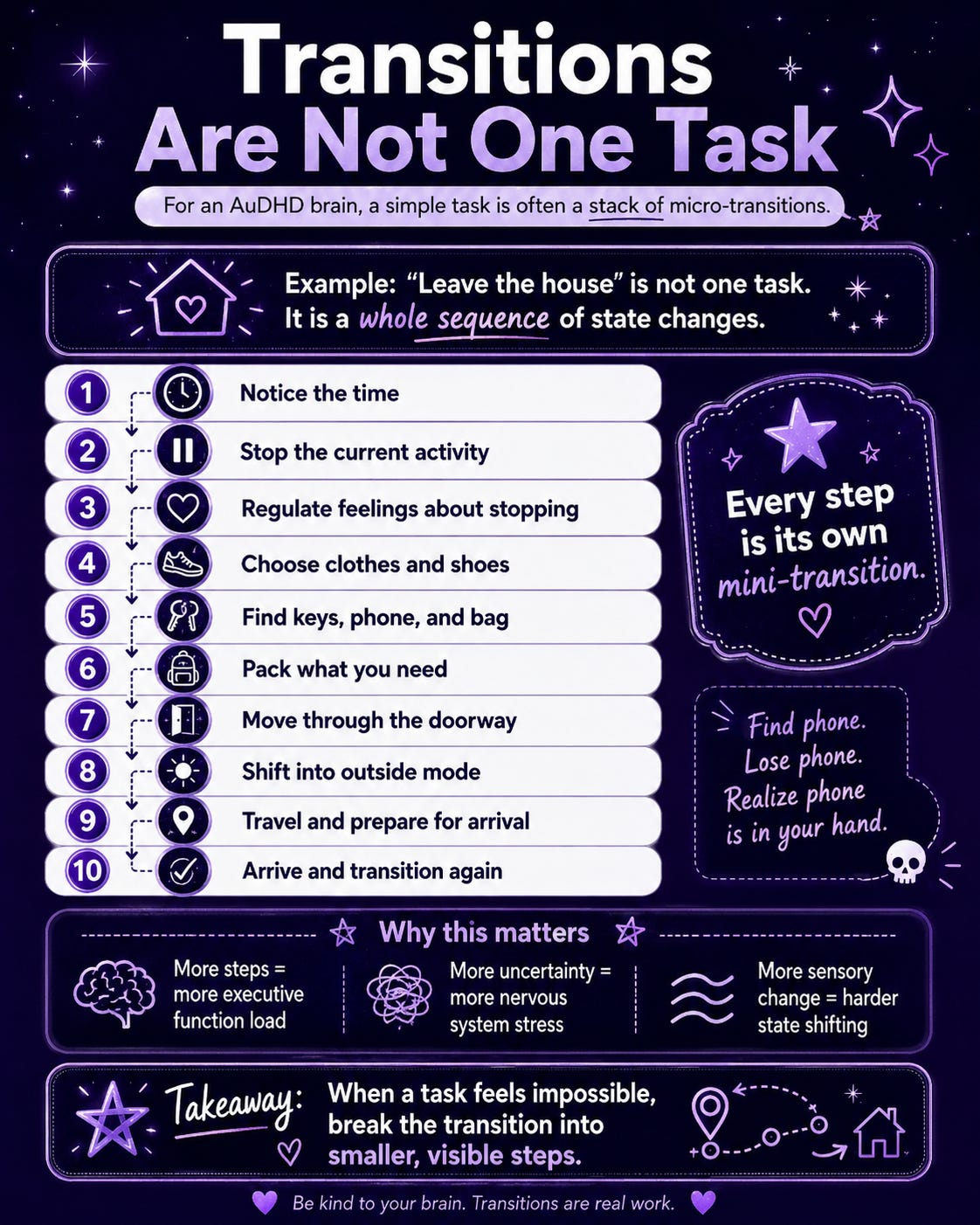
Let’s use “leave the house” as an example.
A neurotypical-friendly description:
Leave the house.
An AuDHD brain’s actual task list:
Notice the time.
Believe the time.
Stop current activity.
Regulate feelings about stopping.
Remember destination.
Predict weather.
Choose clothes.
Find socks.
Find keys.
Find emotional will to continue.
Pack bag.
Check water bottle.
Find phone.
Lose phone.
Find phone in hand.
Put on shoes.
Transition through doorway.
Tolerate outdoor sensory input.
Get into car.
Switch from house mode to driving mode.
Mentally prepare for arrival.
Arrive.
Transition out of car.
Become perceived.
That is not one task.
That is a neurological triathlon with footwear.
And if there are kids, pets, partners, weather, hunger, sensory overload, poor sleep, hormone shifts, anxiety, or time pressure involved?
Now it is a group project, and everyone in the group is a raccoon.
How Transition Difficulty Can Present
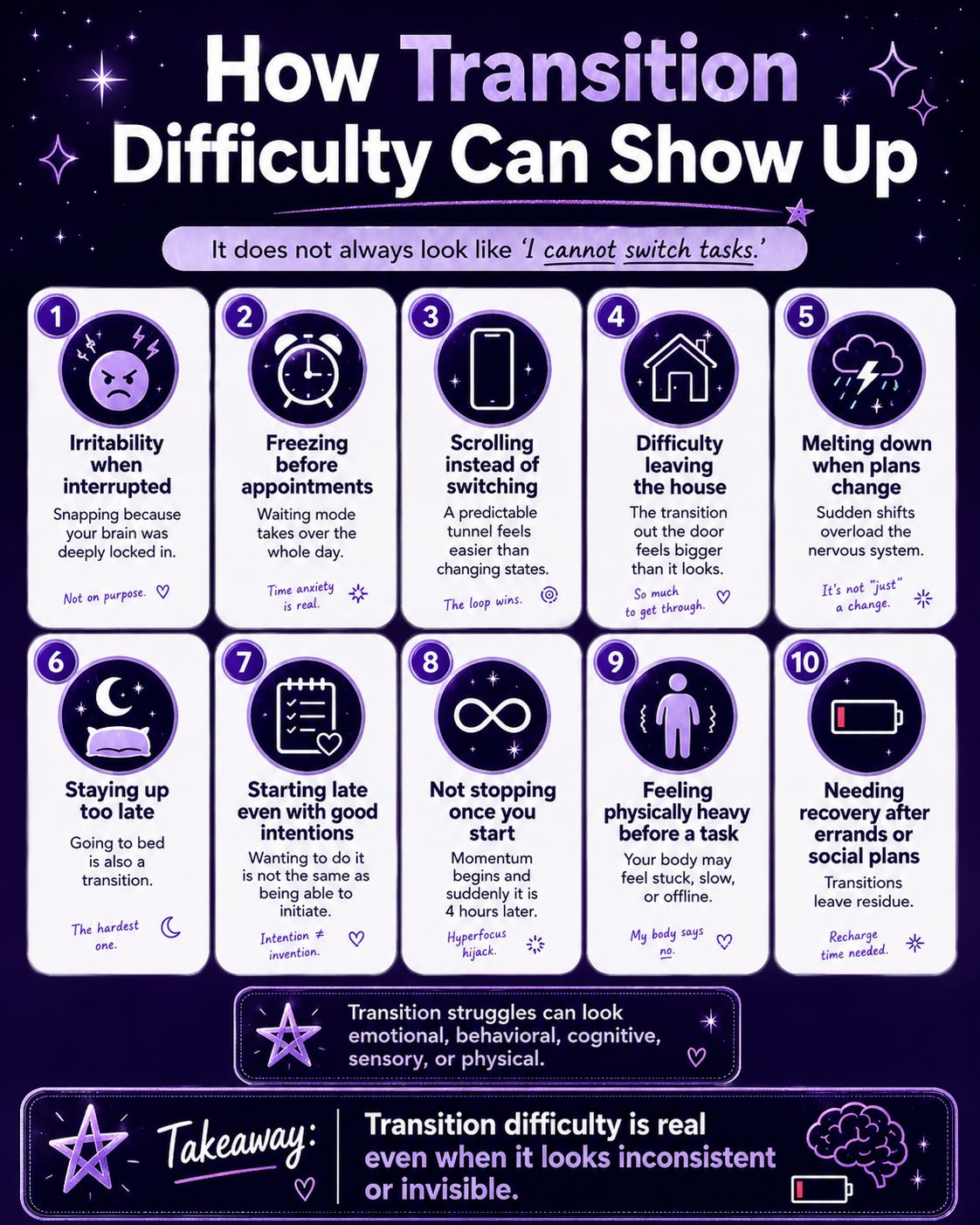
Transition struggles do not always look like “I cannot switch tasks.”
Sometimes they look like:
Irritability when interrupted.
Snapping when someone asks a simple question.
Avoiding starting because stopping later will be painful.
Staying up too late because going to bed is a transition.
Scrolling because it creates a predictable sensory tunnel.
Melting down when plans change.
Freezing before appointments.
Being late even when you started getting ready early.
Feeling physically heavy before a task.
Needing long recovery after errands.
Overplanning as a way to reduce transition uncertainty.
Underplanning because planning itself is too many transitions.
Demand avoidance when a task suddenly feels like pressure.
Saying “one more minute” and accidentally entering a new geological era.
This is why AuDHD can feel contradictory.
You may hate being rushed but also need urgency.
You may crave routine but resist being controlled by one.
You may need transitions to be predictable but also need novelty to activate.
You may want help but hate being interrupted.
You may need reminders but feel personally attacked by reminders.
The brain is not being dramatic.
It is trying to meet competing needs with one nervous system and a suspiciously limited battery
The Shame Trap
Here is where it gets emotionally gross.
When you struggle with transitions, people often misread it as:
Lazy.
Defiant.
Immature.
Unmotivated.
Careless.
Dramatic.
Self-sabotaging.
Bad at time management.
Not trying hard enough.
And after years of being misunderstood, you may start saying those things to yourself.
“I’m just lazy.”
“I don’t know why I’m like this.”
“I ruin everything.”
“Why can’t I just do normal things?”
“I’m an adult. This should not be this hard.”
Pause.
No.
A hard thing being invisible does not make it fake.
A transition can be neurologically real even when nobody else can see the gears grinding behind your eyes.
You are not failing at transitions because you are morally defective.
You are struggling because your brain has to do more work to shift states, and nobody gave you a transition ramp. They just handed you a cliff and said, “Hop down.”
How whimsical. How illegal.
The Nervous System Piece
Transitions are not just cognitive. They are sensory and emotional.
A transition often asks your nervous system to leave a known state and enter an unknown one.
Known state: couch, same lighting, same show, safe blanket, predictable input.
Unknown state: shower, cold air, water pressure, decisions, body sensations, post-shower tasks, existential dread in a towel.
Known state: classroom routine.
Unknown state: assembly, fire drill, schedule change, surprise visitor, different room.
Known state: alone time.
Unknown state: phone call, social interaction, being perceived, needing words.
For autistic nervous systems especially, sameness and predictability can reduce cognitive and sensory load. Autism research describes restricted/repetitive patterns, insistence on sameness, sensory reactivity, and executive-function differences as part of the broader autism profile, which helps explain why abrupt transitions can feel like a nervous system threat rather than a minor inconvenience.
This is why transition support is not babying yourself.
It is nervous system infrastructure.
A bridge is not “cheating” because the river exists.
So What Helps? Transition Ramps, Not Shame Whips
You do not need more self-bullying.
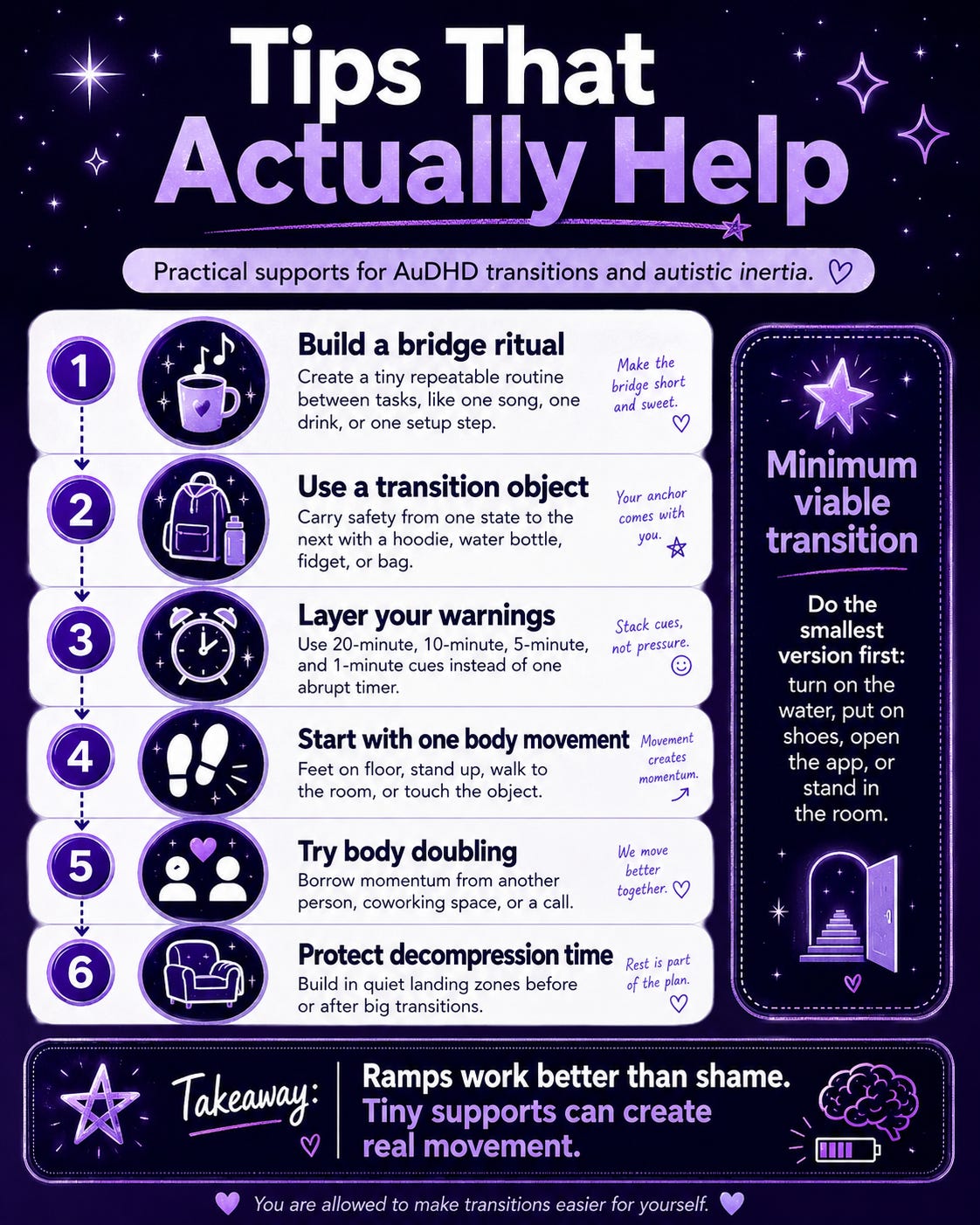
You need ramps.
A ramp is anything that reduces the cognitive, sensory, emotional, or physical load of moving from one state to another.
Here are strategies that actually respect the AuDHD brain.
Tips and Strategies for AuDHD Transitions and Autistic Inertia
1. Name the real transition
Instead of saying:
“I need to shower.”
Try:
“I need to transition from couch mode to bathroom mode.”
That sounds small, but it matters. When you name the transition, you stop treating the task like one giant moral test.
Ask:
What state am I in now?
What state am I trying to enter?
What is the hardest part of the shift?
Sometimes the issue is not the task.
It is the state change.
2. Use a transition object
A transition object is something that helps your brain carry safety from one state into the next.
Examples:
A specific hoodie.
A water bottle.
A fidget.
A playlist.
A scent.
A comfort item.
A “leaving the house” bag.
A coffee or Celsius. Naturally, the emotional support beverage must be respected.
The object says, “We are changing states, but we are not entering the void empty-handed.”
Very dramatic. Very effective.
3. Build a “bridge ritual”
A bridge ritual is a tiny repeated routine between tasks.
Examples:
Before work: same song in the car.
Before shower: turn on bathroom heater, start playlist, lay out clothes.
Before writing: open document, light candle, set timer for 5 minutes.
Before leaving: shoes, keys, bag, water, door. Same order every time.
After errands: sit in car for 3 minutes before entering the house.
The goal is not perfection. The goal is predictability.
Your nervous system loves a little “we’ve done this before” energy.
4. Use countdowns that include emotional warning
A lot of people use timers wrong for neurodivergent brains.
A timer that suddenly screams at you is not support. That is a jump scare with batteries.
Try layered warnings:
20 minutes: “Start closing the loop.”
10 minutes: “Pick a stopping point.”
5 minutes: “Body check. What do I need before switching?”
1 minute: “Stand up or change position.”
End: “Transition begins.”
This gives your brain time to detach.
Because abruptly stopping a preferred activity can feel like ripping a phone charger out of the wall with your teeth.
5. Create stopping points before starting
This is especially useful for inertial motion.
Before starting something immersive, decide:
What counts as done?
When will I pause?
What alarm will tell me to check my body?
What is the next task after this?
How will I exit?
Example:
“I’m going to research for 30 minutes. When the timer goes off, I will write down the next rabbit hole instead of entering it like a scholarly raccoon.”
The goal is not to prevent flow.
The goal is to prevent flow from eating your whole skeleton.
6. Make the first movement physical, not mental
When you are stuck, thinking harder can become quicksand.
Try one body-based cue:
Put feet on floor.
Sit upright.
Turn toward the task.
Touch the object.
Carry one item.
Walk to the room.
Open the document.
Put the toothbrush on the counter.
Do not demand full task completion.
Demand one visible movement.
Momentum often starts in the body before the brain agrees to the terms and conditions.
7. Use “minimum viable transition”
This is your nervous-system-respecting starter version.
Instead of:
“I need to clean the kitchen.”
Try:
“I will stand in the kitchen for 30 seconds.”
Instead of:
“I need to work out.”
Try:
“I will put on shoes.”
Instead of:
“I need to shower.”
Try:
“I will turn on the water.”
Instead of:
“I need to answer all messages.”
Try:
“I will open the app and pick one.”
The transition begins before the task begins.
That is the secret sauce.
Also, the secret sauce is probably in the fridge behind three expired condiments because object permanence is a myth invented by Big Neurotypical.
8. Externalize the sequence
Do not keep the transition plan in your head.
Your working memory is already running from wolves.
Use:
Visual checklists.
Sticky notes.
Whiteboards.
Phone widgets.
Picture cues.
“Leaving the house” cards.
A transition menu.
A first-step list.
A transition checklist might say:
Stop current task.
Save or write stopping point.
Stand up.
Drink water.
Bathroom.
Shoes.
Keys.
Bag.
Leave.
This is not childish.
This is accessible design.
Pilots use checklists. Surgeons use checklists. But somehow we shame neurodivergent people for needing a sticky note that says “bring lunch.”
No. Absolutely not. The sticky note is sacred.
9. Protect decompression time
For AuDHD brains, transitions create residue.
You may arrive home, but part of your brain is still at work.
You may leave a social event, but your nervous system is still processing every facial expression like a cursed detective.
You may finish a task, but your body has not caught up.
Build in landing zones.
Examples:
10 minutes in the car after work.
No questions for the first 15 minutes after getting home.
Quiet snack before chores.
Dim lights after errands.
A reset playlist.
Weighted blanket time.
A walk around the block.
Phone on Do Not Perceive Me mode.
You are not “wasting time.”
You are metabolizing transition load.
10. Use body doubling for state changes
Body doubling can help because another person provides structure, pacing, and external momentum.
This can look like:
A friend on FaceTime while you clean.
A coworking room.
A partner saying, “I’m putting on shoes too.”
A child doing the routine with you.
A podcast that signals “walk time.”
A virtual timer room.
The magic is not that someone does the task for you.
The magic is that your brain borrows their external rhythm until your internal engine catches.
11. Reduce sensory friction
If transitions are sensory assaults, reduce the assault. Revolutionary concept.
For shower transitions:
Warm towel.
Bathroom heater.
Soft robe.
Low light.
Predictable playlist.
Shower chair if helpful.
Dry shampoo on hard days.
Body wipe backup plan.
For leaving the house:
Shoes by door.
Bag packed the night before.
Sunglasses.
Loop earplugs/noise reduction.
Weather check.
Same parking spot when possible.
No extra stops unless pre-planned.
For bedtime:
Dim lights early.
Same scent.
Phone charger outside bed if needed.
Low-demand pajamas.
No “revenge bedtime” shame spiral.
A closing ritual that tells your brain the day is ending, even if your brain has prepared a 47-slide presentation about your 2009 mistakes.
12. Stop using shame as a starter pistol
Shame can create urgency, but it is expensive.
It might get you moving, but it burns the nervous system down like a haunted candle.
Try replacing:
“What is wrong with me?”
With:
“What part of this transition is too big?”
Replace:
“I’m lazy.”
With:
“I’m stuck. What ramp do I need?”
Replace:
“I should be able to just do this.”
With:
“My brain needs a cue, a bridge, or a body-based first step.”
You are not lowering the bar.
You are building the staircase.
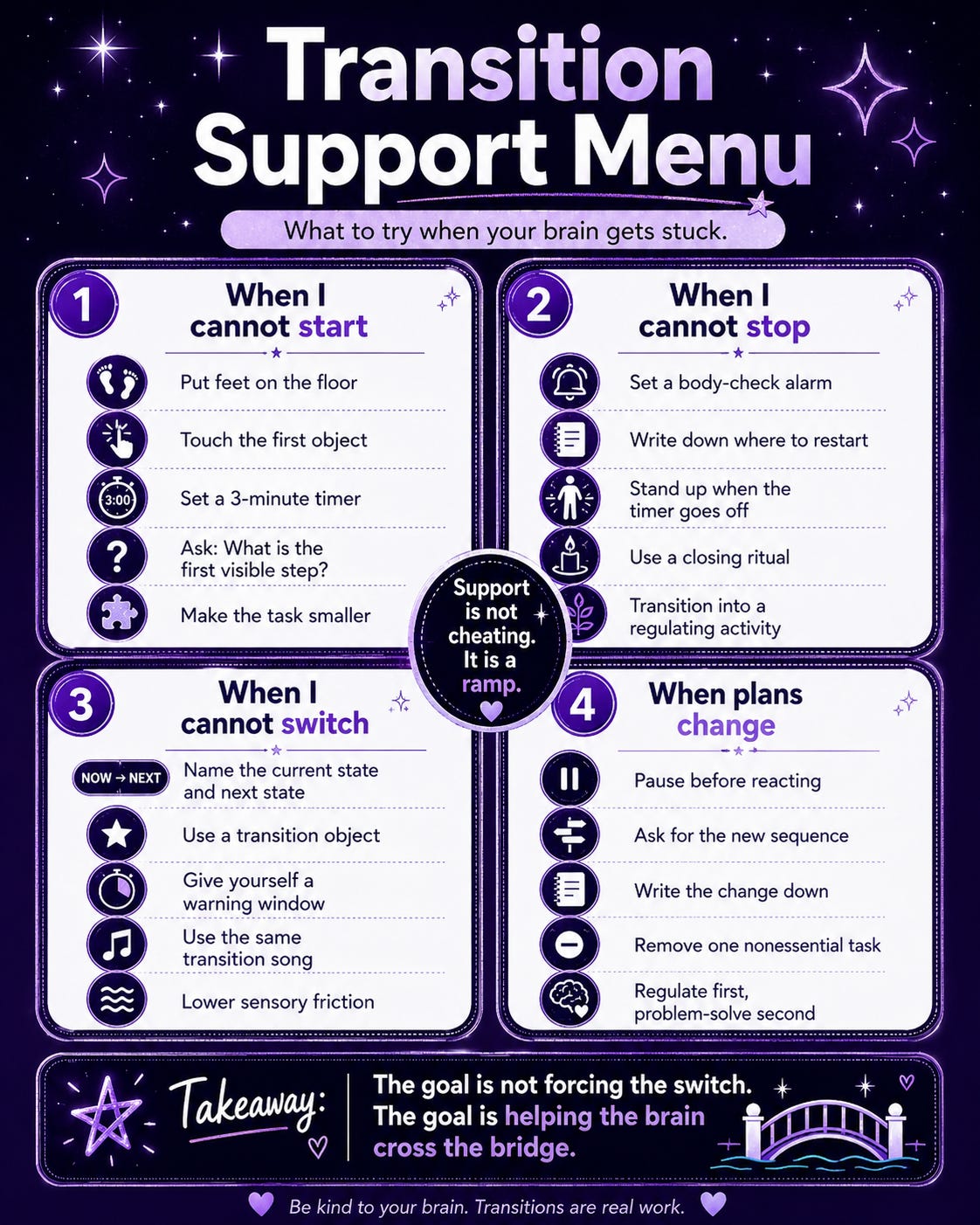
A Transition Support Menu
Use this when you are stuck and your brain has entered “404: Movement Not Found.”
When I cannot start:
Put feet on floor.
Change rooms.
Touch the first object.
Set a 3-minute timer.
Ask, “What is the first visible step?”
Use body doubling.
Add dopamine: music, beverage, novelty, movement.
Make it smaller until it feels almost stupid.
When I cannot stop:
Set a body check alarm.
Write down where to restart.
Use a closing ritual.
Create a “parking lot” note for unfinished thoughts.
Stand up when the timer goes off.
Transition to a regulating activity, not straight into another demand.
Ask, “What will Future Me need if I stop here?”
When I cannot switch:
Name the current state and next state.
Use a bridge object.
Preview the next environment.
Give yourself a warning window.
Use the same transition song.
Do one physical movement toward the new state.
Lower sensory friction.
When plans change:
Pause before responding.
Ask for the new sequence.
Write it down.
Remove one nonessential task.
Regulate before problem-solving.
Say, “I need a minute to update my brain.”
Because honestly? You do.
Scripts for Real Life
For partners/family:
“I’m not ignoring you. I’m having trouble switching states. Please give me a 10-minute warning before you need me to stop.”
For work:
“I do best with transition time between tasks. Can we build in a few minutes between meetings or changes when possible?”
For kids:
“Your brain was doing one thing, and now we’re asking it to do another. Let’s help it switch.”
For yourself:
“I am not lazy. I am in a transition bottleneck. One tiny movement counts.”
For the person who says ‘just do it’:
“Thank you, Nike commercial. Very healing.”
Reflection Journal Prompts
What transitions feel hardest for me: starting, stopping, switching, leaving, arriving, or recovering?
What is one transition I keep labeling as “one task” that is actually many micro-steps?
What sensory changes make transitions harder for me?
When I get stuck, am I usually stuck at rest, stuck in motion, or stuck between steps?
What does autistic inertia feel like in my body?
What helps me move without shame: music, pressure, visuals, body doubling, novelty, routine, urgency, comfort, or quiet?
What transition in my day needs a ramp instead of a demand?
Where do I need more warning time?
What is one “minimum viable transition” I can try this week?
What would I say to a child who struggled with this same transition? Can I offer that same compassion to myself without making it weird? Okay, maybe a little weird. Growth is awkward.
Final Thought: You Are Not Bad at Life. You Are Under-Supported at State Changes.
Transitions are not character tests.
They are brain-body events.
For AuDHD brains, switching tasks can involve executive function, dopamine, sensory processing, emotional regulation, prediction, uncertainty tolerance, motor initiation, and nervous system safety.
So no, you are not “too much” because you need warnings, routines, visual supports, transition objects, decompression time, or a tiny emotional support beverage to become a person again.
You are not lazy because you freeze.
You are not irresponsible because you need ramps.
You are not broken because your brain resists abrupt change.
You are a human nervous system, not a light switch.
And maybe the goal is not to force yourself to transition like everyone else.
Maybe the goal is to stop throwing yourself off cliffs and start building bridges.
Purple ones, obviously. With sparkles. And a tiny sign that says:
Support is not cheating. Support is holy.
Free Bonus Guide / Mini Workbook
The AuDHD Transition Ramp Kit
Download:

A nervous-system-friendly workbook for autistic inertia, task switching, and getting unstuck without bullying yourself into motion
Companion resource for:
“Stuck Between Tabs: AuDHD, Transitions, and Autistic Inertia”
Before We Begin: Tiny Disclaimer, Because We Are Responsible Goblins
This guide is for education, reflection, and support. It is not medical advice, therapy, or a replacement for individualized care. It is a tool to help you understand your nervous system, reduce shame, and create transition supports that actually work with your AuDHD brain instead of trying to drag it by the emotional ankles.
You are not lazy.
You are not broken.
You are not “too much.”
You are probably under-supported at state changes.
And yes, that counts.
Page 1: What Is a Transition Ramp?
A transition ramp is any small support that helps your brain and body move from one state to another.
A ramp can help you:
Start a task.
Stop a task.
Switch tasks.
Leave a place.
Arrive somewhere.
Recover after errands, work, or social plans.
Restart after being interrupted.
Handle plan changes without your nervous system filing for divorce.
A ramp is not cheating.
A ramp is not weakness.
A ramp is accessibility.
Because for the AuDHD brain, transitions are often not one task. They are a stack of invisible micro-tasks wearing a trench coat and pretending to be “just go shower.”
Rude. Deeply rude.
The Transition Truth
A transition often requires your brain to:
Disengage from the current task.
Inhibit the urge to keep going.
Activate the next task.
Sequence the steps.
Tolerate uncertainty.
Regulate sensory changes.
Move the body.
Emotionally detach from what felt safe, interesting, or predictable.
That is a lot.
So when a transition feels impossible, the question is not:
“Why am I like this?”
The better question is:
“What kind of ramp does this transition need?”
Page 2: My Transition Pattern Map
Use this page to notice where your brain gets stuck most often.
I usually get stuck when I need to:
Circle or highlight any that apply.
Start a task
Stop a task
Switch tasks
Leave the house
Get out of the car
Get out of bed
Go to bed
Shower
Eat
Answer messages
Make appointments
Start work
Stop work
Transition from work to home
Transition from alone time to social time
Transition after errands
Handle sudden plan changes
Move from planning to doing
Move from thinking to speaking
Move from one environment to another
Other: _______________________________
My hardest type of transition is usually:
Starting
Stopping
Switching
Arriving
Leaving
Recovering
Restarting after interruption
Handling unexpected change
Why do I think this one is hardest for me?
When I am stuck, it usually feels like:
My body is heavy
My brain is blank
I feel irritated
I feel frozen
I feel overwhelmed
I want to do it but cannot start
I cannot stop once I begin
I avoid the task completely
I scroll or zone out
I get sleepy
I feel anxious
I feel angry
I feel trapped
I feel like I need more information first
I feel like I need the “perfect” time
I feel like the next step is too big
Other: _______________________________
My stuck feeling in one sentence:
Example: “It feels like my brain is buffering while my body is a couch.”
Page 3: Autistic Inertia Check-In
Autistic inertia can mean difficulty starting, stopping, or switching, even when you want to.
It can look like being stuck at rest or stuck in motion.
Both count.
Both are real.
Both deserve support.
Stuck at Rest
This is when you want to begin, move, reply, leave, shower, eat, clean, write, or start… but your body and brain do not shift into motion.
For me, stuck at rest looks like:
Sitting in the car after arriving
Staying in bed even though I am awake
Avoiding a shower even though I want one
Not answering a text
Not starting a project I actually care about
Standing in a room not knowing where to begin
Waiting mode before an appointment
Feeling physically heavy before a task
Scrolling because switching feels too hard
Other: _______________________________
My most common “stuck at rest” situation is:
Stuck in Motion
This is when you finally start something, but stopping feels almost impossible.
For me, stuck in motion looks like:
Researching for hours
Cleaning until I am exhausted
Writing past hunger cues
Working through bathroom cues
Scrolling past bedtime
Hyperfocusing until I crash
Getting irritated when interrupted
Feeling unable to pause “until it is done”
Forgetting time exists, because apparently time is a soup
Other: _______________________________
My most common “stuck in motion” situation is:
Reflection
What do I usually shame myself for that might actually be autistic inertia?
What would change if I treated this as a support need instead of a character flaw?
Page 4: The Micro-Transition Breakdown
Pick one transition that feels way harder than it “should.”
Examples:
Leaving the house
Taking a shower
Starting a blog post
Going to bed
Starting laundry
Stopping work
Answering messages
Getting ready for an appointment
Transitioning home after work
Starting a workout
My transition:
What it looks like from the outside:
Example: “Just take a shower.”
What it actually requires:
Break it into tiny steps.
The hardest micro-step is:
Why this step might be hard:
It requires initiation
It requires stopping something else
It has sensory discomfort
It has uncertainty
It has too many choices
It feels boring
It feels emotionally loaded
It requires being perceived
It requires executive function
It requires time awareness
It requires physical movement
It has no clear end point
It feels like a demand
Other: _______________________________
One way I can make this micro-step smaller:
Page 5: My Transition Ramp Builder
Use this page to design supports for one difficult transition.
Transition I want to support:
Current state:
Where am I starting?
Example: couch mode, work mode, bed mode, car mode, scrolling mode, hyperfocus mode.
Next state:
Where am I trying to go?
Example: shower mode, sleep mode, outside mode, podcast mode, cleaning mode.
What makes this transition hard?
Check any that apply.
Sensory shift
Too many steps
Unclear first step
Task feels boring
Task feels emotionally loaded
I do not know how long it will take
I do not know what “done” looks like
I am already tired
I am interrupted
I am hungry
I am overstimulated
I am understimulated
I am anxious
I feel pressured
I do not want to stop what I am doing
I do not want to start what comes next
The next task has too many decisions
Other: _______________________________
My Ramp Options
Choose 1–3 supports to try.
Body Ramp
Feet on floor
Stand up
Walk to the doorway
Touch the first object
Stretch for 10 seconds
Put on shoes
Carry one item to the next room
My body ramp will be:
Sensory Ramp
Dim lights
Use headphones
Use music
Warm towel
Comfort hoodie
Sunglasses
Lower noise
Use scent
Change temperature
Use a fidget
Drink water
Use an emotional support beverage, obviously
My sensory ramp will be:
Visual Ramp
Sticky note
Checklist
Timer
Whiteboard
Picture cue
Phone reminder
Calendar block
“Now → Next” card
Written sequence
My visual ramp will be:
Dopamine Ramp
Music
Novelty
Reward after
Body doubling
Make it a challenge
Pair with podcast
Use a fun pen
Change location
Add movement
Use a silly name for the task
My dopamine ramp will be:
Emotional Ramp
Self-talk script
Permission to do the tiny version
Lower expectations
Name the state change
Ask for help
Pause before reacting
Remove one nonessential step
Remind myself: “This is hard because it is hard, not because I am bad.”
My emotional ramp will be:
Page 6: Minimum Viable Transition
A Minimum Viable Transition is the smallest possible version of starting the shift.
Not the whole task.
Not the perfect task.
Not the “I have become a new woman and solved my life through discipline” task.
Just the tiniest doorway into movement.
Examples
Instead of “take a shower”:
Turn on the water.
Put towel nearby.
Stand in bathroom.
Wash face only.
Use body wipes if showering is too much.
Instead of “work out”:
Put on shoes.
Stretch for one minute.
Walk to the end of the block.
Do one set.
Stand on the yoga mat.
Instead of “write the blog”:
Open the document.
Write the title.
Brain dump 5 messy bullet points.
Copy one quote or idea.
Set a 5-minute timer.
Instead of “clean the kitchen”:
Stand in the kitchen.
Throw away 3 things.
Put 5 dishes near the sink.
Wipe one counter.
Start with trash only.
My Minimum Viable Transition Plan
The transition I am avoiding:
The full version my brain is panicking about:
The smallest possible version:
How long will I try it?
1 minute
3 minutes
5 minutes
10 minutes
Other: ___________
What counts as success?
Tiny reward or relief after:
Reminder
If you do the tiny version, it counts.
If you start and stop, it counts.
If you only create the ramp today, it counts.
We are not building a shame palace. We are building a bridge.
Page 7: Transition Scripts
Sometimes the hardest part of transitions is explaining them to other people without sounding like you are presenting evidence in the Supreme Court of “Please Stop Perceiving Me.”
Use these scripts as starting points.
For yourself
“I am not lazy. I am stuck between states. What is one tiny ramp I can use?”
“I do not have to finish the whole thing. I only have to begin the transition.”
“My body is buffering. I can start with movement, not motivation.”
“This feels big because it has hidden steps.”
“I am allowed to make this easier.”
For partners or family
“I am having trouble switching states. Can you give me a 10-minute warning before we change activities?”
“I am not ignoring you. I need a minute to transition before I can respond.”
“Sudden changes are hard for my nervous system. Can you tell me the new plan step-by-step?”
“When I get home, I need a short landing zone before questions or tasks.”
“I want to do this. I am just stuck at the start.”
For work
“I do best when I have a few minutes between tasks or meetings to reset.”
“Can you send the steps in writing so I can transition into the task more easily?”
“I am switching from one focus area to another, so I may need a brief reset before responding.”
“I work best with clear start points, end points, and priorities.”
For kids
“Your brain was doing one thing, and now we are asking it to do another. Let’s help your brain switch.”
“First we do this, then we do that.”
“You are not in trouble for having a hard time switching.”
“Let’s make the first step smaller.”
“Your body needs a bridge.”
My favorite script to try this week:
Page 8: My Transition Support Menu
Create your personal menu. Pick options that feel realistic, not options your fantasy self would choose after drinking a magical productivity smoothie.
When I cannot start, I can try:
When I cannot stop, I can try:
When I cannot switch, I can try:
When plans change, I can try:
When I need recovery after a transition, I can try:
Quiet time
Snack
Water
Walk
Weighted blanket
Low light
No talking
Comfort show
Music
Stretching
Journaling
Sitting in the car for 5 minutes
Changing clothes
Taking off shoes
Phone on Do Not Perceive Me mode
My top 3 recovery supports:
Page 9: Weekly Transition Tracker
Use this for one week. Not to judge yourself. Not to become a spreadsheet gremlin of shame. Just to gather data.
Transition I tracked:
DayWhat was the transition?What made it hard?What ramp did I try?Did it help?MondayTuesdayWednesdayThursdayFridaySaturdaySunday
What I noticed this week:
One ramp that helped:
One ramp that did not help or needs adjusting:
One transition I want to support next week:
Page 10: Reflection + Reframe
The transition I am hardest on myself about is:
The story I usually tell myself is:
Example: “I am lazy,” “I am irresponsible,” “I should be able to do this,” “Everyone else can handle this.”
A more accurate nervous-system-based story is:
Example: “This transition has too many hidden steps and not enough supports.”
The support I actually need is:
A compassionate sentence I can practice:
Final Page: Your Transition Permission Slip
You are allowed to need warning time.
You are allowed to need visuals.
You are allowed to need a bridge ritual.
You are allowed to sit in the car for five minutes before going inside.
You are allowed to use timers, scripts, checklists, body doubling, sensory tools, and emotional support beverages.
You are allowed to make the task smaller.
You are allowed to protect decompression time.
You are allowed to start with the tiniest possible version.
You are allowed to stop using shame as a productivity strategy.
You are allowed to support your brain instead of punishing it for having needs.
Because transitions are real work.
Autistic inertia is real.
AuDHD state changes are real.
And support is not cheating.
Support is holy.