
The AuDHD Hack Menu: 30 Tiny Supports for Brains That Refuse to Be Factory Settings
Research-backed strategies for adults and kids with ADHD + autism, because “just try harder” belongs in the trash with dried-out markers and expired yogurt.

Let’s start here:
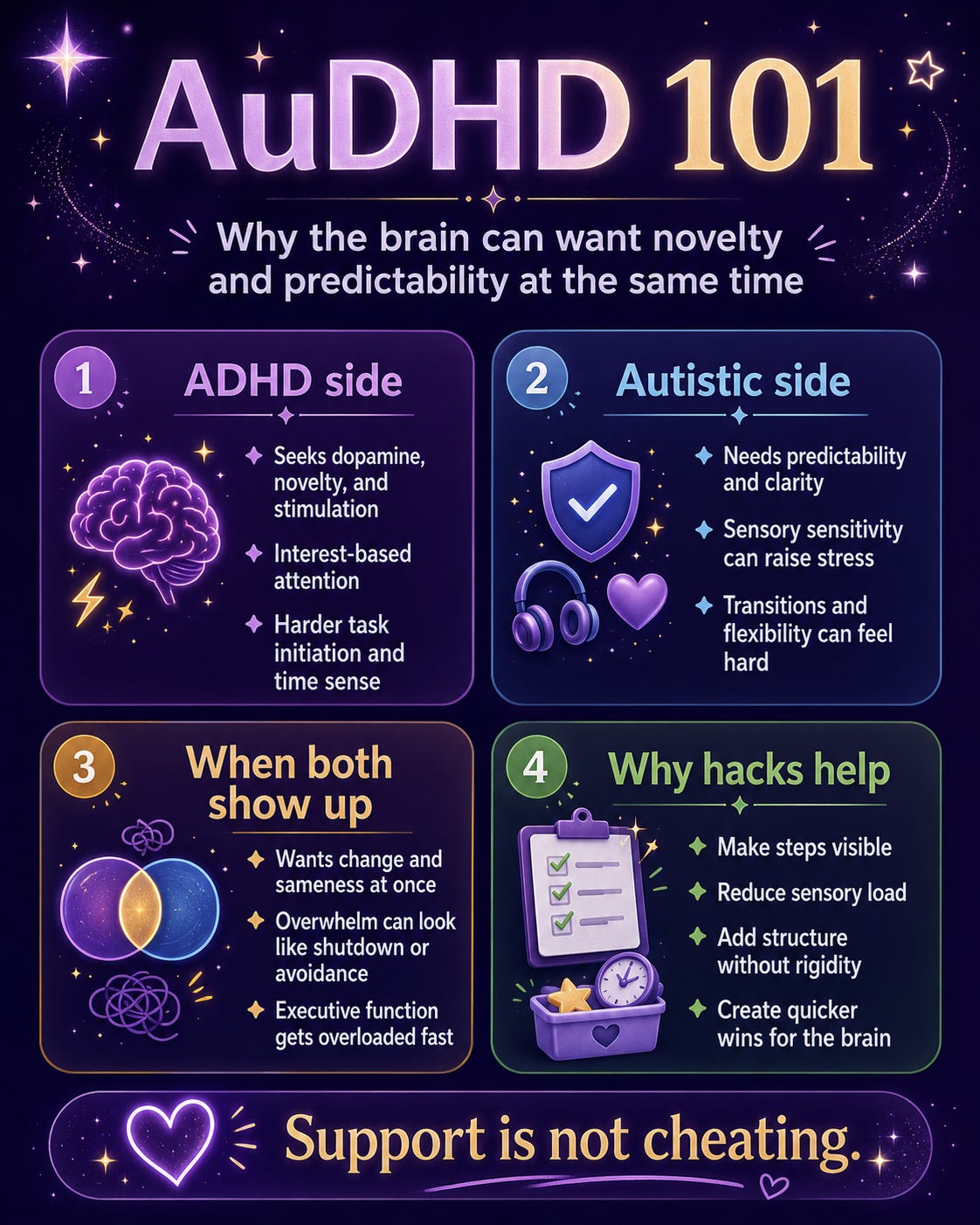
AuDHD is not “ADHD plus autism in a trench coat.” It can feel like two nervous systems sharing one steering wheel. ADHD may crave novelty, speed, stimulation, and dopamine. Autism may crave predictability, sameness, sensory safety, and clear expectations. Together? Whew. The brain can want a new adventure and a laminated routine at the exact same time.
Research backs up what lived experience has been yelling into the void: ADHD and autism both involve executive functioning differences, including planning, attention, inhibition, flexibility, working memory, and emotional regulation. Co-occurring autism and ADHD may create a unique profile rather than a simple overlap of two separate conditions.
And because this is AuDHD, we are not doing “hacks” as in: “Here’s one magical trick to fix your brain.” No. Absolutely not. We are doing hacks as in tiny bridges between intention and action. Supports. Scaffolds. Nervous-system-friendly tools. Little brain ramps. The stuff that helps us stop confusing “I can’t access the skill right now” with “I’m failing as a human.”
ADHD is linked to reward, motivation, and dopamine differences; research has found altered dopamine reward pathway markers associated with inattention, and people with ADHD often show stronger preference for immediate rewards over delayed ones. Translation: your brain may not be “lazy.” It may be struggling to feel the future reward strongly enough to start the task now.
Autism adds another layer: sensory processing, predictability, transitions, and cognitive flexibility can all affect whether a task feels doable or like being asked to fold laundry during a tornado while someone plays jazz with a leaf blower. Sensory processing differences are also associated with executive functioning in children with co-occurring ASD + ADHD.
So this blog is split into two menus:
15 hacks for adult AuDHD brains
15 hacks for child AuDHD brains
Same core idea. Different developmental needs.
Not medical advice. Not a replacement for therapy, OT, medication support, school accommodations, parent training, or professional care. This is a practical, research-informed, lived-experience-loving toolbox.
Active Processing Pause
Before you read the hacks, ask yourself:
Where does my brain or my child’s brain usually get stuck?
Is it starting?
Switching?
Remembering?
Stopping?
Feeling safe?
Handling sensory input?
Knowing what “done” looks like?
Recovering after overwhelm?
That answer matters because the best “hack” is not the trendiest one. It is the one that supports the actual bottleneck.
15 AuDHD Hacks for Adults
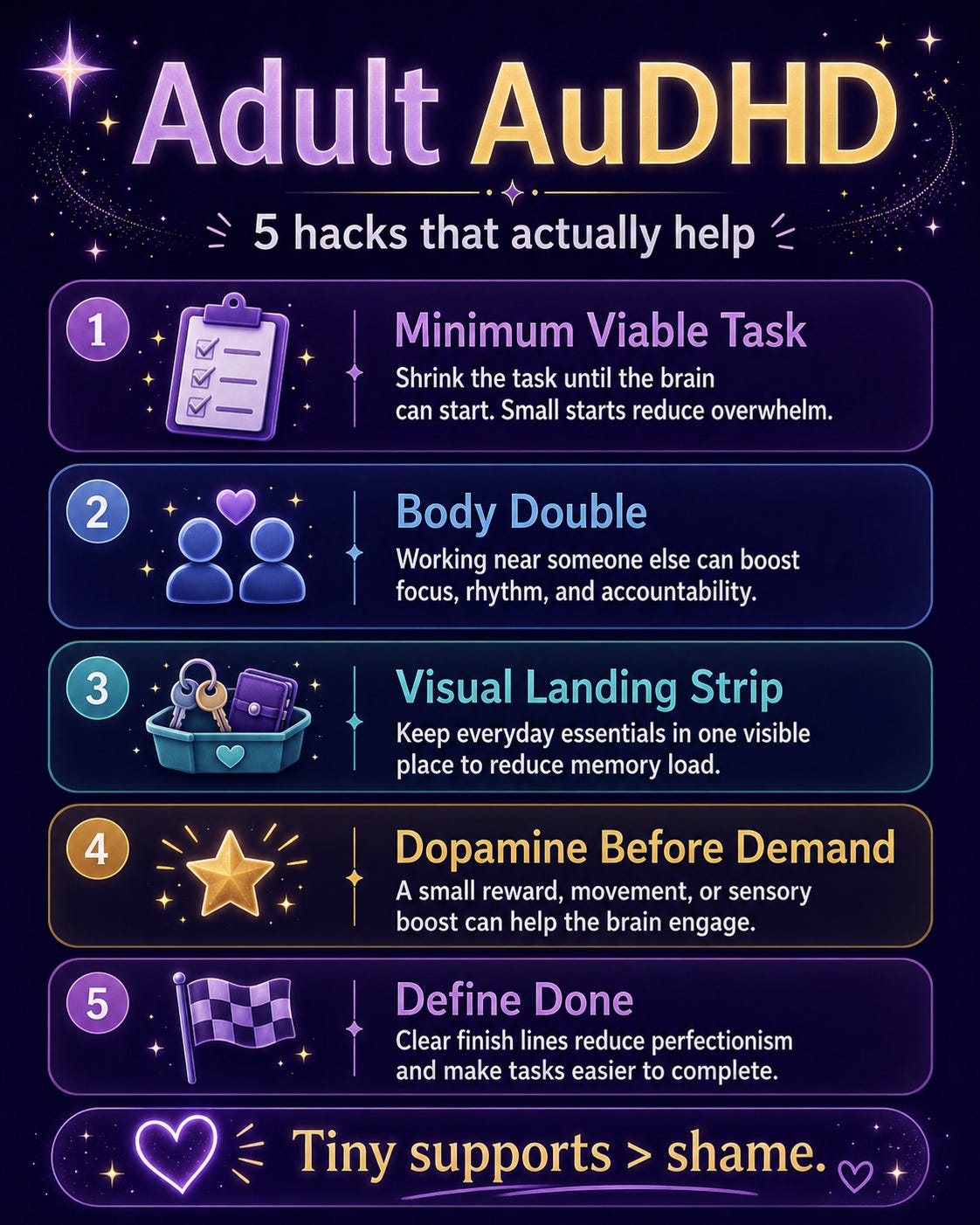
1. The “Minimum Viable Task” Hack
Instead of saying, “I need to clean the kitchen,” shrink it to:
“I will put five dishes in the dishwasher.”
Why it works: Adult ADHD often involves task initiation, planning, and working memory challenges. Autism can add overwhelm when the task feels vague or endless. A minimum viable task lowers cognitive load and gives the brain a visible entry point. It also creates immediate feedback, which helps a dopamine-sensitive brain feel progress sooner.
Active processing question:
What task are you avoiding because your brain is reading it as a mountain instead of a first step?
2. The “Body Double, Not Boss” Hack
Work near another person, on FaceTime, in a coworking session, or even with a “study with me” video. The goal is not supervision. The goal is nervous system anchoring.
Why it works: Many ADHD brains perform better with external structure and social presence. For AuDHD adults, the key is choosing a body double who feels regulating, not demanding. We are not trying to activate shame. We are borrowing another nervous system’s rhythm like a metronome with better boundaries.
3. The “Visual Landing Strip” Hack
Create one place where important items land: keys, wallet, meds, badge, charger, headphones, water bottle.
Why it works: Working memory is not a reliable storage unit for many AuDHD adults. Visual cues reduce the need to mentally track everything. This supports executive functioning by moving information from the invisible brain space into the visible environment. Visual supports and schedules have evidence behind them for improving participation, transitions, and behavior in neurodivergent children, and the same principle often helps adults too: make the next step visible.
4. The “Dopamine Before Demand” Hack
Before a hard task, give your brain a small, non-destructive dopamine spark: music, a walk, a favorite drink, a funny podcast clip, a candle, a sensory tool, or five minutes of novelty.
Why it works: ADHD brains often struggle when the reward is too far away. Pairing a low-demand reward before or during a task can help the brain enter the task with more activation. The trick is to choose something that supports the task, not something that kidnaps you into a three-hour scroll vortex.
Active processing question:
What gives your brain clean energy, not chaotic energy?
5. The “Same Container, Different Contents” Hack
Keep the structure predictable but allow the activity inside to change.
Example:
Every Sunday is reset time, but the reset can be laundry, planning, groceries, or prepping clothes.
Every morning starts with a checklist, but the order can vary.
Why it works: ADHD needs novelty. Autism often needs predictability. This hack gives both parts of the brain a snack. The container provides safety. The contents provide flexibility.
6. The “Transition Object” Hack
Use a specific object to help you move from one mode to another: headphones for cleaning, a certain mug for writing, walking shoes for errands, a hoodie for decompression.
Why it works: AuDHD transitions are not just “switching activities.” They are nervous system shifts. Objects can become cues that tell the brain, “We are moving into this mode now.” It reduces the invisible cost of task-switching.
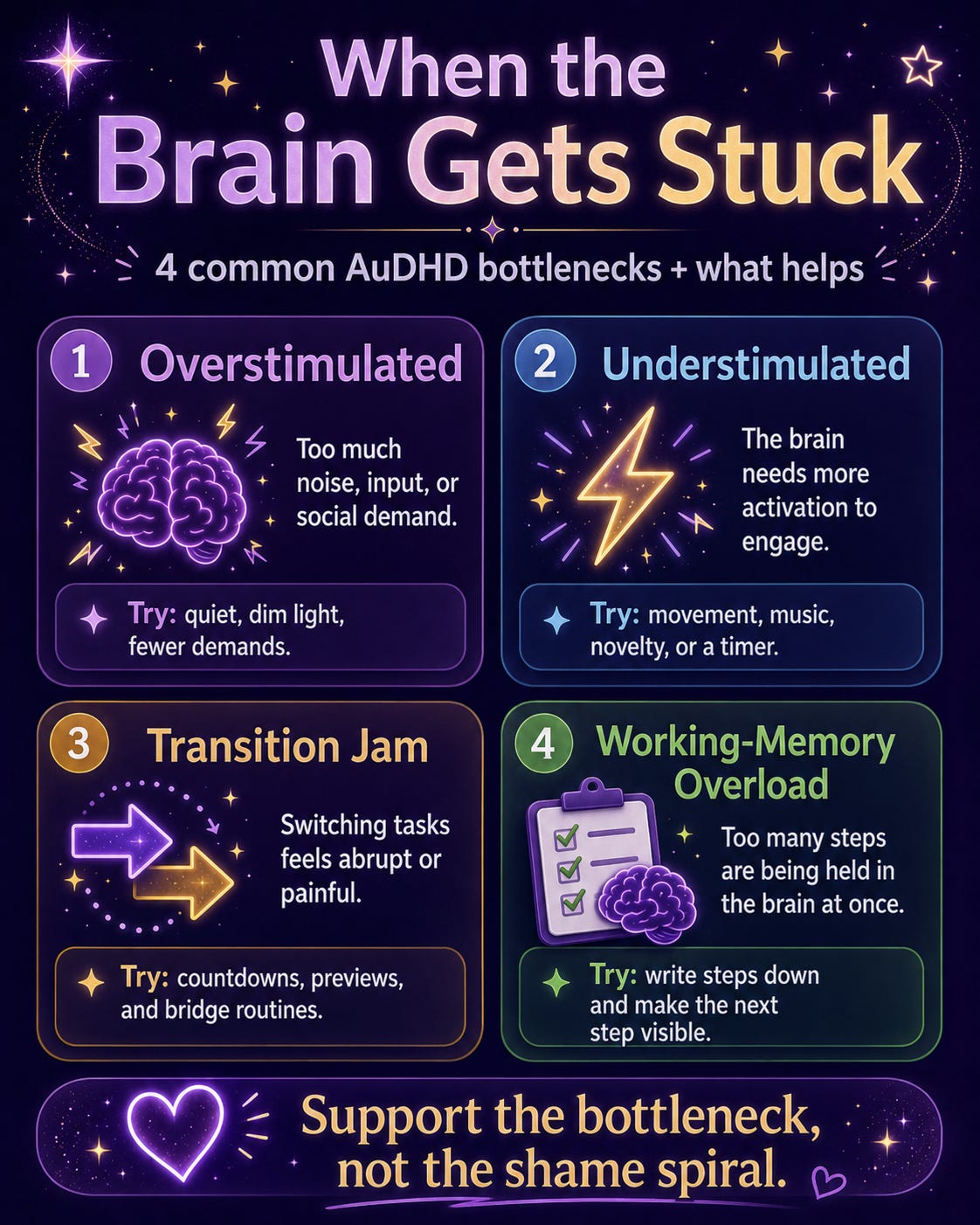
7. The “Sensory Weather Report” Hack
Ask:
Am I under-stimulated, over-stimulated, or sensory scrambled?
Then match the support:
Under-stimulated: movement, music, novelty, pressure, bright light.
Over-stimulated: dim light, quiet, compression, sunglasses, reduced demands.
Scrambled: water, food, body scan, simple repetitive task.
Why it works: Sensory processing is not extra. It is part of the operating system. Research links sensory processing and executive functioning in ASD + ADHD, meaning sensory overload can directly affect planning, attention, inhibition, and regulation.
8. The “Two-List Method” Hack
Make two lists:
Brain Dump List: everything screaming for attention.
Today List: only 1–3 actual priorities.
Why it works: The brain dump clears mental noise. The today list protects working memory and prevents the ADHD brain from treating every thought like an emergency siren. It also helps autistic black-and-white thinking soften from “all of it now” into “some of it today.”
Active processing question:
What is currently on your brain dump list that does not actually belong on today’s list?
9. The “Done Looks Like This” Hack
Before starting, define what finished means.
Instead of: “Clean bedroom.”
Try: “Trash in bag, clothes in basket, clear nightstand.”
Why it works: AuDHD brains can get stuck because tasks are vague. Defining “done” reduces ambiguity and supports planning, sequencing, and stopping. This is especially helpful for perfectionism, because without a stopping point, the brain may decide the only acceptable finish line is becoming an entirely different person with matching storage bins.
10. The “Timer as a Boundary, Not a Threat” Hack
Use timers gently:
“Ten-minute reset.”
“Five-minute start.”
“Twenty-minute focus, then stop.”
Why it works: Timers externalize time. Many ADHD brains have difficulty sensing time internally, and many autistic brains benefit from predictability. The timer creates a visible or audible boundary around effort. It says, “This is not forever.”
11. The “Friction Audit” Hack
When something keeps not happening, ask:
Where is the friction?
Too many steps?
Too many decisions?
Wrong location?
Sensory barrier?
Emotional dread?
No visible cue?
No immediate reward?
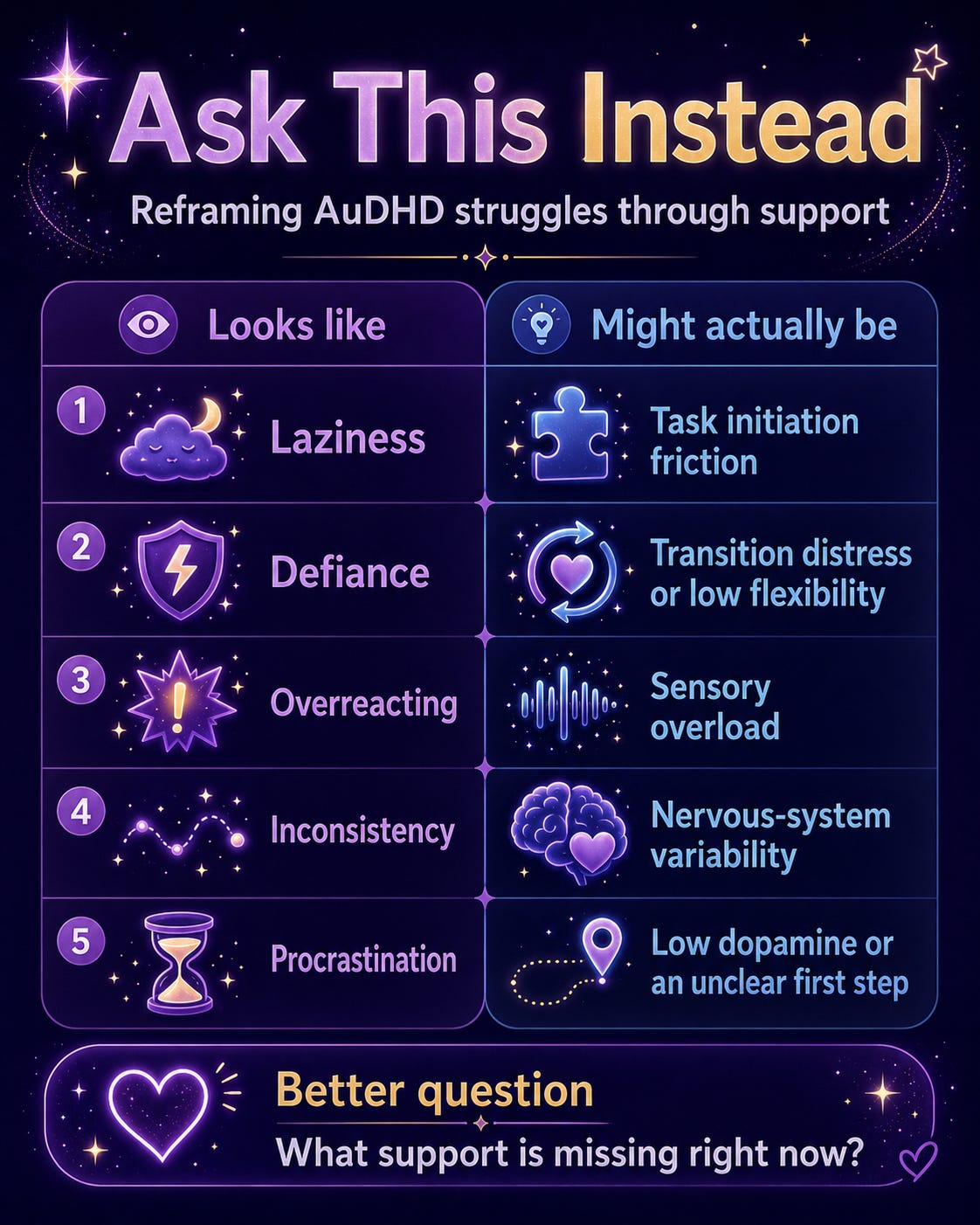
Why it works: This moves the problem from moral failure to design problem. That matters. Shame shuts down learning. Curiosity opens the file folder.
Active processing question:
What is one thing you keep calling laziness that might actually be friction?
12. The “Movement Primer” Hack
Before focus work, do 2–10 minutes of movement: walking, stretching, squats, dancing, wall push-ups, stairs, anything.
Why it works: Exercise has evidence for supporting executive functioning in ADHD, including inhibitory control, cognitive flexibility, and working memory in children, with emerging support for adults too. Movement can increase arousal and help regulate attention without requiring the brain to “think” its way into focus.
13. The “Externalize the Sequence” Hack
Write the steps down even if they seem obvious.
Example:
Open laptop.
Open document.
Write title.
Set timer.
Write messy first paragraph.
Why it works: Sequencing can collapse under stress, fatigue, overstimulation, or emotional pressure. External steps reduce working memory load and help the brain re-enter the task after distraction.
14. The “Recovery Is Part of the Routine” Hack
Build recovery into the plan before you crash.
After errands: 20 minutes quiet.
After social events: no major decisions.
After work: food, decompression, low language.
After parenting: sensory reset.
Why it works: AuDHD burnout is often fueled by pretending output does not have a cost. The nervous system needs recovery time to integrate stimulation, emotion, and demand. Sleep and recovery matter too; sleep problems are common in autism and ADHD populations and are linked with executive functioning difficulties.
15. The “Skills, Not Shame” Hack
Use therapy, coaching, CBT tools, occupational therapy strategies, medication support when appropriate, accommodations, reminders, and environmental design without turning support into a character flaw.
Why it works: Adult ADHD research supports CBT-based interventions for improving ADHD symptoms and functioning, especially around organization, planning, and emotional regulation. Skills work best when it teaches the brain how to build scaffolds, not when it bullies the brain into pretending it is neurotypical.
Adult AuDHD Active Processing Check-In
Pick one:
The hack I already use without giving myself credit is…
The hack I resist because it feels “too simple” is…
The hack my nervous system needs this week is…
The support I need to stop shaming myself for needing is…
Because let’s be honest: half of healing is realizing the “basic” thing works because your brain needed a ramp, not a lecture.
15 AuDHD Hacks for Children
Children with AuDHD are not tiny adults being dramatic. Their brains are still developing, their executive functions are still under construction, and their nervous systems often communicate through behavior before language can catch up.
A child melting down over socks, transitions, dinner, homework, or leaving the park is not automatically “being bad.” Often, they are overwhelmed, under-supported, unclear on expectations, hungry, tired, sensory overloaded, or unable to shift gears. ADHD symptoms can include inattention, hyperactivity, and impulsivity, and ADHD often begins in childhood and may continue into adulthood.
The goal is not to control the child into compliance. The goal is to support regulation, connection, communication, and skill-building.
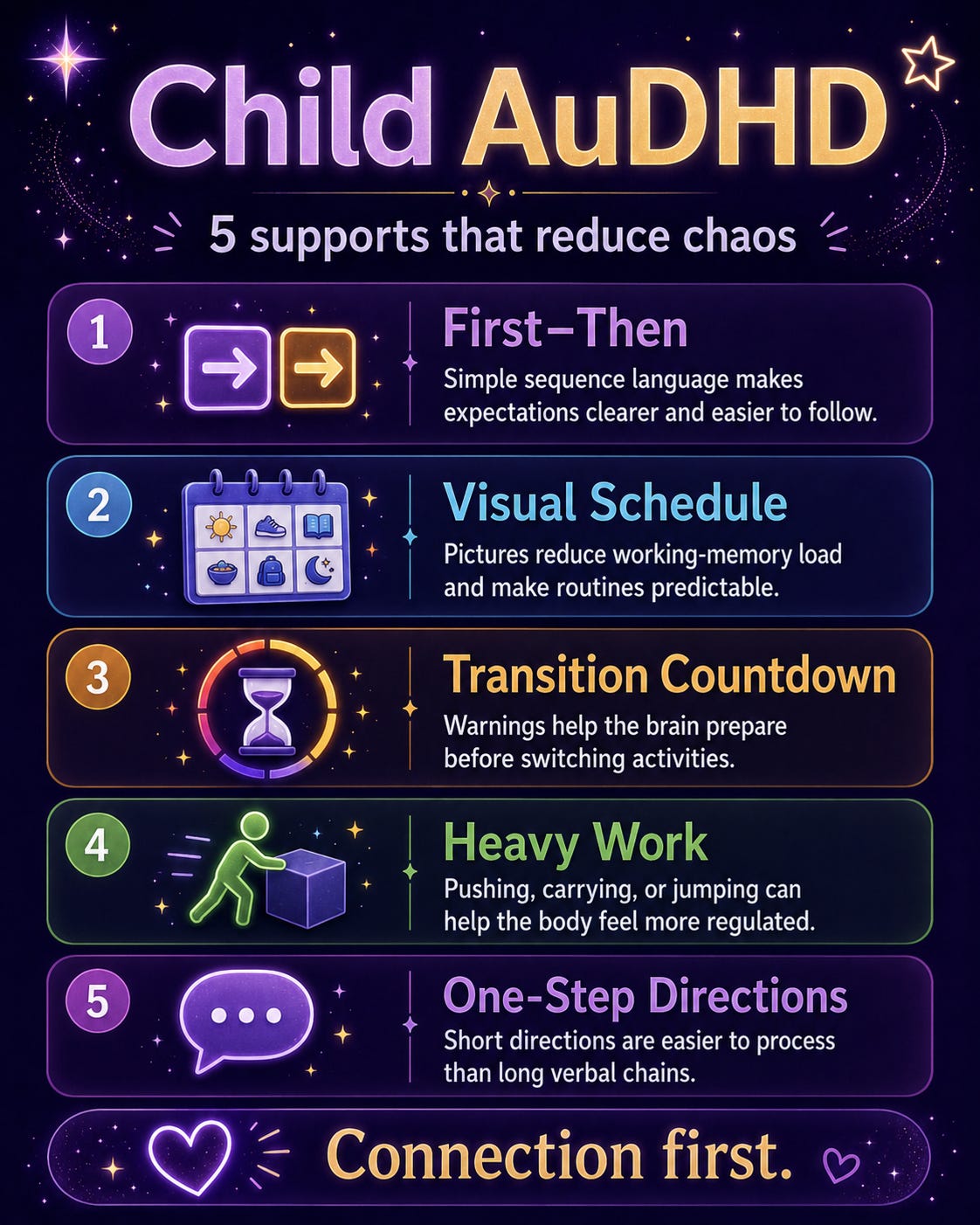
1. The “First-Then” Hack
Use simple language:
First shoes, then outside.
First bathroom, then story.
First clean up blocks, then bubbles.
Why it works: First-then language reduces verbal clutter and gives the child a predictable sequence. It supports working memory and transitions by showing what is happening now and what comes next.
2. The Visual Schedule Hack
Use pictures, drawings, objects, or written steps to show the day or routine.
Why it works: Visual schedules reduce the demand on auditory processing and working memory. Research supports visual activity schedules for children with ADHD, and visual supports are widely used to help autistic children understand routines, follow directions, and manage transitions.
Active processing question for caregivers:
Where does your child hear the most repeated directions? That is probably where a visual support belongs.
3. The “Transition Countdown” Hack
Give warnings before transitions:
“Five minutes, then clean up.”
“Two more turns.”
“One more slide, then car.”
“Last song, then bath.”
Why it works: Transitions require cognitive flexibility, emotional regulation, and inhibition. A countdown gives the brain time to prepare instead of feeling yanked out of one world and thrown into another.
4. The “Heavy Work Before Hard Work” Hack
Before seated tasks, try pushing a laundry basket, animal walks, wall pushes, carrying books, jumping, or squeezing a pillow.
Why it works: Proprioceptive input, or “heavy work,” can help some children regulate their bodies before demands. It gives the nervous system organizing input, which may support attention and reduce impulsive movement.
5. The “Choices Within Boundaries” Hack
Offer two acceptable options:
“Blue cup or green cup?”
“Walk to the car or hop to the car?”
“Pajamas first or teeth first?”
Why it works: Choice supports autonomy without removing structure. ADHD often resists boring demands; autism often needs predictability. Choices within boundaries give the child agency while keeping the adult’s expectation clear.
6. The “Connection Before Correction” Hack
Before correcting, connect:
“I see this is hard.”
“You really wanted more time.”
“Your body has big energy right now.”
“I’m here. We’ll figure it out.”
Why it works: A dysregulated child cannot access problem-solving well. Connection helps reduce threat response. Once the nervous system feels safer, the thinking brain has a better chance of coming back online. This is not permissive. This is strategic. Tiny humans do not learn well while emotionally on fire.
7. The “One-Step Direction” Hack
Instead of:
“Go upstairs, brush your teeth, put on pajamas, pick a book, and get in bed.”
Try:
“Go upstairs.”
Then: “Brush teeth.”
Then: “Pajamas.”
Why it works: Multi-step verbal directions overload working memory. One-step directions reduce processing demand and increase success. Success builds confidence. Confidence builds cooperation. Cooperation builds fewer everyone-is-crying-in-the-hallway moments.
Active processing question for caregivers:
Is your child refusing, or did the direction have too many invisible steps?
8. The “Name the Sensory Need” Hack
Teach simple sensory language:
“Too loud?”
“Too bright?”
“Body needs movement?”
“Need squeeze?”
“Need quiet?”
“Clothes feel wrong?”
Why it works: Children often show sensory distress through behavior because they do not yet have the language for their internal experience. Naming sensory needs builds interoception, self-advocacy, and emotional regulation.
9. The “Calm Corner, Not Punishment Corner” Hack
Create a cozy regulation space with books, soft items, visual feelings cards, headphones, fidgets, weighted lap pad if appropriate, and calming visuals.
Why it works: A regulation space teaches the child where to go to recover. It should not be used as exile. The message is: “Your feelings are safe here.” Not: “Go away until you are easier.”
10. The “Catch Them Being Regulated” Hack
Notice the behaviors you want to grow:
“You waited.”
“You used words.”
“You came back after being upset.”
“You tried again.”
“You asked for help.”
Why it works: Positive reinforcement is central to many evidence-based behavioral supports for ADHD. CDC summaries of AAP guidance recommend parent training in behavior management and classroom behavioral interventions as first-line supports for young children with ADHD.
11. The “Reduce the Language During Meltdowns” Hack
When a child is overwhelmed, use fewer words:
“You’re safe.”
“I’m here.”
“Breathe with me.”
“Hands safe.”
“Quiet break.”
Why it works: During dysregulation, language processing can drop. Long explanations can become more input, not more support. Fewer words reduce cognitive and sensory load.
12. The “Preview the New Thing” Hack
Before appointments, parties, school changes, visitors, haircuts, vacations, or new routines, preview what will happen.
Use pictures, a short story, role play, or a simple script.
Why it works: Predictability reduces threat. Autistic children often benefit from knowing what to expect; ADHD children benefit from having the steps made concrete. A preview helps the child’s brain rehearse before the demand arrives.
Active processing question for caregivers:
What upcoming situation could be made less scary with a preview?
13. The “Movement Menu” Hack
Create a small menu of movement options:
Jump 10 times.
Wall push-ups.
Bear crawl.
Dance song.
Run to the fence and back.
Chair push-ups.
Yoga pose.
Why it works: Movement supports attention and regulation. Exercise research in ADHD shows benefits for executive functioning, especially inhibition, cognitive flexibility, and working memory.
14. The “Emotion Thermometer” Hack
Use a visual scale:
Green: calm
Yellow: wiggly/frustrated
Orange: very upset
Red: meltdown/unsafe
Then teach matching supports for each zone.
Why it works: Emotional regulation requires noticing the emotion before it becomes a volcano. Visual scales help children identify intensity and choose strategies earlier. It also gives adults a shared language that is not “Stop it,” “Calm down,” or the ever-useless “You’re fine.” Spoiler: they are not fine. Their sock seam has declared war.
15. The “Repair After Rupture” Hack
After hard moments, come back gently:
“That was hard.”
“You were upset.”
“I got frustrated too.”
“We are okay.”
“Next time, we can try ___.”
Why it works: Repair teaches children that conflict does not erase connection. This is huge for AuDHD children who may carry shame after meltdowns or impulsive behavior. Repair builds emotional safety, resilience, and trust.
Child AuDHD Active Processing Check-In
For caregivers, teachers, and support humans:
What behavior am I seeing most often?
What skill might be missing underneath it?
What sensory need might be hiding inside it?
What visual, routine, choice, or regulation support could make this easier?
Am I expecting self-regulation before I have offered co-regulation?
That last one is the dagger. Loving, but sharp.
Because a lot of the time, the child is not giving us a hard time. Their nervous system is having a hard time, and we are seeing the smoke from a fire they do not know how to explain yet.
The Big Neuroscience Thread: Why These Hacks Work
Most of these strategies work because they do one or more of the following:
They externalize executive function.
They reduce working memory load.
They make time and steps visible.
They increase predictability.
They add safe novelty or reward.
They support sensory regulation.
They lower shame and threat.
They create immediate feedback.
They turn invisible expectations into visible systems.
This matters because ADHD and autism are not character flaws. They are neurodevelopmental differences that affect attention, flexibility, sensory processing, inhibition, emotional regulation, and daily functioning. Executive functioning challenges show up across ADHD and autism, and co-occurring profiles can be especially complex.
The AuDHD brain often does better when the environment carries more of the load.
Not because the person is incapable.
Because the original environment was built for brains with different wiring.
And honestly? A lot of “normal” systems are just badly designed and then everyone acts shocked when humans suffer inside them. Very on brand for society. Ten out of ten chaos goblin architecture.
Final Reflection: The Best Hack Is Compassionate Design
Here is the truth: the best AuDHD hack is not a planner, a timer, a visual schedule, a reward chart, a body double, or a sensory bin.
The best hack is the mindset shift underneath all of them:
This is not a motivation problem. This is a support-design problem.
Adults with AuDHD need systems that respect energy, dopamine, sensory needs, transitions, and burnout risk.
Children with AuDHD need adults who can look underneath behavior and ask, “What support is missing?” before jumping to “What consequence should I give?”
Because when we stop treating the AuDHD brain like a broken neurotypical brain, we can finally start building lives, classrooms, homes, routines, and relationships that actually fit.
Not perfect.
Not Pinterest-perfect.
Not “I wake up at 5 a.m. and drink lemon water while my nervous system thanks me in cursive.”
Fit.
Real fit.
The kind where the brain can breathe.
The kind where support is not cheating.
The kind where we stop demanding that people climb stairs when what they needed all along was a ramp.
Free Guide
Download:

Or
CLICK HERE
The AuDHD Hack Menu Workbook
Tiny Supports for Adult + Child AuDHD Brains
Companion guide for:
“The AuDHD Hack Menu: 30 Tiny Supports for Brains That Refuse to Be Factory Settings”
Page 1: Welcome, Beautiful Chaos Brain
AuDHD support is not about becoming more “normal.”
It is about building a life, classroom, home, or routine that fits the actual nervous system in front of you.
This workbook is here to help you turn the blog into action.
Not giant action.
Not “new personality by Monday” action.
Tiny action.
Because AuDHD brains usually do not need more shame. They need ramps, cues, fewer invisible steps, sensory safety, and enough dopamine to get the engine to turn over.
Use this workbook to:
Identify where you or your child gets stuck
Choose supports based on the actual bottleneck
Build adult and child-friendly AuDHD hack menus
Reduce overwhelm before it becomes shutdown, meltdown, avoidance, or emotional chaos confetti
Create one realistic support plan
Reminder:
You are not lazy.
Your child is not bad.
Your brain is not broken.
Support is not cheating. It is access.
Page 2: My AuDHD Brain Map
Use this page to notice what is actually happening before choosing a strategy.
When I or my child gets overwhelmed, it usually looks like:
☐ Avoidance
☐ Procrastination
☐ Meltdown
☐ Shutdown
☐ Irritability
☐ Crying
☐ Hyperactivity
☐ Repeating questions
☐ Refusing
☐ Clinginess
☐ Zoning out
☐ Scrolling/escaping
☐ Perfectionism
☐ Task-hopping
☐ Other: ___________________________
The most common stuck points are:
☐ Starting tasks
☐ Switching tasks
☐ Finishing tasks
☐ Remembering steps
☐ Handling sensory input
☐ Managing emotions
☐ Waiting
☐ Cleaning/organizing
☐ Leaving the house
☐ Bedtime
☐ Morning routine
☐ School/work demands
☐ Social recovery
☐ Decision-making
☐ Other: ___________________________
Active processing question:
When I look underneath the behavior, what support might be missing?
Page 3: The Bottleneck Finder
Before grabbing a hack, find the bottleneck. Otherwise, we accidentally put a glitter sticker on a leaking pipe and call it a system.
What is making this hard right now?
1. Is this a task initiation problem?
The task feels too big, too vague, too boring, or emotionally heavy.
Signs:
☐ “I know what to do, but I can’t start.”
☐ I/my child avoids it until pressure explodes.
☐ The first step feels invisible.
Support to try:
Minimum viable task, body double, dopamine before demand, first step list
2. Is this a transition problem?
The brain is struggling to move from one state/activity to another.
Signs:
☐ Leaving is hard.
☐ Stopping is hard.
☐ Starting the next thing causes distress.
☐ Change feels sudden even when expected.
Support to try:
Countdowns, transition object, preview, bridge routine, first-then language
3. Is this a sensory problem?
The nervous system is overloaded, underloaded, or scrambled.
Signs:
☐ Noise, lights, clothes, smells, or touch feel intense.
☐ Movement-seeking or crashing into things.
☐ Irritability rises quickly.
☐ The body seems uncomfortable.
Support to try:
Sensory weather report, heavy work, quiet break, headphones, dim light, movement menu
4. Is this a working memory problem?
Too many steps are being held in the brain at once.
Signs:
☐ Forgetting directions
☐ Losing items
☐ Starting but not finishing
☐ Asking “what now?” repeatedly
☐ Getting stuck halfway through
Support to try:
Visual checklist, landing strip, one-step directions, write the steps down
My current bottleneck is probably:
☐ Task initiation
☐ Transition
☐ Sensory regulation
☐ Working memory
☐ Emotional regulation
☐ Too many demands at once
☐ I honestly do not know yet, but we are being curious, not cruel
Page 4: Adult AuDHD Hack Menu
Choose 3–5 hacks that feel realistic for this week. Not 15. We are not building a command center for NASA. We are trying to live.
Adult Hack Menu
HackWhen I’ll use itMy versionMinimum Viable TaskWhen a task feels too big“I will do _____ for _____ minutes.”Body DoubleWhen I need momentumPerson/video/place: __________Visual Landing StripWhen I lose essentialsMy landing spot: __________Dopamine Before DemandBefore boring tasksDopamine spark: __________Define DoneWhen tasks feel endlessDone means: __________Sensory Weather ReportWhen I feel scrambledMy body needs: __________Two-List MethodWhen everything feels urgentBrain dump + today listTimer as BoundaryWhen time feels invisibleTimer length: __________Movement PrimerBefore focus workMovement option: __________Recovery RoutineAfter demandsRecovery plan: __________
My top 3 adult supports this week:
Active processing question:
Which support feels almost “too simple” but would probably help?
Page 5: Adult Minimum Viable Task Builder
Pick one task you are avoiding.
The big scary task:
Why my brain might be avoiding it:
☐ Too many steps
☐ Too boring
☐ Too emotionally loaded
☐ Too many decisions
☐ Too sensory
☐ No clear finish line
☐ I do not know where to start
☐ I am tired/burned out
☐ Other: ___________________________
Shrink it until it feels almost ridiculous:
Instead of: _________________________________________________
I will: ______________________________________________________
For:
☐ 2 minutes
☐ 5 minutes
☐ 10 minutes
☐ One song
☐ One tiny step
☐ Other: ___________________________
My first visible step is:
Done means:
Reward/recovery after:
Tiny mantra:
Starting counts. Partial counts. A ramp is still progress.
Page 6: Child AuDHD Support Menu
For parents, teachers, caregivers, coaches, therapists, and all the grown-ups trying to help without accidentally becoming the final boss.
Child Support Menu
SupportBest used whenMy child/student’s versionFirst–ThenChild needs clear sequenceFirst _____, then _____Visual ScheduleRoutine feels confusingPictures/objects/wordsTransition CountdownSwitching is hard5 min, 2 min, last turnHeavy WorkBody needs regulationPush/carry/jump/squeezeOne-Step DirectionsDirections get lostSay one thing at a timeCalm CornerChild needs recoveryCozy tools: __________Choices Within BoundariesChild needs autonomyOption A or BPreview New ThingsChange is comingStory/pictures/role playEmotion ThermometerFeelings escalate fastColor/number scaleRepair After RuptureAfter hard moments“We are okay. Next time…”
My child/student most needs support with:
☐ Transitions
☐ Directions
☐ Sensory overload
☐ Emotional regulation
☐ Waiting
☐ Cleaning up
☐ Morning routine
☐ Bedtime
☐ School tasks
☐ Social situations
☐ Other: ___________________________
The support I want to try first is:
How I will make it visible:
Page 7: Behavior Translation Sheet
Behavior is communication, but sometimes it speaks in raccoon-in-a-dumpster energy.
Use this page to reframe what you are seeing.
Looks likeMight actually beSupport to tryLazinessTask initiation frictionShrink the taskDefianceTransition distressCountdown + first-thenOverreactingSensory overloadReduce inputInconsistencyNervous-system variabilityFlexible routineProcrastinationLow dopamine or unclear first stepAdd reward + define stepNot listeningWorking memory overloadOne-step directionClingyNeeds co-regulationConnection before correctionHyperNeeds movement/proprioceptionHeavy workRude toneOverwhelm or low regulationFewer words + repair laterQuittingTask feels too hard/vagueModel + scaffold
A behavior I want to reframe:
The behavior I see:
What it might actually mean:
Support I can try:
Words I can use:
Page 8: Sensory Weather Report
AuDHD brains often need sensory support before they can access executive function. Translation: sometimes the “attitude problem” is actually the fluorescent lights, the itchy shirt, hunger, noise, and being asked to transition with no warning. A villain origin story, honestly.
Check the sensory weather:
Right now, the body/brain seems:
☐ Overstimulated
☐ Understimulated
☐ Scrambled
☐ Tired
☐ Hungry
☐ Thirsty
☐ Emotionally overloaded
☐ Socially drained
☐ Movement-seeking
☐ Unsure
If overstimulated, try:
☐ Dim lights
☐ Quiet space
☐ Headphones
☐ Fewer words
☐ Fewer demands
☐ Compression/weighted item if safe
☐ Sunglasses/hat
☐ Remove scratchy clothing
☐ Slow breathing
☐ Other: ___________________________
If understimulated, try:
☐ Music
☐ Movement
☐ Novelty
☐ Timer
☐ Fidget
☐ Cold water
☐ Crunchy snack
☐ Dance break
☐ Change location
☐ Other: ___________________________
If scrambled, try:
☐ Water
☐ Food
☐ Bathroom
☐ Body scan
☐ One-step direction
☐ Quiet reset
☐ Walk
☐ Simple repetitive task
☐ Other: ___________________________
My go-to sensory supports:
For me: _______________________________________________________
For my child/student: _________________________________________
Page 9: Build Your AuDHD Hack Plan
Pick one recurring hard moment.
Examples: mornings, bedtime, cleaning, homework, leaving the house, work tasks, meal prep, transitions, after-school crash, Sunday scaries, Monday mornings.
The hard moment I want to support:
What usually happens:
The likely bottleneck is:
☐ Starting
☐ Switching
☐ Sensory overload
☐ Working memory
☐ Emotional regulation
☐ Too many decisions
☐ Low dopamine
☐ Unclear expectations
☐ Recovery need
My 3-part support plan:
Before the hard moment, I will:
During the hard moment, I will:
After the hard moment, I will:
What I will stop doing because it adds shame but not support:
What I will try for one week:
Page 10: Reflection + Gentle Tracking
This is not a perfection tracker.
This is a curiosity tracker.
We are collecting data, not evidence for self-punishment. Big difference.
This week I tried:
☐ Minimum viable task
☐ Body double
☐ Visual schedule/checklist
☐ First-then language
☐ Countdown
☐ Heavy work/movement
☐ Sensory weather report
☐ Landing strip
☐ Define done
☐ One-step directions
☐ Calm corner/recovery space
☐ Dopamine before demand
☐ Repair after rupture
☐ Other: ___________________________
What helped even a little?
What did not help or needs adjusting?
What pattern did I notice?
What support do I want to repeat?
What support do I want to make easier?
Final journal prompts:
1. Where am I still expecting willpower when I need support?
2. What would this look like if I designed it for my actual brain or my actual child, not an imaginary “should” version?
3. What is one tiny support I can offer without making it a whole production?
Closing Page: Your Brain Deserves Ramps
You do not have to earn support by falling apart first.
Adults with AuDHD deserve systems that respect their energy, sensory needs, attention style, recovery needs, and emotional bandwidth.
Children with AuDHD deserve adults who ask, “What skill or support is missing?” before assuming the worst.
The goal is not to hack yourself into productivity until you become a burnt-out little robot in cute shoes.
The goal is access.
A little more ease.
A little less shame.
A little more understanding.
A little more “Ohhh, this is why that was hard.”
That is not cheating.
That is the work.
And honestly?
It is holy work.
This is so useful!!! Thank you for breaking things down into such a clear structure, even though you included so much content it was still really easy to process and identify which parts I found most relevant. You’re an absolute gift 💜