
Understanding and Managing Unstructured Time with AuDHD
AuDHD and Unstructured Time: Struggles and Strategies

People with AuDHD (co-occurring autism and ADHD) often find “free time” or unscheduled moments surprisingly hard to handle. Unstructured time means periods without external demands or clear goals – like evenings off work or weekends without plans. Neurodivergent brains thrive on purpose and predictability, so having too many choices or too much downtime can feel overwhelming or chaotic. For example, one writer describes life before the pandemic as “extremely stressful” but surprisingly productive due to a packed schedule of work, chores, and social time.
Once the external structure vanished, tasks piled up, and motivation collapsed without that scaffold
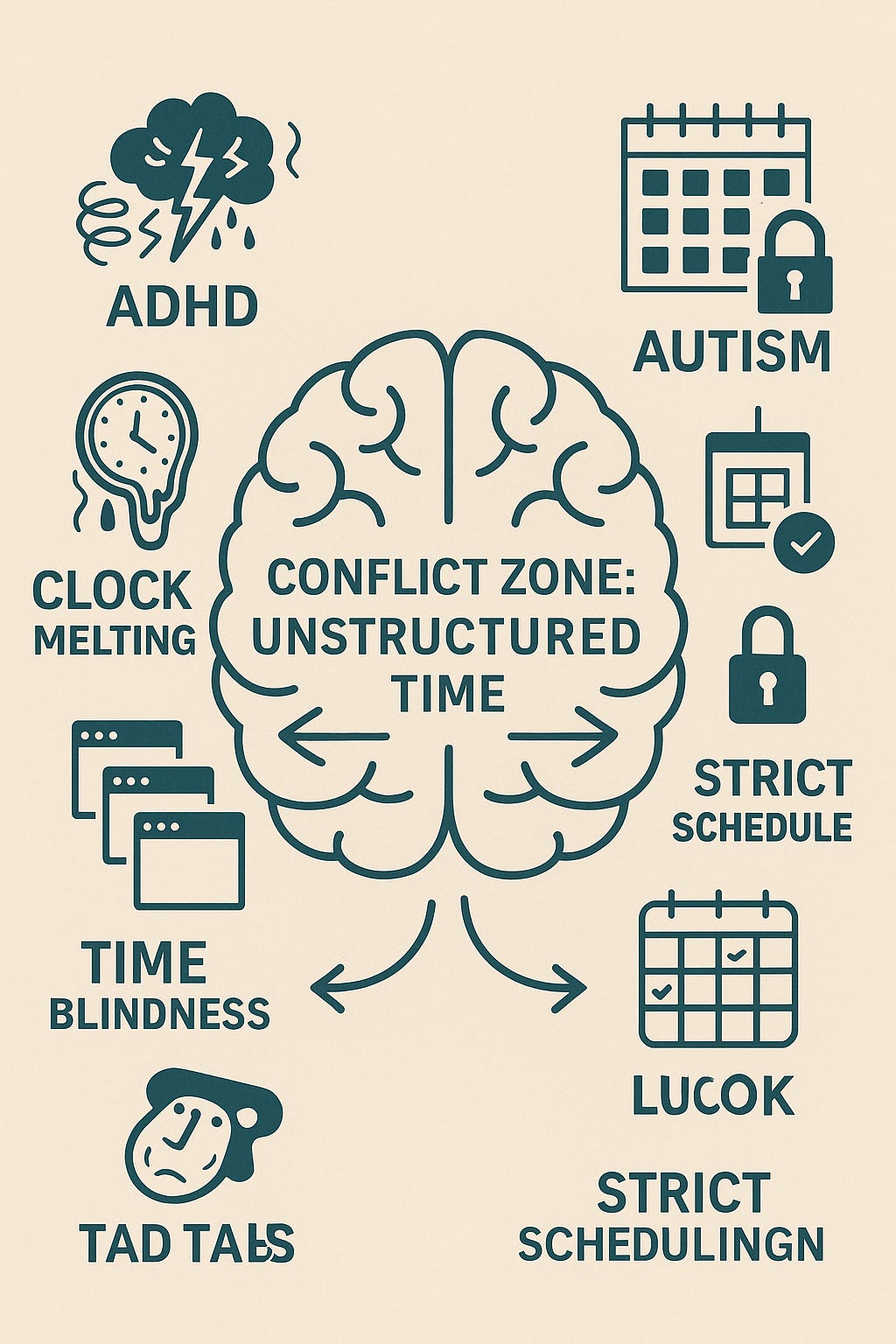
In practice, AuDHD individuals often face a tug-of-war: part of them craves routine and predictability, while another part craves novelty and variety.
This internal conflict – “Do I need routine or spontaneity? Busyness or a steady pace?” – makes free time feel like a double-edged sword.
Challenges of Unstructured Time
Lack of external cues: Without schedules or deadlines, it’s hard to know what to do next. Many people with ADHD struggle to initiate tasks without a prompt. They may hyperfocus on one interest while ignoring other needs (like eating or sleeping)
neurosparkhealth.com
, or they may procrastinate endlessly. Autistic people often rely on routines to feel safe; unstructured moments can trigger anxiety or sensory overload because anything could happen. As one autistic person put it, when life feels “super unpredictable… it all just feels like a big messy room, and I’m in the middle of it unable to control anything”
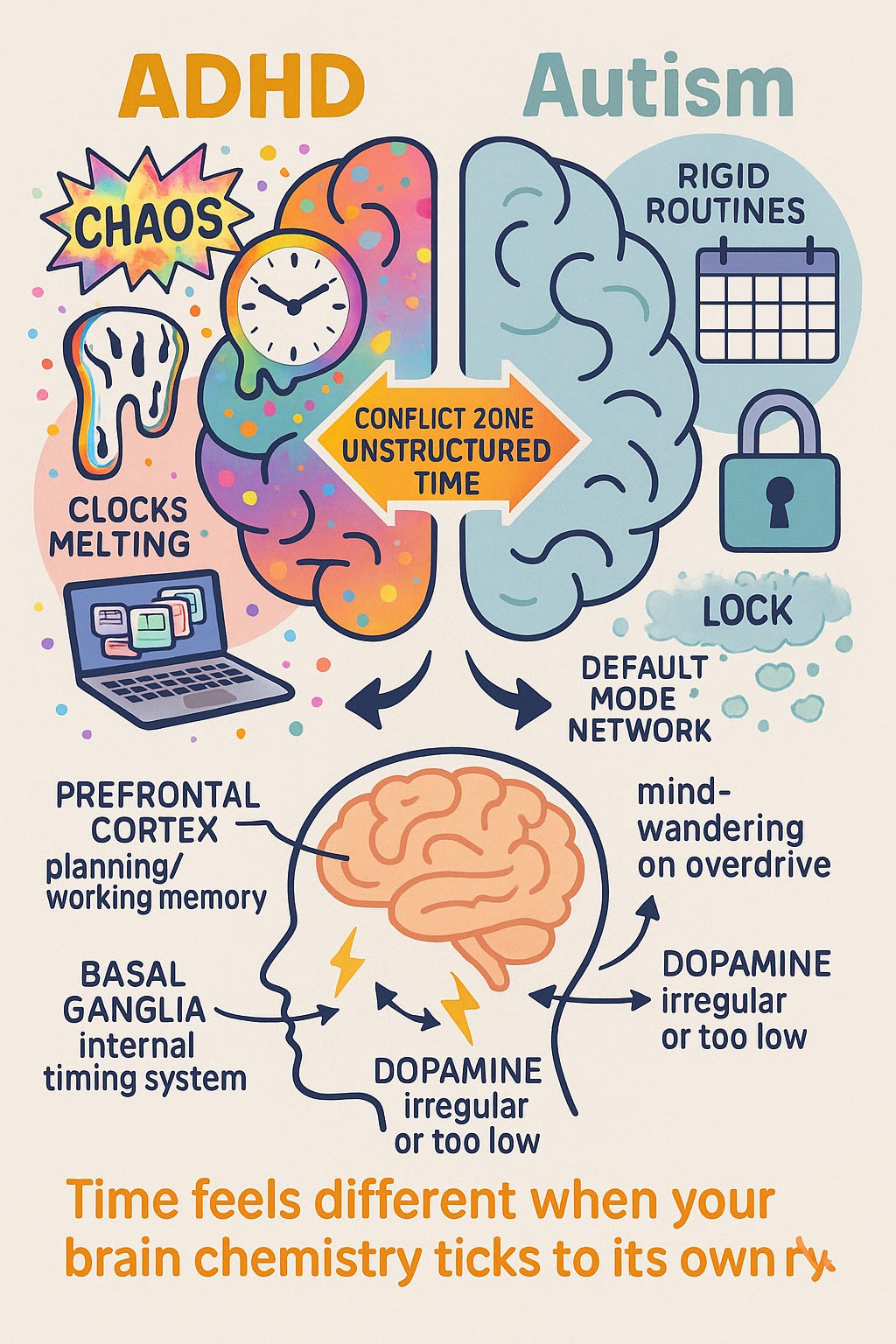
Task paralysis and time blindness: Free time can paradoxically lead to doing less. Neurodivergent brains may shut down when faced with too many options or lack of urgency. People with ADHD describe a warped sense of time: minutes can feel like hours and vice versa. For example, one AuDHD writer noted, “because of my ADHD… that sometimes. means time blindness, and not realizing it’s been X amount of hours since I’ve eaten or drank anything”
This makes even fun plans risk being forgotten, and important tasks get deferred with no clear reason.
Rigid routine vs. restlessness: Autism’s “inflexible adherence to routines” (DSM-5) means many autistic people prefer doing tasks in a specific way.
This can provide comfort, but ADHD often rebels against rigidity. One AuDHD person explains: “Routine is literally both my best friend and my enemy”
Fixed routines feel safe and “organizing” for the autistic side, but the ADHD side feels “trapped and bored” if every day is identical. Over time, a strict routine can feel like a chore, triggering procrastination and guilt instead of calm productivity.
Emotional dysregulation: Unstructured time can amplify anxiety or dysphoria. Without a clear plan, AuDHD individuals may feel lost or inadequate. Many report an internal battle of “Do I follow familiar habits or try something new?”. Unexpected free time can even trigger meltdowns: as one autistic person shares, “when I was recently forced to move… it felt like the world would end if my routine got disrupted”. This emotional distress makes downtime feel less restful and more punishing for AuDHD brains.
Sensory and attention fluctuations: Downtime without structure can leave the brain to wander. ADHD brains often slip into the Default Mode Network (mind-wandering) too easily, causing inattention. Autistic individuals may become hyperaware of sensory input (e.g. noise, lights) without distractions, making it hard to relax. Both traits combined mean “free time” can oscillate between hyperfocus on stimuli (e.g. binge-watching an interest) and feeling overstimulated by the environment.
The Neuroscience Behind the Struggle
Research helps explain why these challenges arise. Neurologically, ADHD and autism both involve executive function (EF) difficulties
A recent study notes that both conditions often show inhibition, working memory, and planning deficits
In younger children, ADHD often hits planning/working memory, while autism often hits flexibility/inhibition.
In practice this means tasks requiring organization or switching (like turning unstructured time into a to-do list) can fail. Crucially, differences in time perception are common to both ADHD and autism, so AuDHD brains really struggle with estimating time or noticing it slip by.
ADHD brains also have peculiar connectivity patterns. Studies show the default mode network (DMN) – a brain network active during rest – is overly connected to task networks in ADHD
In other words, the ADHD brain has a hard time “turning off” mind-wandering when a task demands focus. One study found children with ADHD had higher and more stable DMN connectivity, which correlated with more attention lapses and errors
During unstructured time, this hyperactive DMN can flood the mind with distractions, making it even harder to concentrate on a chosen activity.
Neurochemistry also plays a role. ADHD brains are often low on dopamine, a key neurotransmitter for motivation and reward. Time estimation tasks involve the prefrontal cortex, and lower activity there is linked to poor timing
ADDA notes that ADHD “time blindness” arises partly because of underactivity in these frontal regions and disrupted dopamine signaling.
In practice, this means an AuDHD person’s brain literally perceives time differently: deadlines may arrive without warning (“future time blindness”) and a fun activity might end all too soon on the clock.
Autism contributes its own brain traits: a need for predictability. Autistic people report that routines “bring predictability and order” which helps them self-regulate under stress.
In the absence of structure, the world feels chaotic. This is why one person says building a routine makes everything “neat and tidy…I know what’s going to happen and I feel in control and calm”
AuDHD individuals thus juggle conflicting neural drives: the ADHD-side brain craves novelty and stumbles on inactivity, while the autistic-side brain craves routine and dislikes unpredictability.
Reflection Journal Prompts
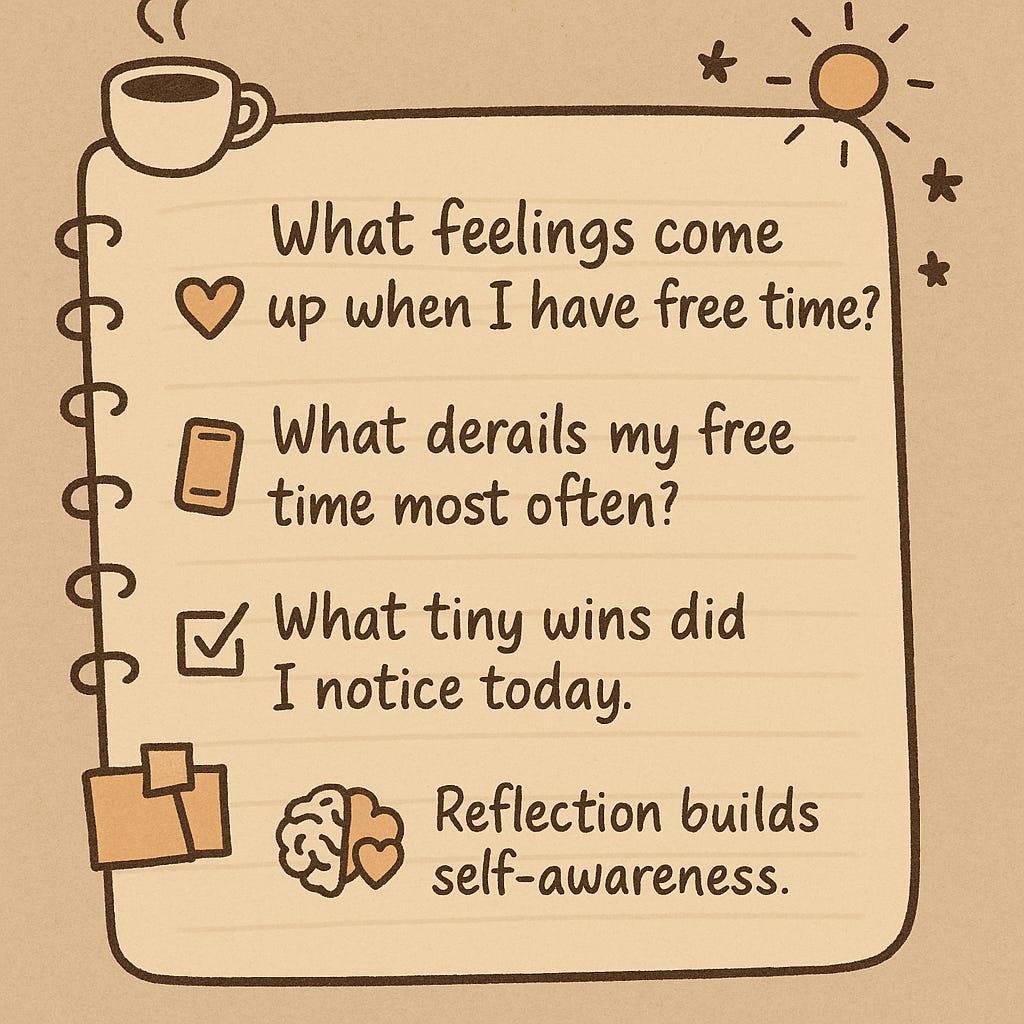
Spending some quiet time reflecting on your experiences with free time can uncover patterns and ideas. Try writing in a journal (or note-taking app) with prompts such as:
What tasks or activities do I want to do in unstructured time? List them and estimate how long each will take
This makes nebulous goals more concrete.
When in the day do I feel most energetic? Least energetic? Plan your free-time activities around these energy levels.
What feelings or thoughts come up when I have free time? (e.g. boredom, anxiety, excitement, guilt). Note any patterns.
Are there specific distractions or urges that derail my free time? (e.g. doomscrolling, restlessness, or social media). What triggers them?
What small wins happened during free time? Celebrate even tiny accomplishments or enjoyable moments.
How did I manage time today? For example, write “I intended to do X by 3pm, but I got sidetracked by Y.” This can reveal the gap between plans and reality.
Writing out questions like these – for instance, “Write down tasks I need to do today and how long each takes” or “Create a schedule for my day, putting demanding tasks in high-energy slots”
– can turn vague frustration into actionable insight. Over time, journaling can highlight trends (e.g. “I always get stuck on phone after lunch”) and suggest personal solutions.
Tips and Strategies for Managing Free Time
Building a supportive structure around unstructured time can help AuDHD brains feel less adrift. Here are some research-backed strategies and practical tips:
Set loose plans or deadlines. Give your free-time tasks a “by when” deadline. As experts advise, phrasing tasks as agreements with deadlines (e.g. “I’ll start X by 3pm”) creates a concrete goal.
Write down your plan or share it with someone for accountability (so it’s a “real” agreement). Without an end time, ADHD minds can drift indefinitely; setting even a soft deadline focuses attention.
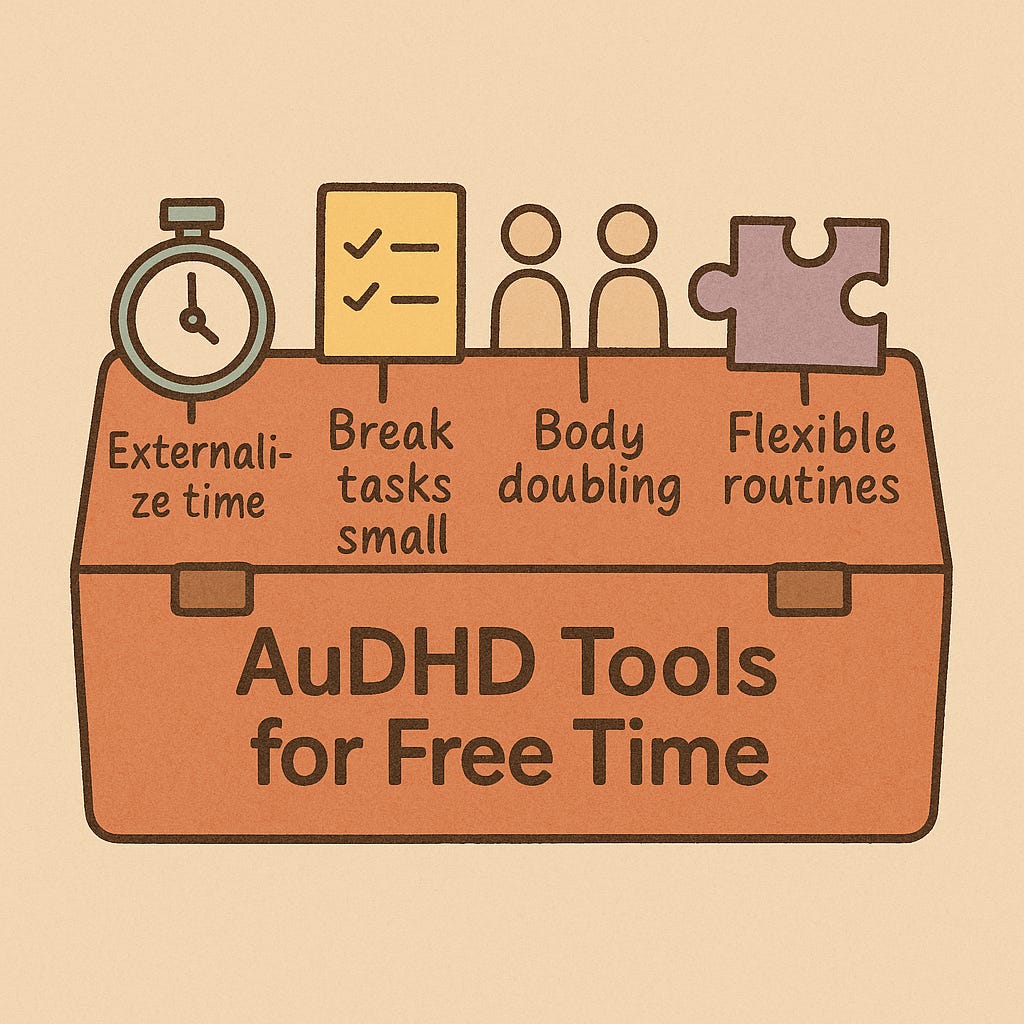
Use timers and reminders. Time-block your free hours if pure downtime is overwhelming. For example, decide you’ll relax for 30 minutes, then use a timer to signal the end. External cues can counteract ADHD time-blindness
Keep visual or auditory reminders (alarms, phone alerts) for breaks and transitions.
Leverage body-doubling. Work “alongside” someone else when possible. Studies and coaches note that body doubling – having another person doing their own task nearby (even virtually) – can significantly boost focus and motivation.
You might schedule a co-working call with a friend during creative free time, or simply sit in a cafe with a book. The social presence provides gentle accountability.
Prioritize with energy. Notice your daily energy curve. If you’re a morning person, schedule your toughest free-time task (e.g. paying bills, organizing) early, and leisure tasks for when you usually crash. One journaling exercise suggests listing your highest- and lowest-energy times and aligning tasks accordingly
Over time, this creates a semi-structured routine that respects your brain’s rhythms.
Incorporate special interests. Use your hyperfocus as a tool. Plan a short “interest break” as a reward or to recharge. For instance, allow yourself 20 minutes on a favorite hobby after completing a small chore. This spurs action and gives the ADHD brain something enticing to look forward to. Just set a timer to avoid spiraling down a rabbit hole!
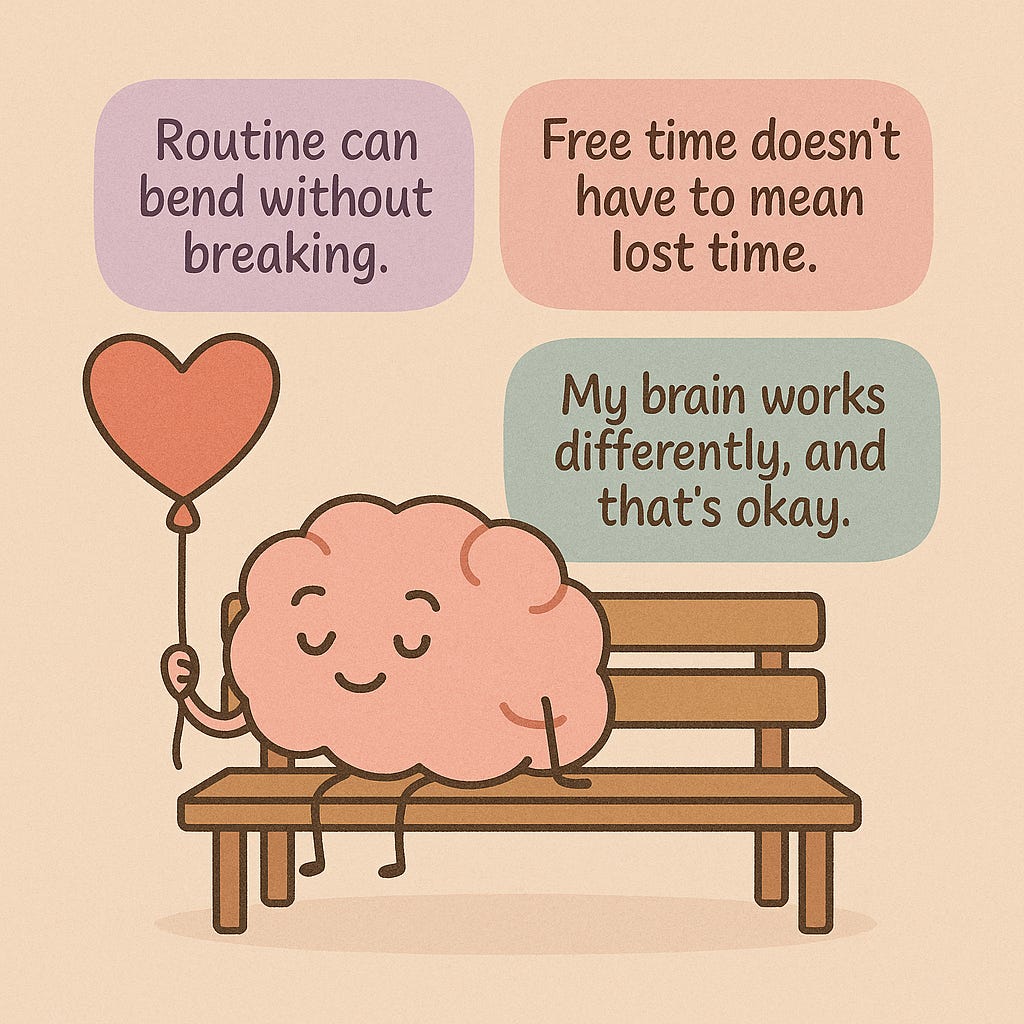
Embrace flexible routines. “Routine doesn’t have to mean schedule,” as one AuDHD writer realized
Keep certain elements constant (like your morning coffee ritual or daily walk), but allow flexibility in timing or order of other tasks. For example, fix what needs to be done each day but not exactly when. This offers predictability for the autistic side and variety for the ADHD side.
Plan “Plan B” and buffer time. Prepare for surprises by having backups. The National Autistic Society suggests always having a plan B/C (e.g. “If I get thrown off, I’ll switch to a simpler task or take a walk”)
Also build extra time into your schedule. If you plan to call a friend during free time, say you’ll call at 4pm or anytime before 6pm. Extra buffers reduce the stress when things inevitably shift.
Use visual structure. Visual schedules or checklists can anchor an empty day. You don’t need a rigid planner – even a whiteboard or sticky notes listing “Good Things To Do If Bored” can guide you. Break tasks into very small steps (e.g. “Set the table” instead of “cook dinner”) and check them off; this provides dopamine hits and a sense of progress.
Stay kind to yourself. Finally, remember that these struggles are neurological, not willpower failures. As Cleveland Clinic experts note, it’s normal for adults with ADHD to feel defeated by time management, but self-criticism hurts progress
Practice self-compassion: acknowledge any small achievement (e.g. “I actually got dressed today”) and gently adjust strategies rather than blame yourself.
Over time, combining these strategies – scheduling the containers around your free time and gently steering yourself through them – can make unstructured moments feel less like threats. With patience and persistence, you can turn chaotic free hours into opportunities for rest, creativity, or progress.

Sources: Research on AuDHD, autism, and ADHD shows how executive function and neural differences underlie these struggles
Clinical and neurodiversity sources (NeuroSpark, Autism Society UK, Cleveland Clinic, etc.) offer practical insights and strategies
The advice above is drawn from these sources and expert guidance to help AuDHD individuals navigate unstructured time more smoothly.