
When your ears work, but your brain is buffering like a haunted 2008 laptop
When your ears work, but your brain is buffering like a haunted 2008 laptop

There is a very specific kind of rage that happens when someone says, “You’re not listening.”
Because excuse me, Janet, I am listening.
My ears have clocked in. They are wearing their tiny little employee badges. They are present.
But somewhere between your mouth and my brain’s customer service department, the message got lost, shredded, reassembled into interpretive jazz, and handed to me as:
“Put the spoon in the laundry?”
Welcome to AuDHD auditory processing: where sound is not just sound. Sound is information, threat, texture, demand, interruption, background chaos, social decoding, emotional labor, and sometimes a full-body jump scare wearing Crocs.
And no, it is not laziness.
No, it is not rudeness.
No, it is not “selective hearing,” although honestly, I wish I could selectively not hear fluorescent lights, chewing, overlapping conversations, and someone breathing like a Victorian ghost in the next room.
Auditory processing means the brain’s ability to interpret and organize what we hear. Central Auditory Processing Disorder, or CAPD/APD, is different from hearing loss: the person may hear sounds normally, but the brain struggles to make sense of them, especially speech in noise, fast speech, competing sounds, or complex verbal directions. ASHA describes CAPD treatment as typically involving environmental modifications, direct auditory skills work, and compensatory strategies, often used together.
So when we talk about AuDHD and auditory processing, we are talking about the overlap of:
ADHD attention and working memory differences.
Autistic sensory processing differences.
Possible auditory processing disorder.
Language processing demands.
Nervous system overload.
And the existential horror of someone giving a 7-step verbal direction while the dishwasher is running.
Lovely. Stunning. Put it in the museum of “why am I like this?”
First, let’s separate hearing from processing
Hearing is:
Can the ears detect sound?
Auditory processing is:
Can the brain organize, prioritize, decode, remember, and use that sound?
That difference matters.
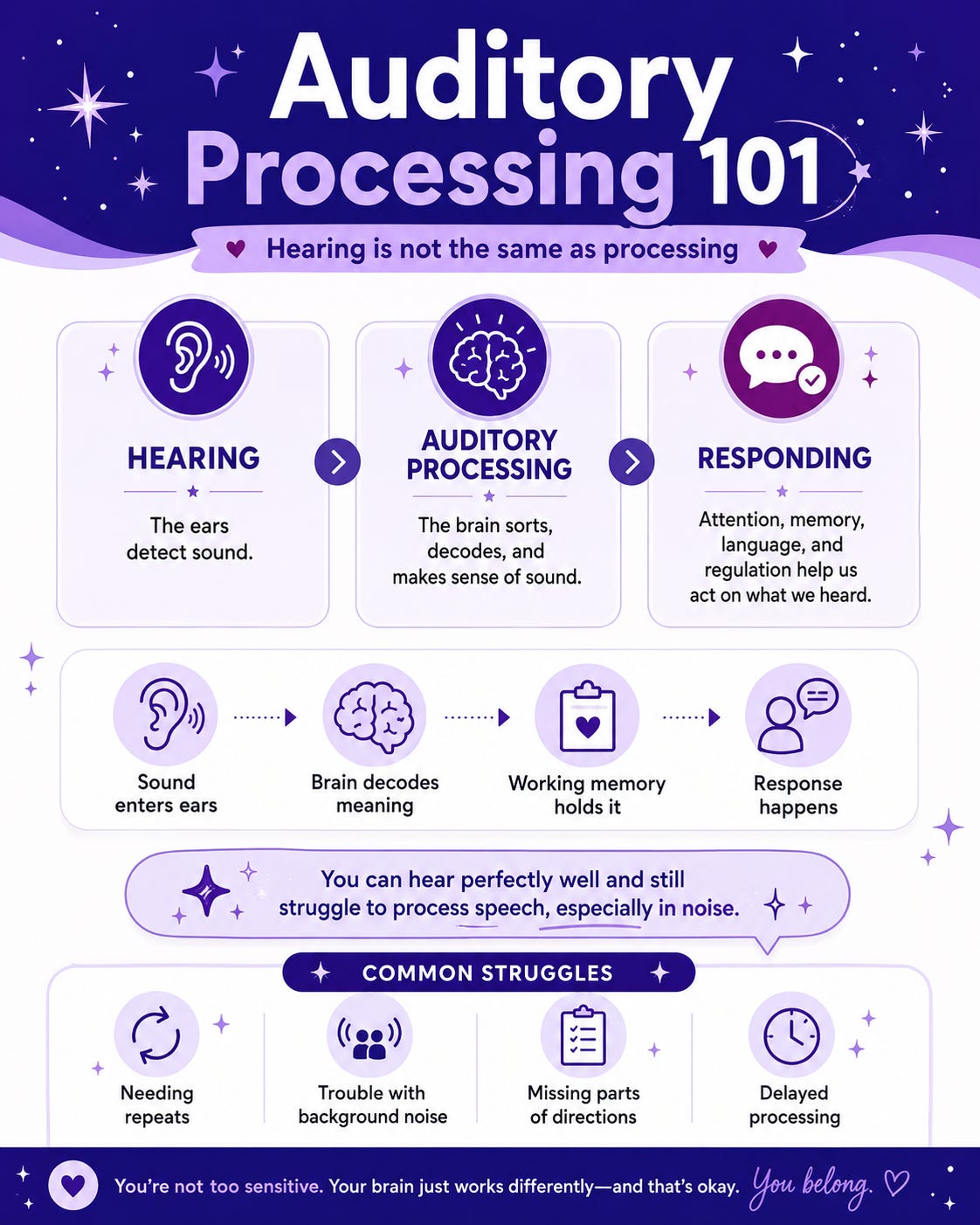
A person can pass a basic hearing test and still struggle to understand speech in a noisy restaurant. They can hear someone talking and still need subtitles. They can technically “hear” the teacher, partner, boss, child, or podcast host, but their brain might not successfully turn those sounds into clean, usable meaning.
Think of it like this:
Your ears are the microphone.
Your brain is the audio engineer.
In AuDHD, the audio engineer may be brilliant, creative, sensitive, and exhausted… but also trying to mix 47 soundtracks at once while the studio is on fire.
The CDC describes autism as a developmental disability involving brain differences, with people learning, communicating, interacting, moving, and paying attention in different ways. It also notes that ADHD occurs more often in autistic people than in non-autistic people. NIMH describes ADHD as involving patterns of inattention, hyperactivity, and impulsivity, and notes that ADHD often co-occurs with learning, sleep, anxiety, and other conditions that can make diagnosis and support more complicated.
So when autism and ADHD are both in the same nervous system, auditory processing can become a real “group project where nobody read the instructions.”
Active Processing Question
When you struggle with listening, is it usually because you cannot hear the sound, cannot understand the sound, cannot remember what was said, or cannot tolerate the sound long enough to process it?
That distinction is gold.
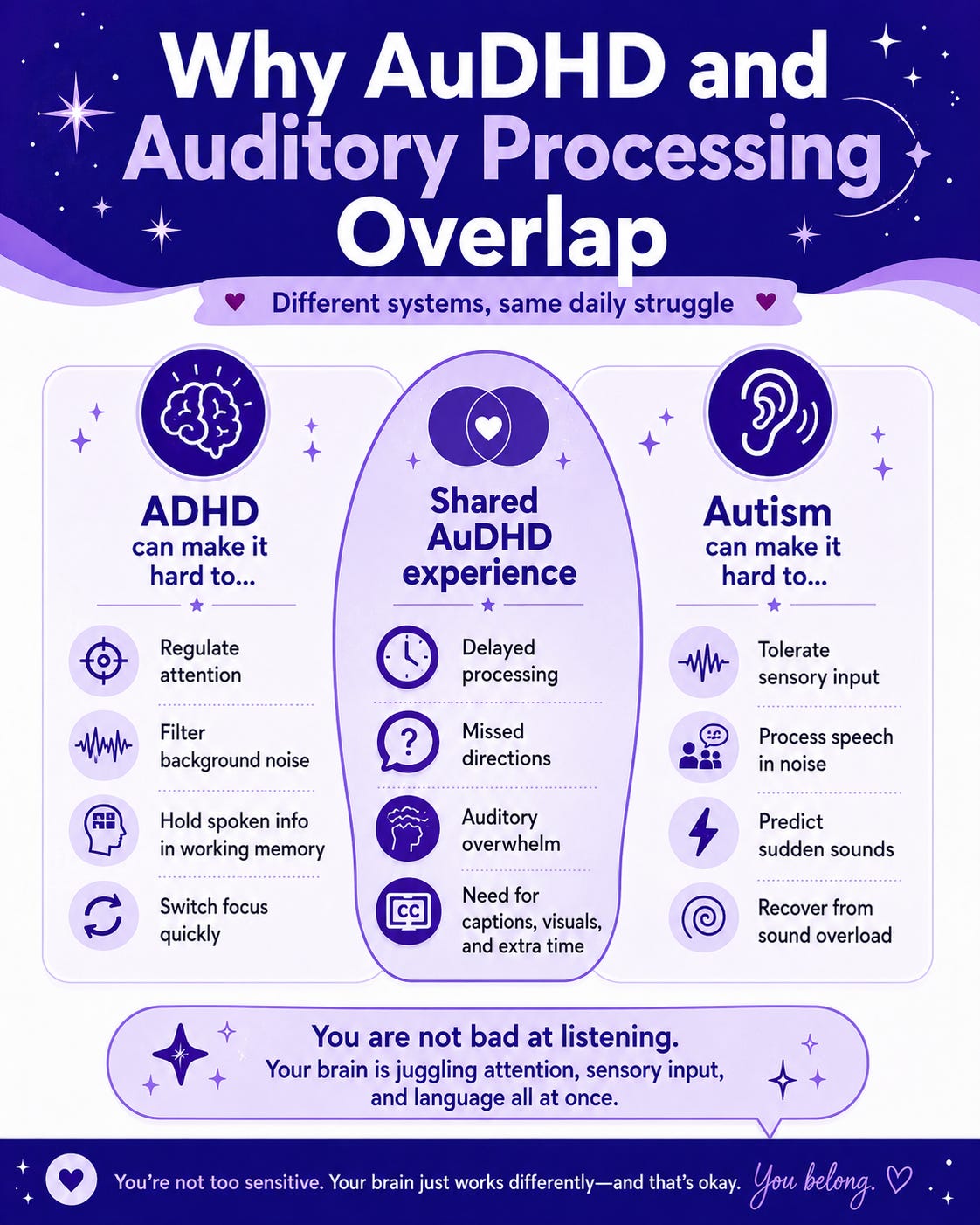
What auditory processing issues can look like in AuDHD
Auditory processing struggles do not always look like “I cannot hear you.”
Sometimes they look like:
“Wait, what?” five seconds after you understood.
Needing subtitles even when the volume is loud enough.
Hearing words but not meaning.
Panicking when multiple people talk at once.
Losing the first half of a sentence because your brain was still loading.
Feeling physically angry at chewing, tapping, humming, or background TV.
Needing written directions after verbal directions.
Answering the wrong question because your brain filled in the blanks with garbage confetti.
Avoiding phone calls because they are basically social escape rooms with no visual clues.
Looking “defiant” when you are actually overwhelmed.
Missing sarcasm, tone shifts, or emotional nuance because your processing bandwidth is already maxed out.
Melting down after a loud event even if you “had fun.”
Needing silence after school, work, social events, errands, or parenting because your auditory system has filed a hostile workplace complaint.
And here is the nasty little twist: auditory processing issues can be mistaken for attitude.
A child may look like they are ignoring directions.
An adult may look distracted.
A partner may seem uninterested.
A student may seem noncompliant.
A friend may seem flaky.
A coworker may seem “slow to respond.”
But inside?
The brain is often doing Olympic-level gymnastics just to decode the sentence, store it, connect it to context, and respond like a socially acceptable mammal.
A systematic review found significant overlap between children diagnosed with APD and children with developmental conditions including ADHD, autism, dyslexia, language disorders, and learning disorders, which is one reason assessment needs to be careful instead of “well, they seem like they’re not listening.”
Active Processing Question
When people think you are “not listening,” what is usually happening internally: distraction, overwhelm, delayed processing, sensory pain, confusion, shame, or all of the above wearing a trench coat?
The ADHD piece: the brain hears everything and prioritizes nothing
ADHD is not simply “can’t pay attention.”
It is often more like:
The brain struggles to regulate attention.
That means attention can be too slippery, too sticky, too hungry, too scattered, or too locked onto the wrong thing.
In auditory processing, ADHD can create issues because listening requires several executive functions at once:
Sustained attention.
Working memory.
Inhibition.
Processing speed.
Filtering irrelevant noise.
Switching attention when someone changes topics.
Holding the beginning of a sentence while the end arrives.
Not interrupting when your thought finally spawns like a chaotic little goblin.
Working memory is especially important. It is the brain’s temporary sticky note system. ADHD can make that sticky note system act like it was purchased from the dollar store during a thunderstorm.
Research on adults with ADHD has found they can be more vulnerable to auditory distraction, especially when working memory demands are high. Translation: when your brain is already holding a task, background noise can come crashing in like a raccoon through drywall.
This is why someone with ADHD might say:
“I heard the words but lost the meaning.”
“I understood it when you said it, but then it evaporated.”
“I need you to say it again, but slower.”
“I can’t listen while that noise is happening.”
“Please do not talk to me from another room unless you enjoy disappointment.”
The ADHD brain may not have a volume problem. It has a filtering and holding problem.
Metaphor moment
Imagine trying to carry a tray of drinks through a crowded restaurant while people keep throwing ping-pong balls at your face.
That is auditory working memory in ADHD.
You are not weak.
You are under attack by invisible sound ping-pong.
The autism piece: sound is not just information, it is sensation
Autism often includes sensory differences. Sound can be too loud, too sharp, too unpredictable, too layered, too sudden, or too emotionally loaded.
For some autistic people, sound is not background. Sound is foreground, middle ground, underground, and also somehow inside the bones.
A fluorescent light hum might feel like a tiny demon tuning a violin in your skull.
A vacuum might feel like the apocalypse got a leaf blower.
A fork scraping a plate might make your soul briefly leave your body and file taxes elsewhere.
Autistic auditory processing can involve differences in how the brain detects, predicts, filters, integrates, and responds to sound. Reviews of autism sensory processing research describe atypical responses to auditory, tactile, and visual stimuli, and newer reviews focus specifically on how auditory processing can influence autistic traits and daily functioning.
This is where autistic auditory processing can show up as:
Sound sensitivity.
Delayed response to speech.
Difficulty understanding speech in noise.
Auditory overwhelm.
Strong reactions to specific sounds.
Shutdowns or meltdowns after loud environments.
Needing predictability around sound.
Difficulty filtering background noises from important voices.
Feeling safer with headphones, loops, ear defenders, white noise, or silence.
And let’s be honest: society is wildly casual about noise.
People will be like, “It’s just a little background music,” while your nervous system is lying face-down in the metaphorical parking lot whispering, “Tell my story.”
Active Processing Question
Which sounds drain you fastest: sudden sounds, layered sounds, human-made repetitive sounds, high-pitched sounds, low rumbles, voices, chewing, music, machines, or emotional tone?
Your pattern matters. Your nervous system has preferences, even when the world acts like it should just “get over it.”
The AuDHD overlap: when ADHD wants stimulation and autism wants mercy
Here is where AuDHD gets extra spicy.
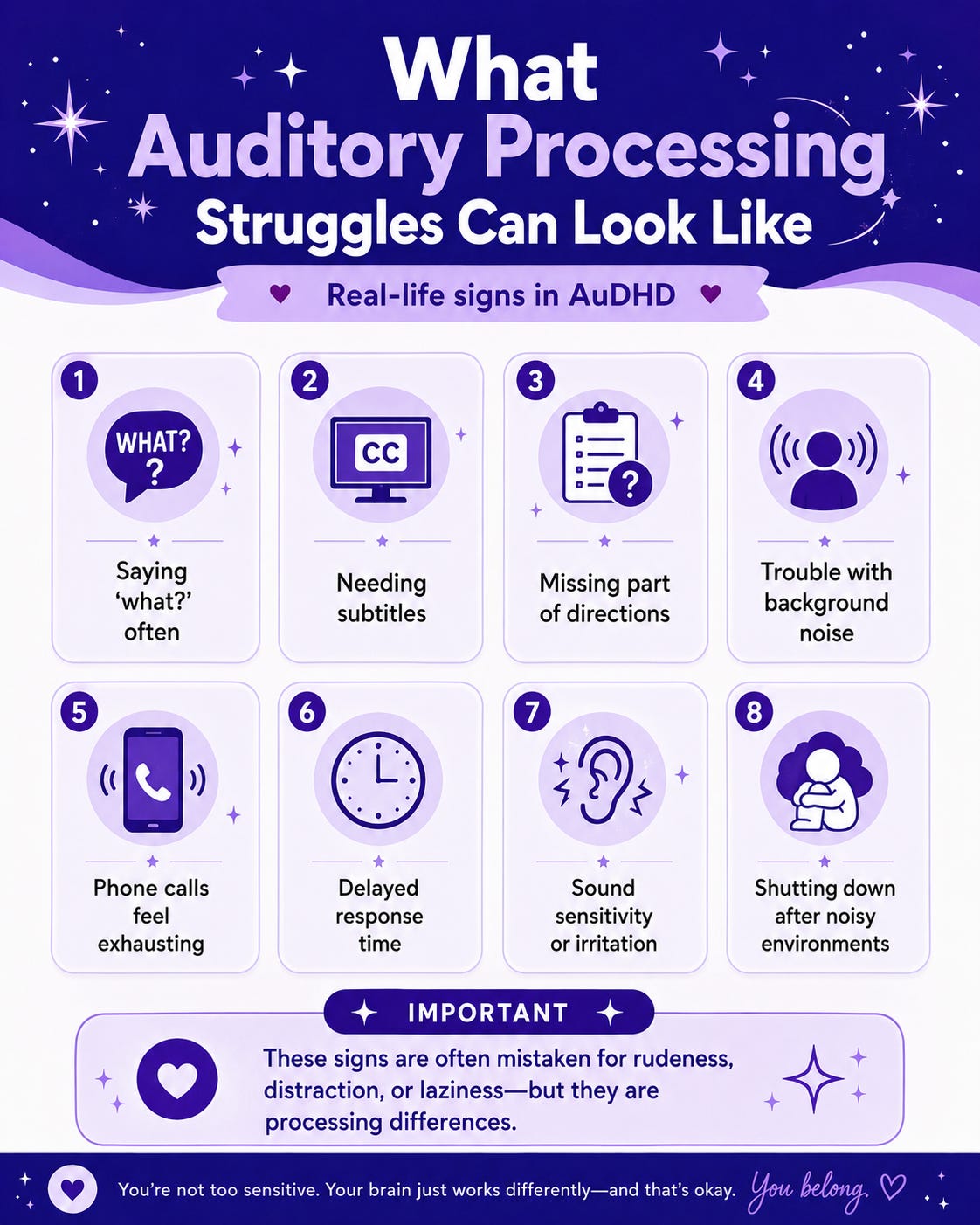
ADHD may crave novelty, sound, stimulation, music, podcasts, conversation, movement, and dopamine.
Autism may crave predictability, controlled input, quiet, sameness, and sensory safety.
So your brain may be like:
“I need noise to function.”
Also:
“If one more noise happens, I will become a Victorian widow staring out a rainy window.”
This is why AuDHD auditory processing can feel contradictory.
You may need music to clean, but then the music becomes too much.
You may love concerts, but need three business days to recover.
You may crave podcasts, but cannot process someone talking to you after work.
You may enjoy social gatherings, but overlapping conversations make you want to crawl into the ceiling.
You may ask for silence, then immediately feel under-stimulated and restless.
You may need subtitles because your brain processes visual language better than floating invisible mouth sounds.
AuDHD auditory processing is not “I hate sound.”
It is more like:
I need the right sound, at the right intensity, at the right time, with the right control, while my nervous system is not already being chased by wolves.
That last part is essential.
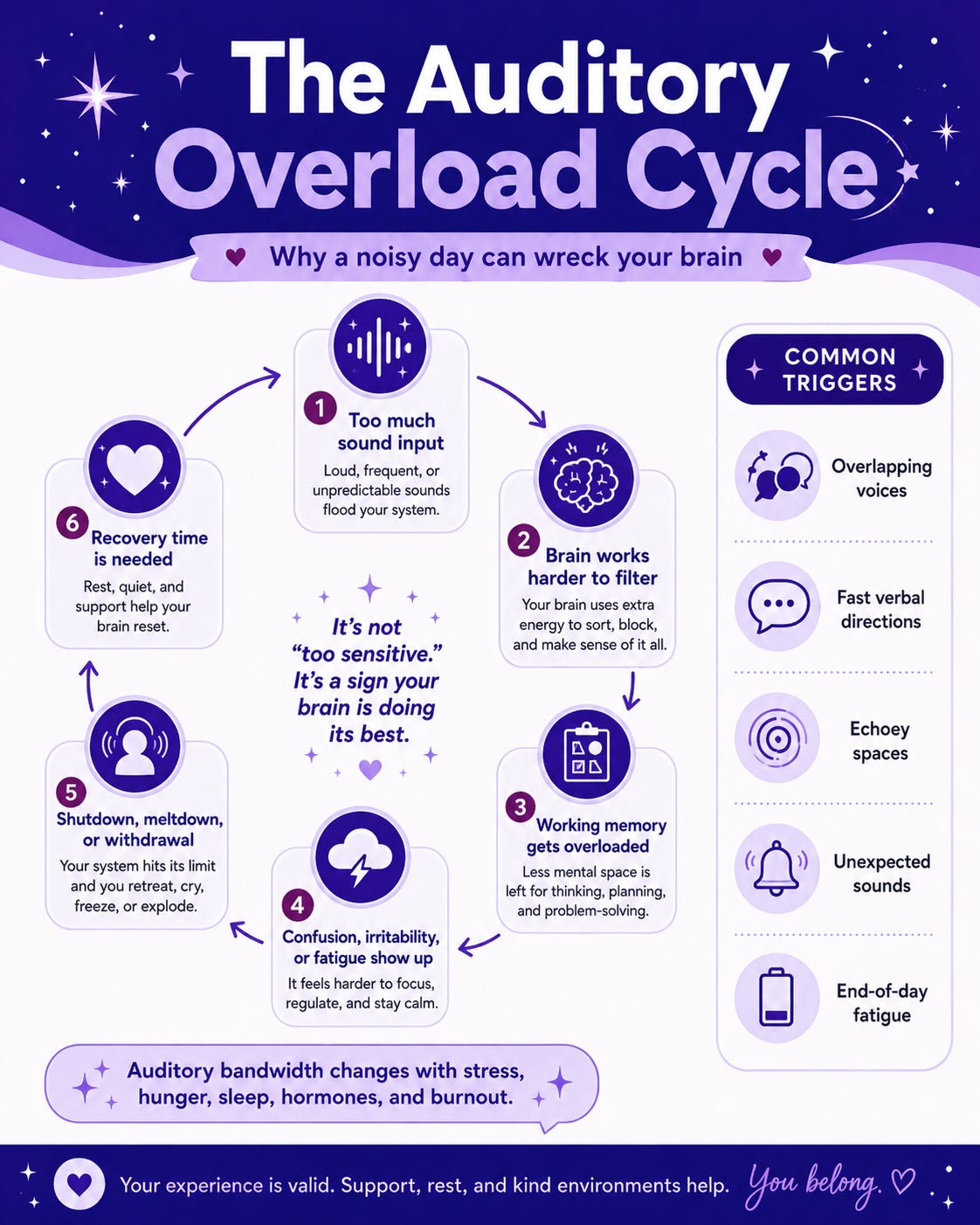
Auditory processing gets worse when the nervous system is already overloaded. Hunger, fatigue, stress, hormonal shifts, burnout, transitions, masking, social pressure, pain, and anxiety can all shrink your auditory bandwidth.
That is why you might handle sound beautifully one day and fall apart over someone opening a granola bar the next.
You are not inconsistent.
You are a nervous system with weather.
Active Processing Question
When your auditory processing gets worse, what else is usually present: fatigue, hunger, stress, hormones, burnout, social masking, clutter, pain, too many transitions, or emotional overwhelm?
Why verbal directions can feel like being attacked by a podcast
Verbal instructions are sneaky. They seem simple, but they require a ridiculous amount of brain labor.
To follow spoken directions, the brain has to:
Notice the speaker.
Shift attention.
Filter background noise.
Decode speech sounds.
Attach meaning.
Hold words in working memory.
Sequence steps.
Connect steps to action.
Ignore distractions.
Start the task.
Monitor progress.
Remember what comes next.
Not emotionally combust when someone says, “It’s easy.”
For AuDHD brains, verbal directions can fail at multiple points.
The sound may be too noisy.
The language may be too vague.
The sequence may be too long.
The working memory load may be too heavy.
The environment may be too chaotic.
The person may be speaking too fast.
The instruction may include implied steps that neurotypical people treat like common sense but are actually hidden DLC.
Example:
“Can you clean up in here?”
A neurotypical brain might hear:
Put dishes away, throw trash out, wipe counters, organize items.
An AuDHD brain might hear:
In here? Which part? What counts as clean? What order? How clean? Where do random objects go? Why is there a receipt from February? Is this a moral failure? Should I move houses?
Then the auditory processing issue becomes an executive function issue becomes an emotional regulation issue becomes the shame spiral express train. Choo choo, next stop: “I’m broken.”
You are not broken.
The system is overloaded.
The emotional side: being misunderstood hurts
Auditory processing struggles are not just inconvenient. They can shape identity.
If you grew up being called careless, rude, dramatic, lazy, sensitive, spacey, or difficult, you may have learned to mistrust your own brain.
You may apologize too much.
Laugh when you did not understand.
Nod and hope context saves you.
Avoid asking people to repeat themselves because you do not want to be “annoying.”
Pretend you understood and then panic later.
Feel embarrassed when you miss a joke, instruction, tone shift, or important detail.
Snap when someone talks over noise because your brain is already clinging to the edge of a cliff with one acrylic nail.
That is not a character flaw. That is years of unsupported processing differences being interpreted through a moral lens.
And that moral lens needs to be thrown into the sea.
Active Processing Question
What story did you learn about yourself because of auditory processing struggles?
“I’m rude”?
“I’m slow”?
“I’m too sensitive”?
“I don’t care enough”?
“I’m bad at relationships”?
Now ask: what changes if the story is actually, “My brain needed support and nobody gave me the manual”?
So what treatments and supports can actually help?
Let’s call this the auditory processing support buffet, except instead of sad lukewarm cafeteria peas, it has actual options.
Different supports help different parts of the system. The goal is not to become a neurotypical listening machine. Ew. No thank you. The goal is to reduce suffering, increase access, and build a life where your brain does not have to raw-dog every sound like it is a survival trial.
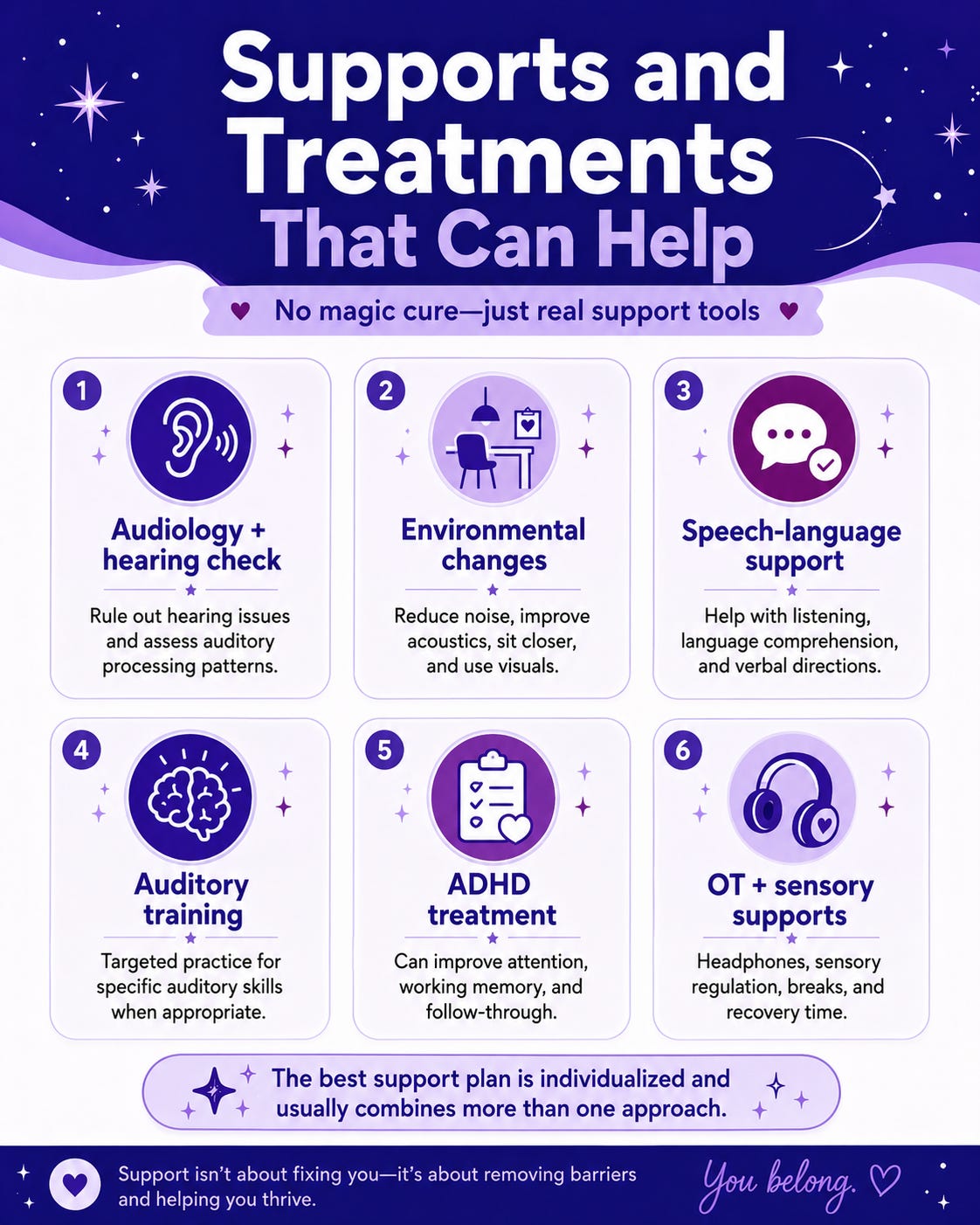
ASHA describes three broad CAPD treatment categories: environmental modifications, direct skills remediation, and compensatory strategies. These are often combined and should be individualized based on assessment, context, and functional needs.
1. Start with assessment: rule out hearing and clarify the pattern
Before assuming it is “just ADHD” or “just autism,” it can help to rule out hearing issues and consider an evaluation with an audiologist, especially one familiar with auditory processing. A speech-language pathologist may also assess language processing, comprehension, and functional communication. CAPD can overlap with language, learning, attention, and developmental conditions, so a team-based view is often more useful than a single-label guessing game.
This matters because treatment changes depending on the root issue.
If the problem is hearing access, that needs one pathway.
If the problem is auditory discrimination, another.
If the problem is working memory, another.
If the problem is sensory overload, another.
If the problem is all of them holding hands in a haunted circle, welcome to AuDHD, babe.
2. Environmental modifications: change the room, not the person
This is the most underrated support category because it sounds too simple.
But environment is not “extra.” Environment is nervous system medicine.
ASHA lists environmental modifications such as reducing competing noise, improving acoustics, strategic seating, pairing verbal information with visuals, recording verbal presentations, written supports, and asking speakers to slow down, pause, emphasize key words, and chunk information.
Examples:
Use written directions.
Ask for one direction at a time.
Move away from fans, vents, buzzing lights, doors, and chaos portals.
Use captions.
Use agendas.
Use visual schedules.
Ask people not to talk from another room.
Reduce background TV.
Use rugs, curtains, soft surfaces, or acoustic panels when possible.
Choose quieter restaurant seating.
Take meetings with notes or transcripts.
Use “say it, show it, send it” as a communication rule.
For kids, this might mean visual supports, preferential seating, noise reduction, teacher check-ins, chunked directions, and assistive technology.
For adults, this might mean requesting written follow-up after meetings, using captions on video calls, taking notes, wearing noise-reducing earplugs, or saying:
“Can you send that to me in writing so I can process it accurately?”
That is not needy. That is access.
3. Remote microphone/FM/DM systems: bring the voice closer to the brain
Remote microphone or FM/DM systems can improve the signal-to-noise ratio, which is fancy audiology language for:
make the important voice louder and clearer than the chaos soup.
ASHA includes hearing assistive technology such as FM/DM systems as an environmental modification for people who struggle to understand auditory messages, especially in classrooms. Research on remote microphone hearing aids in children with APD found improved classroom listening after use, without adverse effects over the study period.
This can be especially helpful for students who hear fine in quiet but struggle in classrooms, where noise, distance, echo, and competing voices turn learning into an audio escape room designed by Satan’s substitute teacher.
4. Auditory training: targeted practice, but not magic fairy dust
Auditory training may target skills like sound discrimination, speech-in-noise listening, temporal processing, auditory memory, binaural integration, and phonological awareness. ASHA notes that some computer-based and direct auditory training approaches may support auditory plasticity, but they should be evidence-based, individualized, and monitored by an audiologist or SLP.
Important: auditory training is not a guaranteed cure.
Some evidence is promising. Some is mixed. Some programs are marketed like they will turn your brain into a luxury sound system, and we need to be careful with that nonsense.
A 2024 systematic review and meta-analysis looked at hearing rehabilitation interventions for adults with APD, which is important because adults are often left out of the support conversation like we all magically became fine at 18.
Translation: auditory supports can help, but they should be chosen thoughtfully. No one needs another expensive “brain training miracle” that gives you three games, a login password, and emotional damage.
5. Speech-language therapy: when language processing is part of the problem
Sometimes the issue is not only sound. It is language.
Speech-language therapy can help with:
Following directions.
Auditory comprehension.
Narrative language.
Phonological awareness.
Vocabulary.
Repair strategies.
Self-advocacy scripts.
Social communication.
Figurative language.
Processing spoken information with visual supports.
For AuDHD people, SLP support can be especially helpful when auditory processing intersects with language comprehension, social communication, school demands, or workplace communication.
This is not “fixing” the person.
It is building ramps for information.
6. Occupational therapy and sensory supports: regulate the nervous system so listening can happen
If sound feels physically painful or overwhelming, auditory processing support cannot only be about listening harder.
That is like telling someone on fire to improve their posture.
Occupational therapy can help identify sensory triggers, build regulation strategies, and create sensory environments that reduce overload. For autistic and ADHD nervous systems, sensory supports may include headphones, noise-reducing earplugs, sensory breaks, deep pressure, movement, visual schedules, predictable routines, and recovery time.
This matters because a dysregulated nervous system does not process information well. It protects first, understands later.
Your brain cannot decode a sentence while it is screaming, “WE ARE UNDER ATTACK BY THE HAND DRYER.”
7. ADHD treatment: helps the attention system, not necessarily the auditory system
ADHD medication, coaching, behavioral strategies, sleep support, exercise, and executive function tools may improve attention, working memory, task initiation, and emotional regulation. That can indirectly improve listening because the brain has more available bandwidth.
But ADHD treatment does not automatically “cure” auditory processing disorder.
It may help you attend to speech.
It may help you hold instructions longer.
It may reduce distractibility.
It may improve follow-through.
But if there are specific auditory processing deficits, sensory sensitivities, or language processing issues, those may still need their own supports.
This is why some people say, “My meds help me focus, but I still need subtitles.”
Yes. Exactly. Both can be true.
8. Mental health support: because being overwhelmed all the time is not cute
Auditory overwhelm can create anxiety, irritability, shutdowns, conflict, avoidance, and shame. Therapy can help with the emotional fallout: self-advocacy, boundaries, nervous system regulation, shame repair, communication scripts, and trauma from years of being misunderstood.
But again, therapy should not become “learn to tolerate everything silently.”
No. Absolutely not.
We are not doing martyrdom in noise-canceling headphones.
Therapy should help you understand your needs, communicate them clearly, and stop treating access as a personality defect.
Active Processing Question
Which support category do you need most right now: better environment, better tools, better language supports, better nervous system regulation, better medical assessment, better boundaries, or better self-trust?
Tips and Strategies for AuDHD Auditory Processing
1. Use the “say it, show it, send it” rule
For important information, ask for three forms when possible:
Say it out loud.
Show it visually.
Send it in writing.
This is especially helpful for meetings, appointments, school directions, therapy plans, partner conversations, and anything involving dates, money, time, or consequences.
2. Stop accepting verbal-only instructions as your villain origin story
Try saying:
“Can you text that to me?”
“Can you write the steps down?”
“Can you say one step at a time?”
“Can you pause after each direction?”
“Can you repeat the last part slower?”
“I process better with visuals.”
Not dramatic. Not high-maintenance. Just accurate.
3. Use captions like they are prescription glasses for your ears
Captions are not cheating.
Captions are access.
Use them for TV, videos, online meetings, trainings, webinars, and educational content.
Sometimes the brain processes written language faster than floating sound. That does not mean your ears are broken. It means your brain likes receipts.
4. Protect your auditory bandwidth before it hits zero
Do not wait until you are feral.
Build in quiet before and after noisy things:
Before meetings.
After school/work.
After errands.
Before social events.
After restaurants.
After concerts.
After kid birthday parties, aka tiny war zones with frosting.
Even five minutes of quiet can be a nervous system reset.
5. Create a personal sound menu
Make three categories:
Sounds that help me focus: brown noise, instrumental music, rain sounds, café noise, silence, binaural-style tracks, nature sounds.
Sounds I can tolerate sometimes: podcasts, TV, music with lyrics, crowded spaces, group conversations.
Sounds that make me want to fake my own disappearance: chewing, tapping, overlapping voices, hand dryers, alarms, loud bass, fluorescent lights, loud toys.
Then plan accordingly. This is data, not drama.
6. Use noise tools without shame
Options include:
Noise-canceling headphones.
Loop-style earplugs.
Over-ear defenders.
White noise machine.
Brown noise.
Soft background music.
Earbuds with transparency mode.
Quiet rooms.
Car silence after work.
You are allowed to reduce input. You do not have to earn peace by suffering first.
7. Ask people not to talk from another room
This one deserves its own national holiday.
Talking from another room is auditory terrorism for many AuDHD brains.
Try:
“I want to hear you, but I cannot process from another room. Can you come closer or text me?”
Beautiful. Clear. No courtroom defense needed.
8. Chunk verbal information
Instead of:
“Go upstairs, grab your shoes, put your lunch in your bag, check your folder, brush your teeth, get your water bottle, and meet me by the door.”
Try:
“First: shoes.”
Then pause.
“Next: lunch in bag.”
Then pause.
For adults too:
“First, what is the deadline?”
“Second, what is the first step?”
“Third, what needs to be sent in writing?”
Chunking lowers working memory load.
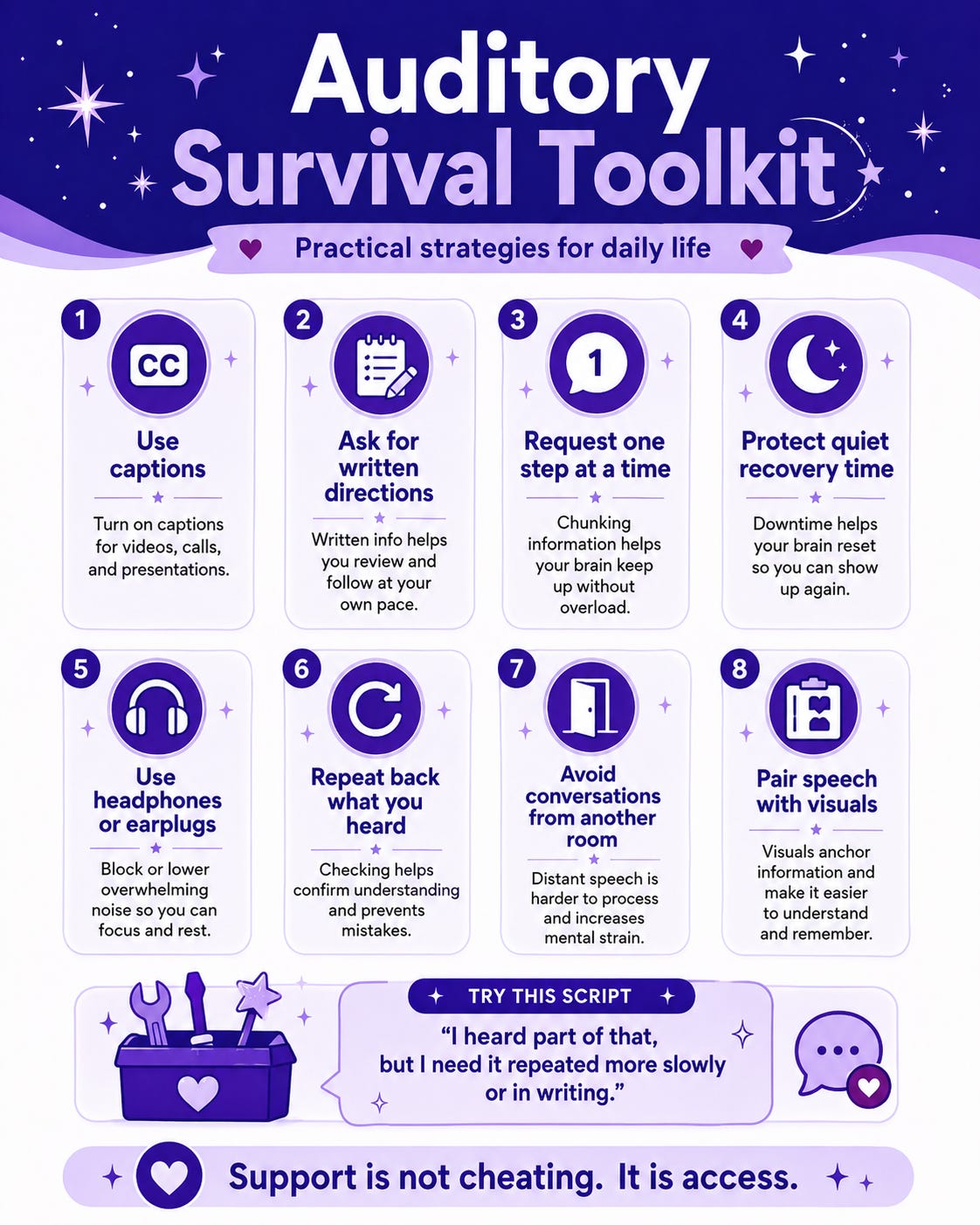
9. Repeat back what you heard
This is not childish. This is executive function scaffolding.
Try:
“Let me make sure I got that.”
“So the plan is…”
“You need me to do A, B, and C by Friday?”
“I heard the first part, but lost the second.”
This prevents the classic AuDHD experience of confidently doing the wrong task with the passion of a Greek tragedy.
10. Build recovery time into noisy days
If you know you have a loud day, plan a soft landing:
Quiet car ride.
No extra errands.
Simple dinner.
Low talking time.
Comfort show with captions.
Dim lights.
Weighted blanket.
No “quick phone call” unless legally required by the gods.
Recovery is not laziness. It is auditory digestion.
11. Use visual anchors during conversations
Looking at a person’s face may help some people process speech because visual cues support comprehension. For others, eye contact may be too intense and actually reduce processing.
So experiment.
Try looking at the speaker’s mouth, their shoulder, a note page, a fidget, or a neutral spot nearby.
The goal is not to perform “good listening.”
The goal is to actually process.
12. Make your own “I did not process that” scripts
Because in the moment, words disappear like they owe you money.
Scripts:
“Can you say that another way?”
“I heard you, but I need a second to process.”
“My brain dropped the middle part. Can you repeat from there?”
“I want to answer, but I need a pause.”
“Too much background noise. Can we move or text?”
“I am not ignoring you. My processing is delayed.”
Put them in your phone if you need to. Scripted support is still support.
13. Teach kids that listening is more than ears
For children, especially AuDHD kids, replace shame with skill-building.
Instead of:
“You never listen.”
Try:
“Your brain missed part of that. Let’s use a visual.”
“That was too many steps. Let’s do one at a time.”
“The room is loud. Let’s move closer.”
“Show me what you heard.”
“Do you need me to say it, show it, or write it?”
We do not build listening by threatening children with adult disappointment. We build listening by making information accessible.
14. Track your auditory patterns
For one week, notice:
When do sounds bother me most?
Which environments are hardest?
Do I process better in the morning or evening?
Does hunger affect it?
Do hormones affect it?
Does medication timing affect it?
Does sleep affect it?
Do I struggle more with certain voices, speeds, accents, tones, or background sounds?
Patterns are power.
15. Stop moralizing your sensory needs
You are not “too much” because the world is loud.
You are not rude because your brain needs time.
You are not broken because you need captions.
You are not childish because you need written directions.
You are not dramatic because sound can hurt.
You are a human nervous system, not a Bluetooth speaker with unlimited battery.
Reflection Journal Prompts
What sounds make me feel safe, focused, or regulated?
What sounds make me feel irritated, trapped, panicked, or exhausted?
What do people misunderstand about my listening?
What support do I need but feel embarrassed to ask for?
When did I first learn that my processing differences were “bad”?
What would change if I treated auditory processing as an access need, not a personal failure?
What is one communication boundary I can practice this week?
Where do I need more written support in my life?
What environments drain my auditory battery fastest?
What would my life look like if I stopped pretending I can process everything in real time?
Final Thought
AuDHD auditory processing is not just “I don’t like noise.”
It is the lived experience of having a brain that hears too much, filters too little, processes unevenly, remembers inconsistently, feels sound deeply, and still tries so damn hard to participate in a world that refuses to turn the volume down.
You are not failing at listening.
Your brain may need clearer input, fewer competing sounds, more time, more visual support, more recovery, and less shame.
Because sometimes the most healing sentence is not:
“Try harder.”
It is:
“Of course that was hard. Your brain was translating sound through a thunderstorm.”