
"Where Did the Time (and Instructions) Go?"
Navigating Working Memory Gaps and Time Blindness in AuDHD Brain

🧠 Segment 1: Executive Function’s Tug-of-War in AuDHD Brains
Executive functioning is like the brain’s behind-the-scenes director — organizing, planning, managing time, switching tasks, and holding things in mind. But for people with AuDHD (co-occurring Autism and ADHD), that director often shows up late… or forgets the script entirely.
Two of the most derailing executive function struggles?
👉 Working memory gaps — aka: “Wait… what were we doing again?”
👉 Time blindness — aka: “There’s no such thing as future me; there is only now-me, and she wants snacks.”
These aren’t character flaws. They’re neurodevelopmental hiccups backed by solid science:
ADHD-related executive dysfunction is linked to hypoactivity in the prefrontal cortex and altered dopamine transmission (Barkley, 2011).
Autistic processing differences often involve more rigid time schemas, detail-oriented focus, and difficulty switching between tasks (Happé & Frith, 2006).
When both exist together in an AuDHD brain, you get the perfect storm of now-focused urgency and rigid sequencing, making time and memory a daily battlefield.
🧩 Segment 2: Working Memory Gaps — “I Swear You Just Told Me That…”
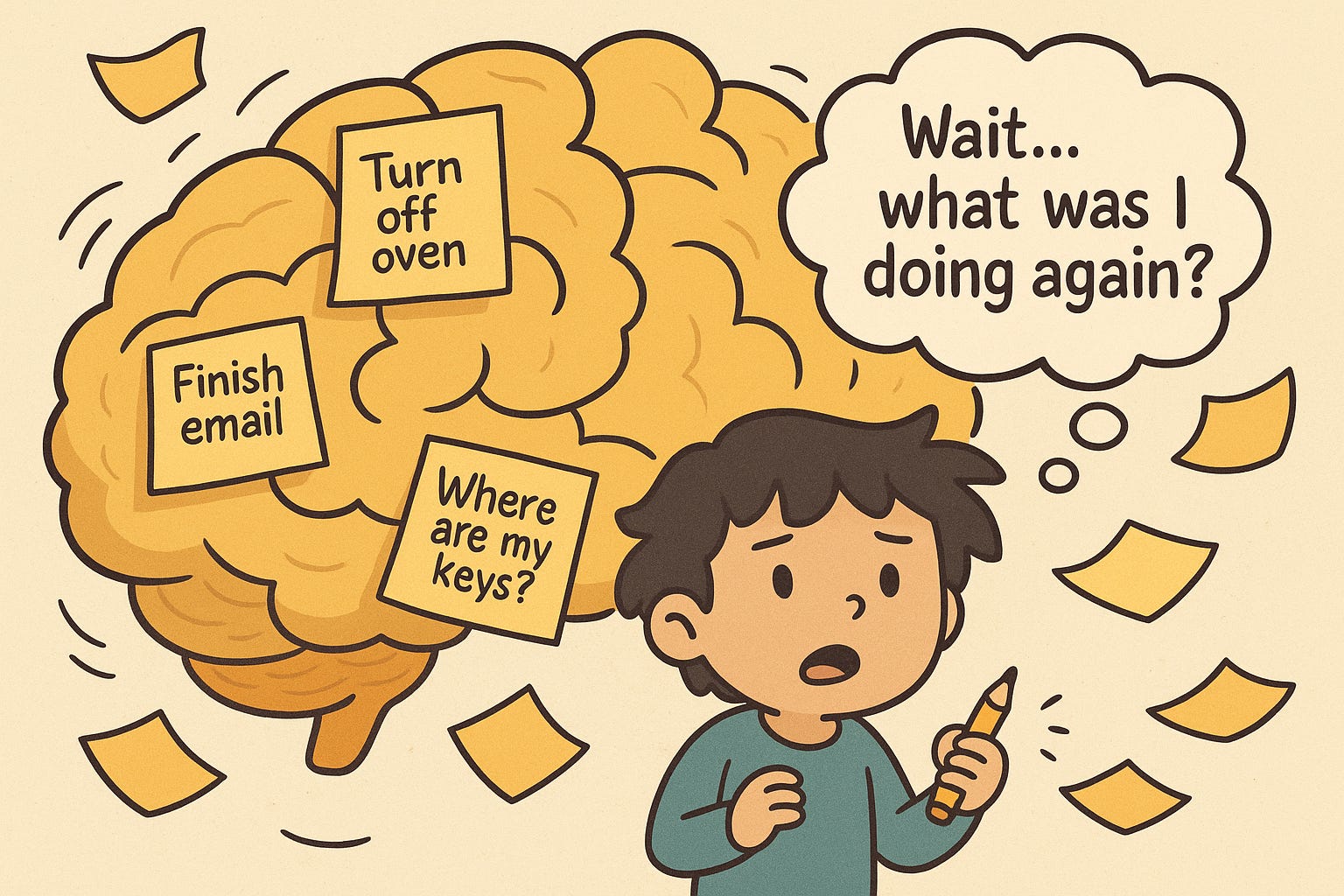
Working memory is not the same as long-term memory — it’s the brain’s temporary “scratchpad” where you hold and manipulate information briefly (like remembering a phone number long enough to type it in).
In AuDHD adults, that mental scratchpad tends to:
Erase itself prematurely under stress or overstimulation
Drop random pieces of info mid-task
Struggle to juggle multiple ideas, especially if verbal
🧠 Why this happens:
Neuroscientific research links working memory deficits in ADHD to underactivation in the dorsolateral prefrontal cortex — a key area for holding short-term information (Kasper et al., 2012). Add autistic traits like processing overload and black-and-white thinking, and you've got a brain that's trying to juggle jello.
💥 Common lived experiences:
Forgetting what someone just said — even when you were listening
Losing your place mid-sentence, mid-task, mid-thought
Mentally “buffering” during conversations, then blanking
Needing to re-read instructions 12 times, only to forget them after 5 seconds
🎯 Metaphor: It’s like trying to build IKEA furniture… but the instructions keep disappearing as you read them.
🕰️ Segment 3: Time Blindness — “I Thought I Had More Time…”
Time blindness isn’t just “bad time management.” It’s a literal neurological disconnect from time as a measurable, predictable thing.
Dr. Russell Barkley, a leading ADHD researcher, describes ADHD as a “disorder of performance over time.” In ADHD brains, the prefrontal cortex struggles to hold the concept of “future,” while the limbic system dominates with what feels urgent right now.
For autistic folks, time is often perceived rigidly or inconsistently — think hyperfixation zones that make hours vanish, or high anxiety around exact timing.
Put them together? You get:
Losing track of time completely (thanks, hyperfocus)
Chronic lateness — or excessive earliness from anticipatory anxiety
Underestimating or overestimating how long things take
Panic when transitions arrive “too fast,” even if they were scheduled
🎯 Metaphor: Imagine you're driving through time fog. Sometimes it feels like you're speeding uncontrollably, other times you're stuck in molasses, and you can't trust the dashboard clock.
🔄 Segment 4: When Both Collide — The AuDHD Productivity Paradox
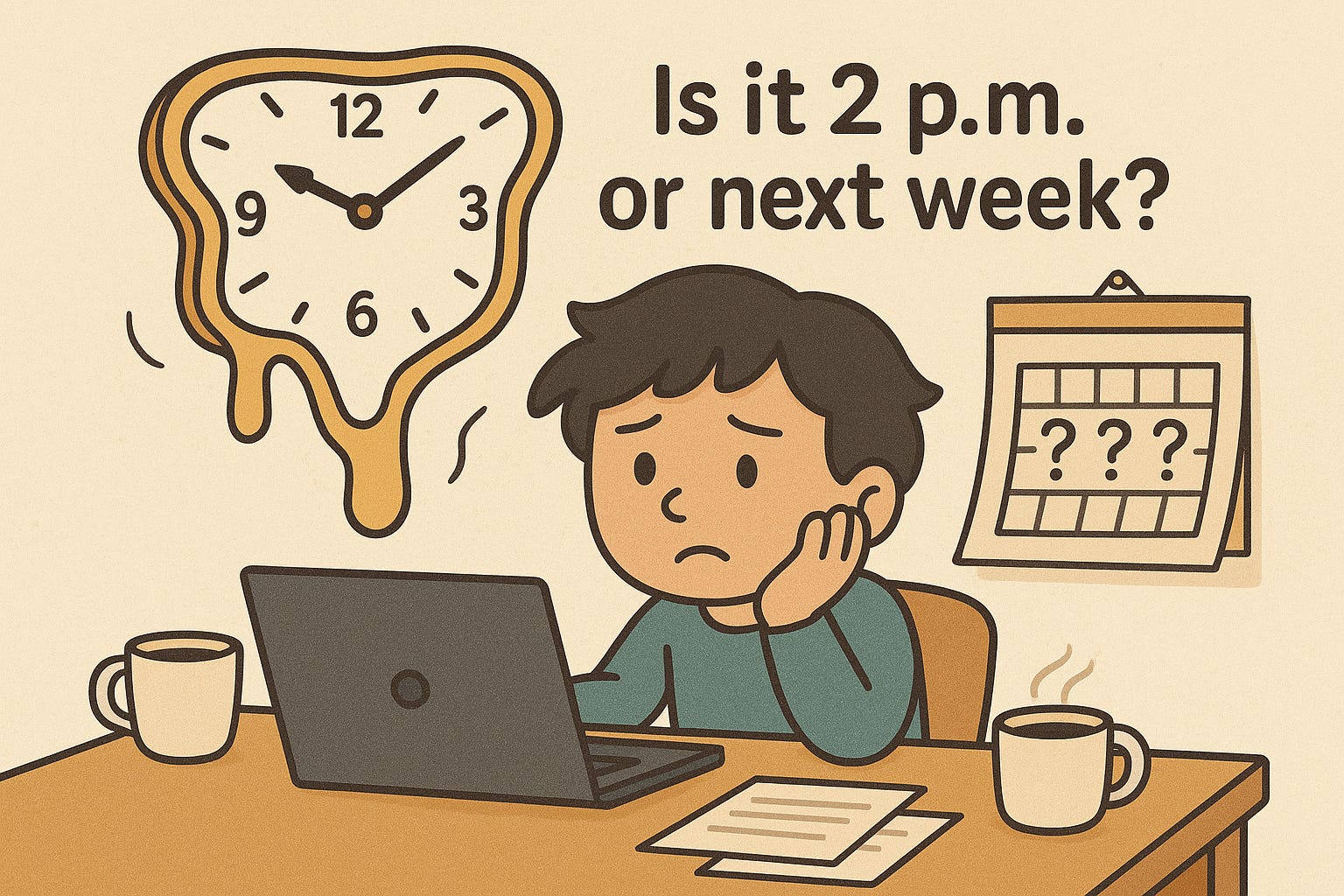
Let’s talk about how these two executive function gaps amplify each other:
You forget the plan (working memory)
→ so you switch tasks impulsively (time blindness)
→ then hyperfocus for hours without eating or moving (time blindness again)
→ but forget where you left off when interrupted (working memory gap)
→ and now you’re overwhelmed, behind, and low-key dissociating.
You may look lazy, scattered, or "bad at adulting"…
But in reality, your brain is:
Holding too little
Processing too much
Predicting too poorly
Judging itself way too harshly
💡 This is not a motivation problem. It’s a neurological navigation problem.
And good news? With the right supports, you can build workarounds that externalize time and memory — instead of blaming yourself for not performing like a neurotypical planner robot.
🛠️ Segment 5: Tips, Tools, and Journal Prompts to Build Supportive Systems
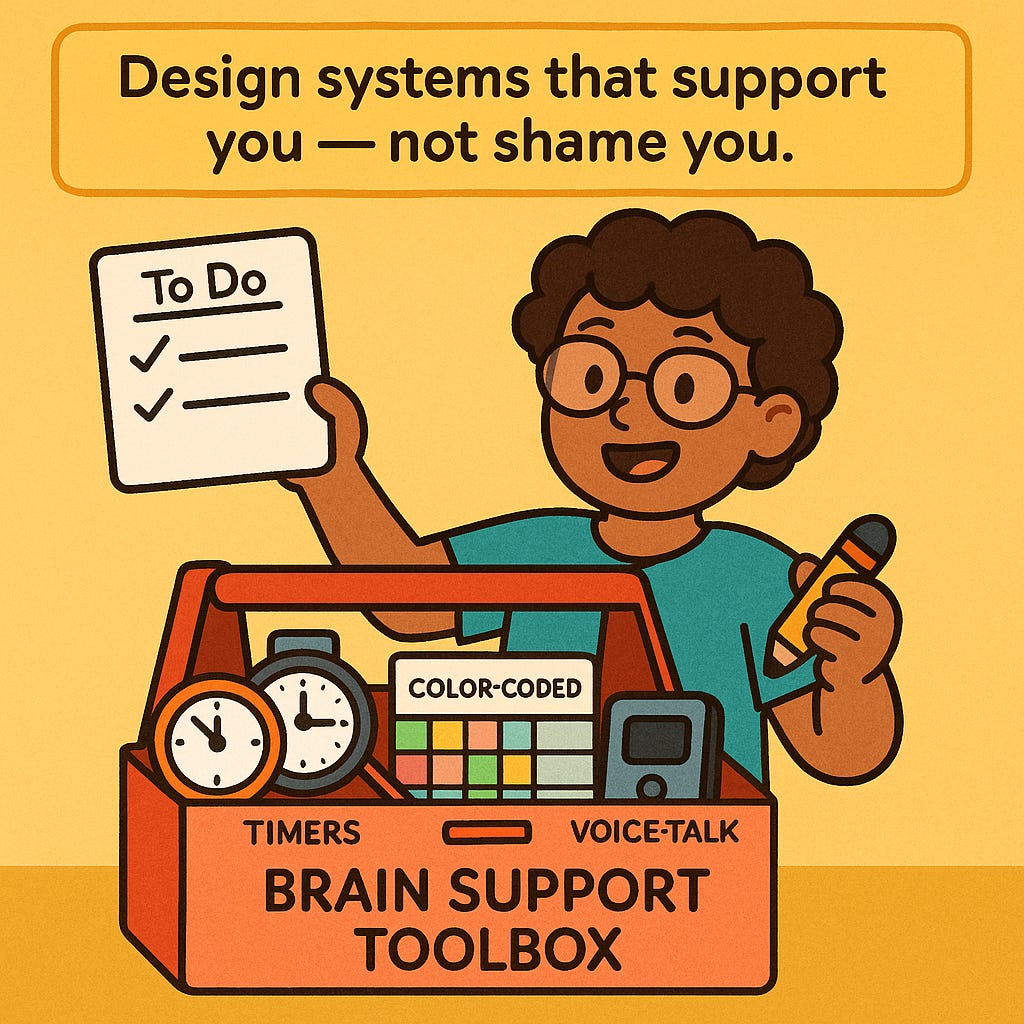
Let’s wrap with science-backed, neurodivergent-friendly strategies.
🧰 3 Game-Changing Strategies
1. Externalize Your Brain
Use whiteboards, sticky notes, checklists, and calendars where you can see your thoughts.
Try digital apps that remind you with labels and notifications (like Todoist or Tiimo).
Use “talk to text” or record voice memos when you’re afraid you’ll forget something important.
🔁 Tip: Don’t rely on remembering. Rely on designing your environment to do it for you.
2. Make Time Visual & Sensory
Try a Time Timer (visual countdown clock) or sand timer for tasks and breaks.
Color-code your calendar by type of task (e.g., admin = blue, creative = yellow).
Use analog clocks so you can see time passing instead of disappearing in digits.
🕒 Tip: Future-you needs present-you to give time a shape, not just a number.
3. Break It Down to "Next Tiny Step"
Don’t ask “What’s the whole task?” Ask, “What’s the very next step?”
Use backward chaining: Start with the end goal and work backwards one step at a time.
Narrate it aloud or write a checklist (even for things that seem basic, like “open laptop”).
💥 Tip: Autopilot doesn’t work here. But small, conscious steps? They’re magic.
✏️ Journal Prompts for Integration
"What’s one moment this week when I lost track of time? What helped me re-center?"
"When I forget something, how do I talk to myself about it? How can I respond with more self-compassion?"
"What does time feel like in my body? What cues help me reconnect to it?"
"Where could I put a reminder, timer, or visual that supports my memory — without judgment?"
"If my brain was a team, what roles need more support (planner, rememberer, timer, encourager)?"
🧡 Final Thoughts
If you’ve ever felt like time is a slippery eel and memory is a leaky bucket, you’re not broken — you’re just wired differently. Working memory gaps and time blindness don’t make you less intelligent or capable — they simply call for a more innovative, externalized, and supportive approach.
You deserve tools that honor your brain's rhythm, not punish it for marching to a different beat.
🌟 You are not a time-management failure. You’re a creative, capable, neurodivergent human building systems that finally make sense.