Why Does Cleaning Feel Like a Boss Battle? AuDHD Hacks for Routines, Burnout, and the Tiny Daily Chaos Goblin
Your brain is not broken. It is running three operating systems, six browser tabs, a sensory alarm, and one raccoon with a clipboard.

There is a specific kind of betrayal that happens when you look around your house and realize the mess is not just “a mess.”
It is laundry with emotional backstory.
It is dishes that have somehow become a moral referendum.
It is mail you moved from the counter to the table to the other counter because apparently your brain believes “relocation” is the same as “completion.”
It is the tiny daily chaos goblin sitting on your shoulder whispering, “Let’s reorganize the entire closet at 9:47 p.m. but absolutely do not put away the clean socks.”
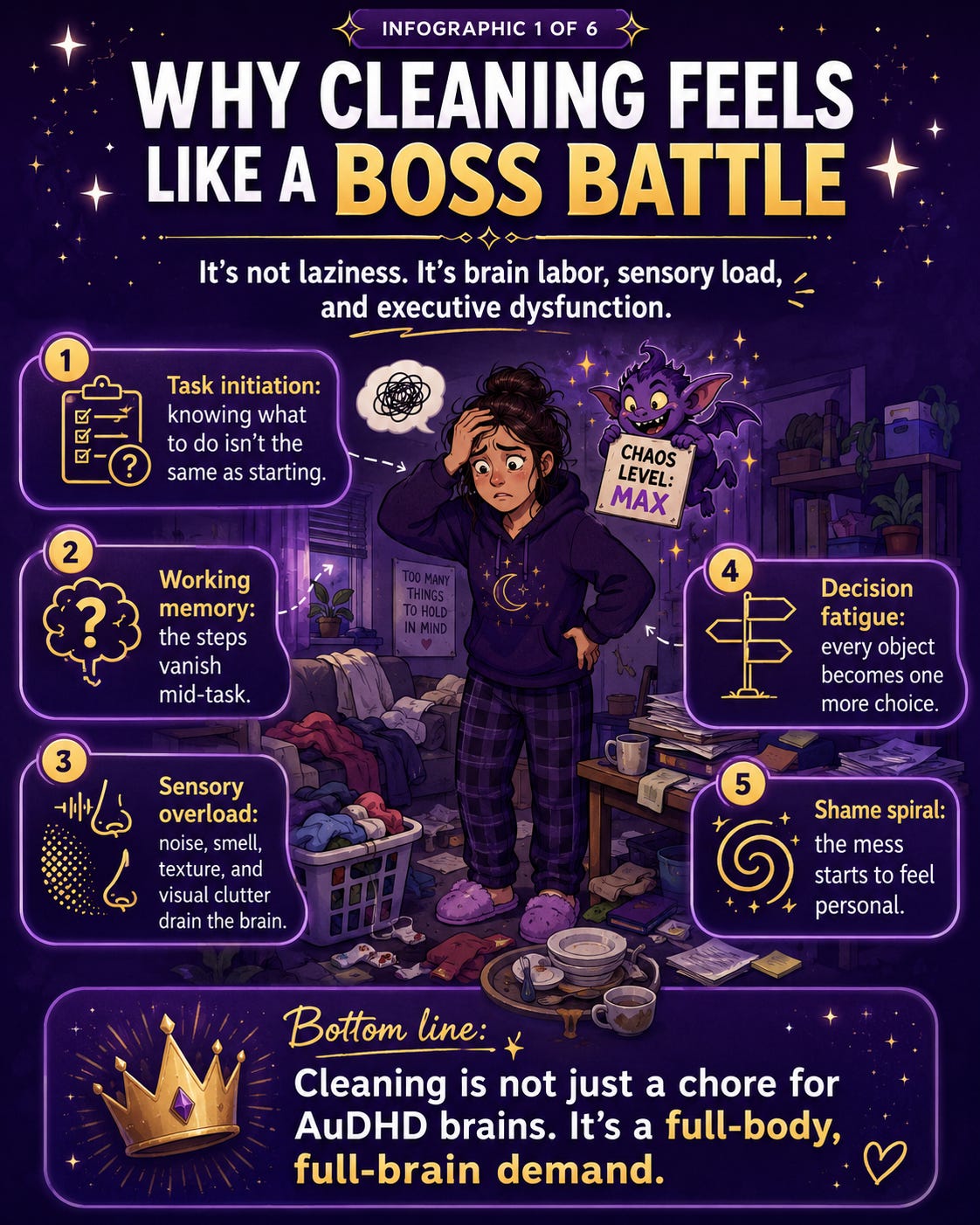
For ADHD, autism, and AuDHD brains, cleaning and routines are rarely just about cleaning and routines. They are about executive function, sensory load, task initiation, motivation, perfectionism, predictability, burnout, transitions, and nervous system capacity. Research consistently connects ADHD with executive functioning challenges, including planning, working memory, inhibition, and organization, while autistic adults can also experience clinically significant executive function difficulties that affect daily living.
So no, you are not “just lazy.” Lazy is when you do not care. Executive dysfunction is when you care deeply, you can see the task, you know it matters, and yet your brain will not hand you the keys to start the car.
Rude? Yes.
Personal failure? Absolutely not.
The Problem Is Not the Chore. It Is the Invisible Brain Labor Around the Chore.
Neurotypical cleaning advice often sounds like this:
“Just do a little every day.”
“Set a routine.”
“Put things away when you’re done.”
“Clean as you go.”
Cute. Precious. Very live-laugh-lobotomy.
For an AuDHD brain, “clean the kitchen” is not one task. It is a haunted advent calendar of micro-decisions:
Where do I start?
Do I need gloves?
Is the sponge gross?
Why does the sink smell like swamp trauma?
Should I unload the dishwasher first?
What if the dishwasher is full?
What if the counters need wiped first?
Where does this random charger go?
Why am I suddenly remembering a conversation from 2017?
Wait, am I hungry?
Why is the light buzzing?
Why did I walk into this room?
This is where executive function enters the chat, kicks off its shoes, and immediately loses them.
Executive functions are the brain’s self-management skills: planning, prioritizing, sequencing, initiating, shifting, monitoring, and inhibiting impulses. These skills are commonly impacted in ADHD, and research also shows executive function challenges in autism, especially in daily living tasks that require flexibility, planning, and self-management.
For some people with ADHD, the barrier is not knowing what to do. It is activating the brain to do it, especially when the task is boring, repetitive, low-reward, or emotionally loaded. ADHD research has linked motivation difficulties to differences in the dopamine reward pathway, meaning the brain may struggle to mobilize effort for tasks that do not feel immediate, novel, urgent, or rewarding.
For some autistic people, the barrier may be unpredictability, sensory overwhelm, transitions, demand overload, or the distress of doing a task in a way that feels inefficient, incomplete, or wrong. Autistic burnout research describes chronic exhaustion, loss of skills, and reduced tolerance to sensory input after prolonged stress and demands that exceed capacity.
And for AuDHD brains?
Oh honey. That is where the plot thickens.
AuDHD is commonly used to describe co-occurring ADHD and autism. Research reviews suggest ADHD and autism co-occur frequently, though estimates vary widely depending on sample, age, diagnostic criteria, and measurement tools. One review notes that 50–70% of autistic individuals may also present with ADHD.
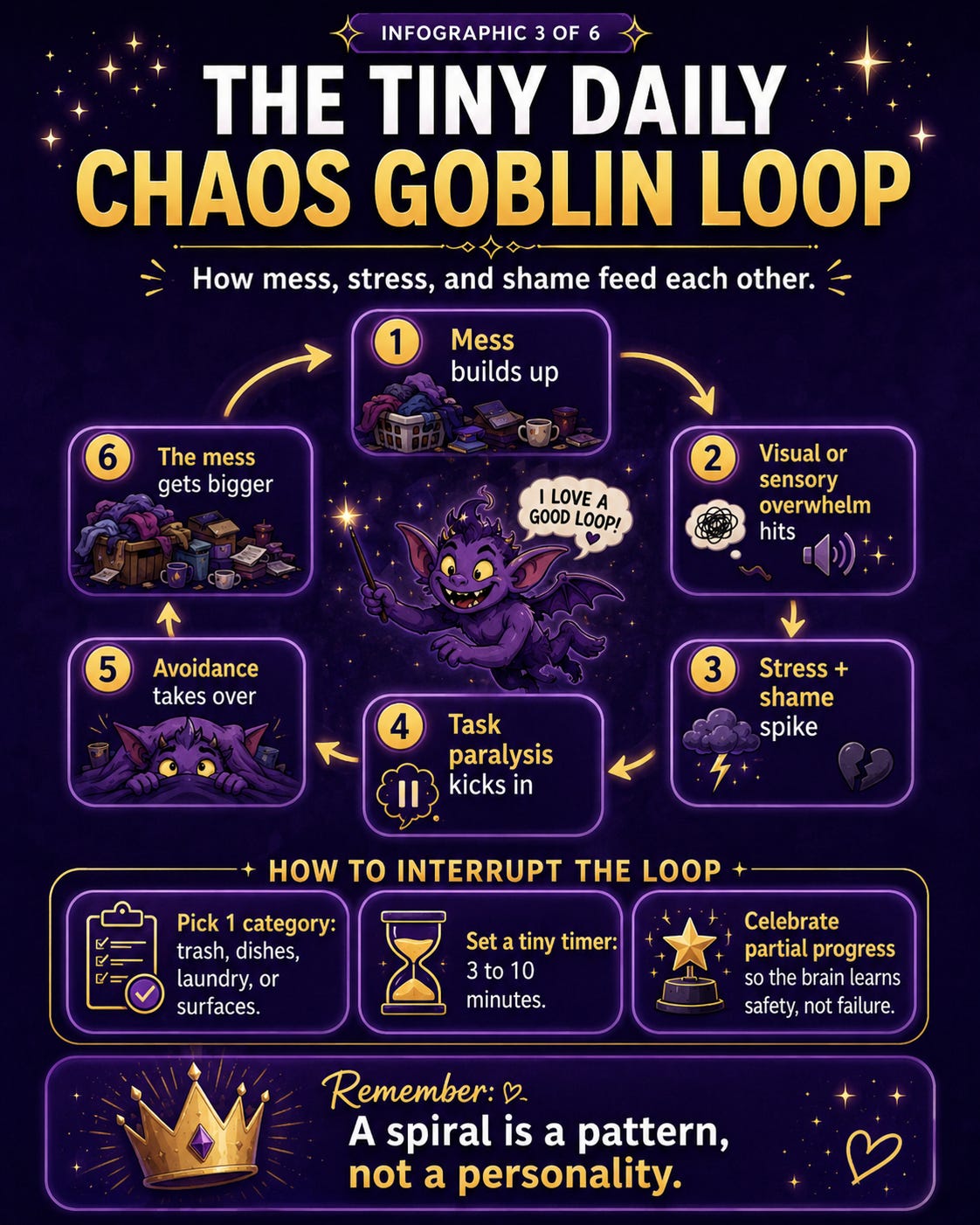
This means one part of the brain may crave novelty, stimulation, and dopamine, while another part craves sameness, predictability, and sensory safety.
So you want a routine…
but you also get bored of routines.
You need structure…
but too much structure feels like a demand cage.
You want your home clean…
but the sounds, textures, smells, and decisions make your nervous system pack a suitcase and flee the premises.
That is the Tiny Daily Chaos Goblin.
Not a character flaw.
A nervous system with competing needs.
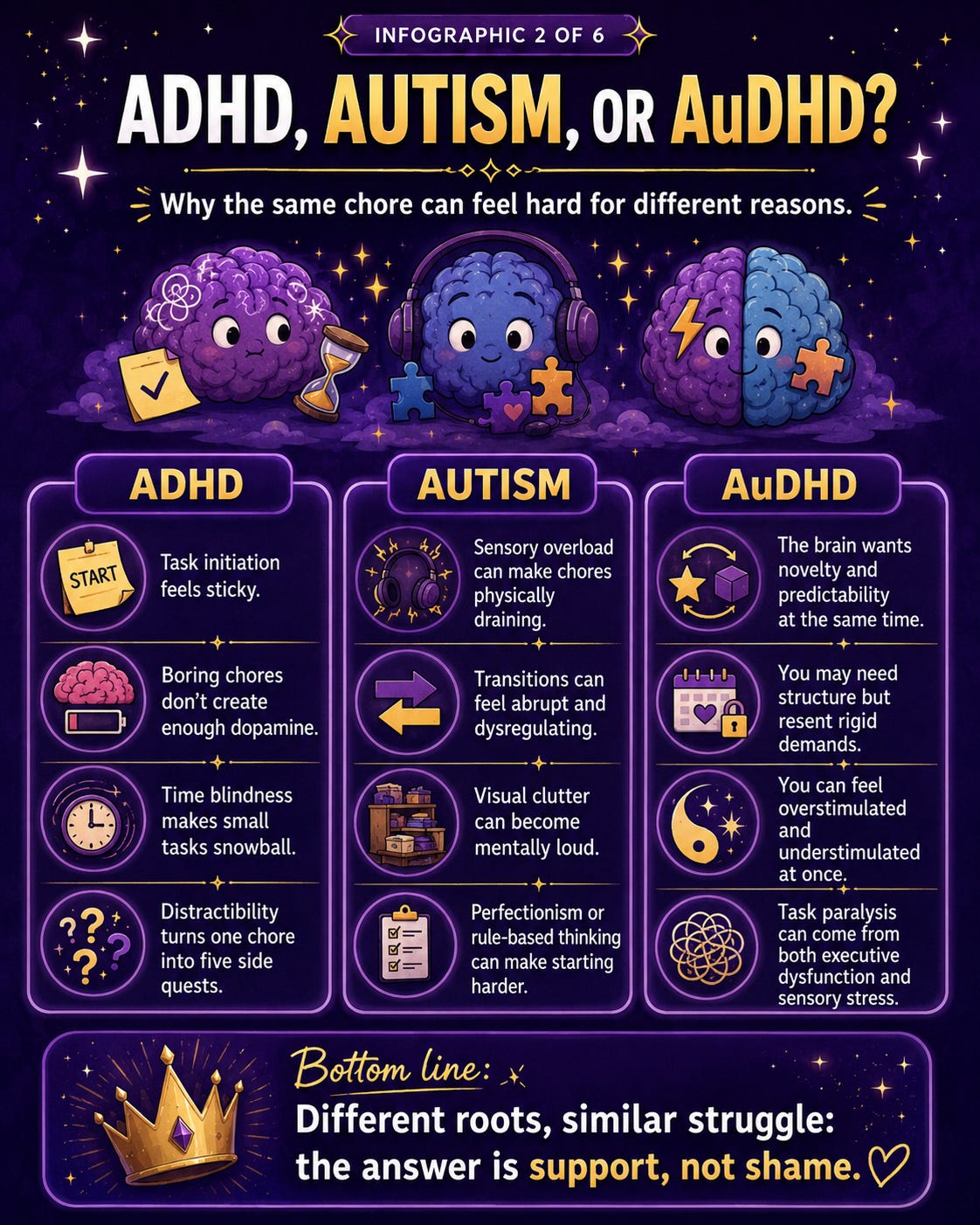
Why Cleaning Can Feel So Hard for ADHD Brains
For ADHD brains, cleaning is difficult because it requires the exact skills ADHD tends to hijack: initiation, sequencing, time awareness, working memory, sustained attention, and emotional regulation.
Cleaning is also usually delayed-reward work. The reward comes after the task, not during it. And the ADHD brain often needs the reward up front, in the middle, or at least somewhere close enough that dopamine can smell it.
That is why “I’ll feel better after” may not work.
Your logical brain may know that Future You will enjoy the clean room. But your ADHD brain is often voting based on Present Dopamine. Present Dopamine says, “This task has no sparkle, no urgency, no novelty, and too many steps. Motion denied.”
ADHD can present in cleaning as:
Starting five cleaning tasks and finishing none.
Walking room to room carrying one object like a confused side quest character.
Hyperfocusing on one tiny drawer while the rest of the house burns metaphorically.
Avoiding the mess until it becomes a crisis.
Feeling intense shame when the environment does not match your values.
Needing a deadline, guest, or emotional spiral to finally clean.
Being unable to “see” clutter until suddenly you see all of it and want to scream.
Getting bored halfway through and abandoning the task like a Victorian ghost.
And here is the part we do not talk about enough: ADHD cleaning struggles often become identity wounds.
The mess becomes “proof” that you are failing.
The laundry becomes “evidence” that you are immature.
The sink becomes a tiny courtroom where shame is the judge, jury, and weirdly aggressive bailiff.
But the research points toward brain-based self-regulation challenges, not moral defects. ADHD has been linked to executive function difficulties and reward/motivation differences, which can make repetitive daily maintenance tasks genuinely harder to start and sustain.
You do not need more shame.
You need better scaffolding.
Why Cleaning Can Feel So Hard for Autistic Brains
For autistic brains, cleaning can be difficult for different, overlapping reasons.
Sometimes the barrier is sensory. The smell of old food. The texture of wet dishes. The sound of the vacuum. The brightness of the bathroom light. The feeling of crumbs under your feet. The chemical smell of cleaners. The chaos of objects being visually “loud.”
Research has found relationships between sensory processing and executive functioning in autistic and ADHD populations, suggesting that sensory load can interact with the brain systems needed for planning, self-regulation, and task completion.
Translation: sensory overwhelm does not just feel bad. It can steal the keys from executive function.
Sometimes the barrier is transition-based. Moving from resting to cleaning, from one task to another, or from “mental plan” to “body action” can feel like trying to pull your entire soul through a keyhole.
Sometimes the barrier is perfectionism or rule-conflict. If the task cannot be done “the right way,” the autistic brain may struggle to begin at all. Not because you are dramatic, but because incomplete or ambiguous tasks can feel deeply dysregulating.
Autistic cleaning struggles can look like:
Avoiding a task because the sensory experience is unbearable.
Needing a specific order or method before starting.
Becoming distressed when someone cleans “wrong” or moves things.
Struggling to restart after interruption.
Feeling overwhelmed by visual clutter.
Having a shutdown or meltdown after too many household demands.
Needing recovery time after “simple” chores.
Losing daily living skills during burnout.
And when autistic burnout enters the picture, the issue becomes much bigger than “I need to clean more.” Autistic burnout is characterized by long-term exhaustion, reduced tolerance to sensory input, and loss of functioning or skills, often after prolonged mismatch between demands and needs.
So when someone says, “I used to be able to do this, why can’t I now?”
That question deserves compassion.
Burnout can make basic tasks feel like climbing a mountain while carrying a flaming dishwasher.
Why AuDHD Makes Routines So Weirdly Complicated
Routines are supposed to help.
And they do. Sometimes.
But with AuDHD, routines can become complicated because ADHD and autism may pull in different directions.
The autistic part may say:
“I need predictability. I need sameness. I need to know what is happening.”
The ADHD part may say:
“If we do this same routine one more time, I will simply evaporate.”
The autistic part may want a detailed plan.
The ADHD part may resent the plan as soon as it becomes a demand.
The autistic part may crave order.
The ADHD part may create novelty-seeking chaos piles.
The autistic part may need low sensory input.
The ADHD part may need music, movement, caffeine, novelty, or urgency to activate.
This is why a routine can work beautifully for three days and then suddenly feel like a haunted contract you signed under duress.
AuDHD routine struggles can look like:
Constantly rebuilding systems instead of using them.
Getting bored with routines that actually help.
Needing structure but feeling trapped by structure.
Melting down when the routine gets disrupted.
Forgetting the routine exists unless it is visible.
Doing well with routines during high-capacity seasons and losing them during burnout.
Feeling like you are “inconsistent” when really your nervous system capacity keeps changing.
This is the part that matters: AuDHD support cannot be only ADHD-friendly or only autism-friendly. It has to respect both the need for stimulation and the need for safety.
That means your routine should not be a rigid prison.
It should be a flexible ritual.
A routine says: “Do it exactly this way.”
A ritual says: “Here is the shape. Adjust the texture.”
That distinction? Life-changing.
Burnout: When the Chaos Goblin Becomes the Landlord
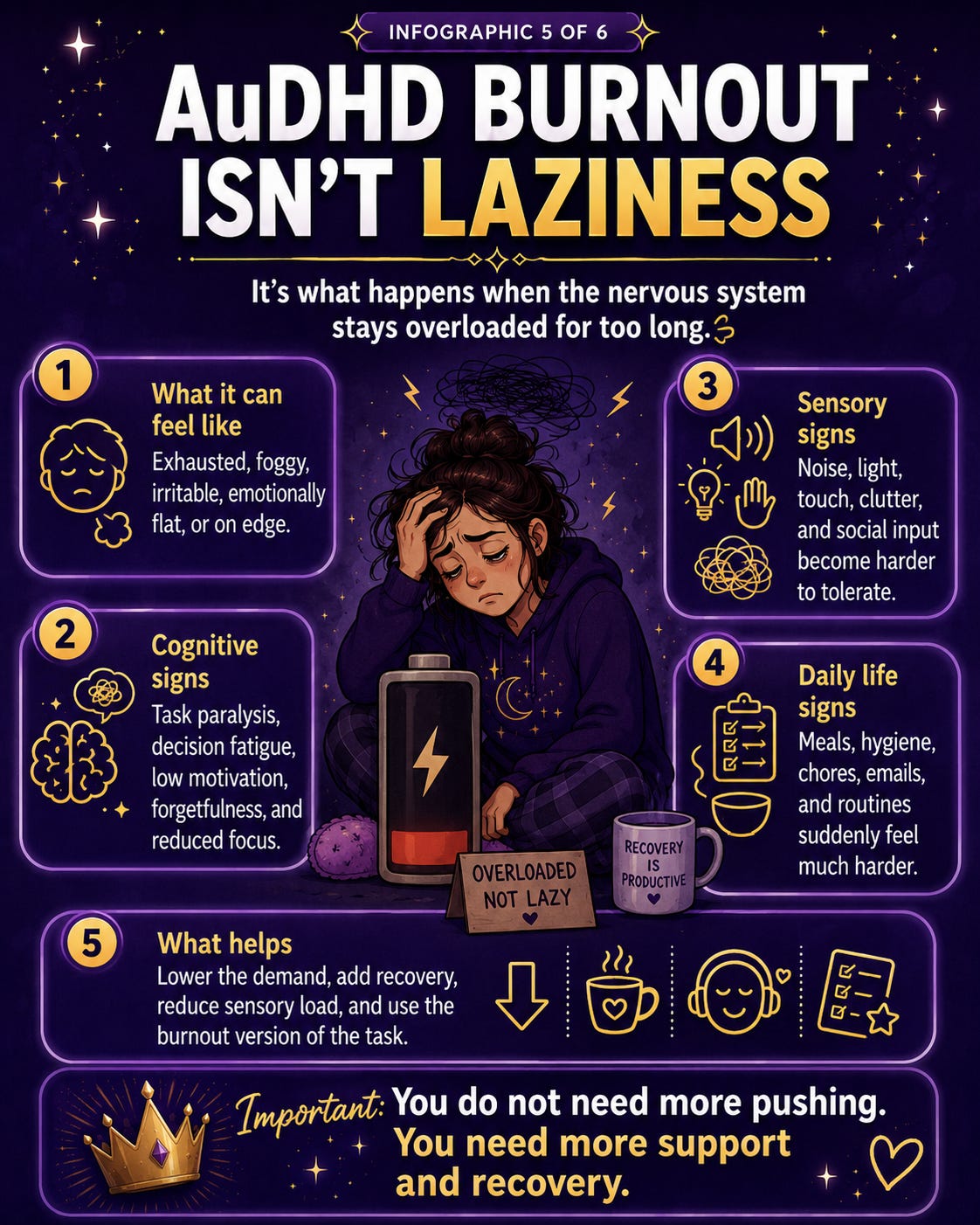
Burnout is what happens when your nervous system has been paying bills it never agreed to.
For neurodivergent people, burnout often comes from chronic masking, sensory overload, executive demand, emotional labor, lack of recovery, and trying to function in environments that were not designed for your brain.
For ADHD, burnout may show up as total motivational collapse, emotional volatility, decision fatigue, task paralysis, increased distractibility, and shame spirals.
For autism, burnout may show up as sensory intolerance, loss of speech or communication capacity, reduced daily living skills, shutdowns, social withdrawal, and needing much more recovery time.
For AuDHD, burnout can feel like both at once:
You are understimulated and overstimulated.
You are bored and exhausted.
You want novelty but cannot handle change.
You need help but cannot explain what is wrong.
You want a clean house but cannot tolerate the process of cleaning.
You want routine but every routine feels like being emotionally held hostage by a laminated checklist.
Autistic burnout research describes exhaustion, loss of skills, and reduced tolerance to stimulus; ADHD research highlights executive and motivational pathways that can affect task initiation and sustained effort. Together, these can make daily maintenance tasks feel impossible during burnout seasons.
This is why “just push through” is often terrible advice.
Pushing through may work for one afternoon.
But if your nervous system is already overdrawn, pushing through can turn a small crash into a full-body system outage.
Sometimes the most productive thing you can do is lower the demand before your brain pulls the fire alarm
.
How This Affects Neurodiverse Lives
Cleaning, routines, and burnout are not small issues. They touch everything.
They affect relationships.
They affect self-trust.
They affect hygiene, meals, sleep, finances, work, parenting, teaching, caregiving, friendships, and mental health.
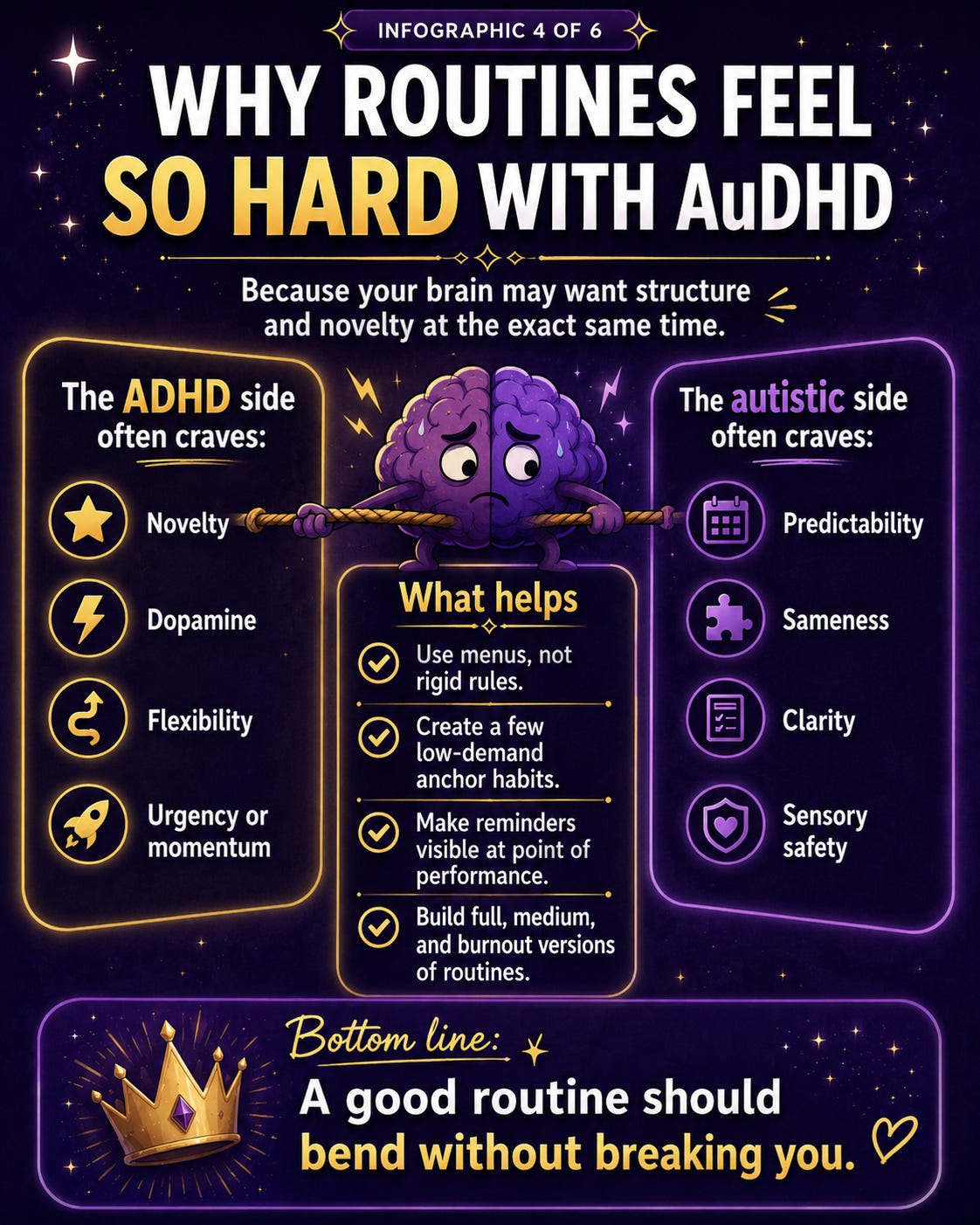
A messy environment can become visually overstimulating.
Visual overstimulation can increase stress.
Stress can reduce executive function.
Reduced executive function makes cleaning harder.
Then the mess grows.
Then shame grows.
Then avoidance grows.
Then the Tiny Daily Chaos Goblin gets a timeshare in your frontal lobe.
It is a loop.
And the cruelest part is that many neurodivergent people are not struggling because they do not care. They are struggling because they care so much that the task becomes emotionally loaded.
The laundry is not laundry.
It is “Why can’t I keep up?”
The dishes are not dishes.
They are “Everyone else seems to do this.”
The routine is not a routine.
It is “What is wrong with me that I cannot stay consistent?”
Nothing drains the brain like turning every chore into a character assassination.
So let’s stop.
The goal is not to become a neurotypical cleaning influencer with beige bins and suspiciously empty counters.
The goal is to build a life that supports your actual brain.
A home that functions.
A routine that bends.
A recovery plan that does not require you to earn rest by suffering first.
Tips & Strategies: Hacks That Actually Respect the AuDHD Brain
1. Make the Task Smaller Than Your Shame Thinks It Should Be
Your shame wants a full reset.
Your nervous system may only have capacity for one counter.
Choose the smallest visible action:
Put five things away.
Clear one chair.
Wash only cups.
Start one laundry load.
Throw away obvious trash.
Wipe one surface.
Set a timer for three minutes.
This is not “doing nothing.” This is lowering the activation energy. ADHD brains often struggle with task initiation, so making the starting line ridiculously small is not cheating. It is brain-based strategy.
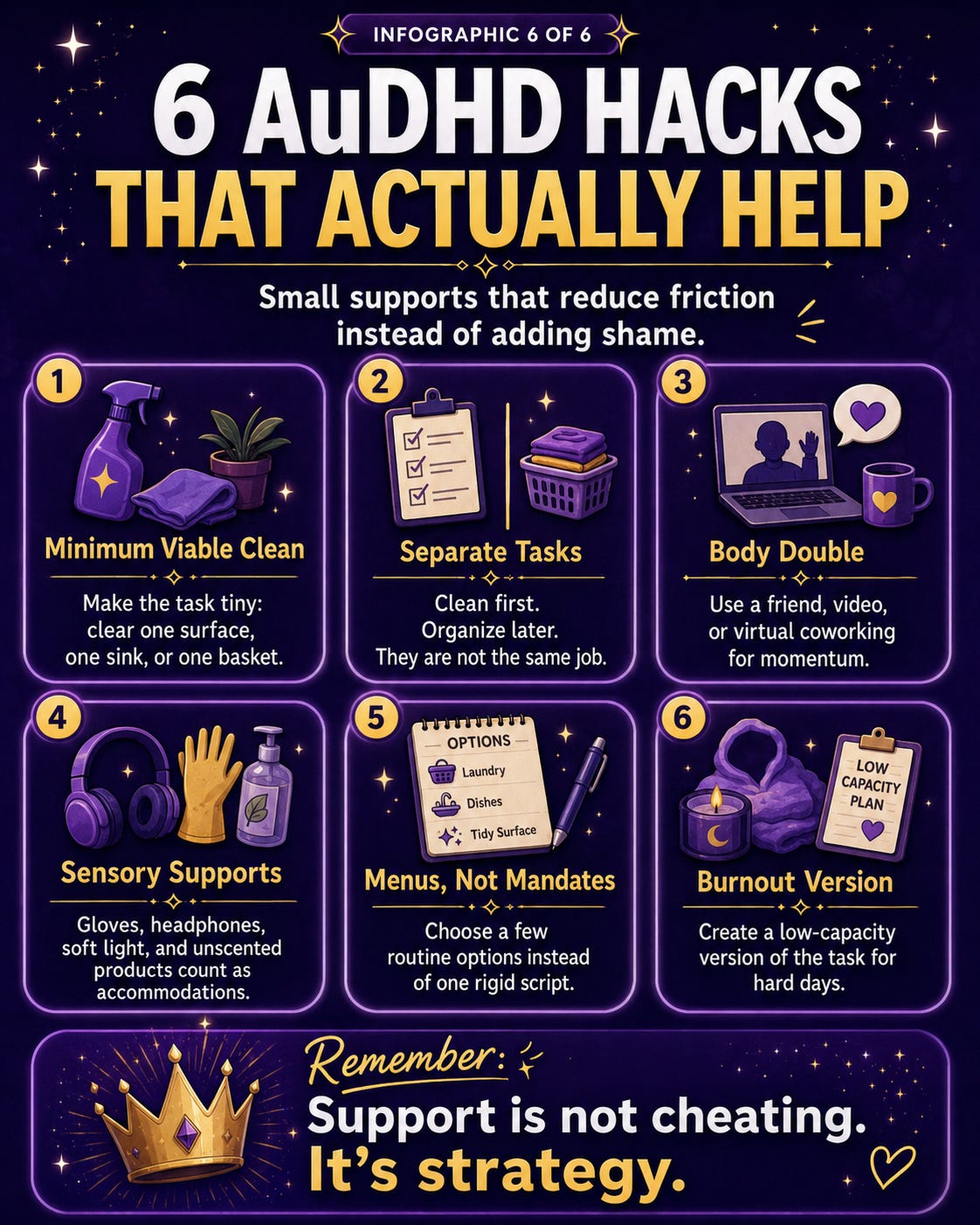
Call it the Minimum Viable Clean.
Not “clean the kitchen.”
“Rescue the sink.”
Not “organize the bedroom.”
“Clear the bed so I can sleep.”
Not “fix my life.”
“Throw away the snack wrappers, babe.”
Tiny counts. Tiny is holy.
2. Use Body Doubling, Even Digitally
Body doubling works because another person’s presence can create gentle accountability, social regulation, and task momentum.
Options:
Clean while on FaceTime.
Send a friend a “before and after” picture.
Play a body-doubling video.
Join a virtual co-working room.
Ask someone to sit nearby without helping.
Use a podcast as an “audio companion.”
The point is not surveillance. The point is nervous system co-regulation.
Sometimes your brain does not need a lecture.
It needs a witness.
3. Create Cleaning Zones Instead of Cleaning Days
A full cleaning day can become too vague and too huge.
Try zones:
Sink zone
Floor zone
Laundry zone
Trash zone
Food zone
Bathroom reset zone
Bed/sleep zone
This helps reduce decision fatigue. You are not cleaning “the house.” You are entering one small kingdom and handling one category of chaos.
The chaos goblin hates categories.
That is how we know they work.
4. Separate “Cleaning” From “Organizing”
This one matters.
Cleaning means removing dirt, trash, dishes, laundry, crumbs, smells, and hygiene hazards.
Organizing means creating systems, arranging items, labeling bins, making choices, and deciding where things live.
Those are not the same task.
Do not start “cleaning” and accidentally end up reorganizing childhood photos, expired lotion, and your identity.
Try this rule:
First remove trash, dishes, and laundry. Then stop.
That alone changes the room dramatically.
You can organize later when your brain is not in raccoon mode.
5. Build Routines With Menus, Not Mandates
Rigid routines often fail AuDHD brains because capacity changes day to day.
Instead of one routine, create a menu.
Morning Menu
Choose 3:
Drink water.
Take meds/vitamins if prescribed.
Brush teeth.
Put on clean clothes.
Open blinds.
Eat something with protein.
Check calendar.
Pack bag.
Start one load of laundry.
Evening Menu
Choose 3:
Clear bed.
Prep clothes.
Plug in phone.
Put dishes near sink.
Five-minute floor reset.
Wash face.
Set tomorrow’s “first step.”
Low light, low sound, low demand.
A menu gives structure without trapping you.
This respects the ADHD need for choice and the autistic need for predictability.
Chef’s kiss. Nervous-system cuisine.
6. Add Dopamine Without Turning the Task Into a Carnival
ADHD brains often need interest, novelty, reward, or urgency to activate. That does not mean every chore needs to become a Broadway production, but adding stimulation can help.
Try:
A specific cleaning playlist.
A “one song only” reset.
A favorite podcast.
A fun drink.
A candle after finishing.
A sticker chart, yes, even as an adult.
A race against the microwave.
A “clean with me” video.
A ridiculous alter ego: “Domestic Goblin Manager.”
But keep it sensory-safe. If you are autistic or sensory-sensitive, stimulation should support you, not attack you.
Music may help one day. Silence may help another.
Both are valid.
7. Make the Environment Do the Remembering
Working memory is not a moral value.
Use visual supports:
Open bins.
Clear labels.
Hooks instead of hangers.
Laundry baskets where clothes actually land.
Trash cans in multiple rooms.
A dish bin for “not ready to wash yet.”
A launch pad by the door.
A visual reset checklist.
Sticky notes at point of performance.
Point of performance means placing the reminder where the task happens.
Not “remember to bring lunch” written in a planner you will not open.
A note on the door that says: LUNCH, BESTIE.
External supports are not childish. They are accessibility tools.
8. Use Sensory Barriers
If cleaning feels disgusting, loud, sticky, smelly, or physically unbearable, accommodate that.
Try:
Gloves.
Mask.
Apron.
Noise-canceling headphones.
Unscented cleaners.
Long-handled scrub brush.
Dish wand.
Slippers for crumb floors.
Blue-light or softer lighting.
Cleaning wipes instead of sprays.
A fan or open window.
Sensory needs are real. Research supports that sensory processing differences can relate to executive functioning in autistic and ADHD populations, so reducing sensory load may also make task completion more possible.
Do not raw-dog the dishes if the dishes are the villain.
Wear the gloves.
9. Create a Burnout Version of Every Routine
Your high-capacity routine should not be your only routine.
You need three levels:
Full Capacity
The “I have energy and a frontal lobe” version.
Medium Capacity
The “I can do some things but please don’t perceive me” version.
Burnout Capacity
The “keep me alive and reduce harm” version.
Example:
Full kitchen reset: dishes, counters, sweep, trash, prep coffee.
Medium kitchen reset: dishes into sink, trash thrown away, wipe one counter.
Burnout kitchen reset: toss trash, put unsafe food away, fill water bottle.
This prevents all-or-nothing thinking.
You are not failing because you cannot do the full version.
You are adapting because your capacity is real.
10. Stop Restarting Your Entire Life Every Monday
The AuDHD brain loves a fresh start.
New planner.
New bins.
New routine.
New identity.
New morning schedule involving lemon water, yoga, journaling, protein, and becoming a woodland CEO by 6:15 a.m.
And listen, I support a dramatic rebirth. I do.
But sometimes the “fresh start” is actually avoidance wearing a motivational quote hoodie.
Instead of restarting everything, ask:
What part of the system almost worked?
Keep that part.
Maybe the checklist worked, but it was too long.
Maybe the routine worked, but only at night.
Maybe the cleaning basket worked, but you needed one upstairs too.
Maybe the Sunday reset worked, but it needed to be 20 minutes, not three hours.
Do not burn down the whole village because one cottage had bad lighting.
Adjust. Do not annihilate.
A Tiny Daily Chaos Goblin Reset Plan
Use this when your space feels overwhelming and your brain is buffering.
Step 1: Pick One Category
Choose only one:
Trash
Dishes
Laundry
Food
Floors
Bathroom
Bed
Step 2: Set a Tiny Timer
Try 3, 5, 7, or 10 minutes.
Stop when it rings unless you genuinely want to continue.
Step 3: Use a Sensory Support
Gloves, music, silence, headphones, candle, open window, comfy clothes.
Step 4: Reward Immediately
Not after the whole house is clean. After the tiny task.
Reward the nervous system quickly so the brain learns, “Oh, this task does not only lead to suffering.”
Step 5: Name the Win Out Loud
“I cleared the bed.”
“I threw away trash.”
“I made the room safer.”
“I did not fix everything, but I interrupted the spiral.”
That counts.
Let it count.
Reflection Journal Prompts
Use these when you want to understand your patterns without turning your journal into another place to bully yourself.
What cleaning task feels the most emotionally loaded for me, and what story do I attach to it?
When I avoid cleaning, am I avoiding boredom, sensory discomfort, decision fatigue, shame, perfectionism, or exhaustion?
What does my home need to do for me functionally, not aesthetically?
What is one household task I could make easier with an accommodation instead of more willpower?
What sensory part of cleaning bothers me the most: smell, sound, texture, visual clutter, temperature, movement, or interruption?
What routine has almost worked for me before, and what made it fall apart?
Do I need more novelty, more predictability, or both?
What does my burnout version of cleaning look like? What is the bare minimum that keeps me safe and supported?
Where am I confusing consistency with perfection?
What would change if I stopped treating chores as proof of my worth?
What is one “tiny daily chaos goblin” pattern I can meet with humor instead of shame?
What support would I give a friend with my exact same brain and circumstances? Can I offer myself one piece of that support today?
Final Thought: You Are Not a Mess. You Are Managing One.
The house is not a moral test.
The routine is not a personality exam.
The laundry pile is not a prophecy.
You are a neurodivergent human trying to care for yourself inside systems that often pretend brains are all built the same. They are not. Some brains need visual reminders. Some need dopamine. Some need silence. Some need gloves. Some need body doubling. Some need a three-level burnout routine and permission to stop turning every chore into a shame séance.
The goal is not to defeat the Tiny Daily Chaos Goblin forever.
The goal is to stop giving it the whole house.
Start small.
Make it visible.
Lower the sensory cost.
Reward the attempt.
Build routines that bend.
And for the love of your nervous system, stop measuring your worth in folded laundry.
Your brain is not broken.
It is asking for a system that finally speaks its language.