Why One Tiny Thing Can Hijack Your Whole Day
AuDHD, Waiting Mode, and the Brutal Physics of Autistic Inertia

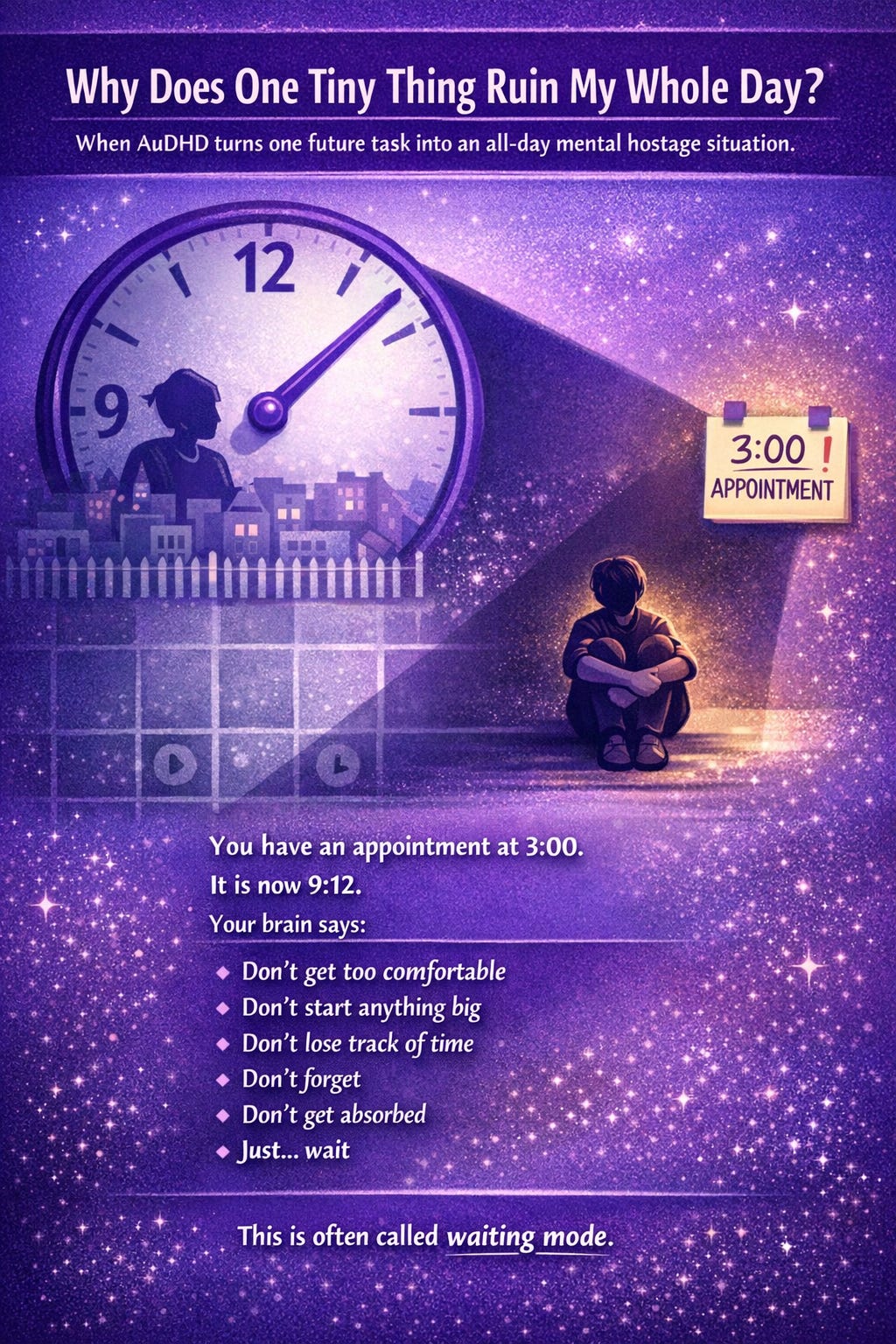
Sometimes AuDHD does not look dramatic from the outside. It looks like a person who has one appointment at 3:00 p.m. and somehow loses the entire day to it. It looks like sitting still but not resting, freezing but not relaxing, wanting to start but somehow never quite crossing the invisible line into motion. To a neurotypical observer, this can look confusing, irrational, even a little ridiculous. “You have hours before you need to leave.” Yes. And yet the whole day has already been emotionally zip-tied to that one future event.
That experience often gets described in neurodivergent spaces as waiting mode. And when autism is part of the picture, many people also relate to the phrase autistic inertia. These are not identical ideas, but they overlap so hard they practically share an apartment.
AuDHD is, in fact, a common co-occurrence rather than a rare oddity, and research consistently shows meaningful overlap between autism and ADHD in genetics, executive-function challenges, and day-to-day impairment. One meta-analysis estimated current ADHD prevalence in autistic people at 38.5% and lifetime prevalence at 40.2%.
What “waiting mode” actually is
“Waiting mode” is mostly a community term, not a formal diagnosis or official clinical construct. But the experience it points to is very real. In plain English, waiting mode is when an upcoming event hijacks your ability to engage with the present. Your brain starts orbiting the future task so intensely that it becomes hard to begin anything else, relax fully, or judge how much time you actually have. That maps pretty closely onto known ADHD-related difficulties with executive functions, timing, working memory, prospective memory, and delay aversion. Reviews of ADHD neuroscience describe differences in brain networks involved in cognitive control, attention, timing, working memory, motivation, and switching between task-focused states and the default mode network. Reviews on adult ADHD time perception also suggest that time-processing differences are a core part of the condition, not just a random side effect.
So when someone with ADHD says, “I can’t start because I have something later,” it is not usually because they are being precious, lazy, or dramatic. It is often because the brain is doing terrible math with time, threat, effort, and attention. The future event becomes a mental tab left open in the background. And some ADHD brains are absolute menace goblins about open tabs.
What “autistic inertia” is
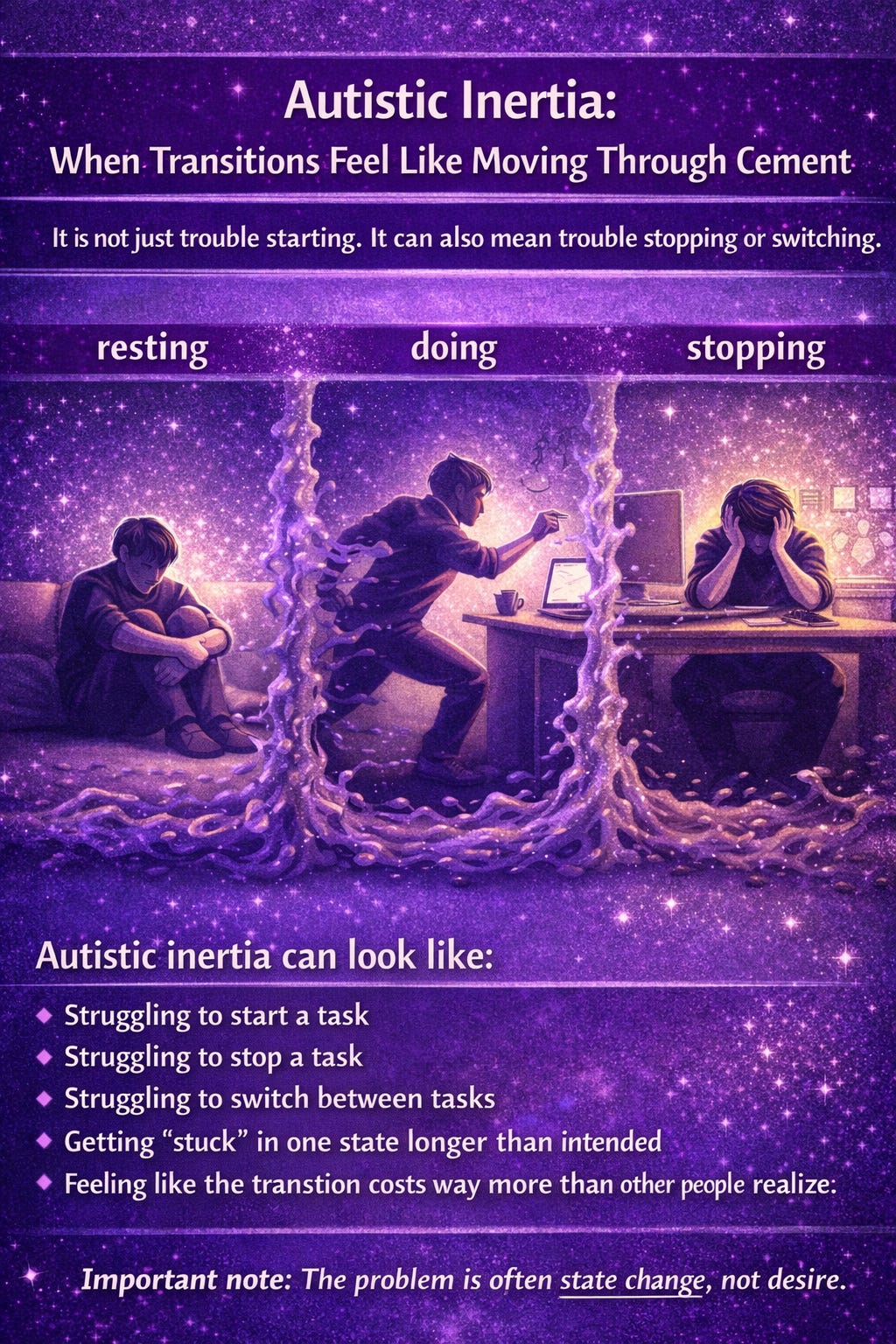
Autistic inertia is a term used by autistic people to describe difficulty starting, stopping, and switching tasks or states. Unlike waiting mode, this phrase has emerging peer-reviewed research behind it, though the literature is still relatively early and still growing. In a 2024 qualitative study of autistic adults, participants described inertia as difficulties “moving from one state to another,” affecting them “every single day.” The researchers noted that participants described it as both highly disabling and, at times, beneficial, because that same “staying with the thing” quality can also support deep immersion and flow.
That part matters. A lot. Because autistic inertia is not just “can’t get going.” It can also be “can’t stop once going.” It is not only about getting off the couch. It can also be about being unable to disengage from a task, an interest, a train of thought, a sensory experience, or a routine. The same nervous system that struggles to initiate may also struggle to interrupt. Research on autism and cognitive flexibility backs up that broad picture: autistic people, on average, show greater difficulties with cognitive flexibility and set-shifting across the lifespan, though there is meaningful variability from person to person.
The neuroscience under the hood
At the center of both waiting mode and autistic inertia sits executive function—the mental skill set involved in starting, stopping, shifting, holding information in mind, planning, and directing attention. Executive function is not one single superpower. It is more like the brain’s air-traffic control system. When that system is glitchy, even simple transitions can feel weirdly massive.
In ADHD, the research points toward differences in networks involved in timing, working memory, attention regulation, reward processing, and task-state switching. That helps explain why an upcoming appointment can feel bigger than it “should.” The brain may over-allocate attention to not missing it, underestimate what can be done before it, and struggle to smoothly toggle between now and later. Add delay aversion—basically, a nervous-system dislike of waiting—and the result can be a person who is stuck in anticipation, unable to settle into either productivity or rest.
In autism, differences in cognitive flexibility, attentional allocation, and often intolerance of uncertainty can make transitions feel even more loaded. Research describes intolerance of uncertainty as a dispositional risk factor involving maladaptive responding under uncertain conditions, and it is strongly discussed in autism-anxiety literature. In real life, that can mean the upcoming event is not just “later.”
It’s a pocket of uncertainty your brain refuses to ignore. Autistic-developed theories such as monotropism also suggest that autistic attention may be more intensely channeled into fewer things at once, which can make interruption and switching especially costly.
How they overlap in AuDHD
Now mash those two profiles together and you get the spicy little storm cloud known as AuDHD.
ADHD can make time feel slippery, priorities unstable, and future tasks weirdly loud. Autism can make switching, unpredictability, and state changes feel more neurologically expensive. Together, that can create a perfect trap: you are hyper-aware that something is coming, you do not trust your internal timing, you do not want to get stuck in something and miss it, and you also cannot comfortably settle into “nothing” while waiting. So you hover. You stall. You scroll. You circle. You become emotionally parked in neutral with the engine still running. That is not a moral failure. That is a nervous system trying—badly, but earnestly—to protect against transition failure. This interpretation is an inference from the overlapping findings on ADHD timing/executive networks, autism-related cognitive flexibility, and uncertainty sensitivity.
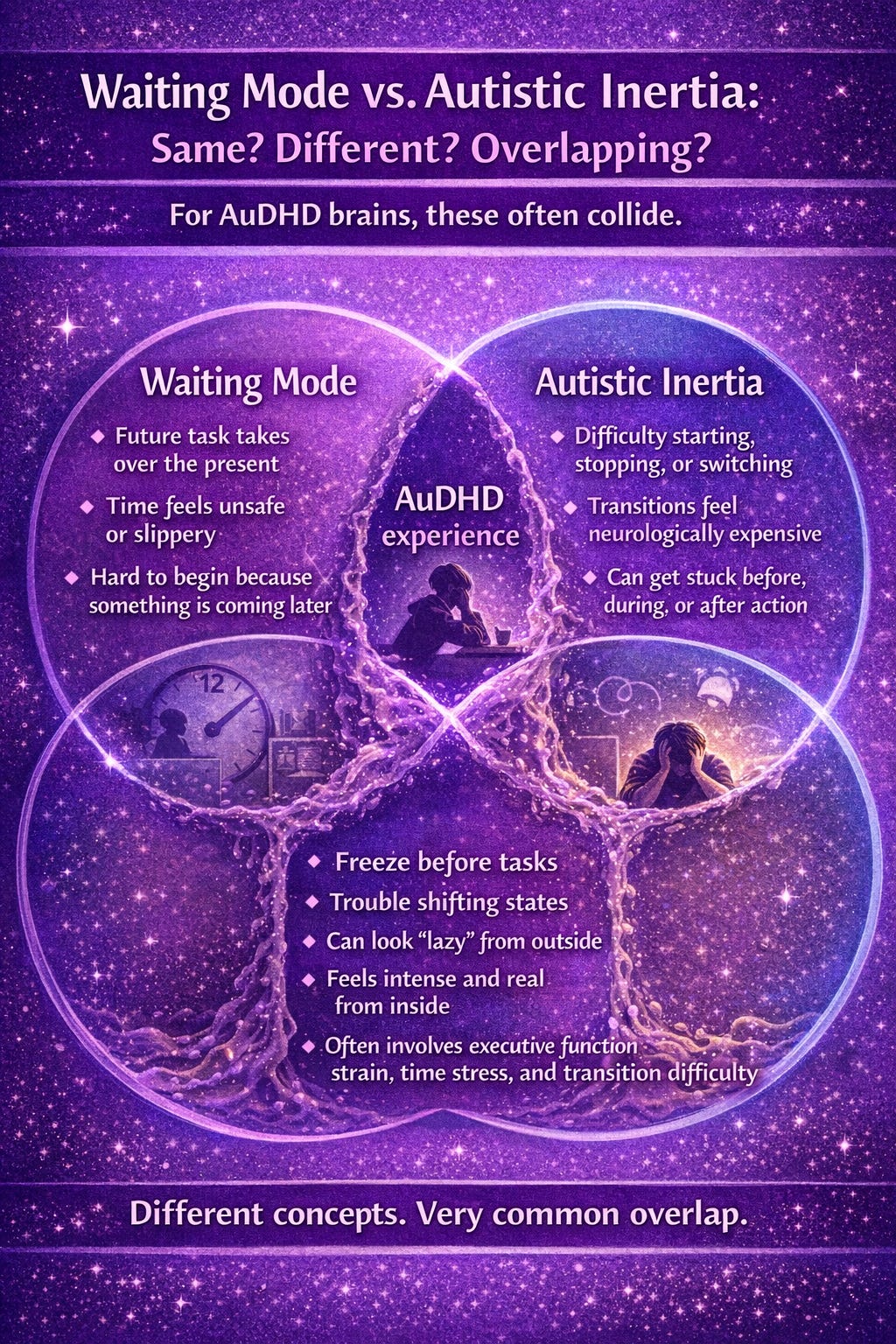
This overlap also explains why AuDHD can feel wildly contradictory. You can crave stimulation but hate interruption. You can want structure but resent it. You can be unable to start the boring task and then unable to stop the interesting one. You can spend three hours waiting for a 20-minute appointment and then be late anyway, because irony apparently pays rent in the AuDHD brain. That paradox is consistent with research showing that inertia can involve both disabling stuckness and enabling deep immersion, while ADHD involves shifting problems tied to executive control, timing, and motivation.
What this can look like from a neurotypical perspective
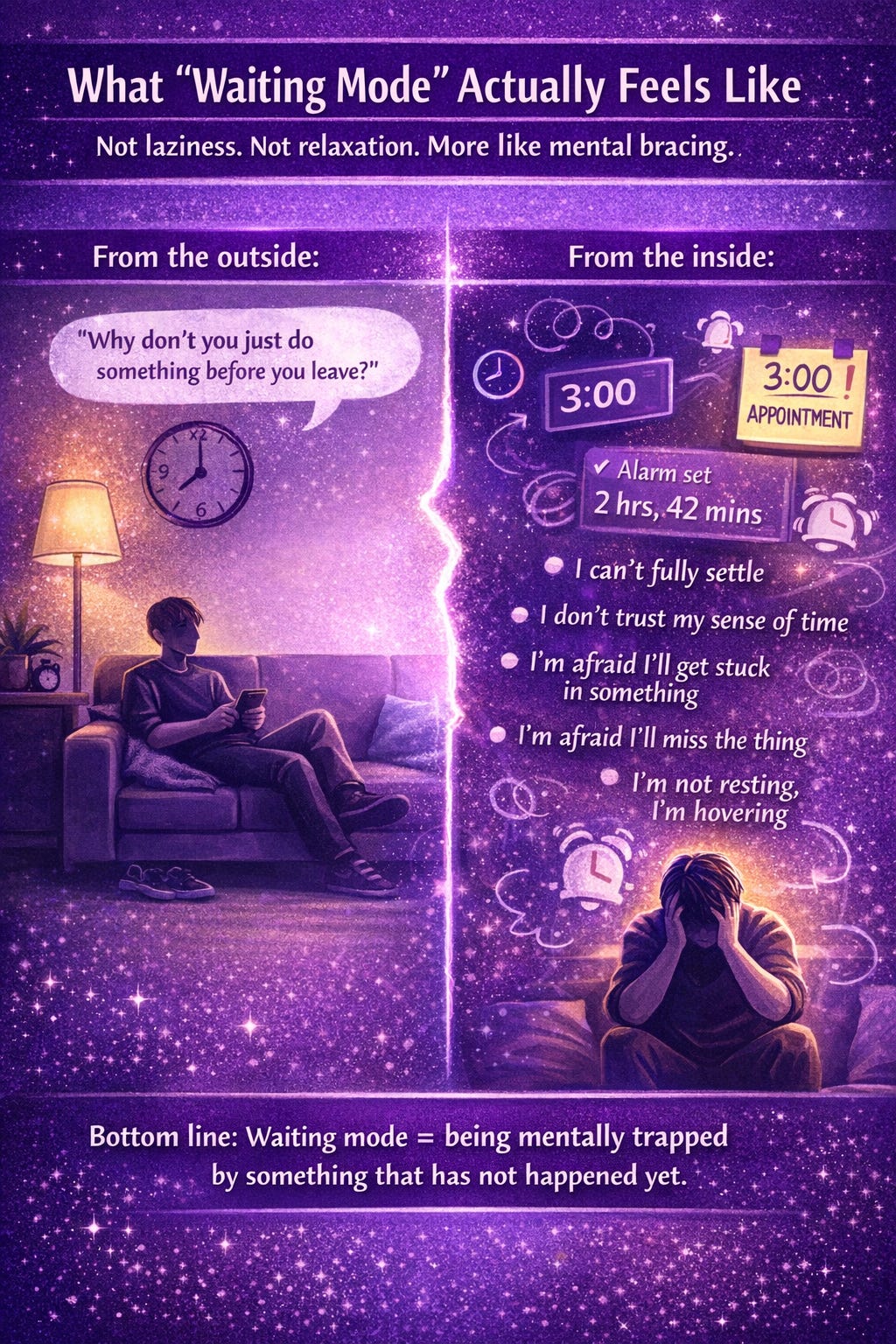
From the outside, waiting mode and autistic inertia are easy to misread.
A neurotypical person might see:
“You had all morning free.”
“Why didn’t you just do it before you left?”
“Why are you making one appointment into a whole thing?”
“If you wanted to start, you would.”
“Why can’t you just pause and come back later?”
But from the inside, the experience may be:
“If I start, I might get absorbed and lose track of time.”
“If I relax, I might forget the appointment.”
“If the transition is abrupt, my whole nervous system will hate me.”
“I’m not resting. I’m bracing.”
“I’m not refusing to switch. I’m having trouble crossing states.”
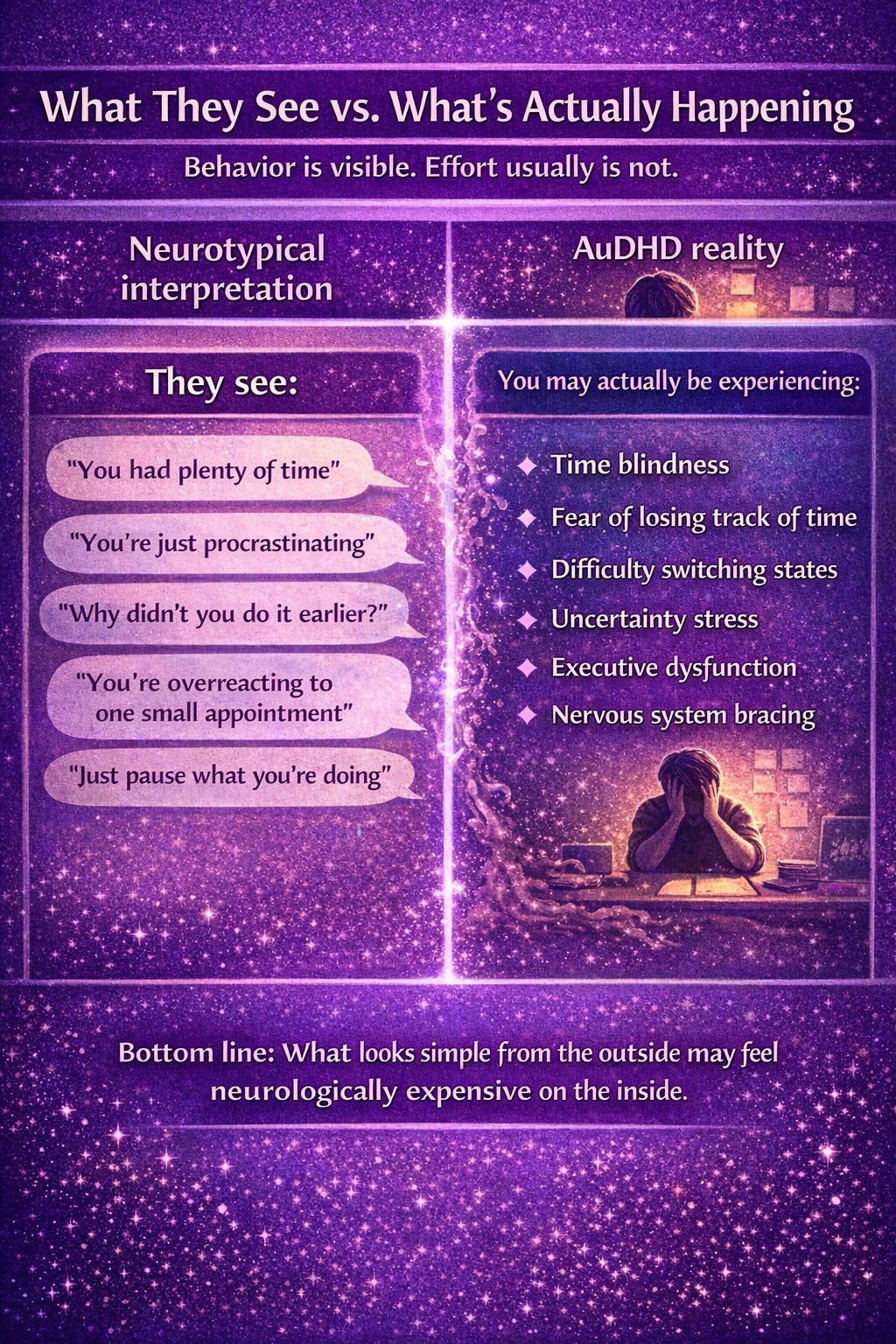
That neurotypical/autistic gap is not proof that one side is foolish. It is proof that outward behavior and inward effort do not always match. Research on autistic inertia specifically highlights that these starting-and-stopping difficulties are often invisible from the outside while still affecting daily life profoundly.
Tips and strategies that actually help
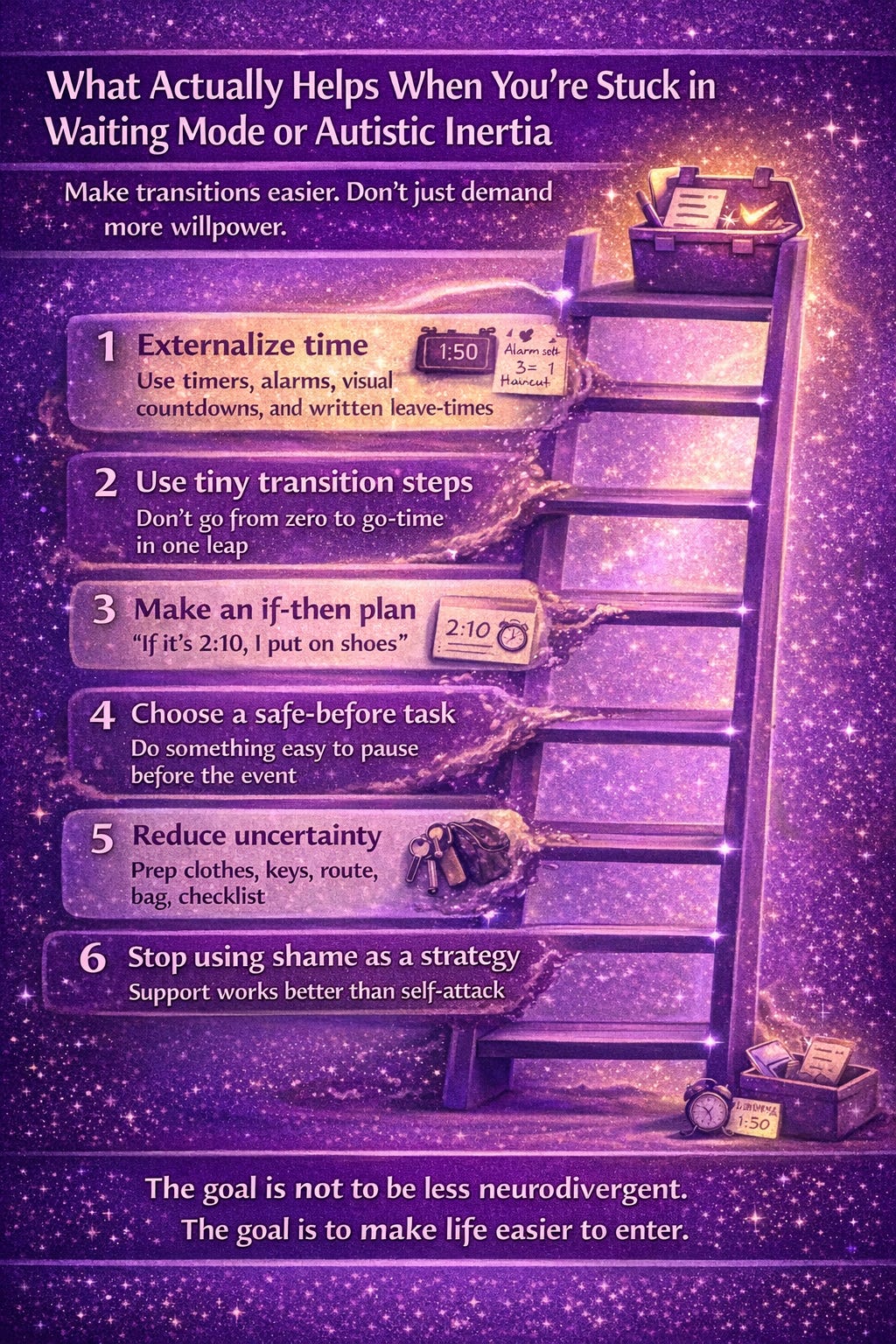
Here is the gentle truth: the goal is usually not to force yourself into acting like a perfectly flexible neurotypical person with a color-coded planner and suspiciously calm central nervous system. The goal is to reduce transition cost.
1. Externalize time instead of holding it in your head
If time lives only in your brain, your brain will turn it into haunted vapor. Put the future event outside of you: visible timers, alarms with labels, countdown widgets, calendar notifications, a sticky note that says “leave at 2:20, not 3:00,” whatever works. Research on ADHD shows problems with time perception and prospective memory, and broader cognitive research shows that reminders and “intention offloading” reduce internal monitoring demands.
2. Use “if-then” plans for the transition
Instead of “I need to get ready later,” make the brain a tiny script: If it is 2:10, then I will save my work and go put on shoes. These implementation intentions help translate intentions into action by pre-deciding the cue and the response. That matters a lot when initiation is the problem.
3. Build a transition runway
Do not expect yourself to go from deep rest to full motion in one dramatic cinematic leap. Give yourself a runway: first warning, second warning, prep step, exit step. For autistic and AuDHD brains, reducing uncertainty and making transitions more predictable can lower the nervous-system cost.
4. Create a “safe before” task
Pick one activity that is low-stakes, easy to pause, and does not suck you into another dimension. Not your favorite hyperfocus bait. Not a giant project. Think: fold towels, answer one email, unload part of the dishwasher, listen to one podcast segment while getting ready. The point is to avoid the all-or-nothing trap of “I can’t start anything.” This strategy is an applied inference from what research shows about switching costs, timing difficulties, and inertia.
5. Try body doubling for initiation
The research base here is still more modest than for reminders or planning, so I want to be honest about that. But qualitative work in adults with ADHD reports that people often experience body doubling as a strong motivator that makes starting easier. A quiet person nearby, virtual coworking, or even a check-in text can help the brain cross the starting line.
6. Protect the good side of inertia
If you know you enter deep, beautiful motion once you are in it, use that. Schedule demanding tasks for blocks where interruption is less likely. Batch similar tasks. Reduce unnecessary stopping points. The 2024 autistic inertia study found that inertia is not only disabling; it can also support joy, immersion, and flow. You do not just need help getting unstuck. Sometimes you need help staying with what matters without being yanked around all day.
7. Stop using shame as a scheduling tool
Shame is a trash executive assistant. It barks, blames, and never once actually carries a clipboard. If your brain struggles with waiting mode or inertial transitions, the answer is usually not “try harder.” It is “make the switch easier, more visible, more external, and less uncertain.” That conclusion is grounded in the research above on executive function, timing, cognitive flexibility, uncertainty, and prospective memory.
The bottom line? Waiting mode is the lived experience of getting mentally trapped by a future event. Autistic inertia is the difficulty of starting, stopping, and switching states. In AuDHD, they can collide into a very specific kind of paralysis that looks lazy from the outside and feels like being neurologically handcuffed from the inside. But once you understand the mechanics, you can stop calling yourself broken and start building supports that match the actual problem. And honestly? That is where things get softer. Smarter. More doable.
🌙 Reflection Prompts: Waiting Mode & Autistic Inertia
Subtitle:
Notice first. Fix later. Shame never helps.
🧠 1. Pattern Spotting (aka: “Wait… this happens a lot”)
What kinds of events trigger waiting mode for me most often? (appointments, social plans, work deadlines, etc.)
How early does my brain start “waiting” before the actual thing?
What time of day do I notice inertia the most?
Do I struggle more with starting, stopping, or switching?
What patterns have I been calling “random” that might not be random?
⏳ 2. Time & Trust
How much do I trust my sense of time, honestly?
What am I afraid will happen if I do start something before an event?
Have I ever gotten “lost” in something and missed something important before?
What does my brain believe about time that might not always be true?
What would help me feel safer engaging with time instead of fighting it?
⚡ 3. The Body Check-In
What does waiting mode feel like in my body? (tight, restless, heavy, buzzy, frozen?)
What does autistic inertia feel like physically when I’m stuck?
What does it feel like right before I can start something?
What’s the difference between “I don’t want to” vs. “I can’t shift” in my body?
🔄 4. Transition Awareness
Which transitions feel the hardest for me right now?
What part of the transition feels most difficult? (starting, stopping, switching, uncertainty?)
What makes a transition easier—even a little?
When was the last time a transition went well? What helped?
🧩 5. Friction Finder
What is actually making this harder than it needs to be?
What feels unclear, unstructured, or unpredictable?
What am I trying to hold in my head that could live outside of me?
If I could remove ONE barrier, what would it be?
🛠️ 6. Support Mapping (aka: “What would actually help?”)
What support do I always wait too long to use?
Which of these feels most helpful for me right now:
timers
visual countdowns
step-by-step plans
body doubling
prep ahead of time
What is ONE tiny support I could try today?
What would “easier” look like—not perfect, just easier?
💬 7. Reframing the Story
What have I been calling “lazy” that might actually be inertia or waiting mode?
What would I say to a friend who struggled with this?
What label am I ready to soften or let go of?
What if this is not a failure of character—but a mismatch of support?
🌱 8. Gentle Experiment Prompts
What happens if I try a 5-minute safe task before my next event?
What happens if I set a clear “leave time” instead of “event time”?
What happens if I build a transition runway instead of a last-minute switch?
What happens if I support myself before I push myself?
✨ Closing Reflection
What did I learn about my brain from this?
What surprised me?
What felt validating?
What is one thing I will do differently—not perfectly, just differently?