
Why Some Generic ADHD Medications Feel Different — And Why Your Brain Notices

There’s a conversation happening all over ADHD spaces online right now. People are saying things like:
> “My medication suddenly stopped working.” “This generic feels weaker.” “I’m exhausted, foggy, emotional, anxious, or crashing harder.” “This doesn’t feel like the same medication.”
And honestly? Some of this is not “just in your head.”
The complicated truth is that generic ADHD medications are not always identical to brand-name versions — especially when it comes to extended-release stimulants like Adderall XR, Concerta, or Vyvanse.
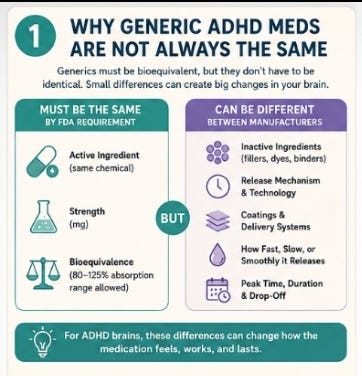
The active ingredient must be considered bioequivalent by the FDA, but the inactive ingredients, release systems, fillers, dyes, coatings, and delivery mechanisms can differ between manufacturers.
And for ADHD brains? Tiny differences can feel enormous.
The ADHD Brain Is Extremely Sensitive to Dopamine Timing
ADHD medications work largely by affecting dopamine and norepinephrine — neurotransmitters involved in motivation, focus, alertness, reward processing, and executive functioning.
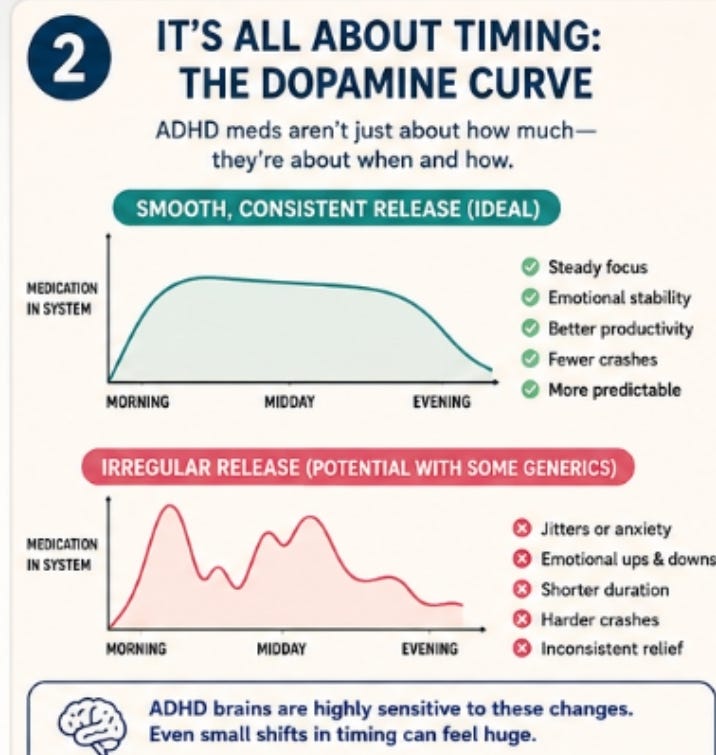
The keyword here is not just amount. It’s timing.
Your brain is not only responding to whether medication releases dopamine support. It’s responding to:
how fast it releases
how smoothly it releases
when it peaks
how long it lasts
how sharply it drops off
That’s why some people describe one generic as:
“smooth”
“clean”
“calming”
…while another version of the same medication feels:
jittery
emotionally harsh
ineffective
sedating
inconsistent
anxiety-provoking
Especially with extended-release stimulants, the delivery system matters massively.
The Concerta Example Is the Biggest Proof
One of the clearest examples is Concerta.
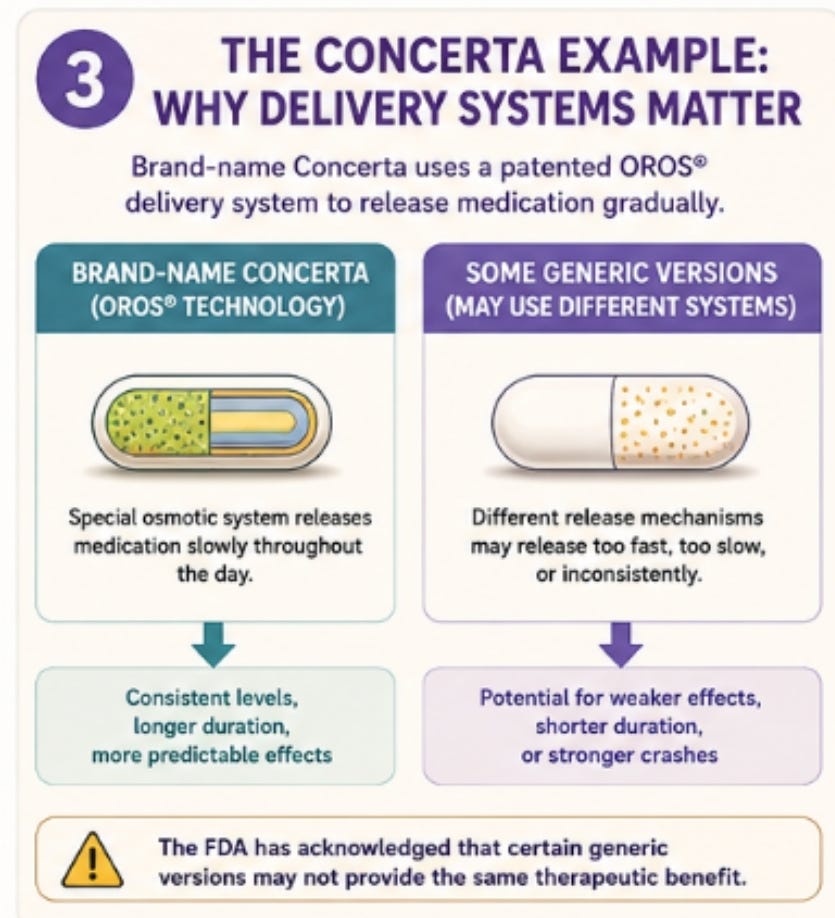
Brand-name Concerta uses a patented delivery system called OROS, which releases medication gradually throughout the day.
Some generic versions did not use that same technology.
Years ago, the FDA actually downgraded the therapeutic equivalence ratings of certain generic Concerta manufacturers after concerns that patients were not getting the same clinical effects.
The FDA specifically acknowledged that some generics “may not produce the same therapeutic benefits” as the brand-name medication.
That’s a huge deal.
Because many ADHDers already spend years gaslighting themselves: “Maybe I’m lazy.” “Maybe I’m broken.” “Maybe I’m imagining this.”
Meanwhile their nervous system is basically screaming: “No babe, the release curve changed.”
“But Generics Are Supposed to Be the Same”
This is where nuance matters.
Generics are required to demonstrate bioequivalence, meaning they must fall within an acceptable range of absorption compared to the original medication.
But that does not mean:
identical fillers
identical absorption
identical release mechanisms
identical coatings
identical subjective experience
And ADHD medication is uniquely sensitive to those differences because stimulants are acting directly on brain systems tied to arousal, attention, emotional regulation, reward, and executive functioning.
A small variation to a neurotypical person may feel gigantic to an ADHD brain trying to maintain regulation all day long.
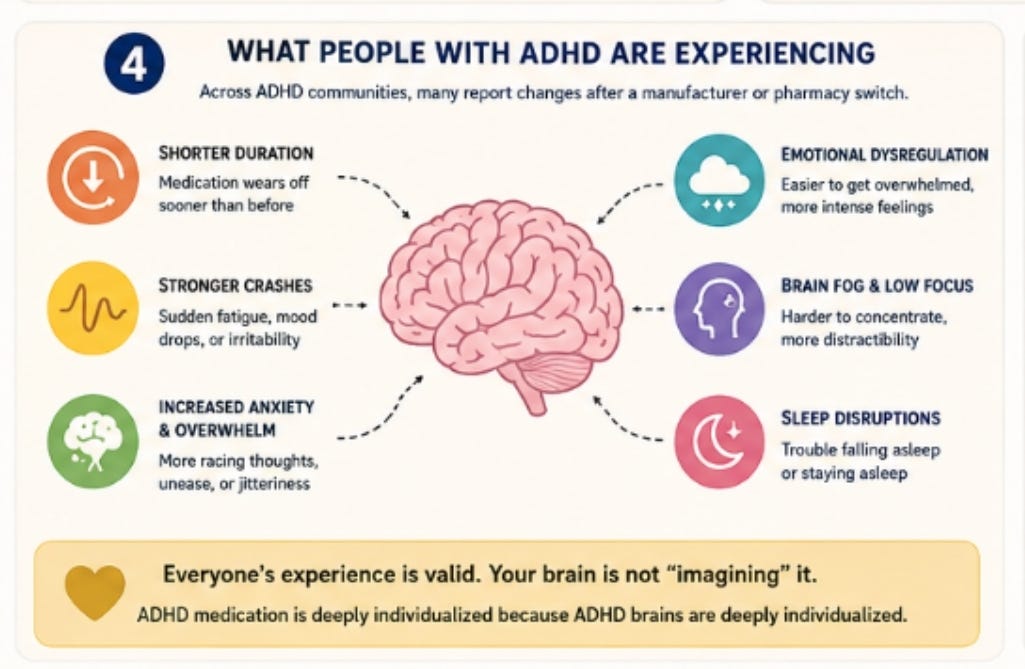
What People Online Are Reporting
Across ADHD communities online, many people describe:
stronger crashes
shorter duration
emotional dysregulation
increased anxiety
irritability
fatigue
brain fog
insomnia
inconsistent symptom control
…after pharmacy switches or manufacturer changes.
Now — important nuance: not every online report is scientifically verified.
Some differences may also involve:
stress
sleep deprivation
hormone changes
burnout
nutrition
medication tolerance
placebo/nocebo effects
ADHD medication shortages causing inconsistent access
But dismissing all patient experiences is also not evidence-based.
Especially because the FDA itself has acknowledged therapeutic concerns with certain ADHD generics before.
Why This Hits ADHDers So Hard Emotionally
Because when medication suddenly stops working the same way, ADHD symptoms often come roaring back fast.
And ADHD isn’t just “can’t focus.”
It can affect:
emotional regulation
task initiation
working memory
overwhelm tolerance
rejection sensitivity
sensory processing
motivation
sleep
impulse control
So when medication changes unexpectedly, people may suddenly feel:
emotionally unstable
“lazy”
exhausted
depressed
ashamed
incapable
The ADHD nervous system thrives on predictability. Medication inconsistency can feel like the ground moving beneath your feet.
What You Can Actually Do About It
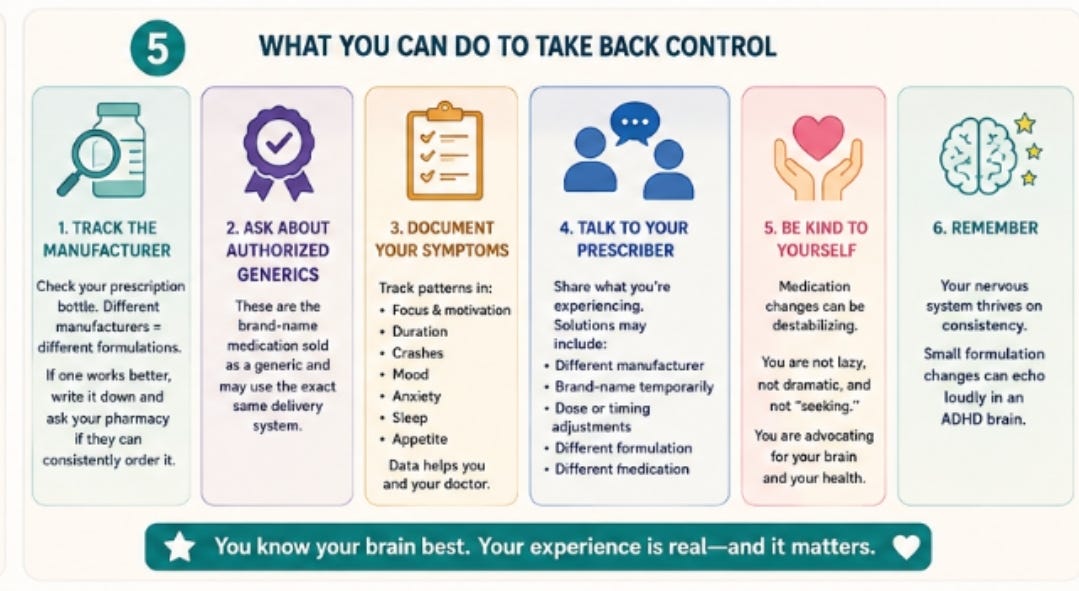
1. Track the Manufacturer
Look at the prescription bottle.
Different manufacturers can produce different generic versions.
If one worked better for you, write it down.
You can even ask your pharmacy if they can consistently order a specific manufacturer.
2. Ask About “Authorized Generics”
An authorized generic is essentially the brand-name product sold as a generic.
For some ADHD medications, these may use the exact same delivery system as the original brand medication.
3. Document Your Symptoms
Track:
duration
crashes
mood shifts
appetite
sleep
focus
anxiety
physical side effects
Patterns matter.
4. Talk to Your Prescriber
Do not suddenly increase doses on your own.
Sometimes the solution is:
switching manufacturers
trying brand-name temporarily
changing formulations
adjusting timing
adding boosters
changing medications entirely
5. Remember: Your Experience Is Real
You are not “drug-seeking” for noticing differences. You are not dramatic for noticing your brain functioning differently.
ADHD treatment is deeply individualized because ADHD brains are deeply individualized.
And honestly? The brain is less like a machine and more like a symphony orchestra held together with dopamine, sleep, cortisol, trauma history, hormones, sensory load, and pure audacity.
Tiny shifts can echo loudly.
And sometimes your nervous system notices the difference before science fully catches up.
DISCLAIMER: I AM NOT A DOCTOR OR A MEDICAL PROFESSIONAL. Just a girl, trying to help others with the struggle that is ADHD.