
Why Your AuDHD Brain Needs Journaling More Than Another Productivity Hack
How putting your thoughts on paper can calm the chaos, support emotional regulation, and help ADHD and Autistic brains finally hear themselves think.

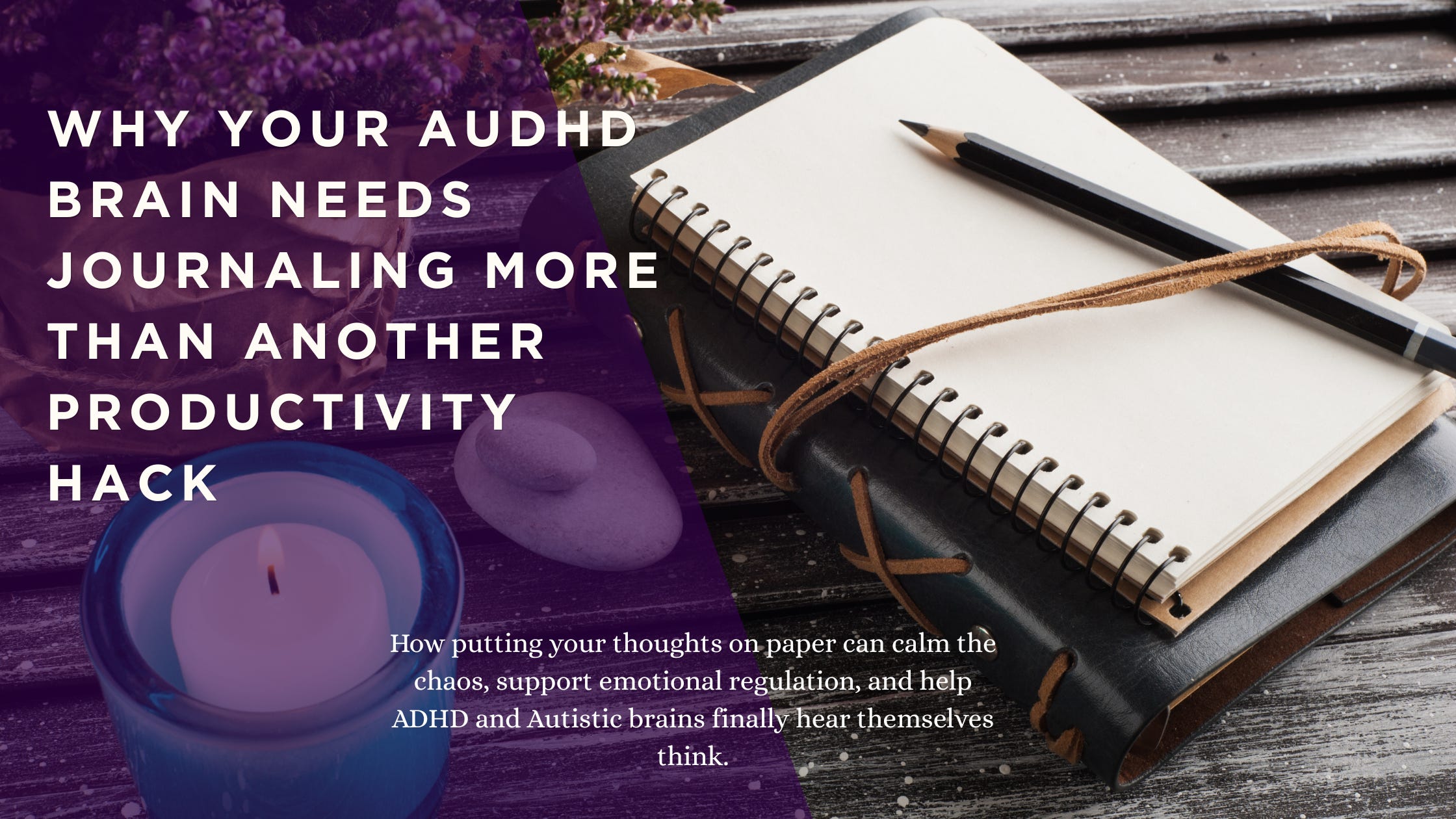
Journaling is not just a cute little self-care habit with a fancy pen and a Pinterest mood board. For ADHD, Autism, and AuDHD brains, journaling can become a powerful external processing tool — a way to take the swirling thoughts, sensory overwhelm, emotional static, body clues, and executive dysfunction fog and place them somewhere outside the brain. And sometimes, that tiny shift is everything. Research shows that executive functioning and emotional regulation are deeply connected in ADHD and Autism, which means our ability to plan, pause, reflect, regulate, and respond can get tangled fast when our nervous system is overloaded.
When we journal, we give the brain a bridge between feeling and understanding. Putting emotions into words — sometimes called affect labeling — has been linked to reduced amygdala reactivity, which is the brain’s threat-detection system, while engaging prefrontal regions involved in regulation, reflection, and problem-solving. In plain English: naming what is happening inside us can help the brain stop treating every feeling like a five-alarm fire.
For ADHD brains, journaling can support working memory by getting thoughts out of the crowded mental junk drawer and onto paper. It can help with prioritizing, noticing patterns, tracking emotions, reducing rumination, and creating a “pause button” before impulsive reactions take the wheel. Some research on expressive writing suggests it may free up working memory by reducing intrusive thoughts, which matters because ADHD brains are often already juggling seventeen tabs, three songs, and a forgotten laundry load in the background.
For Autistic brains, journaling can support self-understanding, sensory awareness, emotional identification, and transition processing. Autism is associated with differences in communication, learning, movement, attention, sensory experience, and behavior, so journaling can create a predictable, low-demand space to decode what happened, what felt hard, what felt safe, and what support is actually needed.
Journaling does not have to be daily, beautiful, deep, or grammatically acceptable to count. It can be messy. It can be bullet points. It can be “I am overstimulated and everyone is breathing too loud.” That still counts. Because for neurodivergent brains, journaling is not about becoming a more disciplined person. It is about building a compassionate feedback loop with yourself — one page, one sentence, one nervous-system whisper at a time.
Why Journaling Can Be Hard for ADHD, Autism, and AuDHD Brains
Journaling sounds simple in theory: just write down your thoughts.
Cute. Adorable. Extremely disrespectful to the neurodivergent brain.
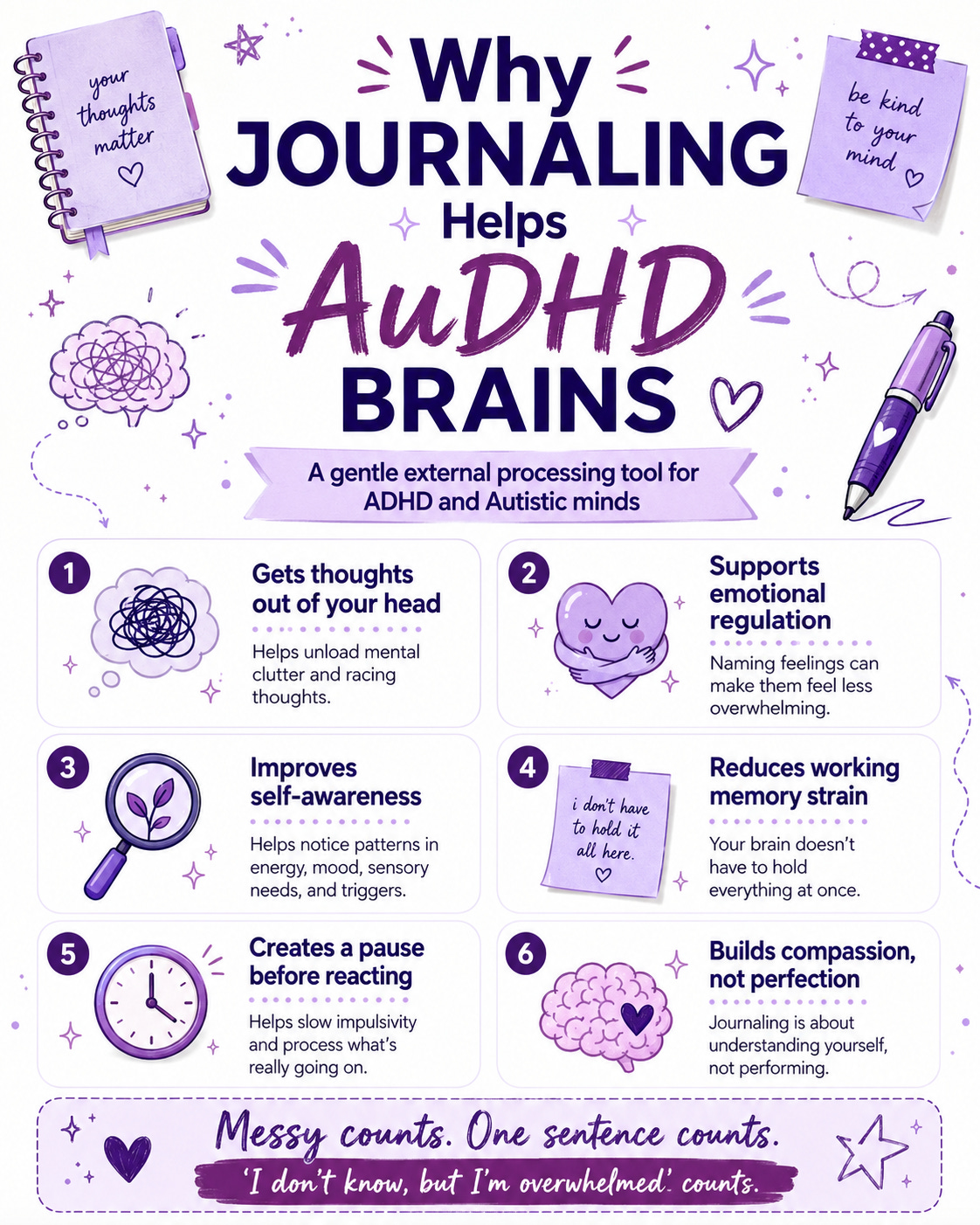
Because for ADHD, Autism, and AuDHD brains, journaling can bump into the exact things we are already trying to manage: executive dysfunction, perfectionism, emotional overwhelm, sensory needs, task initiation, working memory, demand avoidance, and the ever-present brain gremlin whispering, “If you can’t do it perfectly, simply do not do it at all.”
For ADHD brains, journaling can be hard because thoughts move fast. Like, six-lane highway with no traffic laws fast. You may sit down to write one feeling and suddenly your brain opens seventeen tabs: the grocery list, a childhood memory, the text you forgot to answer, the laundry you abandoned, the deep existential question of whether you’re wasting your life, and oh look — your pen feels weird.
ADHD can also make consistency difficult. You may journal intensely for three days, buy beautiful supplies, create a whole routine, and then forget the journal exists until you find it under a hoodie three months later. That doesn’t mean journaling failed. That means your brain needs a flexible system, not a shame contract.
For Autistic brains, journaling can be hard because emotions are not always easy to identify in the moment. Alexithymia, sensory overload, shutdown, masking, and delayed emotional processing can make it difficult to answer prompts like, “How do you feel?” because the real answer may be: “I do not know yet, but my shirt tag is committing crimes and my nervous system is buffering.”
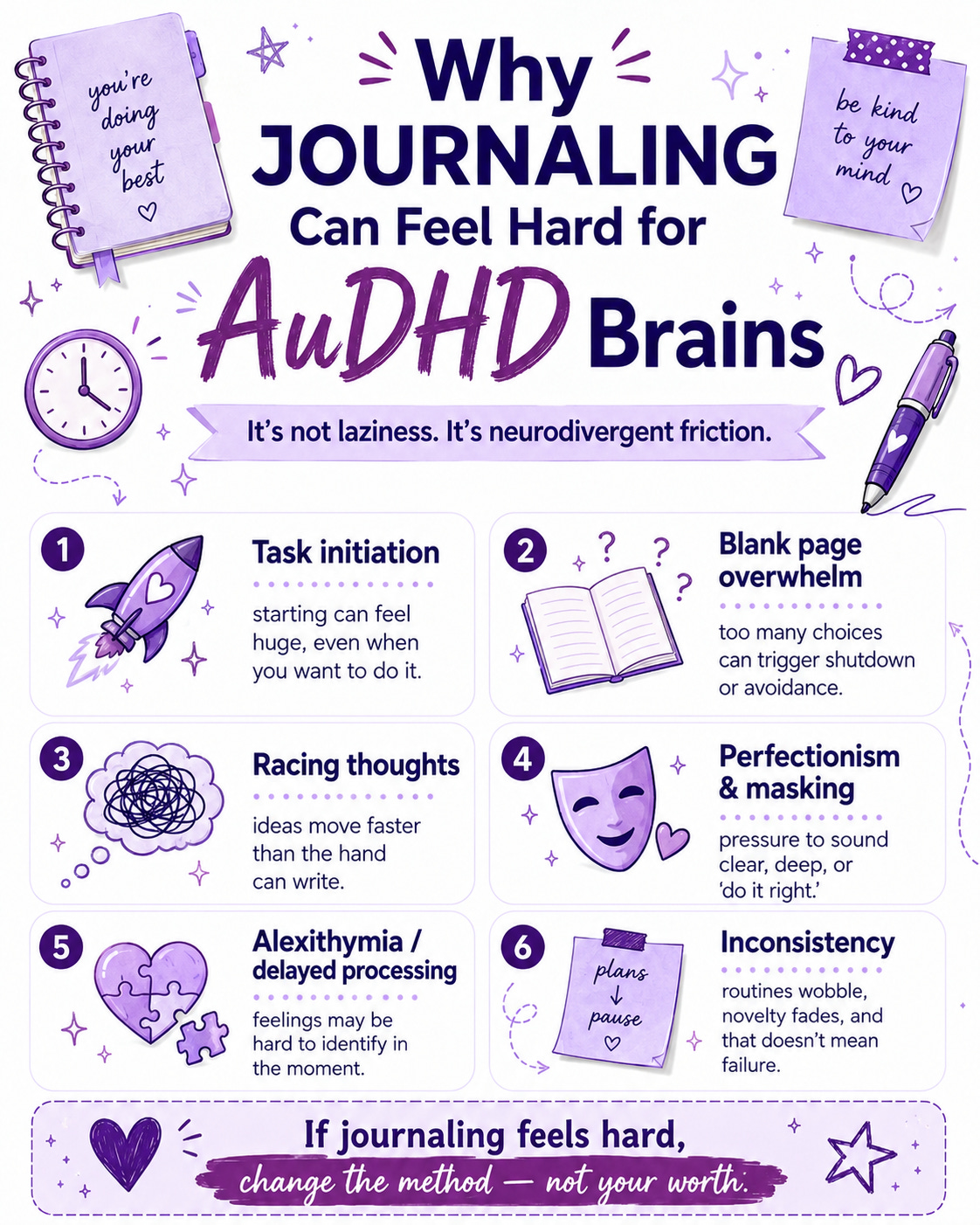
Autistic brains may also struggle with open-ended prompts. A blank page can feel less like freedom and more like being dropped into a foggy field and told to “just explore.” Too many choices can become its own form of overwhelm.
For AuDHD brains, journaling can be extra complicated because ADHD may crave novelty while Autism may crave structure. One part of you wants colorful pens, stickers, chaos, and spontaneous emotional excavation. The other part wants a predictable format, rules, and absolutely no surprises. So the goal is not to force one “right” way to journal. The goal is to build a menu.
Journaling does not have to look like long handwritten paragraphs in a pretty notebook. That’s one option, not the law. We are not serving a life sentence in the Court of Aesthetic Productivity.
Different Ways to Journal
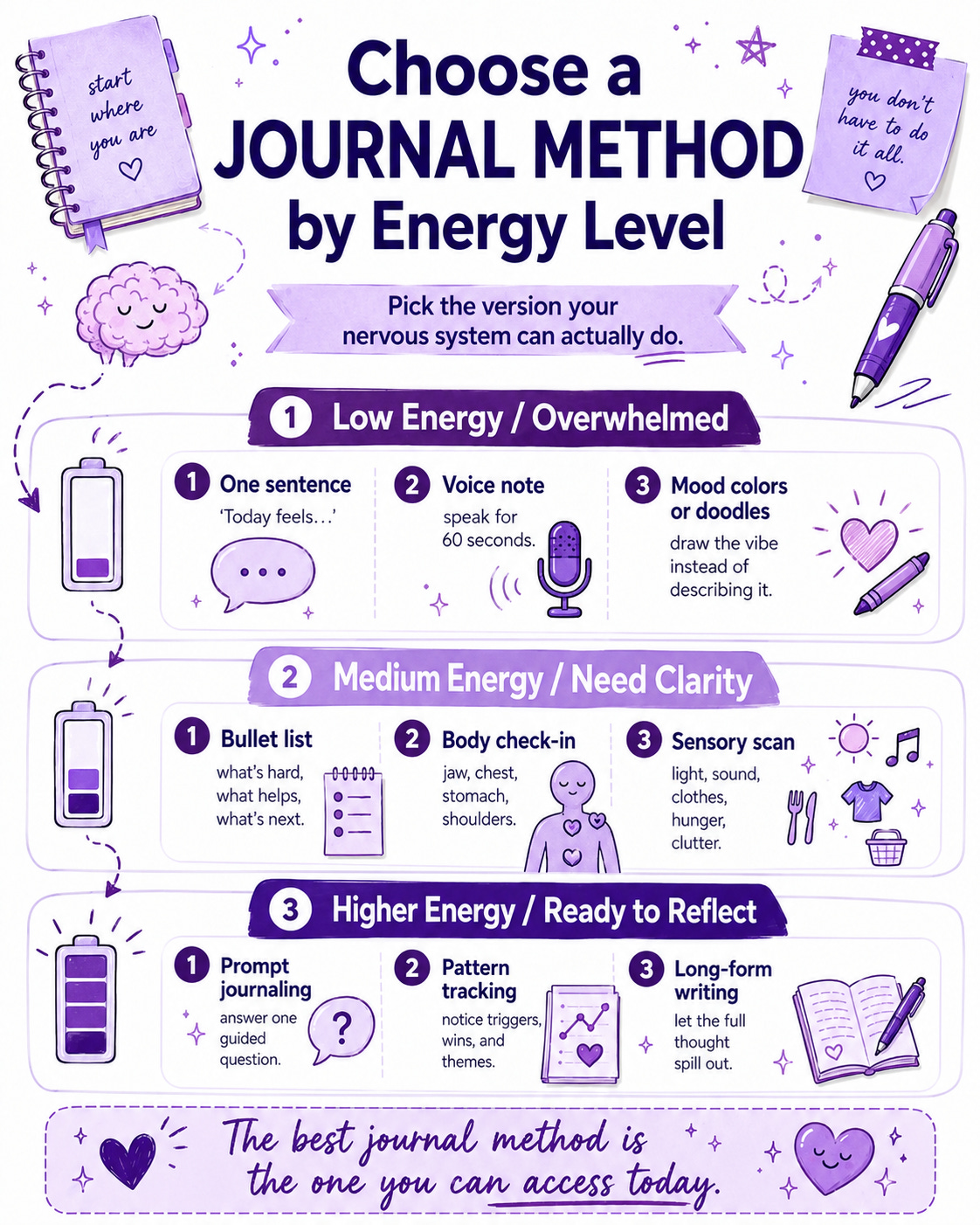
1. The One-Sentence Journal
Write one sentence. That’s it.
Examples:
Today my brain feels like:
One thing I need is:
Something that felt hard today was:
Something I survived today was:
Tomorrow I want to remember:
This works well when you are tired, overwhelmed, or in a season where “deep reflection” feels like being asked to fold a fitted sheet with your soul.
2. Bullet Point Journaling
No full sentences required. No grammar. No emotional poetry unless it shows up wearing shoes.
Example:
Slept badly
Feeling overstimulated
Need food
Avoiding email
Proud I took a walk
Shower would help
Do not make big life decisions tonight
Bullet points are beautiful because they reduce pressure. They let the brain drop crumbs instead of baking a whole loaf.
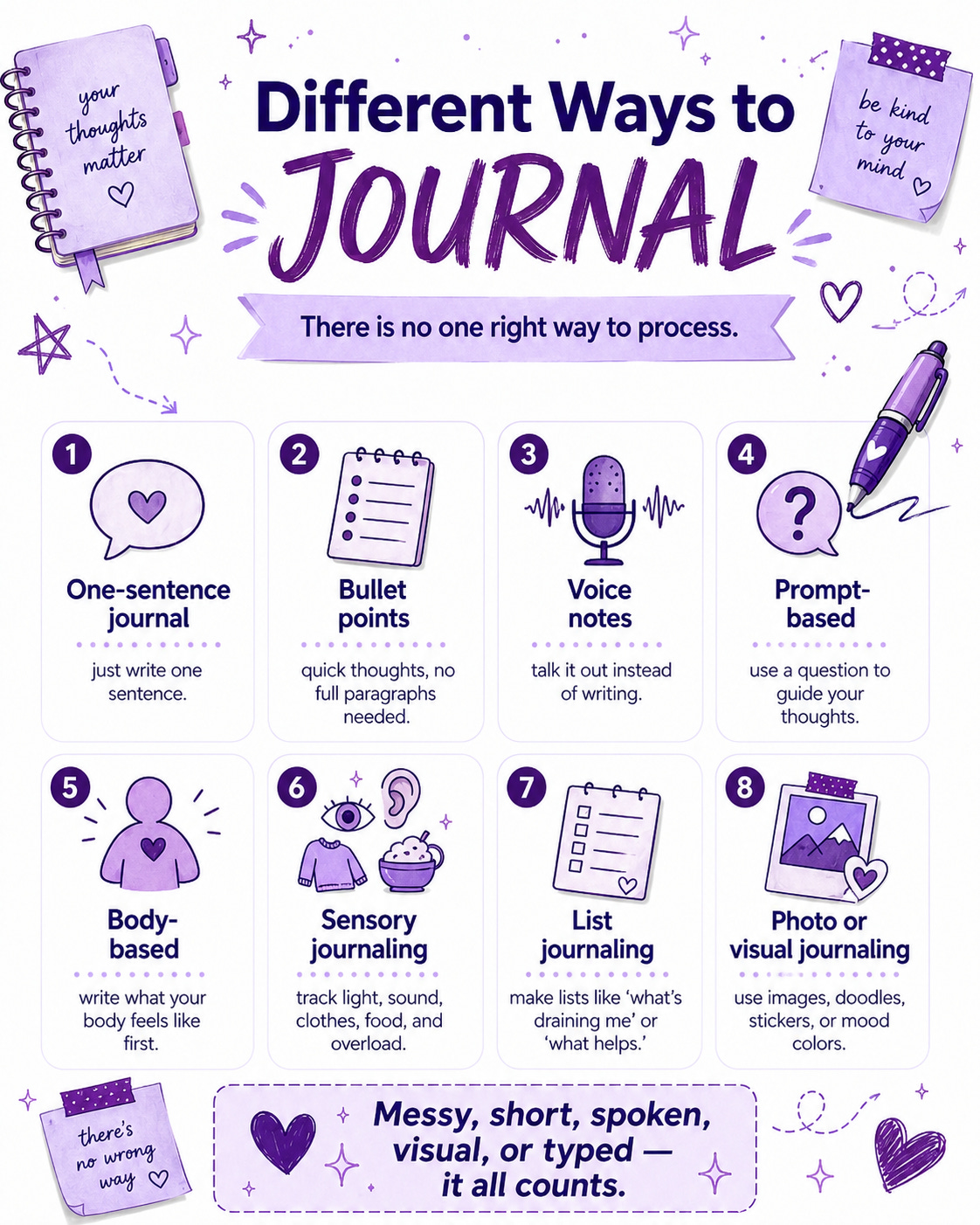
3. Voice Note Journaling
Sometimes writing is too slow for the ADHD brain and too demanding for the overwhelmed body. Voice notes let you talk it out without needing to organize it first.
Try saying:
“Okay, I don’t know what I’m feeling yet, but here’s what happened…”
This can be especially helpful for ADHD thought-speed, autistic delayed processing, and those moments when your brain has a full essay but your hand is like, absolutely not, babe.
4. Prompt-Based Journaling
Prompts help reduce the terror of the blank page.
Try prompts like:
What is my nervous system asking for today?
What am I pretending is fine that is not actually fine?
What sensory need have I been ignoring?
What is one thing I can make easier today?
What emotion might be hiding underneath my irritation or shutdown?
What would “enough” look like today?
Prompts are like emotional guardrails. They give the brain a lane without trapping it in a cage.
5. Body-Based Journaling
This is great when feelings are hard to name. Instead of asking, “How do I feel?” ask, “What is my body doing?”
Try:
My jaw feels:
My chest feels:
My stomach feels:
My shoulders feel:
My energy feels:
My sensory system feels:
Example:
“My shoulders are tight, my stomach feels buzzy, and sounds feel sharp today.”
That counts as journaling. That is self-awareness. That is data. Tiny scientist behavior.
6. Sensory Journaling
This is especially helpful for Autistic and AuDHD brains because sensory input often shapes mood, energy, and behavior more than we realize.
Try tracking:
Lights: too bright / okay / calming
Sound: too loud / manageable / need quiet
Clothes: comfy / irritating / unbearable
Food: safe / difficult / forgot to eat
Social battery: full / medium / crispy
Environment: cluttered / calm / visually loud
Over time, this helps you notice patterns like, “Oh, I’m not randomly angry. I am overstimulated, hungry, wearing bad socks, and sitting under the evil light.”
Mystery solved. The villain was fluorescent lighting.
7. Visual Journaling
Words are not always the best doorway. You can journal through:
doodles
color blocks
mood symbols
stickers
scribbles
charts
mind maps
emotion wheels
messy diagrams
You can literally draw a tornado and label it “my brain after work.” That counts. Honestly, sometimes that is more accurate than a paragraph.
8. “Three Things” Journaling
This is simple, structured, and not too emotionally invasive.
Try:
One thing I noticed:
One thing I need:
One thing I can do next:
Or:
One win:
One hard thing:
One support:
This works because it gives the brain a beginning, middle, and end. No wandering into the forest unless you choose to bring snacks.
9. Text Message Journaling
Open a note in your phone and write like you are texting a safe friend.
Example:
“Okay so today was a lot. I think I’m not mad, I’m actually overwhelmed. Also I need food before I become a haunted Victorian child.”
This can feel less formal and more natural, especially if traditional journaling feels too precious or performative.
10. List Journaling
Lists are excellent for ADHD and AuDHD brains because they organize chaos quickly.
Try lists like:
Things draining me:
Things supporting me:
Things I keep avoiding:
Things I wish people understood:
Things that helped this week:
Things I need to make easier:
Things that are not emergencies, even though they feel loud:
Lists help externalize mental clutter without requiring emotional excavation with a tiny spoon.
11. Audio-to-Text Journaling
Use speech-to-text and let your phone do the writing. This is especially helpful when your thoughts are faster than your fingers.
You can start with:
“I’m going to ramble for two minutes and then I’m done.”
Set a timer. Talk. Stop. No editing required.
Because editing your journal into a polished essay is how perfectionism sneaks in wearing a fake mustache.
12. The “I Don’t Know” Journal
For days when every prompt feels annoying, start with:
I don’t know what I feel, but…
I don’t know what I need, but…
I don’t know why I’m overwhelmed, but…
I don’t know where to start, but…
This gives your brain permission to begin without certainty. Sometimes clarity shows up after the first sentence, not before it.
13. Regulation Journaling
This type of journaling focuses less on storytelling and more on helping your nervous system settle.
Try:
What activated me?
What did my body do?
What helped even a little?
What made it worse?
What can I try next time?
This turns journaling into a compassionate pattern tracker instead of a shame scrapbook.
14. Photo Journaling
Take one photo that represents your day and write one caption.
Example:
Photo of coffee: “Trying to become a person.”
Photo of messy room: “This is not moral failure. This is executive dysfunction with props.”
Photo of a walk: “My brain needed sky.”
This is great when writing feels like too much but you still want to capture meaning.
15. The Minimum Viable Journal
For the days when even the easier version needs an easier version.
Write:
Today was:
I need:
One tiny next step:
Example:
Today was: loud
I need: quiet and food
One tiny next step: make toast
Done. Count it. Gold star. We are not arguing with success.
The Real Goal of Journaling
The goal is not to become a perfect journal person.
The goal is to create a place where your brain can land.
A place where thoughts stop ricocheting around your skull like caffeinated moths. A place where emotions can be named gently. A place where sensory needs, patterns, stress signals, and tiny wins become visible.
Journaling is not about documenting your life perfectly.
It is about learning how to listen to yourself without immediately judging what you hear.
AuDHD Journal Prompts
What does my nervous system actually need today: stimulation, rest, connection, solitude, movement, or comfort?
What is one thing I want to do today because it would make me feel alive, not because it proves I’m productive?
What “should” am I carrying into today that I can gently put down?
If today had a minimum viable version, what would be enough?
What sensory things are affecting me right now?
Think: clothes, lighting, sound, temperature, hunger, smells, body pain, clutter.What is one tiny task that would make future me feel supported?
Where am I craving novelty today, and how can I give myself some without blowing up my whole routine?
Where am I craving sameness today, and how can I protect that without guilt?
What emotion might be hiding underneath my boredom, irritability, avoidance, or shutdown?
What would make today feel like a “real weekend” to me?
Am I avoiding rest because I feel guilty, or avoiding action because I feel overwhelmed?
What is one thing I can do for my body today that isn’t punishment?
What part of my home feels the loudest right now, and what is the gentlest way to quiet it?
What do I need to stop pretending is easy for me?
What joy is available to me today in a small, weird, beautifully specific way?
What would I do today if I trusted that rest counts as regulation?
Who or what feels safe to connect with today?
What boundary would make this weekend feel less draining?
What am I proud of myself for surviving, handling, or trying this week?
What do I want Sunday night me to thank Saturday me for?
Tiny Saturday Check-In
Body: What does my body need?
Brain: What is my brain craving?
Heart: What feeling needs attention?
Environment: What around me is helping or hurting?
One small promise: Today, I will support myself by ________.
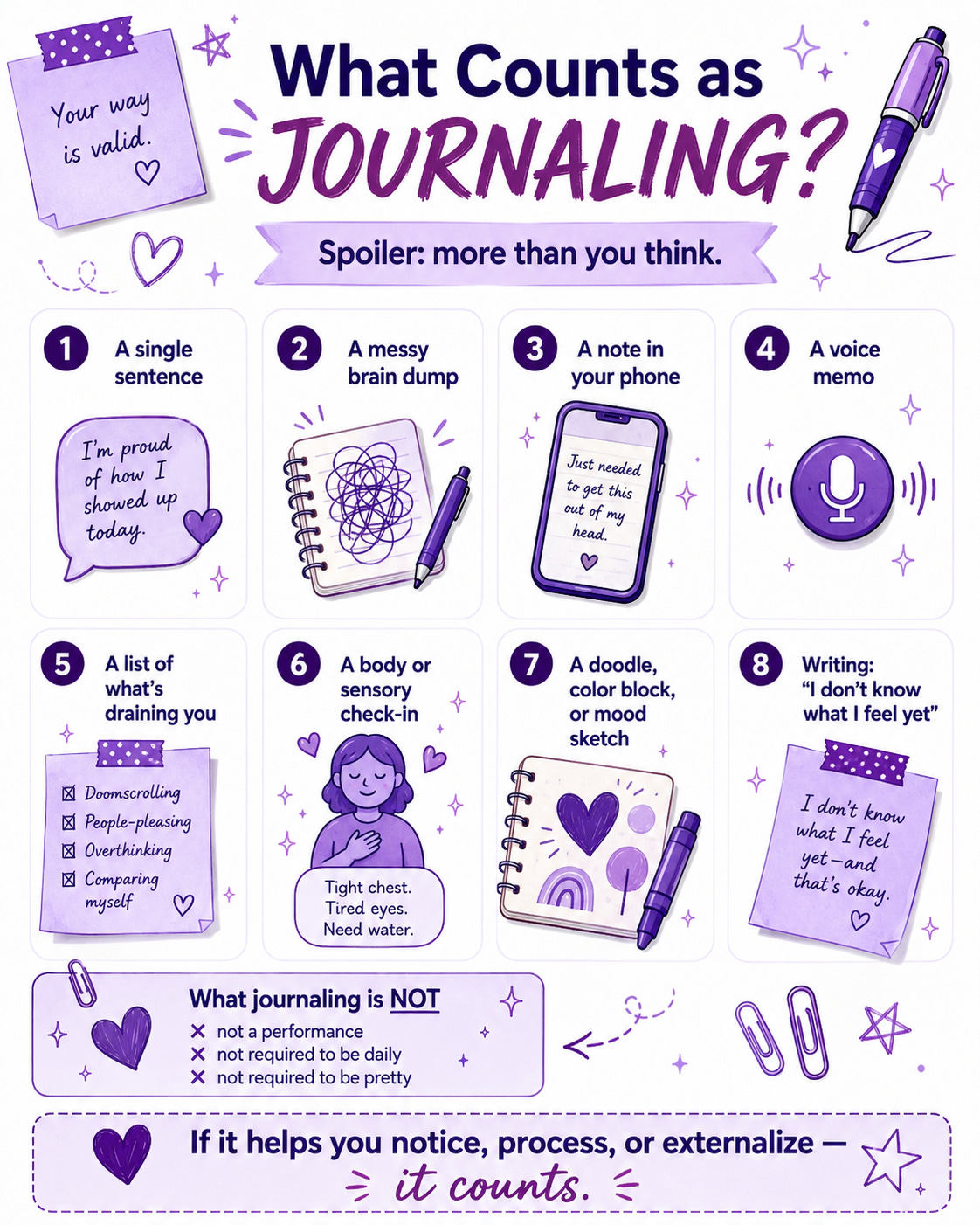
And because the AuDHD brain loves a loophole: answering one prompt counts. Half a sentence counts. Writing “I don’t know but I’m tired” absolutely counts.
Podcasts on this
Topic by me:
https://open.spotify.com/episode/0B3GKUeiOHpqMNsbvDawGI?si=qTOLf-9EQcGum5CMkNbe9w
https://open.spotify.com/episode/0ErWksqPqWoolD7SnxFJoF?si=fVx5zBt3Q0OJSb41VNVFbQ