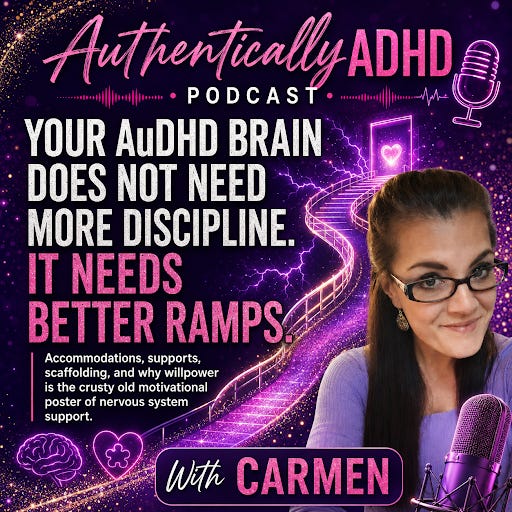
Your AuDHD brain does not need more discipline. It needs better ramps.
In this episode of Authentically ADHD, we’re breaking down why willpower is the crusty old motivational poster of nervous system support — and why accommodations, scaffolding, visual supports, sensory tools, body doubling, timers, scripts, and low-capacity plans are not cheating. They’re access.
For AuDHD adults, tasks are not just “easy” or “hard.” They come with invisible barriers: executive dysfunction, sensory overload, demand pressure, shame, working memory load, transition difficulty, time blindness, and emotional threat. So when your brain freezes, avoids, spirals, or shuts down, the answer is not always “try harder.” Sometimes the answer is: build a better way in.
We’ll talk about the neuroscience behind why task initiation, planning, transitions, and follow-through can feel so physically impossible for AuDHD brains — and why support systems work better when they reduce friction instead of demanding perfection.
This episode is a love letter to every late-diagnosed neurodivergent adult who has spent years thinking they were lazy, inconsistent, dramatic, or broken.
You were never broken because stairs were hard.
You deserved a ramp.
We’ll end with five practical tips for building your own AuDHD ramps, including how to identify access barriers, externalize memory, create low-capacity versions of tasks, pair demands with regulation, and review your supports without shame.
Because support is not failure.
It’s architecture.