If you’re AuDHD (autism + ADHD), life can feel like a constant contradiction: craving routine but rebelling against it, needing stimulation but getting overwhelmed, wanting connection but burning out socially. In this episode, Carmen breaks down what neurodivergence actually means (not a personality test), explains ADHD vs autism vs AuDHD, and gives practical, nervous-system-friendly strategies to build a life that fits your brain.
Timestamped Chapters (approx)
0:00 — Cold open: the AuDHD paradox in one breath
1:30 — Neurodivergence: what it is (and what it isn’t) Autistic Self Advocacy Network+1
6:00 — ADHD explained: executive function + attention regulation CDC+1
9:30 — Brain networks + “default mode interference” (why focus leaks) PMC+1
11:30 — Autism explained: social communication + restricted/repetitive patterns CDC+1
13:30 — Sensory processing differences + prediction models PMC+2PMC+2
15:00 — AuDHD: why it’s missed + DSM-5 history PMC+1
18:00 — Co-occurrence and what it means (you’re not “rare” or “weird”) PMC+1
23:00 — The AuDHD Paradox Show: real-life examples
32:00 — Tools & strategies: rails not cages, rotation menus, sensory-first, scripts
39:30 — Closing: your brain is patterned + gentle next steps
Key Takeaways
Neurodiversity = natural variation in brains; neurodivergent is a nonmedical identity term. Autistic Self Advocacy Network+1
ADHD centers on executive functioning and attention regulation, not intelligence or effort. CDC+1
Autism centers on social communication differences + restricted/repetitive patterns, often including sensory differences. CDC+1
AuDHD can look contradictory because traits can mask each other; dual diagnosis became formally allowable in DSM-5. PMC+1
Sustainable support = “rails not cages,” rotation menus, sensory regulation, and externalizing executive function.
Resources Mentioned
CDC: ADHD diagnosis overview CDC
CDC: ASD clinical diagnostic criteria overview CDC
ASAN neurodiversity explanation Autistic Self Advocacy Network
AuDHD comorbidity review (open access) PMC
Predictive processing + prediction differences in autism (review/empirical)PMC+1
SCRIPT:
Hey there! Welcome or welcome back to another episode of authentically ADHD. I am not going to lie, this year has been hard and im so glad if you have stuck along with me, because the rest of the school year is going to be even busier. So thank you for your patience, and grace as I work through this year and let out episodes when I can. I had some inspo for this one because of the new year coming up, and ive talked about this before but not so much in depth. As I go through this episode, i want to share that ive recently self diagnosed myself as AuDHD, a person who has both ADHD and Autism. What does that mean? Well, lets talk about it!
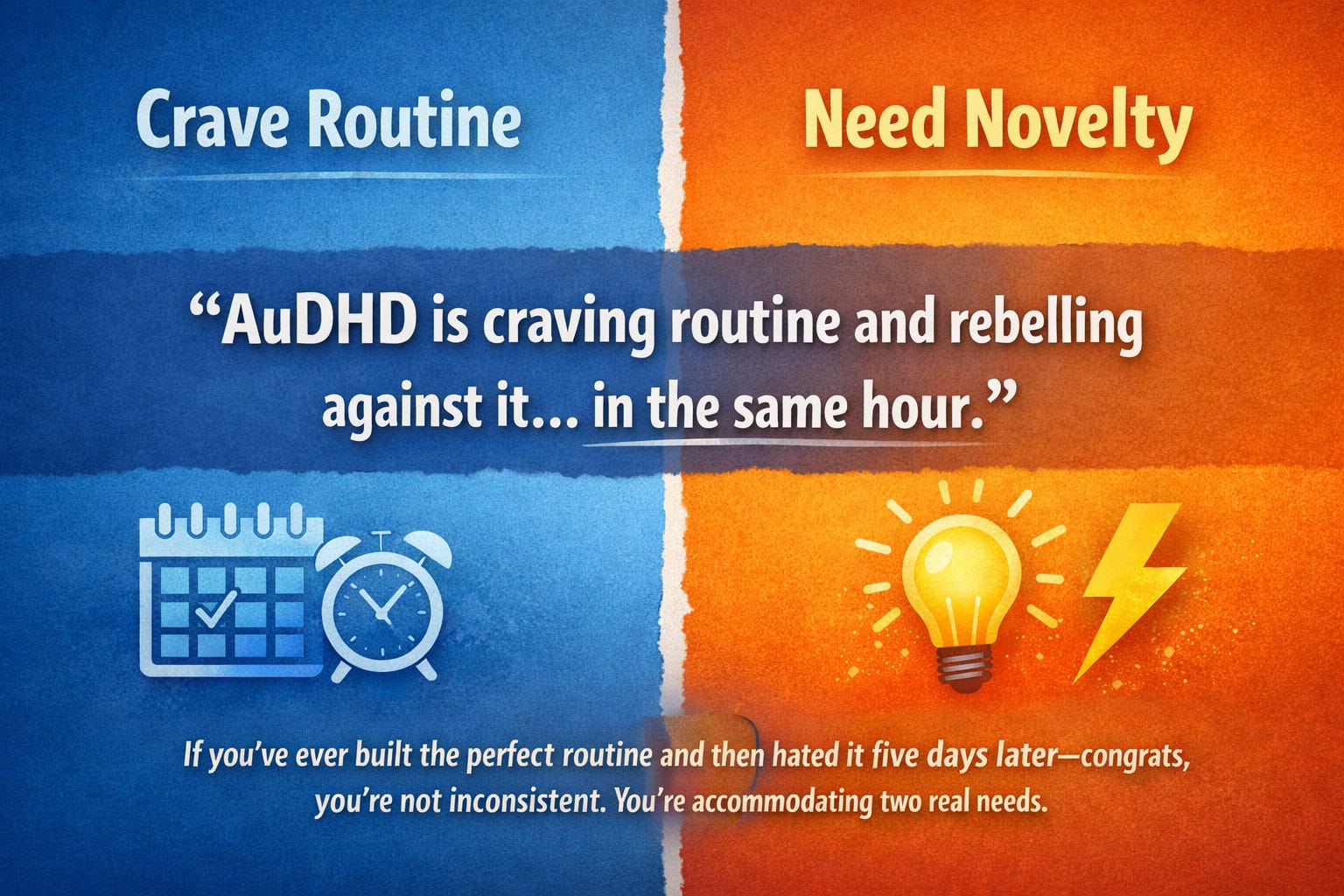
Okay, quick check-in: have you ever felt like your brain is two different people sharing one body—
one who’s like, “Please, for the love of God, routine. Predictability. Same mug. Same route. Same show on repeat.”
and the other who’s like, “If I do the same thing twice I will evaporate into dust like a vampire in daylight.”
If yes… hi. Welcome. You’re in the right place.
Today’s episode is called: “Your Brain Isn’t Broken — It’s Patterned.”
Because I need you to hear this like it’s a bass line in your chest:
Your brain is not morally failing.
Your brain is not lazy.
Your brain is not “too much.”
Your brain is patterned.
And if you’re AuDHD—autism + ADHD—your pattern can feel like a paradox factory that runs 24/7 with no off switch and a slightly rude customer service department.
So… let’s talk about what neurodivergence actually is, how ADHD and autism overlap, where they differ, and why AuDHD can feel like living inside a contradiction—and then I’m gonna give you real strategies that don’t feel like being yelled at by a productivity guru who thinks “just try harder” is a nervous system plan.
[tiny pause]
Are you ready? Let’s get started.
Substack ad
Okay, tiny intermission—because if this podcast is helping your brain feel a little more understood, I want you to know there’s a whole extra layer of support waiting for you on my Substack.
That’s where I publish Authentically ADHD, and you can usually get the podcast there first—but it’s not just a podcast drop. I’ve started writing blogs there too, which means you get deeper dives, the “ohhh THAT’S what’s happening in my brain” explanations, plus practical tools you can actually use when your executive function is doing that thing where it simply… leaves the chat.
And here’s why I’m obsessed with it: Substack is neurodivergent-friendly by design. You can read posts when you want to skim, you can listen when reading is too much, and I include graphics most of the time because we deserve information in formats that don’t require suffering.
So here’s your invitation: come subscribe on Substack. It’s free to join, and if you decide to become a paid member, you’ll get even more—bonus resources, extra content, and additional supports I’m building specifically for AuDHD/ADHD brains.
Subscribe free… or go paid if you want the “director’s cut” plus the toolbox. Either way, I’m really glad you’re here.
Neurodivergence: What it is
So lets talk about neurodivergence & how it is not a personality test.
It’s not “Which quirky brain are you?” It’s not “I’m such an Aquarius so obviously I can’t do laundry.”
And I say that as a person who loves a good identity moment.
Neurodiversity is the idea that human brains vary—like biodiversity, but for minds. There isn’t one “correct” way a brain must work to be worthy.
Neurodivergent is a non-medical term people use when their brain develops or functions differently from what society calls “typical.”
Now—this matters—
Saying “it’s a difference” does not erase disability. Some people are deeply disabled by ADHD or autism. Some need significant supports. Some don’t. Many fluctuate across seasons of life.
But the point is: difference isn’t the same thing as defect.
A patterned brain can be brilliant and still struggle.
Because a lot of suffering isn’t just “the brain,” it’s the brain + the environment.
If the world is built for one nervous system style, and you’re running a different operating system, you’re going to feel like you’re constantly doing life on hard mode.
[pause]
And if you’ve spent your whole life trying to “fix” yourself into the version of you that makes other people comfortable—
I just want to say: I see you. That’s exhausting. That’s not personal weakness. That’s chronic mismatch.
6:00–15:00 — ADHD vs Autism: Overlap and differences (clear, non-weird)
Let’s do ADHD vs autism without turning it into a simplistic “either/or” checklist, because real humans are not BuzzFeed quizzes.
ADHD (core pattern)
ADHD is a neurodevelopmental condition where the core struggles involve attention regulation, impulsivity, and executive functioning—planning, starting, stopping, shifting, organizing, time sense, working memory… the invisible stuff that makes life run. Important: ADHD is not “can’t pay attention.”
It’s can’t consistently regulate attention—especially when bored, stressed, overwhelmed, under-stimulated, or over-stimulated.
One research-heavy way people talk about ADHD is the “default mode interference” idea—basically, brain networks involved in internal thought can intrude when you’re trying to stay on task. It’s not the only model, but it helps explain why focus can feel like trying to hold water in your hands.
Real-life ADHD examples:
You can focus for hours on something you care about… and cannot start the thing you care about that also feels hard.
You lose time like it’s a hobby.
You forget what you’re doing while you’re doing it.
You can be highly intelligent and still struggle with basic tasks because executive function isn’t IQ
Autism (core pattern)
Autism is also neurodevelopmental. Clinically, it involves:
differences in social communication and interaction across contexts
and restricted/repetitive patterns (routines, sameness, focused interests, stimming, etc.)
Also—and this is big—many autistic people experience sensory processing differences: the world can be too loud, too bright, too unpredictable… or sometimes not enough and you seek sensation.
Researchers also explore prediction-based models—how the brain learns patterns and predicts what’s next, and how differences in prediction/updating may relate to autistic experience. It’s nuanced (and not every study supports every claim), but it’s a helpful lens for why uncertainty can feel physically stressful.
Real-life autism examples:
Social rules can feel like invisible ink.
You may crave clarity and directness and feel drained by ambiguity.
Transitions can hit like a wall.
You might have deep, intense interests that feel regulating and grounding.
So then, hers the overlap, why it’s confusing. ADHD and autism can both include:
sensory sensitivity
emotional overwhelm
social exhaustion
executive dysfunction
hyperfocus
stimming/fidgeting
burnout
So yes, overlap is real. Which brings us to the main character of today’s episode…
Patreon & focused ad
AuDHD: The overlap, the “double bind,” and why it’s missed
AuDHD is shorthand for being both autistic and ADHD. It’s not a separate DSM diagnosis label, but it’s a very real lived experience.
And historically, here’s why many adults didn’t get recognized:
Before DSM-5 (2013), autism could prevent someone from also being diagnosed with ADHD—even though many people clearly had both. DSM-5 changed that, acknowledging the reality of co-occurrence. PMC+1
Co-occurrence is common enough that researchers and clinicians have been studying it heavily; some reviews discuss high overlap rates (numbers vary by study and method), but the key point is: this isn’t rare. PMC+1
Now the AuDHD “double bind” can look like:
ADHD traits can mask autism traits (you seem spontaneous and social… until you crash).
Autism traits can mask ADHD traits (you seem organized because you built rigid systems… until the system breaks and chaos floods the house).
You can be sensory avoidant and sensory seeking.
You can crave routine and crave novelty.
AuDHD often feels like living in a brain that says:
“I need sameness.”
“I need dopamine.”
“I need quiet.”
“I need stimulation.”
“I need certainty.”
“I need freedom.”
…and they’re all yelling at once. [small laugh]
So when people say, “But you don’t seem autistic,” or “You don’t seem ADHD,”
sometimes what they’re actually noticing is: your traits are playing tug-of-war.
23:00–32:00 — The AuDHD Paradox Show (real-life examples)
Paradox #1: Routine vs novelty
Autism: “Same breakfast. Same spoon.”
ADHD: “If I eat the same breakfast again I will emotionally file for divorce.”
Real life: You create the perfect morning routine. It works for four days.
On day five your brain wakes up and goes:
“Actually, we hate that now.”
Not because you’re flaky.
Because the need for predictability and the need for stimulation are both legitimate.
Paradox #2: Social craving vs social cost
ADHD can crave social stimulation.
Autism can find social processing costly.
Real life: You make plans and feel excited.
Then the day arrives and your body feels like you’re trying to attend a party wearing jeans made of sandpaper.
So you cancel, then feel guilty, then feel lonely, then feel annoyed that humans require maintenance.
[pause]
Relatable.
Paradox #3: Sensory seeking vs sensory pain
Real life: Loud music helps you focus…
until one more sound happens and suddenly you’re like, “I live in a cave now.”
You can want pressure and weight and deep sensory input while also being destroyed by light touch or fluorescent lights.
Paradox #4: Hyperfocus vs shutdown
Real life: You can research a niche topic for six hours and forget you have a body…
but you cannot reply to a two-sentence text.
Because replying requires:
context switching
social interpretation
decision making
emotional energy
working memory
And your brain is like, “That’s 12 tasks. No thanks.”
Paradox #5: Justice sensitivity + impulsivity
Real life: You notice something unfair. Your body becomes a courtroom.
ADHD makes you say it immediately.
Autism makes you say it precisely.
And suddenly everyone is uncomfortable and you’re like,
“What? I brought facts.”
Paradox #6: The “I’m fine” lie
A lot of AuDHD adults become world-class at looking “fine.”
Not because it’s fine—because it’s practiced.
Real life: You hold it together all day.
Then you get home and collapse like a puppet whose strings got cut.
That is not you being dramatic.
That is nervous system math.
Strategies: “Rails not cages” + tools that actually work
Alright. Let’s talk tools—AuDHD-friendly, reality-based, and not built on shame.
Rule #1: Build rails, not cages
A cage is a rigid routine that breaks the second you miss a step.
Rails are guiding tracks that keep you moving even on messy days.
Do this: Create three anchors, not a full schedule.
Anchor 1: Start — water + meds + protein OR any “first 5 minutes” ritual
Anchor 2: Midday reset — sensory check + movement + hydration
Anchor 3: Land — dim lights + predictable wind-down cue
If you miss an anchor, you don’t throw away the day.
You grab the next rail.
Rule #2: Rotate instead of “routine”
AuDHD often needs predictability in category and novelty in options.
So instead of one rigid breakfast, do a Breakfast Rotation Menu:
5 safe breakfasts
3 “no-cook” defaults
2 “my brain is fried” emergency options
Same for outfits. Same for playlists. Same for chores.
It’s not indecision. It’s accommodating the paradox.
Rule #3: Sensory first, then strategy
If your nervous system is in siren mode, no planner hack will work.
2-minute reset:
change input: step away / dim light / earplugs
add steady sensation: pressure, cold sip, gum, textured object
long exhale (longer out than in)
You’re not “calming down.”
You’re changing states.
Rule #4: Externalize executive function (because willpower isn’t storage)
Executive function can tank under stress in ADHD and autism.
So stop trying to “remember harder.”
Externalize:
visual timers
one-step checklists
“landing pads” (keys, meds, bag)
pre-decisions (“If it’s Tuesday, I do X”)
If it has to live only in your head, it will get evicted.
Rule #5: Transition protocol (gentle, not militant)
Transitions can be brutal because they require stopping, switching, sensory changes, and decision-making.
5-minute bridge:
“Close” the old task: write one sentence: “Next I start by ____.”
body bridge: stand, water, stretch
2-minute micro-start on the new task (so it’s not a cliff)
Rule #6: Scripts are accessibility tools
Scripts aren’t fake. They’re scaffolding.
Steal these:
“I want to, but my brain can’t today. Can we reschedule?”
“What’s the plan and how long are we staying?”
“I’m going quiet to regulate, not because I’m mad.”
“I need a minute to process before I answer.”
Rule #7: Stop treating burnout like a personal failure
Burnout often comes from masking, chronic mismatch, sensory load, and executive demand.
You don’t fix burnout with hustle. You fix it with less demand and more support.
Quick audit:
What drains me that I keep calling “normal”?
Where am I denying myself accommodations because I want to look “easy”?
What would sustainability look like—literally, this week?
So here’s what I want you to take with you:
Your brain isn’t broken. It’s patterned.
And patterned brains don’t need shame.
They need fit. They need support. They need design.
If this episode hit you in the chest a little—breathe.
You’re not behind. You’re not defective.
You’re learning your pattern. And that’s not a small thing. That’s a homecoming.
If you want, share this episode with the friend who keeps calling themselves “too much.”
And if you’re new here—welcome. You’re safe. You’re seen.
And as always: this is educational, not medical advice. If you’re seeking diagnosis or support, a qualified clinician can help you sort what’s AuDHD and what’s trauma, anxiety, sleep, hormones, or burnout wearing a trench coat. Until nextt time, stay authentic my friend, & we will talk soon.
SubStack Page: